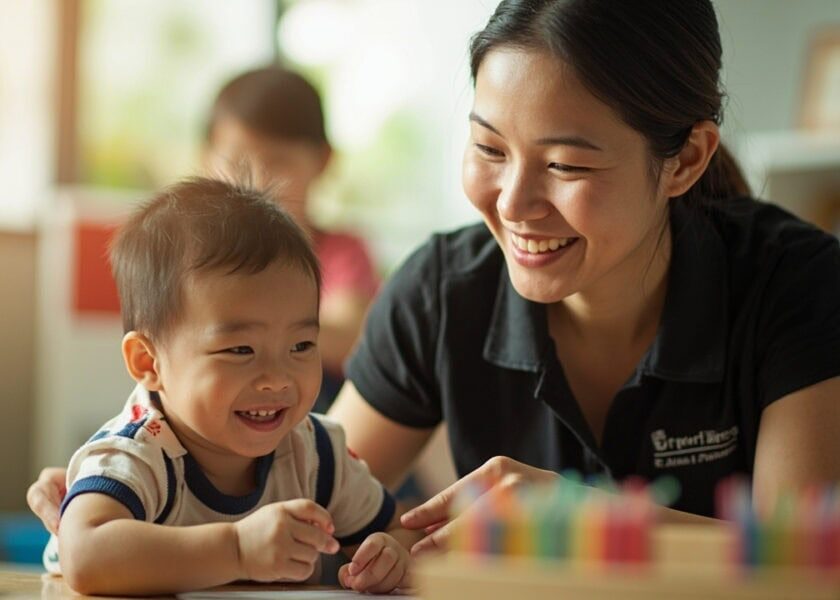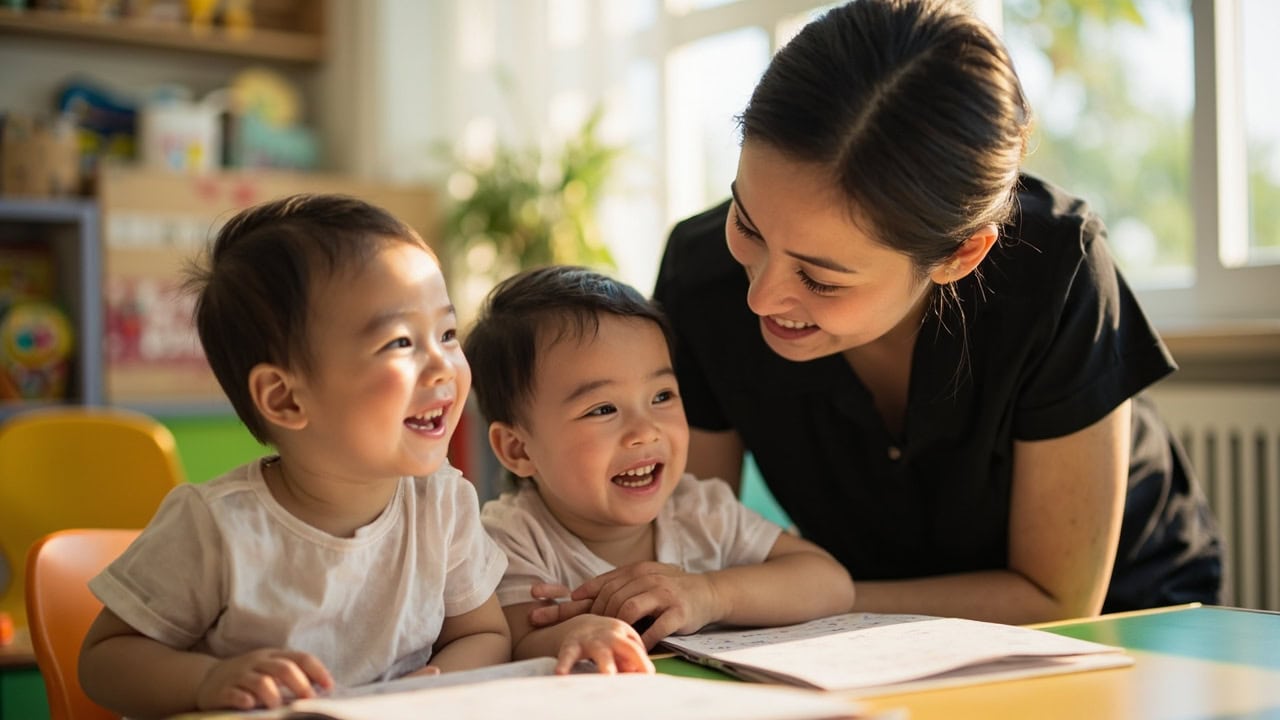
Who Is Your Child Becoming? A Singapore Parent’s Guide to Developmental Care
Beyond Safety: The Question Every Singapore Parent Is Really Asking
There is a question that lives quietly beneath every decision a Singapore parent makes about childcare. It is not the question you ask out loud at open houses or in parent group chats. It is not the question your mother asks when she worries you have chosen convenience over family.
It surfaces in the quiet moments. Perhaps when your child is being dropped off and turns back to look at you. Perhaps when you pick them up and notice something has shifted in the way they carry themselves.
The question is this: not simply whether your child is safe, or comfortable, or well-fed — though of course you need those things to be true — but who is your child becoming through this care?
That question is not a luxury. It is not the concern of overanxious first-time parents or the indulgence of those who have too much time to think. It is the most important question a parent can ask about the early years.
Because those years are not a waiting room before your child’s real life begins. They are the foundation of everything.
Every Day Is Construction: Why the Early Years Matter
Every single day in the early years is not just a day of care. It is a day of construction. The neural pathways that will govern how your child thinks, feels, learns, and connects are not waiting to be assembled later. They are being built right now — in the interactions, the environments, the quality of attention, the responsiveness of the adults around them.
The question is whether that construction is happening deliberately, with intention and understanding, or whether it is happening by accident.
Singapore parents are extraordinarily thoughtful. You are navigating cultural expectations that prize achievement, that begin asking about school trajectories before your child has learned to hold a crayon properly. You are balancing the demands of careers, the pressures of cost, and the guilt that arrives uninvited when you drop your child at childcare and return to work.
You are doing this with more awareness, more intention, more genuine love than perhaps any generation of parents before you. And yet for all this thoughtfulness, there remains a quiet anxiety that quality childcare articles rarely address directly.
It is the anxiety that goes beyond logistics. It is the sense that you are handing something precious to someone else and hoping — genuinely hoping — that it will be returned to you not just unharmed but enriched.
That hope is not weakness. It is the mark of a parent who cares deeply about what their child is becoming. But hope alone is not enough. And it should not have to be.
From Hope to Knowing: Reading Your Child’s Development
What if you did not have to hope? What if, instead of wondering whether your childcare choice is good enough, you could know — with clarity and confidence — that your child is growing, learning, and developing in meaningful ways every single day they are in care?
What if you had the language to read the signs?
What if you could look at your eighteen-month-old at the end of a care day and recognize, in their behavior, in their language, in the way they play and solve problems and connect with others, evidence that their brain is being built, their social capacity is expanding, their emotional resilience is taking root?
This is what quality developmental care makes possible. Not as a promise written in brochures, but as an observable reality that you can learn to see.
These developments are not invisible. They are not happening in some mysterious realm that only experts can perceive. They are observable. They are real. And as a parent, you can learn to see them.
When your two-year-old comes home and spontaneously shares their snack with their younger sibling, that is not coincidence. That is social development you can witness.
When your infant reaches for you with open arms instead of crying, that is attachment security you can recognize.
When your child attempts a puzzle for the third time instead of throwing it, that is persistence and problem-solving you can observe.
These are the signs. They are not subtle or hidden. They are written in your child’s behavior, in the way they play, in the words they use, in the way they move through the world.
Developmental Signs Across Key Areas
Cognitive Growth
- Problem-solving attempts that show trial and error
- Cause-and-effect exploration — dropping things, filling and emptying containers
- Increasing attention span during play
- Ability to remember and anticipate routines
Social Development
- Initiating interaction with peers rather than just parallel play
- Showing awareness of other children’s emotions
- Emerging capacity to wait, take turns, and share
- Seeking out familiar caregivers for comfort
Language and Communication
- Increasing vocabulary and word combinations
- Responsive conversation — back-and-forth exchanges
- Using words to express needs rather than only crying or gesturing
- Understanding and following simple instructions
Emotional Regulation
- Recovering from frustration without prolonged distress
- Showing flexibility when plans change
- Self-soothing strategies emerging naturally
- Growing capacity to accept comfort when upset
Motor and Physical Confidence
- Increasing physical coordination and control
- Willingness to attempt new physical challenges
- Body awareness in space — not bumping into things constantly
- Fine motor skills developing — holding crayons, building with blocks
What Quality Developmental Care Looks Like in Practice
Let me tell you what this looks like in practice, because the theory of developmental care means very little if it cannot be seen in the everyday moments of your child’s life.
Cognitive Development: When Curiosity Becomes Architecture
When your infant returns from quality developmental care, you may notice something in how they explore. There is a different quality to their curiosity.
They do not simply grab at toys. They examine them. They experiment. They bring objects together, testing what happens when one thing meets another.
This is not random play. This is cognitive architecture being built in real time. Your child is constructing the foundational logic of cause and effect, of problem-solving, of the understanding that their actions produce results.
A quality developmental environment does not leave this to chance. It curates the materials, structures the interactions, and responds in ways that extend and deepen this exploration.
When a caregiver notices your child’s moment of discovery and names it — “You found that the ball rolls down the ramp!” — they are not just being affectionate. They are reinforcing neural pathways, building language, and communicating to your child that their thinking matters.
Social Development: Your Child’s First Relationships
Consider social development, which is perhaps the most undervalued dimension of early childcare.
In the first thousand days, your child is learning whether the world is trustworthy. They are learning whether other people are reliable, whether they respond with warmth, whether they can be partners in play and comfort.
In a quality developmental setting, your child is not merely surrounded by other children — they are guided into relationships. A skilled caregiver creates moments of parallel play that gradually become cooperative play. They help toddlers navigate the difficult feelings that arise when a toy is taken or a friend walks away.
They model emotional regulation not by telling children to calm down, but by remaining calm themselves, by narrating their own responses, by being a steady presence that teaches your child what regulated human connection looks like.
The social-emotional skills your child develops in these early years — the ability to wait, to share, to recover from disappointment, to approach a peer with interest rather than fear — these are not soft skills. They are the foundation of every meaningful relationship your child will ever have.
Language Development: Why Words Blossom in Quality Care
Singapore parents often tell me they are surprised by how much their child’s language has blossomed in quality childcare. But this should not be surprising if we understand what developmental care actually does.
Language acquisition is not passive. It does not simply happen because a child hears speech around them. It happens because speech is directed at the child, responded to, expanded upon.
“You see the bird! The bird is flying. The bird has wings. Where are the bird’s wings?”
This is not small talk. This is deliberate linguistic scaffolding — a term developmental scientists use to describe the responsive, back-and-forth exchange that builds vocabulary and grammar and ultimately the capacity for complex thought.
Children who receive this kind of language-rich interaction in their early years do not simply know more words. They think more clearly. They can sequence, compare, hypothesize. They have the raw material for academic success not because they were drilled, but because they were spoken to — truly spoken to — as full human beings worthy of rich language.
Emotional Development: The Invisible Foundation
And then there is emotional development. This is where many parents feel most uncertain. You can see when your child is physically safe. You can verify that they have been fed and changed and rested. But emotional development is harder to read, and yet it may be the most consequential.
In the early years, your child is building the capacity to regulate their own emotions — to move from chaos to calm, from frustration to recovery, from fear to trust.
A quality developmental caregiver does not prevent your child from experiencing difficult emotions. That would be a disservice. Instead, they create the conditions in which your child can feel those emotions fully and learn, with expert support, how to return to equilibrium.
When a child in a quality setting falls and cries and is picked up by a caregiver who names their feeling — “You are so frustrated. That fall surprised you” — and then gently helps them try again, something essential is happening.
Your child is learning that feelings are survivable. That the world responds to their distress with comfort rather than dismissal. That they are capable of recovering from difficulty.
This is the seed of emotional resilience, and it is planted in the daily, patient, responsive interactions of developmental care.
Character: The Person Your Child Is Becoming
There is also the dimension we sometimes forget to mention: the development of character. Not as a moral judgment, but as the early emergence of who your child is becoming.
Does your child show curiosity or caution? Do they persist at a task or abandon it quickly? Do they show empathy when another child is upset? Do they demonstrate independence or do they constantly seek reassurance?
These are not fixed traits. They are tendencies that are being shaped by the environments and relationships your child experiences.
In quality developmental care, caregivers notice these tendencies and respond in ways that build strength:
- A child who gives up easily is given challenges slightly beyond their current ability — with support just enough to succeed
- A child who struggles to share is given structured opportunities to practice generosity, with patient guidance
- A child who hesitates before new experiences is given the time and safety to approach at their own pace, building confidence not through pressure but through trust
The character your child is developing right now — their persistence, their empathy, their curiosity, their resilience — is not emerging from nothing. It is being cultivated, deliberately, by the quality of the care they receive.
The EduNanny Approach: Developmental Care in Singapore
For families navigating the range of childcare options in Singapore, understanding what quality looks like matters more than ever. Whether you are considering infant care centres, preschools, or home-based childminding arrangements, the principles remain consistent.
Quality childminding is not simply about supervision ratios or safety certifications. These are necessary baseline conditions, not the full picture. True quality lies in the intentionality of daily interactions — the way caregivers observe, respond to, and extend your child’s natural curiosities and emerging abilities.
EduNanny operates within the ECDA Childminding Pilot, which means our model is built on a foundation of regulatory recognition and developmental accountability. We offer home-based care and community pathways, understanding that different families have different needs and that the best care fits your life rather than demanding that your life fit the care.
What Sets EduNanny Apart
Our infant ratios are structured to ensure that your child is not one of too many — that they can receive the responsive, individualized attention that developmental science tells us is essential in the early years.
In home-based care settings, your child benefits from:
- Smaller group sizes that allow for responsive, individualized attention
- A domestic environment that can feel more familiar and less overwhelming
- Consistent caregiver relationships that build attachment security
- Flexibility to follow your child’s natural rhythms rather than rigid schedules
Our fee structures are designed to be accessible within the pilot framework, and we make it straightforward to use your Child Development Account and Baby Bonus contributions, because we believe developmental care should not require financial acrobatics to access.
Our Core Conviction
At EduNanny, we have built our approach around a single conviction: that every interaction between a caregiver and a child is an opportunity for development.
Our caregivers are not simply watching children. They are observing, responding, extending, and building. They are narrating your child’s discoveries. They are scaffolding their emotional regulation. They are creating the relational conditions in which your child’s brain can grow in the ways that matter most.
Parents as Partners
We understand that you are partners in this work, not bystanders. One of the most important things we offer is transparency.
When we communicate with you — about your child’s day, about the developmental milestones we are noticing, about the challenges and breakthroughs — we are giving you the language and the framework to see what we see.
For some families, we have implemented communication measures including visual updates and documentation that allow you to see into your child’s day. These are not surveillance tools. They are windows into development. They are evidence of the architecture being built.
We want you to have certainty, not just hope.
Answering the Questions Singapore Parents Carry
“Am I choosing the right care?”
This is the question beneath the question. And the honest answer is that there is no perfect choice — there is only an informed choice made with care, updated as you learn more about your child and your options.
What matters is that you have the framework to evaluate what you see. To observe whether your child is returning to you with evidence of growth, not just with clean nappies and full tummies.
A quality care arrangement will welcome your questions. It will communicate regularly. It will help you understand what you are observing in your child and why.
“Will my child remember this time?”
Your child may not consciously remember the specific interactions of their early years. But their brain will remember. The neural pathways being built now — for trust, for curiosity, for the capacity to learn and connect — these are the architecture that will serve your child for the rest of their life.
The early years are not forgettable simply because they are pre-verbal. They are foundational precisely because they are pre-verbal — because they are building the structures that all later learning will rest upon.
“Am I doing the right thing by working?”
This guilt arrives uninvited for many Singapore parents. And while we cannot resolve it entirely — because parenting always involves trade-offs — we can offer this perspective:
The question is not whether your child is in care. The question is what that care provides. A child who receives quality developmental care is not being disadvantaged. They are being built — by loving family AND by skilled caregivers who understand that they are, in this moment, co-architects of your child’s future.
The presence of quality care does not diminish your role as a parent. It extends your capacity to provide for your child while building the very developmental foundations that will serve them.
“How do I know if my child is on track?”
Developmental milestones exist for a reason — they give us markers to observe. But every child develops at their own pace, and the signs of quality care are not just about hitting milestones on schedule.
Look instead for:
- Engagement — does your child seem curious and interested in their world?
- Connection — does your child form warm relationships with caregivers and peers?
- Growth — do you notice your child attempting new things, persisting at challenges, expanding their capabilities?
- Responsiveness — does your child seem to be processing and learning from their experiences?
These are the signs that your child’s brain is building, regardless of whether they hit every milestone at the textbook time.
Questions to Guide Your Search for Quality Care
If you are researching infant care options in Singapore, here are the questions that matter most:
Questions to Ask Yourself When You Visit
- Do I see children engaged in meaningful activity — or just being kept occupied?
- Do the caregivers name what children are doing, narrating their discoveries and explorations?
- Do the caregivers respond to children with warmth, even in moments of frustration?
- Are there opportunities for one-on-one interaction, or is every child just one of many?
- Does the environment feel alive and intentional — with materials that invite exploration?
- Will I receive regular, meaningful updates about my child’s development — not just what they ate and slept?
- Can I observe signs of developmental intentionality — the building of skills, not just the filling of time?
Questions to Ask Providers
- How do you support children’s cognitive development through daily activities?
- How do caregivers scaffold language and communication with infants and toddlers?
- What is your approach to helping children regulate difficult emotions?
- How do you individualize care for each child’s unique temperament and needs?
- How will I know my child is growing and developing in your care?
- What training do your caregivers receive in child development?
- How do you handle the transition period when children first join your care?
The Provider That Is Right for You Will
- Treat your child as a whole person — not just a set of physical needs to be met
- See every interaction as an opportunity for development
- Welcome your questions and observations about your child
- Communicate in ways that help you understand what you are seeing
- View you as a partner in your child’s development, not a client to be served
Your Child Is Being Built: The Truth That Changes Everything
Let us return to where we began. That quiet question: who is my child becoming?
If you have been carrying that question with uncertainty, if you have been hoping that your childcare choice is good enough without being certain — I want to offer you this.
You do not have to hope. You can know.
Not with the false certainty of perfection, because no care, no environment, no human relationship is perfect. But with the grounded confidence of a parent who has learned to read the signs.
- Who can see cognitive growth in the way their child solves problems
- Who can see social development in the way their child reaches out to peers
- Who can see emotional regulation in the way their child recovers from frustration
- Who can see language blooming in the richness of their child’s speech
- Who can see character emerging in their child’s persistence, their empathy, their curiosity, their growing independence
Your child is being built. Not just kept. Not just watched. Built.
The architecture of their mind, the architecture of their relationships, the architecture of their capacity to live a meaningful and connected life — these are taking shape right now, in the hours they spend in care.
The question is not whether this construction is happening. It is whether it is happening with intention, with expertise, with the kind of deliberate attention that transforms ordinary childcare into developmental care.
At EduNanny, we believe that every child deserves to be known. Not just watched, but known — their rhythms, their strengths, their emerging capacities, the unique person they are becoming.
We believe that parents deserve to see this knowing in action, to participate in it, to have it reflected back to them in clear and meaningful communication.
We believe that the early years are not a waiting room before your child’s real life begins. They are the beginning. And they deserve to be treated as such.
You have already made a choice that reflects your love and your intention. You are here, thinking carefully about these questions, refusing to settle for less than your child deserves.
That tells me everything I need to know about the kind of parent you are.
Now I want to give you something more. I want to give you the confidence to trust what you are already seeing in your child. The language to name their growth. The certainty that the hours of care you have chosen are hours of construction, not mere supervision.
Your Next Step
Your child is becoming. And you — with the right support, the right framework, the right partnership — can see exactly who they are becoming.
Not with hope. With certainty. With pride. With the kind of clear-eyed confidence that comes from knowing, not guessing.
That is what EduNanny offers. That is who we are. And that is the future we are building together, with you, one developmental day at a time.
If you are ready to learn more about how EduNanny’s developmental childminding approach can support your child’s early years, we invite you to connect with our team or explore our services to discover what quality developmental care looks like in practice.
Learn more about who we are and our commitment to thoughtful, development-oriented care for Singapore families.