The Sibling Threshold: How Singapore Families Transform When a Second Child Arrives
“`html
The Sibling Threshold: How Singapore Families Transform When a Second Child Arrives
There is a moment, if you are a Singapore parent, that you may recognise even before you name it. It arrives not with the first scan or the first kick, but with a quieter realisation somewhere between confirming the pregnancy and telling your parents. It arrives when you sit down with your phone or notebook and begin, almost instinctively, to think about childcare.
For your second child, this moment carries something distinct. The emotion is not fear, exactly. It is something more specific. It is the sudden understanding that the arrangement you spent months or years building for your first child, the one that finally felt right, the one your firstborn has come to trust and depend on, is about to be tested. Not replaced. Not discarded. Tested. And you are not entirely sure it will hold.
This is the sibling threshold. And it is one of the most underestimated transitions in Singapore family life.
Quick Summary
- When a second child arrives, childcare does not simply double—it transforms structurally, relationally, and emotionally
- The first child’s care experience shifts fundamentally when a sibling enters the picture
- Quality sibling care requires caregivers who understand sibling dynamics as a primary focus
- The sibling bond formed in these early years is shaped profoundly by the care environment
- The families who navigate this well are those who find the right support before the challenge overwhelms them
Why Childcare That Works for One Child Does Not Scale for Two
We talk a great deal about preparing for a second child in terms of logistics. The bigger car seat. The conversion of the spare room. The hand-me-down cot from your firstborn’s nursery. These are real, and they matter.
But beneath the logistics is a question fewer people are willing to name with honesty: What happens to your childcare when your family doubles? What happens to your firstborn when the caregiver who has been their primary secure base now has an infant to tend as well? What happens to the infant when the rhythm of the household is still, in many ways, organised around the older child’s routines and needs?
Let us begin with what most families discover, sometimes gently and sometimes with a jolt. The childcare that worked beautifully for one child does not simply scale up for two. It transforms. And the transformation is not merely logistical. It is relational, emotional, and structural.
The Orbit Changes: What Happens to Your Firstborn
The first child, in most families, arrives into a world where every resource, every ounce of parental and caregiver attention, flows in one direction. The firstborn becomes the centre of an orbit. The childcare arrangement reflects this. The environment is designed—consciously or not—around one child’s needs. The caregiver develops a deep, almost intuitive understanding of that one child.
But when the second child arrives, the physics of that orbit changes. The first child must now share not just toys or parental attention, but the caregiver’s gaze, patience, and emotional availability.
Here is what most families sense but rarely hear articulated with care: the first child’s response to this sharing is not merely emotional. It is architectural. The sibling relationship begins to take shape in these early months and years. And the shape it takes is determined, in large part, by the quality of the care environment in which it is first formed.
This is why the sibling threshold is not just a logistical problem. It is a developmental one. It is an opportunity, and it is a risk, and the difference between the two depends almost entirely on whether your childcare is built to hold two children with the same intentionality it held one.
What Quality Sibling Care Actually Requires
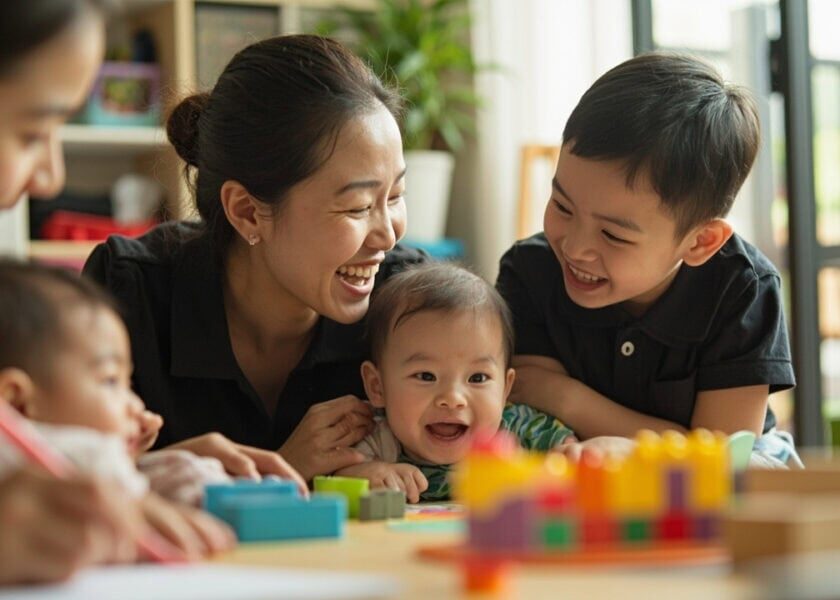
Quality sibling care requires caregivers who understand sibling dynamics, not as a background condition but as a primary focus of their practice. It requires environments where two children can be present without competing. It requires rhythms that can accommodate the newborn’s need for closeness and the older child’s need for autonomy.
It requires a caregiver’s emotional regulation to be so solid that when the two-year-old pushes back against the new reality, and the infant needs feeding, and you—as the parent—arrive slightly frazzled at the end of a workday, the caregiver does not mirror that stress back at you. She holds it. She reorganises. She creates continuity for both children, simultaneously, without dropping either one emotionally.
This is extraordinarily demanding work. And it is work that most standard childcare arrangements are not designed to do. They are designed to serve one child well, and then to absorb a second child as an addition, rather than as a transformation.
Questions Worth Sitting With
- Does your current caregiver have the capacity to give attuned attention to two children simultaneously?
- Is the physical environment set up for two children to be present comfortably?
- Does your caregiver have a philosophy around sibling dynamics, or is it assumed the children will simply adjust?
- When your firstborn has a difficult adjustment moment, does your arrangement have the flexibility to hold that without neglecting the infant?
- Do you receive enough communication to understand what is happening in the relationship between your children, not just their individual experiences?
If the honest answer to several of these questions is uncertain or no, you are not failing. You are simply encountering the reality that most childcare arrangements are not built for this transformation.
The Overlooked Parental Exhaustion
Now let us talk about the part of this transition that is hardest to discuss and most often avoided in conversations about childcare: you. The parent.
When you had one child, your capacity to manage the logistics and emotions of childcare was strained but manageable. You could keep the important things in view. You could attend to your child’s cues. You could, most days, regulate your own emotional state well enough to be the calm centre your child needed.
With two children in the system, your capacity does not double. It does not even hold steady. It compresses. And the compression is not merely physical. It is emotional, cognitive, and temporal.
You are now managing two sets of medical appointments, two sets of developmental milestones, two sets of sleep regressions, two sets of social calendars, and the ongoing invisible labour of maintaining your relationship with your partner, your work, and yourself.
The Ripple Effect
The parental exhaustion of managing two children’s care rhythms is not the same as the exhaustion of managing one child times two. It is qualitatively different. It is the exhaustion of orchestrating a system where every variable affects every other variable.
Consider a typical week: your toddler’s meltdown at drop-off affects your infant’s mood in the car. Your infant’s growth spurt disrupts sleep, which disrupts your patience, which affects how you respond to your toddler’s bedtime resistance. Your toddler’s first cold means several disrupted nights, which means your workday is coloured by a fog that makes the infant’s cluster feeding feel overwhelming rather than temporary.
Here is what we want you to hear with great gentleness and great honesty: this exhaustion is not a sign that you are doing something wrong. It is a sign that you are doing something extraordinarily complex. And the families who emerge from the sibling threshold with their cohesion intact, with their children thriving, with their own sense of self still recognisable, are the families who found the right support before the challenge overwhelmed them.
The Long-Term Stakes: Why This Moment Shapes Your Children’s Relationship Forever
The sibling bond that forms in the first years of shared life is not accidental. It is not simply a product of genetics or proximity. It is shaped, profoundly, by the environment in which these two children first learn to be siblings together.
When that environment is calm, regulated, emotionally safe, and structured around the needs of both children, the sibling relationship has the opportunity to become a source of lifelong resilience for both children. When it is chaotic, under-resourced, or emotionally neglectful of one child’s adjustment, the sibling relationship can become a site of competition and resentment that echoes into adolescence and adulthood.
This is not a small thing. The sibling bond is one of the longest relationships most of us will ever have. It predates friendship. It predates romantic partnership. And for most of us, it will outlast our parents.
And it begins not at birth, but in the months before birth—in the decisions a family makes about how to prepare the first child, how to introduce the second, and crucially, how to arrange the care that will hold both children during this transformation.
EduNanny Singapore: Built for This Threshold
EduNanny Singapore was built for this moment. Not as a reaction to a gap in the market, but as a thoughtful response to a genuine need in Singapore family life.
We are part of the ECDA Childminding Pilot, which means our model is grounded in standards that take the complexity of family-based care seriously. Our home-based care offers a ratio of up to one to three infants, which means your child is not one face in a large group. It means your caregiver can genuinely know and hold the specific needs of your children, including the relationship between them.
What EduNanny understands, and what we believe sets thoughtful sibling care apart, is that a second child does not add a child to your childcare arrangement. A second child asks you to rebuild it. And rebuilding it requires a philosophy that sees the family as a system, not just as a collection of individual children with individual needs.
When you entrust two children to our care, you are working with a caregiver who understands that the relationship between your children is as important as either child’s individual experience. That the way your toddler is gently supported in adjusting to a new sibling is as much a part of quality care as the way your infant is fed and held. That the first child’s emerging sense of security as an older sibling is a developmental milestone that deserves as much attention as any other.
Supporting the Whole Family
Our fee structures are designed to be accessible within the pilot framework, and our care blocks run Monday to Friday, recognising that Singapore families need consistency. Where applicable, families can access their Child Development Account and Baby Bonus funds, because financial accessibility should not be a barrier to quality care.
We communicate with transparency. In our home-based settings, families have access to measures that offer clarity and peace of mind, because trust is built when you are given the information you need to feel confident in the people you have entrusted with your children.
We are present across Singapore, because this need is not unique to one district or one profile of family. Every Singapore parent navigating the sibling threshold deserves access to care that was designed with their reality in mind.
A Different Kind of Family Future
What we see when we look at a Singapore family with two children in care is two siblings in the most formative phase of their relationship. We see a first child who is learning that the world can expand rather than simply divide. We see a second child who is entering a family that is already a system, already a world with its own rhythms and rules, and who needs to be welcomed into that world with as much care as the first child received.
We see parents who are doing something staggeringly difficult and who deserve support that is as thoughtful and as emotionally honest as the care they are providing.
The sibling threshold is real. It is demanding. It will test every childcare arrangement you have built. But it is also one of the most profound thresholds a family will cross, because what you are building on the other side is not just a bigger family.
It is a different family. A family with a sibling relationship that will shape both children in ways you cannot fully imagine yet. A family with a new centre of gravity. A family that, if it is held with the right kind of care, will be more resilient, more connected, and more capable of navigating the complexities of modern life than it was before.
You do not have to cross that threshold alone. And you do not have to cross it with a childcare arrangement that was built for a family of three. You can cross it with a partner who understands what you are walking into, who has thought deeply about what quality sibling care requires, and who is ready to build that care alongside you.
EduNanny Singapore is here for that. For the second child. For the first child who will become a sibling. For you, in the compression and the beauty of this transition. For the long-term sibling bond that begins, quietly and powerfully, in the decisions you make about care before your second child has even arrived.
The sibling threshold is not an obstacle. It is a threshold. And on the other side of it is a family you are only beginning to know.
Let us walk through it with you.
If you are considering your options for quality sibling care in Singapore, we invite you to connect with EduNanny or learn more about our approach.
“`