What Your Child Is Quietly Becoming While You Are Not There
The Question Every Parent Carries
There is a question that lives quietly in the chest of every parent who entrusts their child to someone else’s care. It surfaces in the quiet moments, in the pause before sleep, in the space between the morning goodbye and the evening return.
The question is this: Who is my child becoming while I am not there?
It is a question we rarely voice aloud, perhaps because it carries with it a strange guilt — the sense that we should be present for every milestone, every small triumph, every moment of growth. And yet we know, in the honest spaces of our hearts, that this is neither possible nor even desirable.
The world our children will inhabit demands something of them that we cannot give alone. It demands confidence born not just from our love, but from their own experiences. It demands self-trust built not just from our reassurance, but from moments when they discover their own capability. It demands emotional resilience that comes not just from our comfort, but from learning that the world can hold them even when we cannot.
The truth is, there is an inner architecture taking shape in your child right now — in the hours between when you leave and when you return. It is quiet work. Invisible to the parent who is not in the room. But it is real, and it matters, and understanding it may be one of the most important things you do as a parent making this decision.
What Quality Care Builds in Your Child
- Agency — The understanding that their choices matter and their voice has weight
- Self-trust — The quiet inner knowledge that they are capable and the world is navigable
- Emotional resilience — The ability to feel big feelings and move through them
- Social confidence — Skills in empathy, negotiation, and genuine connection with peers
- Inner security — A foundation of trust that the world is essentially good and they belong in it
The Invisible Curriculum: What Develops in Quality Care
In a quality care environment, your child is learning something fundamental: that they have agency. That their choices matter. That the world is a place where they can reach, and explore, and decide.
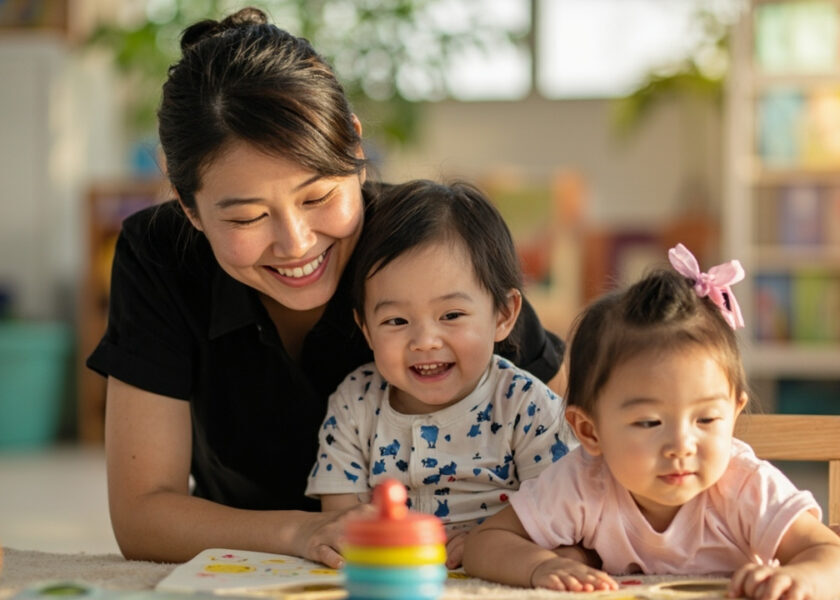
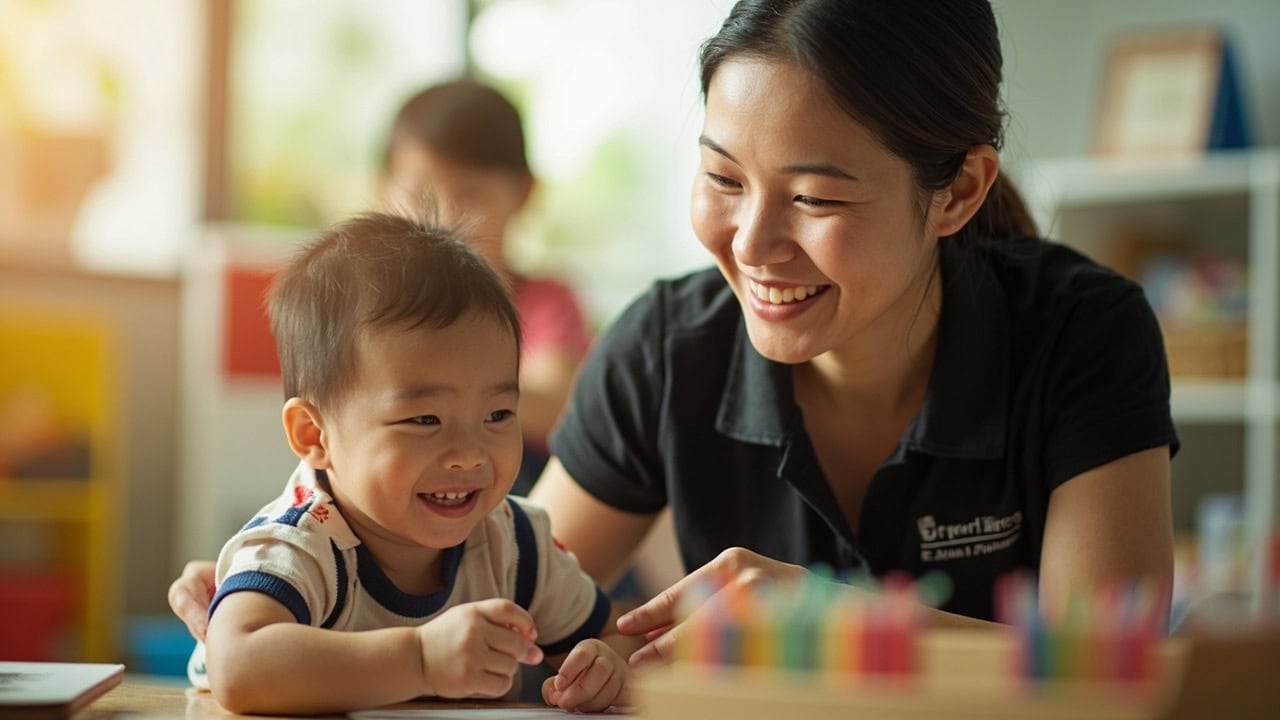
Watch a two-year-old in a nurturing setting and you will see invitations everywhere — to choose between activities, to express preferences that are noted and honoured, to have their experience narrated back to them:
“You chose the blue cup today. You wanted to build with the blocks. You told Mei you wanted a turn.”
This is not incidental. This is deliberate. This is the slow, patient work of building a child who knows that their voice has weight, that their decisions count, that they are not merely acted upon but are active participants in their own life.
From agency, something remarkable emerges: self-trust. When a child is allowed to try, to fail, to try again, to solve a puzzle in their own way, to navigate a small conflict with a peer — when they experience that they can handle things — they are building the quiet inner knowledge: I am capable. The world is not too big for me. I have what I need to face what comes.
Learning to Belong
But agency and self-trust do not develop in isolation. They grow in the soil of relationships — with caregivers who are consistent, warm, and responsive; with peers who are fellow explorers in this new social world.
Watch your child in a quality care setting and you will see something beautiful: the first friendships forming, the first negotiations over toys, the first moments of empathy and conflict and resolution. A child learning to read another’s face, to understand that a classmate is sad, to offer a piece of their snack with genuine care.
These are not small things. These are the early foundations of emotional intelligence — the ability to understand others, to navigate the social world with curiosity rather than fear.
The Emotional Lessons Before Words
There is also what I think of as the emotional curriculum — the lessons your child is learning about feelings long before they have the words to name them.
In quality care, children learn that emotions are not dangerous. That it is okay to feel frustrated, to feel sad, to feel overwhelmed. That there are adults who will stay with them in those feelings rather than dismissing or rushing past them.
They learn to label what they feel — “I see you are feeling angry right now” — and this labelling is the first step toward regulation. They learn that big feelings pass, that they can be held, that the afternoon still holds play and laughter and rest.
This is emotional resilience. Not the absence of difficulty, but the capacity to move through it. And it is a gift that keeps on giving — into school, into adolescence, into the complex emotional terrain of adulthood.
How to Recognise This Development
So how do you know if this is happening? How do you recognise signs of healthy inner development when you cannot see it directly?
You see it in what your child tells you — or cannot yet tell you but shows you.
- You see it in the confidence they carry into new situations, the curiosity that pulls them toward rather than away from the unknown.
- You see it in how they speak about their day — not with anxiety, but with interest. “Today we made something with playdough. Today a friend and I built a tower and it fell down and we laughed.”
- You see it in their emotional vocabulary, in their growing ability to name what they feel.
- You see it in how they relate to peers, in the ease with which they navigate small conflicts, in the warmth of the connections they form.
- You see it in a child who is comfortable in their own skin, who trusts the adults around them, who believes the world is essentially a good place where they can thrive.
You see it, most of all, in something that may seem small but is actually profound: a child who returns from care not diminished by the hours apart, but expanded by them. A child who comes home more themselves, not less.
The Transition from Anxiety to Comfort
The first days and weeks are real. There is often protest, tears, uncertainty. This is not a sign that care is wrong. It is a sign that your child has formed a healthy attachment to you, and that is exactly as it should be.
What matters is what happens next. In a quality environment, with consistent, warm caregivers, something shifts. The child begins to trust that you will return. They begin to trust that the care environment is a good place. They begin, slowly, to relax into it.
And then — and this is the part that matters most — they begin to flourish.
The transition from anxiety to genuine comfort is itself a developmental milestone. The right care environment does not eliminate the natural adjustment; it holds your child through it with patience and skill, until the day comes when your child walks in willingly, even eagerly, ready to play, ready to learn, ready to grow.
What Quality Childminding Looks Like
For parents researching options in Singapore, it helps to understand what distinguishes quality care from adequate care. The difference lies not in flashy programmes or impressive facilities, but in the everyday interactions that shape your child’s inner world.
In quality childminding, you will see:
- Responsive relationships — Caregivers who notice your child’s cues, who tune in to their moods, who respond with warmth and consistency
- Intentional environments — Spaces designed to invite exploration, choice, and safe risk-taking
- Language-rich interactions — Adults who narrate the child’s experience, who name emotions, who engage in back-and-forth conversation
- Supported independence — Opportunities for your child to do things for themselves, with patient support rather than rushed intervention
- Social guidance — Adults who help children navigate conflicts, model empathy, and create space for genuine peer interaction
A Framework for Choosing Childcare in Singapore
When you begin your search, it can feel overwhelming. Here is a simple framework to help you evaluate your options:
Look for signs of emotional safety:
- Do caregivers speak warmly about the children in their care?
- Do children appear comfortable, engaged, and curious?
- Are there consistent routines that provide predictability?
- Do caregivers describe children’s days with specificity and care?
Look for signs of developmental intentionality:
- Are children given meaningful choices throughout the day?
- Is there time for child-initiated play, not just structured activities?
- Do caregivers help children label and navigate emotions?
- Are peer interactions supported rather than just supervised?
Look for signs of partnership with parents:
- Is there regular, transparent communication about your child’s day?
- Do caregivers welcome questions and input about your child’s needs?
- Is there a clear process for discussing concerns or adjustments?
- Do you feel welcomed, respected, and trusted as your child’s primary parent?
Questions to Ask When Evaluating Childcare Options
- Do caregivers consistently respond to children’s cues and emotions?
- Are children given meaningful choices throughout the day?
- How are big emotions handled — with patience or punishment?
- Do children seem curious, engaged, and at ease in the environment?
- Is there time and space for child-initiated play and exploration?
- Do caregivers narrate children’s experiences and validate their feelings?
A Different Approach to Early Care
For families seeking a thoughtfully structured option in Singapore, programmes developed within ECDA’s Childminding Pilot framework offer a considered alternative. These initiatives approach childcare not as a logistical problem to be solved, but as a genuine developmental opportunity — a chance to nurture the person your child is quietly becoming.
The pilot programme, developed in partnership with BUTLER, offers both home-based and centre-based pathways, giving families options that suit their circumstances. Thoughtful ratios ensure that every child receives the attention and responsiveness that meaningful development requires.
Understanding that trust is foundational for parents, quality programmes prioritise transparent communication — regular updates, detailed sharing of your child’s day, and in deployed settings, the ability to see directly what your child is experiencing. This openness reflects a commitment to partnership rather than distance, keeping you connected to your child’s world even when you are apart.
For families navigating cost considerations, many programmes offer structured fee arrangements, with support available through Child Development Accounts and Baby Bonus funds. Operating hours provide consistency for both child and family, with care available Monday through Friday across structured blocks. This approach is accessible to families across Singapore, reflecting a commitment to making quality care widely available.
Addressing Your Real Concerns
Will my child feel abandoned?
Your child’s protest at separation is not evidence of failure — it is evidence of healthy attachment. The goal is not to eliminate this bond but to help your child develop a second secure base: a relationship with their caregiver and environment that complements, rather than replaces, their relationship with you. When done well, your child gains not a replacement parent but an expanded sense of safety.
How do I know what is happening while I’m away?
Quality programmes prioritise transparent communication. Regular updates, photographs, and in some settings, direct access through open observation allow you to remain connected to your child’s day. This is not about micromanagement; it is about partnership. You should feel like an informed, valued part of your child’s care team.
Is it too early for my child to be in care?
The early years are precisely when the brain is most malleable, when the foundations for all future learning and development are being laid. What matters is not whether your child is in care, but what kind of care they receive. Quality matters at every age — and it matters most in the earliest years when the architecture of the brain is still being built.
How do I manage the guilt?
First, acknowledge it. Guilt is the shadow of love, and its presence means you care deeply. Second, recognise that your presence is not the only thing your child needs. They also need opportunities to develop self-trust, to learn from capable adults beyond you, to practice relationships with peers. The hours apart are not time lost; they are time invested in your child’s independent capability. Finally, trust that the love you have given your child stays with them — it is the foundation from which they can safely explore the world.
What if my child doesn’t adjust well?
Every child’s adjustment timeline is different. Some warm to care within weeks; others need more time. What matters is the direction of travel — is your child gradually becoming more comfortable, more curious, more at ease? If you see progress, however gradual, trust the process. If concerns persist, discuss them openly with your caregiver. The right programme will work with you to understand and support your child’s individual needs.
This Is an Investment, Not Just a Choice
The early years are not simply a time to be survived before “real” learning begins. They are the foundation upon which everything else is built. The agency, self-trust, emotional resilience, and social confidence that develop in these crucial years become the inner resources your child draws upon for decades to come.
When a child enters primary school already knowing they are capable, already equipped with words for their feelings, already confident in their ability to navigate relationships — they are not just school-ready in the academic sense. They are ready for the complex, demanding, beautiful work of growing up.
The decision you are making — to entrust your child’s care to someone else during these formative years — is not merely a logistical choice. It is an investment. It is an investment in the architecture of your child’s inner world. In the self they are quietly becoming. In the confidence they will carry into their first classroom, into their friendships, into the challenges and joys that await them.
Every choice they are allowed to make in quality care — every time a caregiver narrates their experience back to them, every time they solve a problem in their own way, every time they navigate a conflict and emerge intact — is a brick in that architecture. Every moment of being held in a consistent, warm relationship. Every experience of safety and exploration. Every lesson in emotional regulation that cannot be taught but must be lived.
The Answer to the Question You Carry
The question we began with — who is my child becoming while I am not there — has an answer now. Not a complete answer, because your child is still unfolding, still becoming. But an answer that can quiet the worry and settle the guilt:
Your child is becoming someone who trusts themselves.
Someone who knows they are capable. Someone who has a rich inner world and the emotional tools to navigate it. Someone who is ready for the world.
That is what quality care gives your child. That is what thoughtful, development-oriented childminding is designed to provide.
And that is why this decision, made with such care and such love, is one of the most important you will ever make.
For many Singapore families, the reality includes the demands of dual-income households, the absence of extended family nearby, and the pressure to return to work. Beneath all of this is a profound desire — the desire to give your child every possible advantage, to set them on a path toward a flourishing life.
Quality childcare does not diminish your role as a parent. It supports you in it. It gives your child additional relationships, additional safety, additional opportunities to grow — all of which serve your deepest hopes for them.
Learn More About EduNanny
If this approach resonates with you — if you are looking for childcare that sees your child as a whole person, not just a schedule to be filled — explore EduNanny Singapore to learn more about what development-oriented childminding can offer your family.
Speak with the EduNanny team with your questions, or visit the about page to understand the vision behind this approach. You can also learn more about the ECDA Childminding Pilot programme that underpins this work.
Your child’s inner world is being built right now. Help ensure it is being built well.