Why Multi-Child Families in Singapore Need Family Systems Childcare
The Childcare Gap No One Talks About: Why Multi-Child Families in Singapore Are Being Failed by a System Built for One
There is a particular kind of tired that does not come from holding a child. It comes from the invisible arithmetic of managing two lives, sometimes three, that exist in the same house but require entirely different worlds of care.
The toddler needs structured stimulation. The infant needs responsive feeding routines. The preschooler needs social preparation for Primary One. And somewhere in between, a parent is supposed to be a person with a name, not just a logistics coordinator with a color-coded calendar.
If this sounds familiar, you are not failing at parenthood. You are living inside a problem that Singapore’s childcare landscape has never properly named, let alone solved.
Quick Summary: The Childcare Gap for Multi-Child Families
- The problem: Singapore’s childcare system is built around individual children, not family systems. When you have two or three children at different developmental stages, you are essentially managing several parallel arrangements that do not talk to each other.
- What gets lost: Sibling relationships, parent mental health, scheduling coherence, and the quiet daily exhaustion of being the only person who holds your family’s full picture.
- What no one tells you: Your exhaustion is not a sign of poor time management. It is a sign that the system around you was never built for your reality.
- What actually helps: A childcare architecture that thinks in family systems, not just individual children. That holds the sibling relationship as something worth protecting. That reduces your coordination burden, not adds to it.
Your Morning Is Already Exhausting. Here’s Why the System Makes It Worse.
Every morning in a multi-child Singapore household, a particular kind of choreography begins.
One child must be at infant care by seven-thirty because the mother’s meeting starts at eight. The other needs to be at a different center by eight because it opens later. The grandmother can help with pick-up for one, but not both, and not after four o’clock.
So there is a shuttle arrangement. A series of handoffs. And somewhere in the middle, the assumption that a four-year-old and a ten-month-old can both be well-cared-for by systems that barely acknowledge they share a family.
This is not a complaint. This is the daily architecture of modern Singapore family life. And it is invisible in every piece of childcare advice that exists.
The Advice Gap Is Real
Go online, and you will find thousands of articles about choosing the right infant care. You will find frameworks for evaluating caregivers. You will find neuroscience explainers about brain development in the first thousand days, as though knowing the phrase “synaptogenesis” somehow helps you get two children to two different places on time.
What you will not find, anywhere that feels like it was written for you, is an honest reckoning with what it means to care for siblings who are not the same child.
The childcare industry, by and large, thinks in individuals. One child. One caregiver. One developmental stage. One set of needs.
This is sensible as far as it goes. But it stops making sense the moment you have a second child, because then you have not doubled a problem. You have multiplied something entirely different.
You have a family system. And family systems have dynamics, pressures, and needs that do not exist when you are caring for one child alone.
What Actually Happens in Most Singapore Households
Consider the typical arrangement. The infant is in a center-based infant care program. The toddler is with a domestic helper, or a grandparent, or a different center that happens to have a toddler slot. The older child might be in kindergarten, or after-school care, or a combination of arrangements that shift by the week.
Each arrangement is fine, on its own terms. Each caregiver is doing their best.
But there is no thread connecting them. No single understanding of who this family is, what these children need from each other, how the sibling relationship itself might be something worth protecting and cultivating in the care setting.
Instead, parents become the thread. Parents become the coordination layer.
Parents hold in their heads the feeding schedule for the baby, the behavioral notes for the toddler, the school reminders for the preschooler, and the unspoken knowledge that their children are siblings who barely see each other during the week because everyone is in different places at different times with different adults who do not talk to each other.
This is the invisible labor of multi-child parenting in Singapore. And it is not in any brochure.
What Gets Lost When Children Are Managed as Individuals
Sibling Relationships
Sibling relationships—the ones that will outlast every other relationship your children will ever have—develop in the spaces between formal care. They develop in the morning chaos, in the shared complaints about dinner, in the way an older child learns to comfort a younger one because they see each other regularly enough to know when something is wrong.
When your children are in separate care arrangements, run by separate people, serving separate developmental goals, those spaces shrink. Those relationships calcify into the occasional weekend encounter that is more performance than presence.
Your Mental Health as a Parent
And here is what else gets lost: the parent’s mental health. Not because parents of multiple children are inherently more anxious, but because the coordination burden itself is a form of labor that accumulates.
Every parent with two or more children describes the same feeling. They are never fully present anywhere.
- At work, they are mentally tracking the baby who did not sleep well.
- At home, they are mentally preparing for tomorrow’s logistics.
- In the evening, when they finally have all their children in one room, they are too depleted to be the parent they want to be.
The childcare arrangement that was supposed to give them relief has become another thing to manage.
Why the Current System Wasn’t Built for Your Family
Singapore’s childcare ecosystem is sprawling. We have center-based infant care, center-based childcare, home-based care, and a landscape that varies enormously in quality, cost, and coherence.
For a family with one child, navigating this landscape is hard enough. For a family with two or three children at different stages, it becomes a full-time expertise that nobody has time to develop.
Consider what each child actually needs:
- The infant needs ratios that feel safe, caregivers who understand responsive feeding, environments that support attachment.
- The toddler needs age-appropriate engagement, physical space to move and explore, social exposure that is carefully managed.
- The preschooler needs readiness for Primary One in the thoughtful, developmental sense that prepares them to love learning—not the anxious, pressure-cooker sense that harms children.
And somehow, these three children need all of this while also being siblings who see each other, know each other, and learn from each other.
Why No Single Center Can Solve This
No single center, no matter how excellent, can solve this. The center-based model is built on cohorts. Age-based groupings. Classrooms of children at the same developmental stage.
This is not wrong. Grouping by developmental stage has real pedagogical value.
But it creates a structural blindness to what happens when children from the same family are in different cohorts, different centers, different care arrangements entirely.
The answer is not to find a single center that can take all your children.
The answer is to find a childcare architecture that thinks in family systems.
That understands that the infant and the preschooler are not just two children with different needs. They are siblings whose relationship matters. They are children whose family dynamic shapes how they see themselves, how they learn to navigate conflict, how they develop empathy or competition, generosity or scarcity.
What Quality Childminding Actually Looks Like for Multi-Child Families
Before we go further, let us be honest about what good care actually means when you have siblings at different developmental stages.
Meeting Each Child’s Needs Within a Family Context
For the infant, quality care means caregiver-to-infant ratios that allow for responsive, attentive care. It means a consistent primary caregiver who understands attachment patterns. It means feeding and sleep routines that are tracked and communicated. It means a physical environment that supports safe exploration as the infant grows.
For the toddler, quality care means active engagement that matches the need for movement and language development. It means social exposure that is managed, not overwhelming. It means limit-setting that is firm but warm. It means physical space that allows for the running that toddlers need.
For the preschooler, quality care means learning readiness that feels like curiosity, not pressure. It means independence skills that prepare for Primary One without creating anxiety. It means social dynamics that include peers but also value sibling connections.
The Sibling Effect in Care Settings
None of this happens in isolation when your children share a care arrangement.
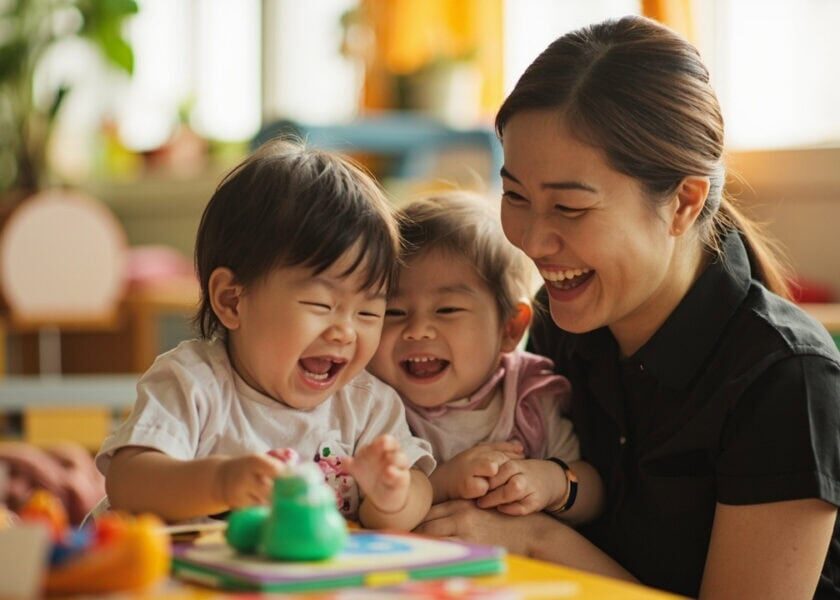
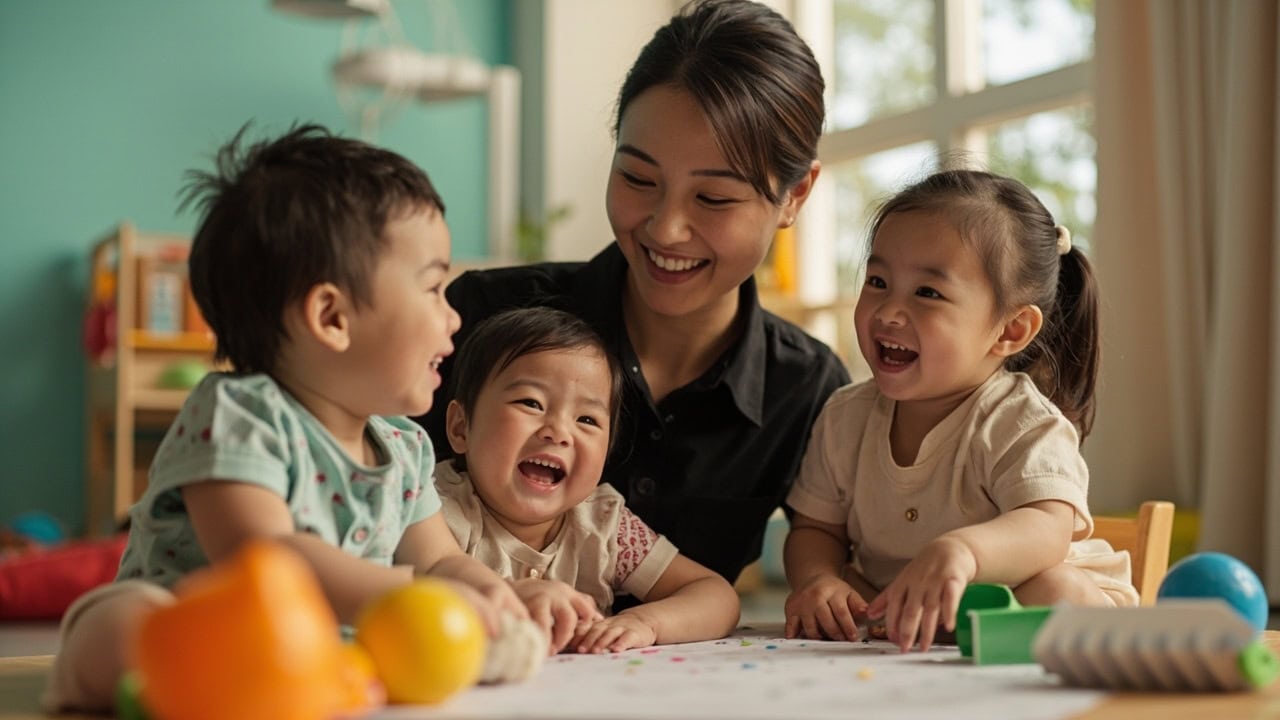
The toddler learns patience by practicing with a younger sibling who needs more attention. The preschooler learns nurturing by having a baby in the home who looks up to her. The infant has models of language and interaction from watching how older siblings engage with the world.
This is the sibling effect in care settings.
It is not sentimental. It is developmental. Siblings in coherent, well-supported care environments develop social competencies faster. They develop emotional regulation skills because they have a built-in peer to practice on. They develop narrative skills, because siblings tell each other stories, negotiate pretend scenarios, argue and reconcile in ways that are foundational to how humans learn to be social creatures.
EduNanny Singapore: A Family-Systems Approach to Childcare
EduNanny, developed under the banner of BUTLER and operating within Singapore’s ECDA Childminding Pilot, represents a fundamentally different way of thinking about what childcare can be. It exists because Singapore’s childcare system recognized, belatedly but honestly, that center-based pathways alone cannot serve the full complexity of how families actually live and care for their children.
Starting With the Family, Not the Child
When a family comes to EduNanny with two children, three children, children at infant, toddler, and preschool stages, the starting question is not what each child needs individually.
It is what this family needs to function, to breathe, to have some version of calm in the middle of everything that is asked of it.
The caregiver or caregivers working with an EduNanny family understand the family as a system. They know that the older child needs to be spoken to in a way that respects her growing autonomy while still providing the structure she relies on. They know that the younger child needs physical affection and verbal narration of his world that builds language. They know that these two children, when they are together in the care setting, are learning from each other in ways that no classroom can replicate.
Reducing the Coordination Burden
There is something else EduNanny understands that most childcare models miss.
The parent in a multi-child family is not just a parent. They are a person carrying a specific, concrete load: the mental load of coordination. The invisible labor of knowing that tomorrow the infant has a pediatric appointment and the preschooler needs permission slips signed and the toddler has outgrown her shoes—and somewhere in the middle of all of this, there is a marriage, a career, a self that is slowly disappearing.
EduNanny addresses this by reducing the coordination burden.
When one caregiver, or a small consistent team, holds the full picture of your family’s needs, something shifts. You do not have to be the translator between your infant’s caregiver and your toddler’s caregiver and the school and the after-school program.
There is a coherence. There is a thread. There is someone else who knows your family as a whole.
What EduNanny Actually Offers
Fee structures and accessibility: EduNanny operates within pilot fee structures designed to make home-based and community-based care accessible, not just aspirational. Families can access CDA and Baby Bonus funding, which significantly reduces the out-of-pocket cost of quality care.
Schedule and coverage: Care blocks run Monday through Friday, covering the core of what working parents need. These are not glamorous features. But they are the architecture of actual relief.
Communication and trust: EduNanny maintains communication protocols and transparency measures, including CCTV where deployed, because parents of multiple children do not have the time to wonder what is happening while they are away. You need to know. You need to be able to trust the answer without interrogating it.
Caregiver quality: In a multi-child family, the caregiver is not just a childcare provider. They are a participant in your family’s emotional ecosystem. EduNanny selects and supports caregivers who understand this weight, matching them to families with attention to developmental stage, family rhythm, sibling composition, and the intangible but real question of fit.
Ratios that allow attention: The infant-to-caregiver ratios maintained through the pilot mean that your infant receives the attentive, responsive care that developmental science confirms matters in those critical first years. But this ratio also means that the caregiver is not spread so thin that they cannot notice when the older sibling is struggling with jealousy, or when the toddler needs a transition object to settle, or when the family is in a particularly stressful week and everyone needs a gentler pace.
This is what it means to care for a whole family, not just a collection of individuals who happen to live together.
Addressing Your Real Concerns
“Is this really worth the effort?”
There is no childcare arrangement that will solve the fundamental tension of modern parenting: you cannot be in all places at once, you cannot give all of yourself to all of your children all of the time, and no system will eliminate the moments of guilt, exhaustion, and doubt that come with raising human beings.
What EduNanny can do is reduce the unnecessary friction:
- The friction of fragmented arrangements that do not talk to each other
- The friction of explaining your family to six different caregivers who each know only one child
- The friction of carrying the mental model of your entire family’s schedule in a head that is already full
- The friction of wondering whether your children even know each other as siblings, or whether they are just strangers who share a bedroom
EduNanny restores scheduling coherence. Not because life becomes simple, but because the complexity is held by someone who can carry it with you.
“But can it actually work for my family?”
Here is the honest answer:
- If you have an infant and a toddler at different centers with different caregivers, EduNanny can provide continuity and sibling connection that currently does not exist in your week.
- If you have a preschooler approaching Primary One and an infant who needs responsive care, EduNanny can hold both developmental needs within one family-aware framework.
- If you are relying on grandparents for pick-up but the schedule is becoming unsustainable, EduNanny’s weekday coverage may fill a gap that has been eroding family relationships.
- If you have been managing this alone and are starting to feel the weight in your body, EduNanny’s coordination reduction may be the difference between sustained exhaustion and manageable complexity.
Building Infrastructure for Your Family’s Next Decade
You are not finding childcare. You are building an infrastructure for your family’s next decade.
The children you are caring for right now—in this exhausting, logistical, beautiful phase—are forming the relational patterns that will shape how they move through the world.
- The sibling bond they are building or not building right now is the one they will carry into adulthood.
- The sense they are developing that their family is a safe, coherent place, or a chaotic, fragmented one, is being formed in the everyday routines of who cares for them, how, and whether those arrangements respect their reality as siblings, not just as individuals.
EduNanny was built on the belief that childcare in Singapore could be more than a service. It could be a support for family life as a whole. Not just the child. Not just the parent. But the irreducible, complicated, essential unit of people who share a home, a history, and a future together.
Moving Forward: What You Can Do Now
If you recognise yourself in this article, you are not asking for too much. You are asking for exactly what your family needs. And it is possible to find it.
Here is what moving forward looks like:
- Name the problem. If you have been feeling like your family’s complexity is a personal failing, let this be permission to see it clearly. The system around you was never built for your reality. That is not your fault.
- Look for coherence, not perfection. The goal is not a childcare arrangement with no friction. The goal is one that holds your family as a system, not just as individuals in parallel care.
- Ask the questions that matter. When evaluating any childcare arrangement, ask: Does this caregiver or center understand my children as siblings? Do they have a way of supporting the sibling relationship? Who holds the full picture of my family’s needs?
- Consider what relief would actually feel like. Not just for the children, but for you. What would it mean to have someone else carry some of the coordination burden? To have one thread connecting your children’s care experiences?
EduNanny Singapore is here. For the whole family.
We understand that raising siblings in Singapore is not the same as raising one child twice. We understand that the childcare system has failed to name your reality, and we are trying to do better.
EduNanny operates within the ECDA Childminding Pilot, offering home-based and community-based care that thinks in family systems. We match caregivers to families with attention to sibling dynamics, developmental stages, and the real daily rhythms of your home.
If you are carrying the weight of fragmented childcare alone, we would like to stand alongside you.
EduNanny Singapore. For the whole family.