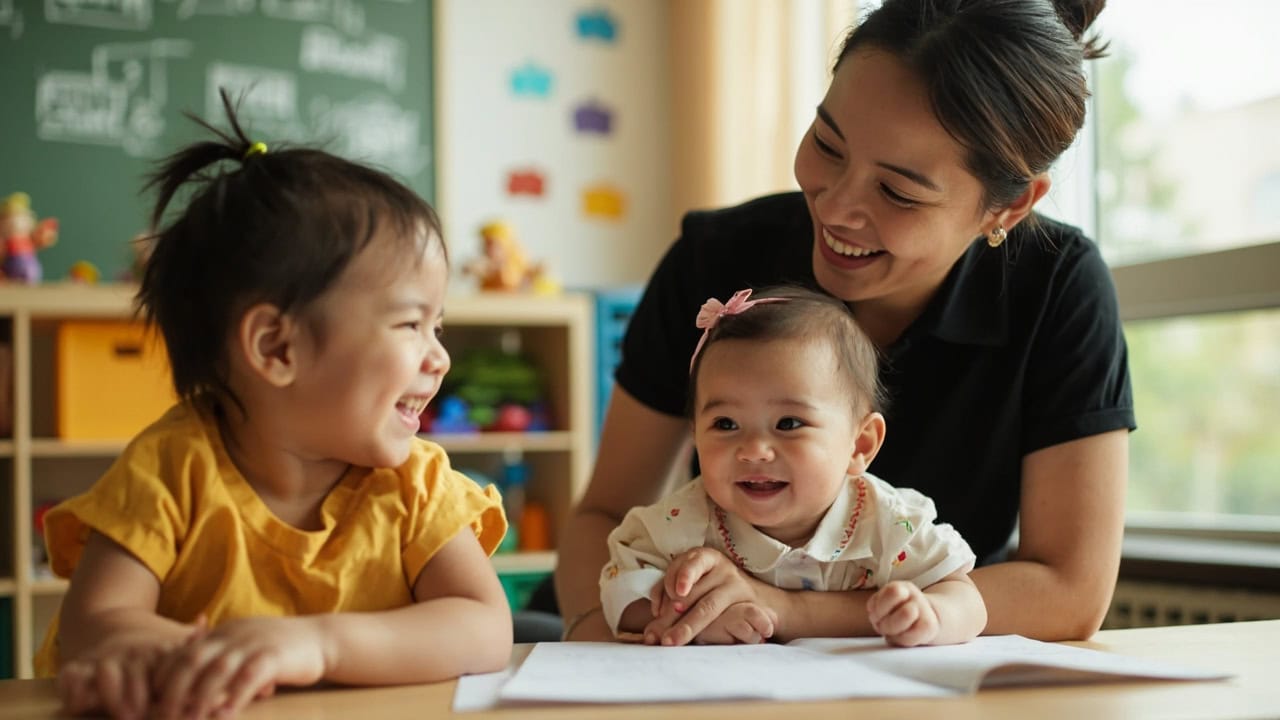
When Your Child Is Known Not Just Watched in Singapore Home-Based Care
What Does Your Child Actually Experience When You’re Not in the Room?
There is a moment every parent in Singapore knows. It happens at the gate, or at the front door, or in the corridor outside a centre. The hand releases. The small body moves forward. And then the door closes.
You turn around. You walk to work, or to a meeting, or simply home to a quieter house. And for the next hours, your child’s world continues without you inside it.
This is the invisible gap. Not the distance between your office and the childcare—but the distance between what you can imagine and what is actually happening. Between the photograph you might see later, the smile in the bag, the vague reassurance of “she had a good day.” And the full, textured, sensory reality of the hours themselves.
Most parents in Singapore have learned to live comfortably inside that gap. They have made peace with it. They have chosen their care arrangements carefully, built relationships with caregivers, and developed trust over time. But peace is not the same as certainty. And every parent, if they are honest, carries somewhere beneath the surface a quiet question: What is my child actually experiencing right now? What does it feel like, from the inside, to be her during these hours I cannot see?
This article is an attempt to answer that question—not with abstract principles or reassuring statements, but with the concrete, sensory detail of what a child’s day can look and feel like when the environment is built around her experience.
The Morning: Crossing a Threshold
When a child arrives at EduNanny, she crosses a threshold that is fundamentally different from the threshold of a centre. This is not metaphor. This is architecture and intention made tangible.
The door opens onto a home. The sounds are home sounds—the kettle, the soft murmur of conversation, the particular acoustics of a space designed for living, not for storing and processing groups of children. The air smells different. There are no hundreds of small bodies and industrial cleaning agents. There is cooking. Fabric. The particular warmth of a space that heats and cools for comfort, not for crowd management.
The caregiver is already there. She has been there since the early morning, setting up the day—not arranging activities on a schedule, but preparing the environment with intention. The play spaces are ready. The sensory materials are accessible. The morning light has been considered.
When your child arrives, the caregiver kneels down. Eye to eye. A name. A greeting. Perhaps a comment about the weather, or about what the child is wearing, or about the toy clutched in her hand.
This moment lasts perhaps ten seconds. It will not make any checklist. It will not appear in any daily report. But it is the hinge on which the entire day will turn. Because it tells your child: You are expected. You are recognized. This space knows your name.
The Physical Dimension: Movement, Touch, and the Learning Body
Let us stay with the physical dimension for a moment, because touch and movement are often the most undervalued aspects of early childhood development—and they are exactly what a home-based setting can provide in ways a centre often cannot.
A child’s body at eighteen months is a learning machine. It is driven to climb, to fall, to climb again. To carry things from one place to another. To crawl under tables, to push chairs, to run with the specific reckless joy of someone who has recently discovered that legs can go fast.
In a centre, this energy must often be contained. There are rules about running. There are safety concerns with larger groups. There are schedules that do not pause for a child’s need to move.
In a home, the child can move. Not recklessly, but freely. The space is scaled for living, which means it is scaled for a small body. The furniture is approachable. The garden or outdoor space is accessible. The caregiver does not say “no running.” She says “let’s run outside” or “watch this step” or “I’ll be right here.” She is present in the child’s movement, not managing it from a distance.
Consider the sensory life of a morning at EduNanny. The child is playing on the floor—let us say she is eleven months old, mobile, curious, reaching for everything. In a home environment, the floor is warm. It is clean. It has texture. She can feel the difference between tile and rug, between the coolness near the window and the warmth near where the morning light falls.
Physical development and emotional development are not separate streams. They are the same river. When a child climbs onto a low stool and the caregiver is there with a steady hand on his back, saying “I see you, you’re being so careful,” the child is learning something about his own competence. He is building an internal architecture of confidence that will shape how he approaches every challenge for the rest of his life.
Human beings are wired for physical connection. Infants and toddlers especially need it—not as a reward or a comfort measure, but as a fundamental nutrient for brain development. A home-based caregiver can hold a child. She can carry him on her hip while she cooks. She can sit with a sleeping toddler in her arms, because the group is small enough that she is not also watching four others. These moments of physical closeness are not extras. They are load-bearing.
The Language Environment: Conversations That Build Brains
Language development in the early years is not primarily about vocabulary cards or structured lessons. It is about exposure, interaction, and response. It is about a child saying “ba” and the caregiver saying “yes, ball. The ball is red.” It is about a child pointing at a bird and the caregiver pausing to look, to name, to extend: “That’s a myna. Do you hear how noisy it is?”
The caregiver moves through the space. She does not interrupt the child’s exploration. She works alongside it. Perhaps she is preparing lunch, and she narrates what she is doing—not for the child’s immediate comprehension, but for his language development, which depends on exactly this kind of ambient, meaningful speech.
“I’m cutting the carrots now. See? Orange. Sharp knife, careful. Now into the pot.”
The child is not paying attention in the way an adult pays attention. He is absorbing. His brain is building pathways that will not show up on any assessment for years.
In a home-based setting, language happens naturally throughout the day. At mealtimes especially. A small group eating together, with a caregiver who sits with them, who names the food, who responds to their sounds and attempts at words, who asks simple questions and waits for answers—even when those answers are just smiles or reaches or the particular intensity of a twenty-month-old who has strong opinions about banana.
Conversations require listening. They require a partner who is present, who is interested, who has the time and the attention to follow a child’s lead. At EduNanny, small group size is not a marketing advantage. It is an environmental condition. When there are three infants in a home instead of fifteen in a room, the caregiver can respond to a child’s facial expression, a change in tone, a moment of frustration, in real time.
Caregiver Continuity: Being Known, Not Just Watched
When the same caregiver is with your child every day, month after month, she learns his rhythms. She knows when he is hungry before he cries. She knows the particular quality of his fussiness that means tiredness, versus the fussiness that means frustration, versus the fussiness that means he wants to be held but is too proud to ask.
She reads him. And because she reads him, she can respond—quickly, accurately, in ways that teach him that his communication matters and that the world is a place that listens.
This deep knowing cannot be replicated in settings where caregivers rotate, where children form attachments to multiple adults, or where the sheer number of children makes individual attunement structurally difficult. It is a product of time, consistency, and a ratio that makes attention possible.
What Quality Childminding Looks Like
Childminding, done well, is one of the most skilled and important forms of work that exists. It requires knowledge of child development, patience that must be renewed every single morning, the ability to read and respond to nonverbal communication, and the stamina to create a warm, safe, stimulating environment day after day.
EduNanny treats this work with the seriousness it deserves. Its caregivers are not babysitters. They are early childhood professionals who have chosen to work in the setting where their impact on a child’s life is most direct and most profound.
- Environment scaled to the child: Spaces that feel warm, sensory-rich, and appropriately sized—not institutional.
- Caregiver stability: The same face, day after day. Consistency that allows attachment to form.
- Responsive interaction: Caregivers who narrate, name, pause, and respond—not just direct.
- Movement freedom: Environments where children can climb, run, and explore within safe, appropriate limits.
- Physical presence: Caregivers who hold, carry, and comfort—not as exceptions, but as a natural part of the day.
- Communication: Regular, genuine updates that tell you not just that your child is fine, but what fine looks like.
Closing the Gap: Transparency and Trust
Parents often feel something they rarely voice: the anxiety of not knowing.
When you drop your child at care in the morning, you close a door. You imagine what happens behind it. You hope it is good. You trust the environment you have chosen. But you do not know—not with the certainty of direct experience. And this not-knowing can sit in a parent’s chest like a small stone, present most days, heavier on others.
EduNanny understands this. Not as a marketing insight, but as a truth about what it means to love a small child and to be separated from them during the most formative hours of their lives.
The transparency measures that EduNanny has in place—communication systems, regular updates—are not bureaucratic additions. They are responses to a legitimate need. Parents need windows. Not just literal ones, though those matter. They need to feel that the door they closed is not an impenetrable wall.
When you receive a photograph of your child stacking blocks, or a note about how she ate lunch, or a message that she pointed at a butterfly during garden time, you are receiving something more than information. You are receiving evidence—evidence that the day is real, that your child is not just a name on a register but a person having experiences, learning, feeling, growing.
Common Questions From Singapore Parents
Is home-based care as structured as a centre? Structure and schedule are not the same thing. A home-based environment follows the rhythms of children—their hunger, their tiredness, their curiosity—not a printed timetable. This is not a lack of structure. It is a different kind: one organized around development rather than logistics.
How do I know my child is actually safe? Safety in quality care comes from attunement, not just supervision. A caregiver who knows your child can read signs of distress, fatigue, or discomfort that a less familiar adult might miss. Small group sizes mean fewer children to watch and more attention available for each one.
Can I really afford this? EduNanny operates within the ECDA Childminder Pilot, which means fee structures are designed to be accessible. CDA and Baby Bonus funds can be used. This quality of care is not reserved for families with significant resources.
The ECDA Childminding Pilot: A New Standard for Singapore
For too long, parents in Singapore have had to choose between options that felt like compromises. Centres with capacity but limited individual attention. Home-based arrangements with warmth but without structured support.
The ECDA Childminding Pilot represents something different: a framework that honors the developmental needs of infants while making quality care accessible and affordable for families across Singapore.
| Feature | Traditional Centre | EduNanny Home-Based |
|---|---|---|
| Group size | 10–20+ infants per room | Up to 3 infants per home |
| Caregiver ratio | 1:4 to 1:8 | 1:1 to 1:3 |
| Environment | Institutional, designed for capacity | Home, scaled for living |
| Caregiver continuity | May rotate shifts | Same caregiver daily |
| Schedule | Fixed routines for groups | Rhythms follow child needs |
| Physical touch | Limited by group management | Natural, responsive closeness |
| Communication | Periodic updates | Regular, evidence-based sharing |
The First Thousand Days Are Not a Slogan
There is a door. You close it. And for the next hours, your child is in a world you cannot see.
This article has tried to open that door—not just a crack, not with a vague description, but wide enough for you to see the texture and warmth and genuine care of what is inside. To see the morning light in a home scaled for a small body. To hear the caregiver narrating a lunch she is preparing for a child who is absorbing every word. To feel the weight of a toddler who is tired and wants to be held, and the presence of someone who has the time to hold him.
If you are a parent in Singapore, and you are making decisions about care, we want you to be able to picture this. Not as a sales image or a reassuring abstraction, but as something real. Something you can ask questions about. Something you can visit, observe, trust.
The first thousand days of a child’s life are not a slogan. They are a fact. The experiences your child has in these years—the sounds, the textures, the words, the faces, the quality of attention she receives—will shape the architecture of who she becomes. This is not exaggeration. This is what decades of research tell us, and what every experienced caregiver knows in her bones.
EduNanny exists because children deserve environments that honor this. Because parents deserve transparency about what those environments contain. Because the work of caring for a young child is skilled, important, and worthy of professional recognition.
If this vision of infant care resonates with you—if you can picture your child in a home scaled for her, with a caregiver who knows her name, her rhythms, her needs—we invite you to take the next step.
Visit us. Ask questions. Observe a morning. Let us show you what we mean when we talk about quality care, and let us answer the questions that matter most to you.
The invisible gap doesn’t have to stay invisible. Not when there are windows to open, and doors to walk through, and people ready to show you what’s inside.
At EduNanny, we believe every child deserves a home where they are known, not just watched. Speak with our team to learn more about home-based infant care in Singapore.