The Person, Not the Programme: What Singapore Parents Should Know
What Singapore Parents Are Really Looking For
When searching for childcare, Singapore parents invest significant time and emotional energy into research. They visit centres, compare curricula, check ratios, and read reviews. But beneath all that rigour lies a quieter, more personal anxiety:
- Not “Is this centre good?” but “Is the actual person caring for my child the right fit?”
- Not “What is the curriculum?” but “Will my child feel seen, warm, and secure?”
- Not “Is this accredited?” but “Will my child be known as an individual?”
These questions deserve honest answers. And they lead somewhere unexpected: to the person, not the programme.
What Great Caregiving Actually Requires
The first thing to understand is that genuine nurturing is a skilled practice. There is a significant difference between supervision and the kind of care that helps a child flourish.
Supervision means keeping a child safe — making sure they do not fall, do not hurt themselves, do not come to harm. It is necessary. But it is not sufficient.
The Art of Trained Attentiveness
Nurturing requires trained attentiveness. It is the capacity to observe a child with real care — to notice not just what they are doing but how they are doing it. To read the signals that precede a meltdown before the meltdown arrives. To recognise the subtle shift in a baby’s face that means they are beginning to feel unwell. To understand that a toddler’s refusal to eat is sometimes not about food but about control, or tiredness, or a need that has no words yet.
A caregiver with trained attentiveness does not simply love children. That is the foundation, but it is not the whole of it. They are also students of the children in their care. They pay attention. They notice patterns. They build, over days and weeks, a picture of each child as an individual — a picture that belongs to no curriculum and no inspection framework but that sits at the very heart of what it means to care for someone well.
What This Looks Like in Practice
A caregiver with genuine attentiveness notices when a toddler who usually runs to greet her at the door instead clings quietly to a parent’s leg. She does not rush to separate them. She gives space. She reads the signal.
She knows that one child in her care is calmed by humming, and another by stillness, and she adapts her response accordingly — not because it is written in any manual, but because she has been paying attention.
She notices when a baby’s cry changes pitch and understands that it might be overstimulation, or the beginnings of illness, or simply a need to be held without agenda.
These are the quiet, daily skills of great caregiving. They cannot be audited in a single visit. They can only be observed over time.
Why Consistency Matters More Than Any Programme
Young children build their sense of security not from environments but from people. Not from the quality of the toys or the design of the room, but from the reliable, repeated presence of specific individuals who know them.
A child does not feel safe in a beautiful centre. A child feels safe in the arms of a familiar person who returns, day after day, with the same patient attention.
The Singapore Reality
This matters enormously in Singapore, where many parents navigate demanding professional lives — long commutes, high-pressure careers, the particular rhythm of life in a city that moves quickly and asks a great deal.
You may not always be there in the morning. You may not always be the first face your child sees when they wake. This is the reality of modern parenting, and it deserves an honest answer: your child does not need you to be present every single moment. But they do need someone to be present with the same face, the same voice, the same warmth, every single day.
What Consistency Gives Your Child
They need the caregiver who remembers that your daughter is scared of automatic hand dryers and will turn hers off quietly without making a fuss. They need the caregiver who knows that your son goes cross when he is hungry before he goes hungry — and who has a snack ready at the right time.
They need the person who knows them specifically, not as a child in a room, but as your child, with their particular temperament, their particular rhythms, their particular way of being in the world.
Consistency gives a child an anchor. It gives them the quiet confidence to explore, to play, to try new things, to be separate from you without being afraid — because there is someone there who knows who they are and will hold that knowing gently.
A Framework for Reading the Caregiver Relationship
If the caregiver relationship is the true quality indicator in childcare, a natural question follows: how do you, as a parent, come to know whether this relationship is developing well?
Here is a way of paying attention — because attentive parents are already doing much of this work, and it may help to name it clearly.
1. Does the caregiver know your child as a person?
Not just as a task — not as a sequence of feeding times and diaper changes — but as a specific human being with a specific temperament, specific preferences, specific ways of expressing joy and distress.
Does she tell you things about your child’s day that reveal she was truly watching? Does she mention that your son has started preferring the blue cup, or that your daughter was particularly drawn to the music session this morning? These small details are the evidence of genuine attentiveness.
2. Is the caregiver learning your family?
A good caregiver does not simply impose a routine. She adapts. She learns that your child sleeps better after a walk. She learns that your family values a certain kind of meal. She learns your language, your rhythms, your expectations — and integrates them into her care.
This is not compliance. It is the beginning of a true working partnership between your family and the person who cares for your child.
3. What does your own instinct tell you over time?
Not the dramatic first impression — the first visit is full of careful performances on all sides. But pay attention to how you feel after a few weeks.
- Do you feel more confident about leaving your child, or less?
- Do you find yourself looking forward to pickup because you are curious about the day, or dreading it because you are anxious?
Your own sense of ease — or its absence — is meaningful data. A good caregiver relationship should, over time, make you feel more capable as a parent, not less. Not because you are replaced, but because you are supported.
4. What does your child show you?
Notice your child over days and weeks, not only at drop-off. Children are complex, and the moment of separation is not always revealing.
- Does she seem settled in the caregiver’s presence?
- Does she move toward the caregiver with some degree of comfort, even if not always with eagerness?
- Does she show any signs — however small — that this is a person she associates with something good?
These are not guarantees. Attachment is complex. But they are quiet, honest signals, and they are worth watching.
A good caregiver will not only welcome this observation. They will invite it. They will want to be known by you, just as they are coming to know your child. Because that is what a real partnership looks like.
What EduNanny Singapore Was Built to Protect
The question most parents carry — the one about whether the person with their child is the right one — is the question that EduNanny Singapore was built to answer.
EduNanny is part of Singapore’s ECDA Childminding Pilot — a deliberate, national effort to offer families a different kind of childcare: one built around the quality of individual care rather than the throughput of institutional models.
Small Groups, Genuine Attentiveness
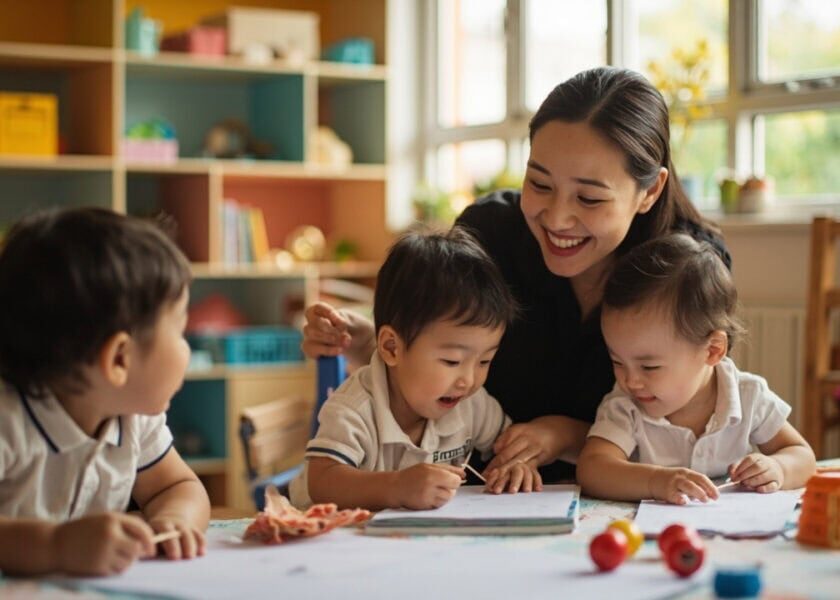
EduNanny maintains small groups with carefully considered infant-to-caregiver ratios — ratios designed not for efficiency but for genuine attentiveness. Each child is with the same caregiver, in the same space, with the same rhythms — not as an accident but as a design. Because EduNanny believes that the relationship between caregiver and child is not incidental to good childcare. It is the point of it.
Caregivers Chosen and Supported for the Work
EduNanny’s caregivers are selected not only for their qualifications but for the quality of their attention — for the ability to be genuinely present with a child in a way that goes beyond the mechanical tasks of feeding, cleaning, and keeping safe.
Once selected, these caregivers are supported continuously. Ongoing training, reflective practice, guidance in the specifics of infant and child development — because EduNanny understands that skilled caregiving requires continuous growth. Their caregivers are not left alone in a room to figure things out. They are supported. They are valued. They are given the tools to do the most important work there is.
Accessible and Transparent
EduNanny has designed their services so that eligible families can make use of CDA and Baby Bonus funds. They keep fee structures accessible within the pilot framework, because they believe that high-quality, relationship-centred care should not be a privilege available only to those with significant financial means.
For families, EduNanny has built transparency into their model: regular communication, shared observations, updates that go beyond the perfunctory. In locations where it is deployed, CCTV is available as an additional measure of openness and trust. EduNanny understands that trust must be earned continuously — and that parents deserve to feel genuinely assured rather than simply reassured.
Structured for Working Families
The care blocks are structured for working families — Monday through Friday, in reliable, consistent sessions that reflect the rhythm of real working life in Singapore. Because the last thing parents need is a childcare arrangement that adds complexity to an already demanding week.
What families need — what EduNanny provides — is something they can depend on, week after week, in the same spirit of warmth and reliability that defines the care itself.
Why This Question Matters More Than Any Checklist
When you place your child in the care of another person, you are making one of the most consequential decisions of your life as a parent.
It is consequential not because it is dangerous — most caregivers are warm, capable, and deeply committed to the children in their care. It is consequential because it is foundational.
The quality of your child’s early experience of being cared for by someone outside your family is not a detail. It is the earliest template for how they will understand the world as a place that is warm or cold, attentive or indifferent, safe or unpredictable.
Every parent knows this, even if it is rarely said so plainly. And yet the childcare industry has built its language around programmes, facilities, philosophies, and outcomes. These things matter.
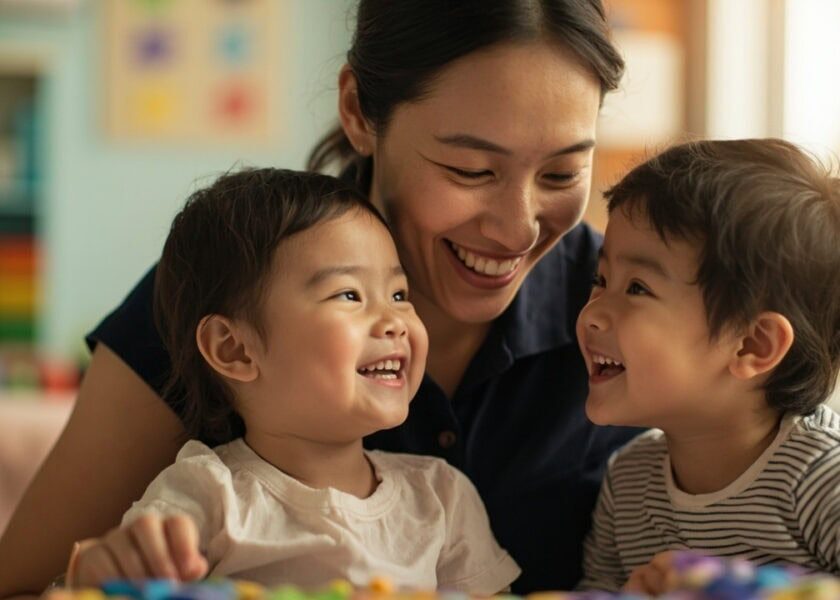
But they matter less than the quality of the person sitting on the floor with your child, noticing the way their face lights up, responding with warmth to their reaching hands, being the steady, patient presence that makes the world feel small and safe.
What EduNanny Has Built
What EduNanny has done is take that quiet, profound truth — that the caregiver relationship is where quality lives — and build an entire organisation around it.
Not just as a philosophy, but as a daily, operational commitment. In how they select. In how they train. In how they structure ratios and communication. In how they support and value the people who do this work. In how they make their services accessible to families across Singapore, regardless of circumstance.
There is something worth pausing over in that commitment. Because it says something about what we believe about children in this city.
It says that every child deserves to be cared for by someone who knows them. That every family deserves to feel that their child is genuinely seen. That caregiving is not a task to be distributed but a relationship to be cultivated.
And that high-quality care — care built on warmth, on attentiveness, on the quiet, daily work of knowing a child — should be within reach of every family who needs it.
If You Are Searching Right Now
If you are a parent in Singapore searching for the right care for your child — not just any care, but the right care — know that the question you are carrying is the right one.
Know that your instinct to look beyond the centre to the person is correct.
Know that somewhere in this city, there are caregivers whose work it is to receive that question with the seriousness it deserves, and to answer it not with a brochure or a tour, but with the only thing that has ever truly mattered:
The quality of their presence, day after day, with your child.
That is what EduNanny Singapore is for. That is what they are here to protect. And that is what choosing the right caregiver has always been — not a transaction, but a quiet, daily act of trust between one human being and another, made with the full knowledge that your child is, and always will be, your whole world.
If you would like to learn more about EduNanny Singapore, explore our childminding programme, or speak with our team, we would be glad to hear from you.