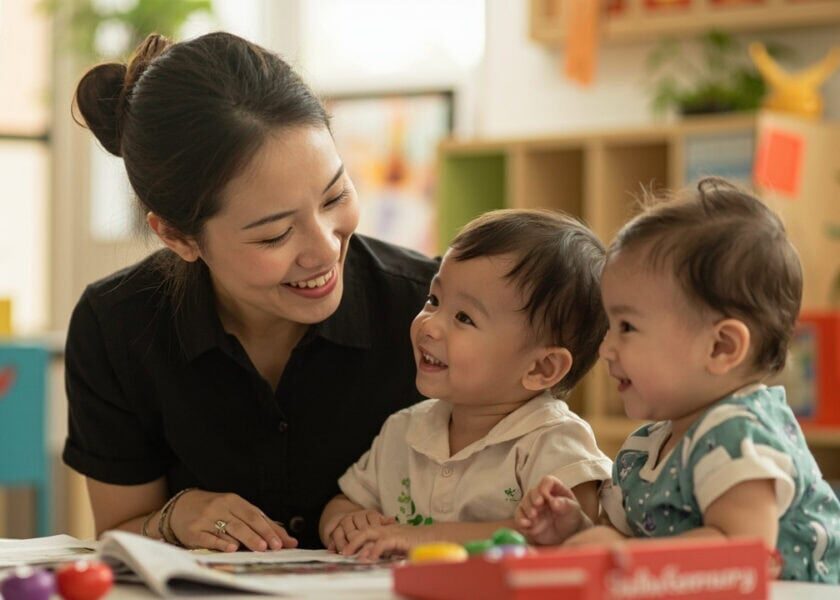
Understanding Your Child’s Inner World at Singapore Childcare
Understanding Your Child’s Inner World in Childcare
There is a particular silence that settles over a Singapore morning as parents hand their child to a caregiver and walk away. It is not the silence of doubt—you have made this choice carefully, thoughtfully, with the best information available to you. It is the silence of not knowing. The hours ahead stretch like a landscape you cannot see, and somewhere in that landscape is your child, living an entire inner world you cannot enter.
This is the quiet reality that many Singapore parents carry. You leave your little one in capable hands, and you trust that everything is fine. But beneath that trust is a question that surfaces in small moments—in the drive to work, in the middle of a meeting, in the brief pause before sleep takes you.
What is actually happening inside my child during those hours? What does my child feel, experience, struggle with, discover, and become when I am not there to witness it?
The truth is that your child is not simply waiting for you. Your child is living, feeling, learning, and growing in ways that are profound, complex, and profoundly important. And the quality of that inner life—the security of your child’s emotional world during the hours of separation—will shape far more than anyone can see in any given afternoon.
Before we explore this conversation in depth, here is what matters most:
- Your child’s inner life during childcare is not invisible—it is speaking to you all the time through behavioral signals, emotional responses, and daily patterns.
- Quality care builds your child’s inner world, not just supervises it. The way a caregiver responds to frustration, offers comfort, and structures the day shapes emotional development.
- You can learn to read these signals. With the right framework, you can move from hope to informed trust, from anxiety to quiet confidence.
- The goal is not a child who never struggles—that is not childhood. The goal is a child who struggles in ways that build rather than deplete.
The Hours You Cannot See
We often underestimate what our young children carry inside them. Before they have the language to name their fears, their joys, their confusions, they are already experiencing them with full emotional weight.
A toddler who clings at drop-off is not being dramatic or manipulative—she is navigating a genuinely overwhelming experience with the only tools she has. A baby who turns away from a new face is not rejecting the world—she is protecting herself from stimulation her nervous system cannot yet process. A child who suddenly falls apart the moment you pick her up is not being difficult—she is finally safe enough to release what she has been holding.
These are not problems to solve. These are windows into your child’s inner life.
The hours your child spends in care are not merely hours spent being watched. They are hours spent building an inner world—a world made of countless small moments: the way a caregiver responds when your child is frustrated, the texture of comfort offered when comfort is needed, the rhythm of the day that either soothes or overwhelms, the quality of attention that either sees your child as an individual or manages her as one of many.
All of this is happening whether or not your child can tell you about it. All of this is shaping who your child is becoming.
Think about what your child is navigating during those hours you cannot see: she is learning whether the world is a place where her needs will be noticed and met. She is building an understanding of whether adults are reliable, whether comfort is available, whether her cries will bring response or silence. She is discovering whether her emotional experience is valid and held, or whether it must be suppressed to survive the day.
These are not abstract developmental concepts. These are the lived experiences of your child, happening right now, shaping the architecture of her nervous system and the foundations of her capacity to trust, explore, and connect.
The hours of separation are not lost hours in your child’s development. They are, in fact, some of the most formative hours. The question is not whether those hours matter—they do. The question is what kind of mattering is happening.
What Attachment Security Looks Like in Daily Life
Developmental research has given us a powerful framework for understanding what quality care produces inside a child. We call it attachment security—the internal sense that you are held, that the world is manageable, that adults can be trusted to respond when you need them.
But what does this look like in a real Singapore home at the end of a childcare day?
It looks like a child who can be comforted when upset. Not because the upset never happens, but because she has learned that being upset does not mean being abandoned. The tears may come, but they come in the presence of a growing trust that someone will stay.
It looks like a child who can tolerate small frustrations. Not because she is being taught to suppress emotion, but because she has an inner sense that she has enough—that the world has resources for her, that she is held, that she will not be depleted by the ordinary demands of the day.
It looks like a child who can be curious. Who can play independently, who can explore a new toy or a new space with the quiet confidence that her caregiver is there, that she can venture out and return, that the bond with her parent is not weakened but expanded by the connections she forms with other caring adults.
It looks like a child who is gradually more at ease with separation over time. Not because she has been taught to hide her feelings, but because her environment has become a place where her nervous system feels safe enough to let go, trusting that reunion will come.
This is what quality care produces. Not a child who never struggles—that is not childhood, and it is not realistic. But a child who struggles in a way that builds rather than depletes. A child who is not merely managed through her day but genuinely known within it.
Your Child Is Already Communicating
Here is the framework that transforms parental anxiety into informed awareness: your child is communicating. The question is whether you have the literacy to hear what she is saying.
| Signal | What It May Tell You |
|---|---|
| The infant who reaches for you with intensity when you return | Something about the security of what happened in your absence. This is not neediness—it is the healthy expression of attachment. |
| The toddler who comes home talkative and curious | Something about how supported her exploration has been. A child who feels safe explores freely. |
| The child who resists separation less and less over time | Something about whether her environment has become a place where her nervous system feels safe. |
| The child who falls asleep easier because her day had predictable rhythms | Something about whether consistency has become a foundation for her sense of security. |
| The child who talks about her caregiver with warmth | Something about whether she has formed a secondary attachment that enriches rather than replaces your bond. |
These signals are real, and they are meaningful. With attention and a little framework, you can learn to read them not as puzzles to solve but as conversations to join.
What Quality Childminding Actually Looks Like
Now we arrive at the practical question: what does quality care actually look like, and how can you recognize it when you are researching your options in Singapore?
Quality childminding is not primarily about curriculum or facilities. It is about the quality of attention your child receives.
The Things That Matter Most
Some things matter more than others when it comes to what is happening inside your child:
- Ratio matters. When one caregiver is responsible for fewer children, your child can actually be perceived, responded to, noticed when something shifts. This is not a luxury—it is the infrastructure that makes genuine nurturing possible.
- Consistency matters. Children build security through predictable rhythms. When the same caregiver is present, when the day’s flow is structured and reliable, your child’s nervous system can settle into the expectation of safety.
- Responsiveness matters. The way a caregiver responds to distress—not just managing behavior but genuinely acknowledging emotion—teaches your child that her inner experience is valid and held.
- Observation matters. A caregiver who notices the child beneath the behavior—who understands that withdrawal and aggression may stem from the same underlying need for security—is practicing the kind of care that builds inner confidence.
Beyond Supervision
Here is the distinction that matters most: quality care is not the absence of problems during the childcare day. It is what happens inside those problems.
A child in quality care will still have hard moments. She will still cry, resist, struggle with sharing, fall apart at pickup. What distinguishes quality care is what happens in response to those moments—and what your child carries away from them.
In quality care, a hard moment becomes:
- A lesson in emotional regulation—being upset is survivable, and comfort is available
- A confirmation that adults can be trusted to stay when things are hard
- An opportunity for your child to learn that her feelings are not too big, not too much, not something to be ashamed of
In inadequate care, a hard moment becomes:
- Something to suppress or manage
- A test that must be endured alone
- Evidence that the world is not safe to express your needs
The difference is not visible in the daily report. It is visible in the arc of your child’s emotional development over months and years.
How EduNanny Approaches Your Child’s Inner World
We want to be clear about something we hold deeply: we do not believe that quality childcare replaces you. We do not believe that what happens in our care is separate from what happens in your family.
The inner world of your child is not compartmentalized. What she experiences with us becomes part of her internal working model of how the world works, how adults respond, how relationships feel.
That is why we see ourselves as an extension of the care you provide, not a substitute for it. We are not raising your child. We are accompanying her through the hours you cannot be there, and we take that accompaniment seriously.
Our Framework
EduNanny, by BUTLER, operates as part of the ECDA Childminding Pilot, which means we are building our approach within a framework designed to support exactly this kind of developmental care—care that sees the whole child, not just her supervision needs.
We offer pathways that include home-based and community options alongside centre-based care, because we know that every family situation is different, and the right fit matters. Some children flourish in centre environments with peers. Others need the intimacy of a smaller setting. We believe the structure should serve the child, not the other way around.
What This Means Practically
- Small ratios. Our infant ratios are intentionally structured so that each child receives attention that can actually perceive her, respond to her, and notice when something shifts.
- Structured rhythms. Our care operates in structured blocks that give your day rhythm and predictability—something young children depend on more than we often realize. Consistency is not just about showing up; it is about creating an environment where your child’s nervous system can settle into the expectation of safety.
- Trained to notice. Our caregivers are trained to see the child beneath the behavior. They understand that a child who is withdrawn may be processing something entirely different from a child who is aggressive, and that both may be navigating the same underlying need for security and understanding.
- Transparent connection. Where deployed, our centre environments include measures that allow you to feel connected to your child’s day—not to surveil, but to witness, to participate in, and to trust. Because the goal is not to make you doubt what happens when you leave; it is to help you feel confident in what happens when you leave.
We understand that Singapore families are navigating real financial considerations alongside their desire for quality care. We are committed to remaining within pilot fee structures that make quality care accessible. Many families are able to utilize their Child Development Account and Baby Bonus funds, which we can discuss with you in the context of your specific situation. We believe that trust is built through transparency, not promised through reassurance—and this includes transparency about costs.
Your Concerns, Addressed Honestly
Let us name the concerns that sit beneath the surface of your childcare research, because they deserve honest answers.
“What if my child is just being managed, not known?”
This is a legitimate fear, and not all care is created equal. The signs of genuine knowing include: caregivers who can tell you something specific about your child’s day, not just generic observations; a caregiver who remembers details from previous days; a program that adapts to your child’s individual rhythms and needs rather than imposing a uniform structure on all children.
“What if my child has a hard day and I never know?”
Hard days will happen. The question is how they are handled and what your child carries away from them. Ask potential caregivers how they respond to distress. Look for answers that go beyond “we comfort them”—because that is the minimum. The better answer involves reflection, individualized response, and follow-up that helps your child process rather than just move on.
“Will my child form an attachment to her caregiver that replaces me?”
This is one of the most common anxieties Singapore parents carry, and it is understandable. The answer is that quality secondary attachments enrich your child’s capacity to connect—they do not diminish the primary bond. In fact, a child who can form warm, trusting relationships with other adults is a child who is learning that adults are reliable and that relationships are safe. This is an expansion of your child’s world, not a replacement of you within it.
“How do I know if something is wrong?”
You will not always know. But you will learn to notice when something is not quite right—the child who was previously comfortable at drop-off who suddenly resists, the child who comes home more withdrawn than usual, the child whose sleep patterns shift unexpectedly. These are not guarantees of a problem, but they are signals worth investigating. Your instincts matter. Trust them while also building the literacy to interpret what you are seeing.
“What if I made the wrong choice?”
You can only make the best choice you can with the information you have. And you can stay attentive to what you learn over time. Quality care will show itself in your child’s development over months—not in perfection, but in a general trajectory of growing security, curiosity, and emotional resilience. If that trajectory is present, you have likely found the right fit. If it is not, you have the information you need to make a change.
What to Look For When Choosing Infant Care in Singapore
Here is what we suggest you look for, ask about, and observe when researching your options:
Questions to Ask
- What is the caregiver-to-infant ratio? Fewer infants per caregiver means more individualized attention.
- How consistent is the caregiver assignment? Predictable relationships build security.
- How do caregivers respond to distress? Look for answers that reflect understanding of emotional needs, not just behavior management.
- What does a typical day look like? Rhythm and predictability are foundations of security.
- How do you communicate with parents? Ongoing connection, not just occasional updates.
- How do you handle separation anxiety? Answers should reflect patience and understanding, not pressure to “tough it out.”
Things to Observe
- How do the caregivers speak to the children? With warmth and genuine engagement, or perfunctorily?
- How do children move through the space? With ease and curiosity, or with visible stress?
- How does the environment feel? Not just clean and safe, but warm and responsive to children’s needs.
- How do caregivers respond when a child is upset? With attention and comfort, or with dismissal or impatience?
Signs Over Time
The quality of care reveals itself not in a single visit but over weeks and months. Watch for a gradual decrease in separation resistance, your child showing warmth toward her caregiver, coming home energized rather than depleted, growing independence and curiosity, and ease with routines and transitions.
You Are Already Doing More Than You Realize
The fact that you are asking these questions, that you care about what is happening inside your child’s day, that you are here reading a conversation about developmental literacy and inner worlds—this tells me that you are the kind of parent your child needs.
The anxiety you feel about the hours you cannot see is not a sign that you are doing something wrong. It is a sign that you understand, at a level deeper than words, that these hours matter.
You are right. They do.
And now, with a little framework, with a little literacy, you can approach those hours with something more than hope. You can approach them with informed trust.
You can notice the signs that tell you your child is not just being watched but being known:
- The child who comes home tired but animated
- The child who talks about her day with the quiet pride of someone who was challenged appropriately
- The child who falls asleep easier because her nervous system has learned to trust that tomorrow will be something like today, and today was okay
These are not guarantees. Children are human, and their development is not linear, and there will be hard days and regressions and moments that make you wonder. But when you understand what you are looking for, those difficulties become information rather than alarms. They become conversations rather than crises.
At EduNanny, we are honored to walk part of this road with you. We are honored to be the place where your child’s inner life is not invisible, where her emotional truth is not overlooked, where her development is not just tracked but genuinely accompanied.
We believe that every child deserves to be known, and that parents deserve to feel that their child is not just safe but thriving—not because someone told them so, but because they can see it, read it, and trust it.
That quiet confidence is possible. It is available to you. And we are here to help you find it.
The inner world of your child is not as invisible as it feels. It is speaking to you all the time—in the way she reaches for you, in the way she plays, in the way she learns to trust or struggles to. Your child is telling you who she is, what she needs, and who she is becoming.
All you needed was someone to help you learn the language.
Ready to Learn More?
If you are researching infant care or childminding options in Singapore, we invite you to continue this conversation with us. Speak with our team to learn about our approach, meet our caregivers, and discover what it means for your child’s inner world to be seen, known, and nurtured.
Because your child’s inner life is not invisible. It has been speaking all along. Let us help you learn to listen.