The Hidden Hours: What Your Child Learns When You’re Not There
The Moment Every Singapore Parent Knows
There is a moment, perhaps just after you have handed your child over at the gate and you are walking to the car or the train, when you stop and wonder.
Not about the milestones they will reach or the skills they will learn. You wonder about something deeper. You wonder what is happening inside them right now, in this building you are leaving them in, while you are not there to see it.
You wonder if they are okay. Not physically safe — you trust that. But okay. Whether the world feels big or small to them today. Whether they are struggling or settling. Whether the person holding them understands what they need before they know how to ask.
This is not a small worry. It is one of the most honest things a parent can carry. And it deserves more than reassurance. It deserves an answer.
Today, we want to talk about exactly what is happening in those hours you cannot see, because it matters more than most of us have been told.
What Quality Childcare Actually Teaches
Before a child learns to count or recite or write their name, they are already learning something far more fundamental. They are learning how to feel.
Emotional intelligence begins not in a classroom, not in an app, not in a structured lesson plan, but in the ordinary, extraordinary moments of early childhood: when a toddler screams because a block tower falls, when a preschooler does not know how to share a toy they love, when a small child cries at separation and then, slowly, begins to trust that you will return.
These are not disruptions to learning. These are learning. The raw material of everything your child will become.
The Capacity to Feel and Recover
We call it emotional intelligence, but perhaps a simpler name is better. It is the capacity to:
- Know what you feel
- Say it in a way others can hear
- Recover when things are hard
It is the difference between a child who is merely quiet and a child who is quietly confident. It is the difference between a child who panics at failure and a child who knows that trying again is possible.
And here is what many parents in Singapore are not told: this foundation is built in the hours you are not there.
The Hidden Curriculum
When a child is in quality childcare, they are not simply being supervised. They are in a learning environment, and the subject is themselves.
They are learning:
- What anger feels like in their body before it becomes a tantrum
- That the word “frustrated” exists and that it describes something real, something that will pass
- That another child can take their toy and the world does not end
- That adults can help, and that sometimes waiting is hard but survivable
They are building, brick by brick, the architecture of an inner life that will serve them through school, through friendships, through adolescence, and into adulthood.
Self-Regulation and Secure Attachment
Self-regulation sounds clinical. But watch a toddler learn it and you will see something beautiful.
A two-year-old who has just been told no, who is red-faced and rigid with fury, who has no words yet for what they feel, and who is learning — slowly, with patient help — that the feeling will not destroy them. That they can breathe. That they can ask for help. That the adult in the room is not rejecting them but holding a boundary because that is what keeps them safe.
Secure attachment works in a way that surprises many parents. We tend to think of attachment as something that only happens between parent and child. But attachment is actually a capacity — a way of relating to the world — and it can be supported by other consistent, loving, responsive adults.
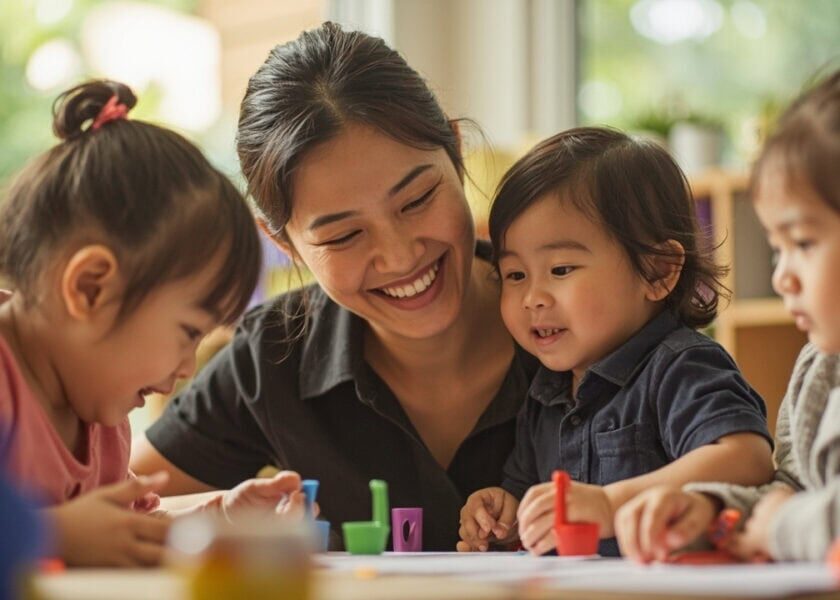
When your child forms a secure bond with their caregiver, they are not replacing you. They are learning that the world contains people who can be trusted, who will notice when they are upset, who will comfort them, who will show up.
This does not undermine your bond with your child. Research consistently shows the opposite: children who have secure attachments in multiple settings are more confident in exploring, more willing to take appropriate risks, and more secure in their primary relationships. The more safe adults your child knows, the more resilient they become.
Why Caregiver Continuity Matters
When a child sees the same faces day after day, when they know who will be there when they arrive, when they have learned the rhythms and routines of that person’s care, something settles inside them.
Their stress response system — which is extraordinarily sensitive in young children — begins to calibrate. Cortisol patterns stabilize. The nervous system learns what safety feels like in multiple contexts.
Your child is not just comfortable with their caregiver. Your child is building a more regulated nervous system that will serve them for life.
What to Look For in a Childcare Setting
Now let us be specific, because parents deserve concrete markers, not abstractions.
Adults Who Name What Children Feel
“I see you are crying. You look like you are feeling really sad that Mama left.”
That naming, that mirroring, is not soft or sentimental. It is precise developmental work. It is teaching a child that feelings have names, that adults can understand them, that being seen is the first step in being helped.
How Adults Respond to Distress
Do they comfort without immediately distracting? Do they allow the child to feel the feeling while holding the boundary? Do they stay physically close, warm, regulated themselves?
A child cannot learn to calm themselves if the adult around them is also escalated. Regulation is contagious. Your child is learning to regulate by being near adults who are regulated.
How Conflict Between Children Is Handled
Not whether there is conflict, because there will be, and should be, but whether the adults use it as a teaching moment.
Whether children are helped to use words, to wait, to take turns, to feel frustrated and continue. Whether the adult names the struggle honestly: “It is hard to wait. Your body feels very angry right now.”
Children who learn that frustration is not dangerous — that it is simply a feeling that passes — become children who can sit with discomfort, who can persist at difficult tasks, who can fail and try again.
Whether Caregivers Know Your Child as an Individual
Not just their name and their schedule, but their particular temperament, their particular triggers, the way they show when they are overwhelmed before they show it fully.
Good caregivers notice. They have the training, the observation skills, and the ratio that allows them to see each child as an individual, not a group.
Signs of Emotional Struggle to Watch For
There will be days when your child comes home and something is not quite right. A child who was previously easy-going is suddenly clingy. A child who loved school is resisting. A child who seemed fine is having new fears, new struggles, new regressions.
These moments are not failures. They are information.
Young children do not have the words to tell you that something is overwhelming them. They show you through behavior:
- Increased clinginess or difficulty separating
- Changes in sleep patterns
- Regressions in milestones they had mastered
- Withdrawal from activities they once enjoyed
- Tantrums that seem disproportionate to triggers
- Stomachaches with no physical cause
These are invitations to pay closer attention, to ask better questions, to partner with your caregiver in understanding what your child is carrying.
Emotional Intelligence Is School Readiness
There is one more thing worth saying, because it is rarely said clearly.
Emotional intelligence is not separate from school readiness. It is school readiness.
A child who cannot manage their emotions cannot sit in a circle and listen. A child who cannot tolerate frustration will avoid the hard work of learning to write, to read, to solve problems. A child who has not learned to read social cues will struggle in group settings, will be isolated or misunderstood, will carry shame that has nothing to do with their intelligence.
The children who thrive in Primary One are not always the children who knew the most. They are the children who could calm themselves, who could listen, who could persist, who could manage disappointment, who could make friends, who could ask for help.
These skills are not innate. They are taught. They are practiced. They are built in the moments you cannot see, in the hands of caregivers who understand that a child who is emotionally regulated is a child who is ready to learn.
Questions to Ask When Choosing Infant Care
If you are researching childcare options in Singapore, these questions will help you understand whether emotional development is genuinely prioritized:
- What is the caregiver-to-child ratio? Smaller numbers mean more attention to each child’s emotional signals.
- How do caregivers respond when a child is upset? Listen for whether they comfort first, name feelings, and hold boundaries — not just distract.
- Will my child have a primary caregiver? Consistency of faces matters more than many parents realize.
- How will I know what my child’s day was like? Look for providers who share meaningful observations, not just schedules.
- How do you handle conflict between children? Quality settings use moments of conflict as teaching opportunities.
- How do you communicate with parents about emotional concerns? You want a partner, not just a service.
- What training do your caregivers have in child development? Not just first aid — emotional development knowledge matters.
The EduNanny Model: Built on Developmental Science
EduNanny by BUTLER was built on a simple but profound premise: that Singapore parents deserve childcare that understands child development, not just childcare that provides supervision.
As participants in the ECDA Childminding Pilot, our model is built on evidence and committed to the standards that developmental science tells us matter most.
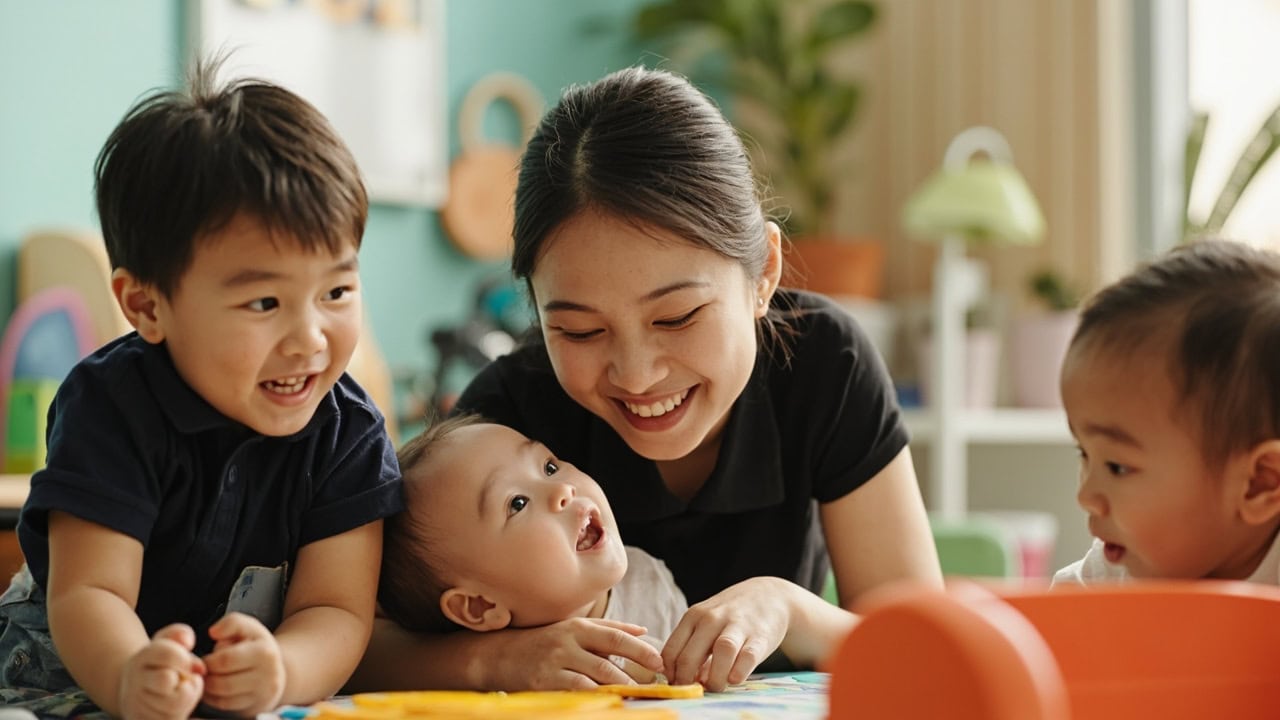
Our home-based pathway offers something rare: care in a setting that feels like a home, with ratios that allow genuine attention. With up to three infants in our care, every cry is heard, every mood is noticed, every child is known.
We offer Monday to Friday care blocks because consistency is not a convenience. It is a developmental need. Children need to return to the same environment, the same rhythms, the same faces, to build the security that makes everything else possible.
Communication as a Cornerstone
We also know that trust is not built on faith alone. That is why communication is integral to our model.
Parents receive regular updates — meaningful information about their child’s day, not just that they ate and slept, but how they were, who they played with, what made them laugh, where they struggled. Where CCTV is deployed, parents have the transparency they need to feel grounded.
These are not administrative features. They are answers to the question you carry every morning: What is happening inside my child when I am not there?
Accessible by Design
For parents navigating the practical realities of Singapore, we have designed our model to be accessible. CDA and Baby Bonus funds can be used within our pilot fee structures, because we believe that quality emotional care should not be a privilege reserved for families with significant means.
This is a commitment, not a concession. Every child deserves a caregiver who notices, who names, who holds, who teaches.
A Place Where Your Child Is Seen
So we come back to the question you carried out of the gate this morning.
What is happening inside your child while you are not there?
Something essential. Something foundational. Something that will shape the person they become more than any flashcard, any app, any academic enrichment class.
Your child is learning to feel. They are learning that feelings have names. They are learning that adults can help. They are learning that frustration does not destroy them, that sharing is hard but possible, that they can be angry and still be loved, that the world is large but not overwhelming, that they can cope.
This is the curriculum that matters most.
At EduNanny, we train our caregivers to notice, to name, to support, to teach. We maintain ratios that make genuine attention possible. We build structures that prioritize consistency and continuity. We communicate with transparency because we know that trust is built in honesty, not in reassurance.
We partner with parents because emotional development is not something that happens in childcare and stops. It is continuous. It is collaborative. It is the most important work we will ever do together.
You brought your child into the world. You are entrusting them to others while you do what you must do. That act of trust is not a failure of parenting. It is an act of faith in your child’s capacity to grow, to adapt, to form new bonds, to learn.
And it is our privilege to receive that trust and to hold it with the care it deserves.
Your child is building something inside themselves that no one will ever fully see. But if the foundation is strong — if the feelings are named, if the stress is managed, if the adults are attuned, if the environment is safe — then what is built will last.
That is what quality childcare gives your child. Not just a place to be while you work. A place to learn the most important lesson of all: that they are seen, that they matter, and that they are capable of navigating this world with a heart that is brave, a mind that is curious, and a spirit that knows how to feel, and how to heal.
That is the work we are honored to do.
If you are looking for childcare in Singapore that takes emotional development as seriously as you do, we invite you to begin a conversation with EduNanny — where every child is known, every feeling is seen, and every parent is a partner.
Learn more about EduNanny’s home-based childminding model or read our story.