
EduNanny by BUTLER Reframing Singapore First Hours with Care, Science, and Heart

EduNanny by BUTLER: Reframing Singapore’s First Hours with Care, Science, and Heart
In a nation measured by skylines and scholarships, EduNanny invites families to measure progress in a more intimate metric: the steadiness of a caregiver’s hand, the security of a sleep space, and the gentle cadence of a voice at eye level. This article delves into how EduNanny translates a bold vision into practical, day-to-day care that supports infants, families, and communities from 7am to 7pm, islandwide. It’s a blueprint for early childhood that blends evidence-based practice with the warmth of human connection, designed for Singapore’s unique social fabric.

The EduNanny Promise: Excellence You Can Touch, Safety You Can See, Development You Can Feel
EduNanny by BUTLER is a centre-based and home-based childminding movement grounded in robust science and guided by compassionate practice. The promise is simple yet profound: high-quality care that is accessible near home, delivered by trained professionals who view caregiving as a dignified profession and a public trust. This section outlines what families can expect and how EduNanny translates promise into practice.
Key commitments that frame every moment
- Evidence-informed practice: care routines and environments designed around the first thousand days, with attention to brain development, attachment, and self-regulation.
- Attunement and transparency: visible caregiver-child interactions, clear handovers, and reliable communication with families.
- Affordability and access: practical fee structures, government-aligned support, and islandwide reach—from heartlands to community hubs.
- Professional care with warmth: a workforce trained to observe, narrate, and respond with sensitivity, ensuring every child feels seen and safe.

How EduNanny Makes Infant Care Great in Singapore
We begin with what the evidence says matters most: the first thousand days. Our design, pedagogy, and routines are crafted to support healthy brain architecture, secure attachment, and resilient self-regulation.
1) Pedagogy: the Attunement Engine
- Notice, Name, Nurture: caregivers observe cues (lip quiver, gaze shifts), name the feelings (curiosity, surprise), and nurture an appropriate response (pause, gentle redirection). This translates Bowlby’s attachment theory into daily, practical moments.
- Movement as learning: inspired by Pikler and Montessori, floor-level environments invite infants to explore at their own pace. Free movement builds strength, coordination, and confidence.
- Zone of proximal development in action: caregivers meet children just beyond what they can do alone, offering scaffolds that encourage the next step—whether reaching for a toy or stringing two sounds into a word.
2) Safety: architecture you can count on
- Five Rings of Safety by design:
- Space: low furniture, rounded edges, anchored shelving, hazard-mapped zones.
- Sleep: firm surfaces, supine positioning, clearly labeled cots, vigilant checks.
- Sanitation: rigorous hand hygiene rituals, rotating toys and surfaces, diapering with clean/soiled flows.
- Supervision: 1:3 ratios, eyes-on and within reach, CCTV access for parents where appropriate and consented.
- Systems: daily safety checklists, incident drills, and open lines of communication with families.
- Environments designed to regulate: modern layouts and calm palettes support emotional regulation and reduce overstimulation, whether care happens in a centre or at home.
3) Development: the first thousand dialogues
- Language-rich routines: narrating diaper changes, feeds, and tummy time to weave words, gestures, and meaning into daily activity.
- Hands-on exploration: fine-motor provocations such as cloth peekaboo, treasure baskets, and open-ended objects stimulate cognition and curiosity.
- Regulation as curriculum: predictable transitions, gentle pace, and caregiver co-regulation scaffold a child’s “inner thermostat” for stress and recovery—foundational for later executive function.
4) Happiness: the quiet metric
- The Joy Protocol: predictable routines, familiar faces, soft lighting, and nature-infused experiences when possible to support wellbeing and curiosity.
- Three core signals: bright eyes (engagement), relaxed shoulders (safety), rhythmic breath (regulation). When these align, learning deepens with less fatigue or distress.
5) Purpose: why childminding matters
- The five roles of the childminder:
- Attachment Gardener: cultivating trust that nurtures independence.
- Safety Sentinel: anticipating hazards and calmly managing the unexpected.
- Development Guide: turning moments into milestones.
- Culture Bearer: singing local songs, speaking shared languages, modelling respectful manners.
- Family Ally: extending care into the home with practical, non-judgmental partnership.
- National implications: quality care supports parental participation in work, reduces future social costs, and strengthens neighbourhood resilience.

What Families Can Expect, Every Day
EduNanny prioritizes presence and relationship. A child is more than a schedule; they are a person in a network of trust. This section outlines daily realities and practical tips for families and caregivers alike.
- Presence, not just presence: with a 1:3 ratio, your infant is in a relational, not anonymous, setting.
- Rituals that regulate: predictable handovers, resets after naps, and slow transitions home to support nervous system calm.
- Sixty-Second Sparks: micro-activities that fit inside ordinary care—finger plays, cause-and-effect play during tidying, soft mirror games before naps.
- Transparent partnership: secure CCTV access (where provided), daily notes on feeding, sleep, mood, and play, plus open channels for questions and guidance.
- Sample daily rhythm (illustrative guide): a morning greeting at eye level, followed by a short sensory activity, labeled diaper changes with narration, a range of fine-motor play, a calm group song, nap, and gentle transitions to caregiver-led exploration.

EduNanny Services: Centre-Based, Home-Based, and Distance Support
EduNanny is designed to meet families where they are—near home, near community spaces, and through remote guidance when required. Here’s how the service lines translate into practical choices for families.
Centre-Based Childminding
- Calm, modern layouts with clear sightlines and floor-level vistas to preserve regulation and safety.
- Proximity to communities and schools to minimize commute times and maximize family time.
- Structured routines that align with the first thousand days of development and local cultural expectations.
Home-Based Childminding
- Near-home pods offering the same safety standards, hazard-mapped rooms, and consistent supervision ratios as centres.
- Care that travels with families into the heart of neighbourhoods, providing familiar, local support for busy households.
Distance Support
- Virtual check-ins and coaching for parents who need guidance between in-person visits.
- Developmental guidance and observation-based feedback delivered remotely to sustain progress at home.
Practical for Families: Access and Affordability
- Weekdays: Monday–Friday, 7am–7pm, islandwide access to fit typical work schedules.
- Financial models: fees payable through CDA/Baby Bonus schemes; affordability starts from as low as $33/day.
- National alignment: part of the ECDA Childminding Pilot and a national effort to dignify caregiving as a profession.
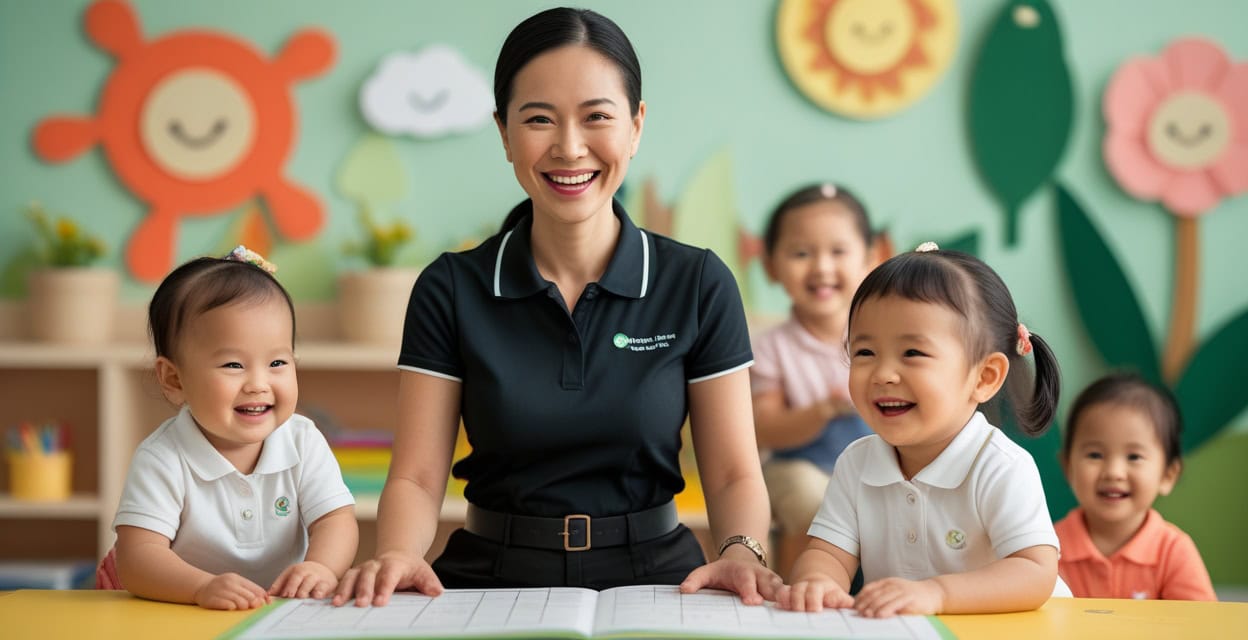
A Brief Field Guide for Our Shared Craft
- Anchor to eye level: kneel, greet, and narrate what’s happening to invite trust and reduce separation distress.
- Read the room: adjust volume, lighting, and space to invite movement or calm as needed.
- Protect sleep: prioritize consistent nap routines, safe sleep practices, and quiet transitions that help children return home rested.
- Celebrate the small: recognize pincer grasps, first words, and purposeful smiles as milestones worthy of praise and documentation.
- Close the loop with parents: co-author the child’s story by sharing observations, questions, and next steps in a collaborative way.

Benefits at a Glance
- Excellence and quality across centre-based and home-based options
- Near-home convenience with islandwide access; Monday–Friday, 7am–7pm
- Affordability from $33/day; fees supported by CDA/Baby Bonus
- 1:3 infant ratio; safety-by-design environments; secure CCTV innovations
- Transparent daily communication and distance guidance for at-home support
- Alignment with ECDA Childminding Pilot and a national mandate for dignified care jobs

A Wind-Back to Everyday Practice: Real-World Routines and Guidance
To translate theory into everyday efficacy, EduNanny provides concrete tools for parents and caregivers. Below are practical examples, checklists, and tips designed to support early development at home and in care settings.
Morning Drop-Off: A Model of Connection
- 7:02am greeting ritual: caregiver kneels to eye level, narrates the handover, and reinforces the child’s sense of safety.
- Handover narrative: “Mummy is going to work; I will keep you safe; we will play; she will be back.”
- Parent cue sheet: share any changes from home routine, dietary notes, or sleep preferences to maintain consistency.
Daily Schedules: Balancing Sleep, Movement, and Talk
- Flexible rhythm: long periods of calm exploration interspersed with brief, purposeful transitions that support self-regulation.
- Language-rich moments: narration during every routine, bilingual opportunities, and responsive listening to long-form babble or single-word expressions.
- Movement opportunities: a safe space for rolling, creeping, crawling, and early standing with spotters and adaptive props.
Home Guidance: Distance Support that Works
- Weekly virtual coaching: developmental milestones, tips for sleep routines, and strategies for soothing.
- Observation-based feedback: caregivers share short videos or notes highlighting cues, engagement, and regulation strategies.
- Parent empowerment: simple activities to extend learning at home—language games, rhythm and music, and sensory play that matches the child’s thresholds.

For Parents: Early Care Deep Dive and Practical Insights
Welcome to a deeper exploration of how early care can support your child’s growth and your family’s wellbeing. The EduNanny approach emphasizes parental partnerships, transparent practices, and routines that reinforce secure attachment and joyful learning.
Choosing Care: Questions to Ask Your Care Team
- What is the caregiver-to-child ratio, and how is supervision maintained across different spaces (centre vs home-based)?
- How are routines structured to support sleep, feeding, and development?
- What safety measures are in place (sleep safety, sanitation, risk assessment) and how can I access CCTV or daily notes?
- How is language development supported, including bilingual opportunities and responsive talk?
- How are concerns communicated, and what is the process for addressing milestones or delays?
Home-Ready Practices: Simple Steps for Everyday Learning
- Attunement at mealtimes: narrate textures, tastes, and reactions to foods; label emotions observed during feeding to support language growth and self-regulation.
- Safe sleep routines: maintain firm sleep surfaces, proper positioning, and a consistent nap schedule; mirror these routines at home to help regulate the child’s nervous system.
- Play with purpose: choose open-ended objects, encourage stacking and releasing to build hand-eye coordination and problem-solving.
- Two-way communication: maintain a shared log or app note about mood, energy, and sleep; use this to tailor daily routines for consistency across caregivers.

Conclusion: A Shared Beginning, A National Promise
Getting the first minutes right is not merely about care; it is about civic virtue. EduNanny offers a scalable model that respects local culture and language, supports families with practical, affordable access, and builds a professional cadre of caregivers whose work shapes tomorrow’s citizens. By centering attachment, safety, language, and routine, EduNanny turns ordinary mornings into foundations for lifelong learning, belonging, and civic contribution.
As families explore EduNanny options—whether in a centre, at home, or through distance guidance—they participate in a national initiative that dignifies caregiving and fosters resilient communities. If you are a parent, caregiver, or policymaker, consider how the first minutes of the day can become a shared act of nation-building: where science informs practice, and care becomes a public trust.
Visit EduNanny.com or Childminding.EduNanny.com to begin your journey toward an excellent beginning for your infant and for Singapore.
Your infant’s best days—and Singapore’s—start here.

SEO Keywords
[#keyword1, #keyword2, #keyword3, #keyword4, #keyword5]Ready to Experience Excellence?
Transform Your Family’s Journey
Discover Singapore’s leading infant care and childminding services. Expert guidance for your little one’s first thousand days.