What Singapore Children Are Really Doing in Childcare
What Your Child Is Actually Doing While You’re Apart
For most parents in Singapore, the search for childcare begins with an act of imagination. You picture your child in the care of someone else and try to see past the blur of your own anxiety to something clear and true. You read reviews. You visit centres. You ask friends, colleagues, your own mother. Somewhere in that process, you are doing something noble and difficult: you are trusting someone else with the most important person in your life.
But even as you make this decision, the conversation around you tends to orbit one place: your peace of mind. Will your child be safe? Will they be loved? Will they be okay until you come back?
These are fair questions. Essential questions. But they are also, in a way, the wrong questions to sit with for too long. Because they keep the story anchored to you, the parent. They keep the narrative about your reassurance rather than your child’s experience.
What if we turned it around? What if we asked not whether your child is surviving the hours apart from you, but what they are actually doing during those hours? Who they are becoming?
The Scene You Rarely Get to Witness
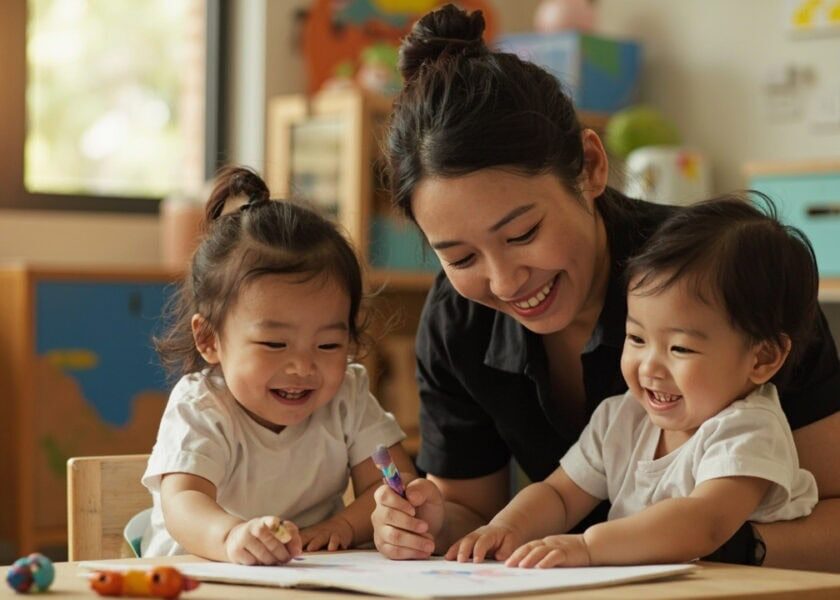
Let me paint something for you. It is a Tuesday morning, and a child who has been in care for three months is sitting on a small rug with two other children. They are building something with soft blocks. One child knocks down what another has built. There is a moment of stillness. Then, something remarkable: the child who built it reaches out, touches the other child’s hand, and begins rebuilding. Together.
No adult has intervened. No one has told them to share or to be kind. But something has happened in this moment that took months to become possible. A social skill has been practiced. An emotional capacity has been exercised. Your child has just learned something about relationships that cannot be taught in a lecture or a book. It can only be lived.
Quality childcare gives your child not just supervision, not just safety, but a curriculum of human connection.
Why Singapore Children Especially Need This
Think, for a moment, about what most Singapore children experience at home. They are loved fiercely. They are held, kissed, sung to, played with. But they are often, by necessity and design, the centre of a family universe. They have adults who anticipate their needs. They have siblings, if there are siblings, but in Singapore, where many families choose to have one child, they may have none.
They live in apartments, in condominiums, in houses where playmates are arranged rather than stumbled upon. They are surrounded by love, but their social world can be narrower than history ever intended a child’s world to be.
Now place that same child in a quality childcare environment, with a ratio of one caregiver to three infants, where every interaction is intentional, where the relational world is as carefully considered as the physical space. Watch what happens.
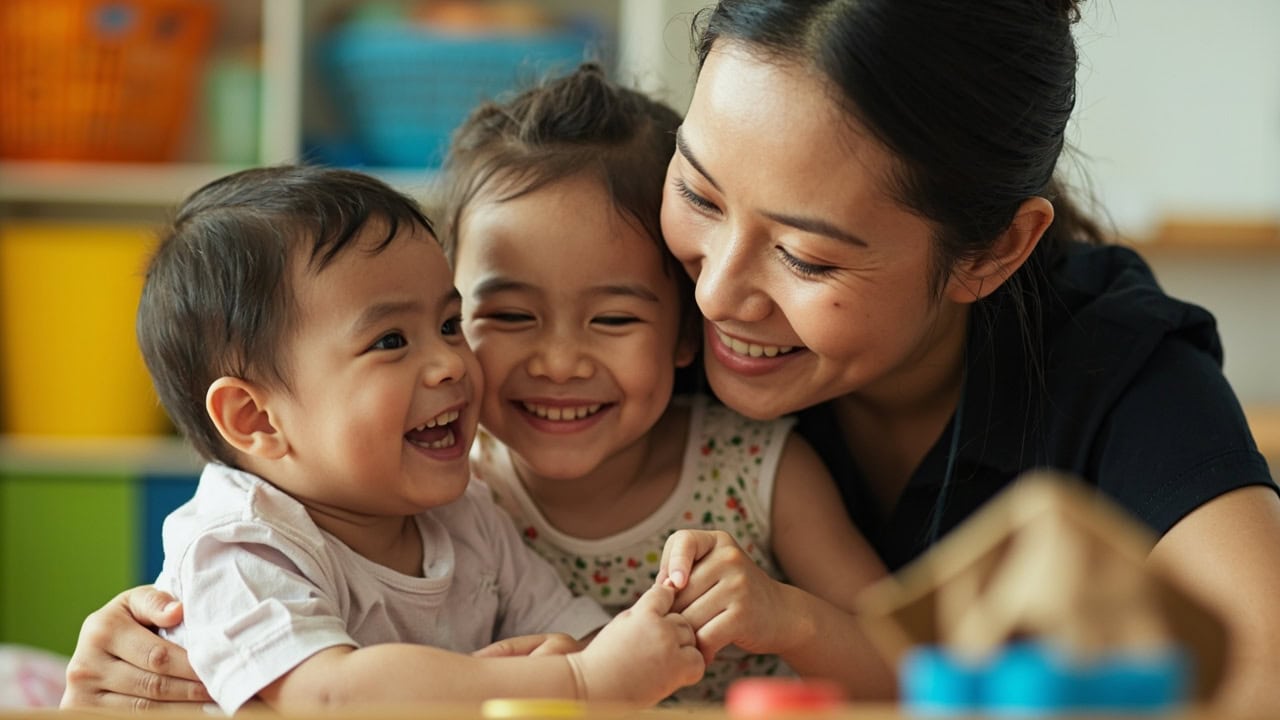
They learn to wait. They learn that another child wanted the same toy and that there is a way to navigate that wanting without breaking. They learn that a caregiver is a person who can be trusted not just for food and comfort, but for consistency, for warmth, for the kind of attention that says: you matter, you are seen, you are safe here.
They learn, in small and enormous ways, what it means to be part of something larger than themselves.
The Secure Base: Why Caregiver Quality Shapes Everything
There is a concept in early childhood psychology called the secure base. It comes from the work of John Bowlby and Mary Ainsworth, researchers who understood something profound: children do not simply need to be loved, they need to feel that the world is a trustworthy place where they can explore and return.
In quality childcare, the caregiver becomes a secure base for your child. Not replacing you, but extending the principle. When your child knows, deeply knows, that there is a warm and consistent adult who will be there, they can afford to look away from that adult. They can afford to engage with other children. They can afford to learn.
This is why caregiver training matters so much. A caregiver who is overwhelmed, juggling too many children, who does not have the emotional bandwidth to attune to each child in her care, cannot provide this secure base. But a caregiver who is supported, who has the time and the tools, who understands that her most important work is relational rather than custodial, becomes something invaluable.
She becomes the person your child will remember. A person who helped shape how your child sees the world.
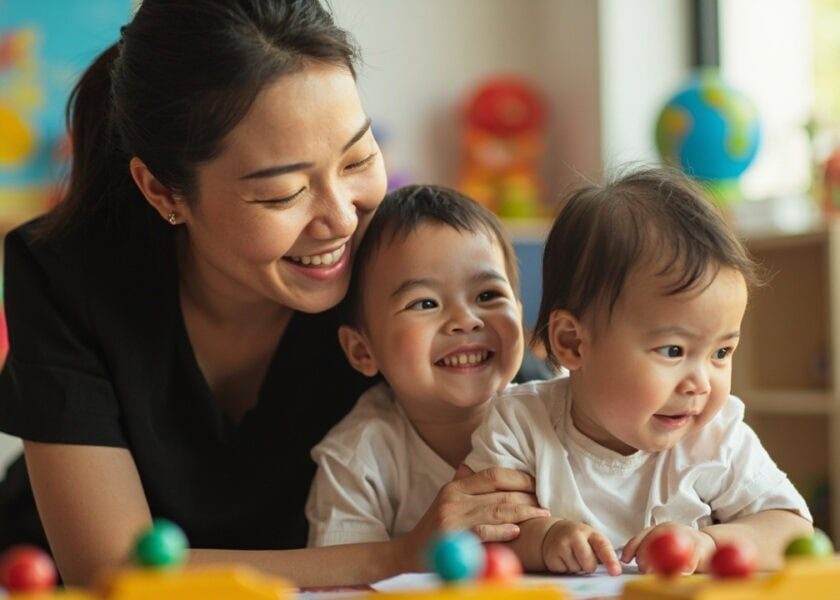
Alongside this secure base, your child is also building something equally important: the capacity to be in relationship with peers. Consider what a child learns in the simple act of parallel play. Two children sitting side by side, each doing their own thing, but aware of each other. Then, gradually, something shifts. They begin to interact. To offer. To take. To negotiate. To feel the sting of disappointment and the joy of shared laughter.
These are not small things. These are the first drafts of empathy. The first experiments in being human with other humans.
The Emotional Skills That Change Everything
There is another dimension to this that we rarely discuss: emotional regulation. The ability to manage one’s feelings, to tolerate frustration, to recover from disappointment, to self-soothe. These are not innate capacities. They are learned. And they are learned, most powerfully, in relationship with others.
Watch a toddler in quality care who has just been told no. Watch them feel the surge of anger, the injustice of it, the full-body frustration that is entirely appropriate to their age and entirely overwhelming to watch. Now watch what happens next.
The caregiver does not dismiss the feeling. She does not mock it or ignore it. She names it. She says: I see that you are angry. It is okay to be angry. But we do not hit. We do not break things. We breathe.
And then she waits. She stays. She is the anchor while the child rides out the storm.
Again and again, across months and years, this happens. The child learns: my feelings are not too big. I can survive them. Someone will stay with me while I feel them.
This is emotional regulation. This is resilience. This is what we all want for our children, and this is what quality childcare can give.
Questions Every Parent Should Ask
Understanding the philosophy is one thing. Seeing what it looks like in practice is another. Before you make your decision, here are the questions that matter most: not about safety records or meal plans, but about the relational environment your child will actually inhabit.
- How many children are in each caregiver’s care? Ratios matter enormously for quality of attention.
- Who are the caregivers, and how long do they stay? Consistency shapes trust.
- How do caregivers respond when a child is upset? This is where emotional development actually happens.
- What does a typical day look like in terms of peer interaction? Are children given time and space to be together?
- How will I know what my child is experiencing? Communication is not optional.
- What training do caregivers receive? Skilled attunement is not accidental.
What you should also expect from a quality environment: warm, consistent relationships where caregivers become familiar faces and predictable sources of comfort; intentional peer interaction that allows children to practice sharing and navigating conflict with support nearby; responsive caregiving where adults name emotions aloud and stay present through difficult moments; safe exploration where children can test boundaries and discover what they are capable of; and transparent communication through regular updates, photographs, and notes.
Where Philosophy Meets Practice
At EduNanny, this understanding shapes everything we do. We know that parents in Singapore face real pressures: dual-income households, the demands of work, the cost of living, the distance from extended family that many families navigate. We know that finding childcare is not a simple task. It is an act of faith.
That is why we built what we built. Our approach reflects a belief that childcare is not a stopgap but a foundation. Our home-based pathway offers families a warm and familiar environment where children can grow in relationship with a caregiver who becomes part of the family’s trusted circle. Our centre-based options extend this same philosophy into community spaces designed with intention.
We keep ratios small so that each child receives the attention and attunement their development requires. We communicate with parents because trust requires transparency. And we believe that quality care should not be a privilege reserved for those who can afford premium pricing.
Because every child deserves a secure base. Because every family deserves to feel confident in the care their child receives.
The Truth Behind the Door
Let me close by returning to where I began. There is a moment when you leave your child. You imagine what they are feeling. You stand outside the door and you wonder.
But here is what I want you to know, what I want you to carry with you as you make this choice, what I want you to trust:
Your child is not simply waiting for you to return. Your child is living. They are forming bonds with caregivers who cherish them. They are playing alongside peers who are becoming their first friends. They are learning to manage their emotions, to navigate disappointment, to celebrate joy, to share, to wait, to try again. They are building the social architecture that will support everything they become.
This is not a consolation. This is the truth.
And when you understand this truth, something shifts. The guilt softens. The worry transforms into something closer to wonder. You begin to see that the hours apart are not hours lost, but hours gained. Hours in which your child is becoming who they are.
You chose this. Not because you had to, but because you wanted the best for them. And the best is not a life lived in isolation, sheltered from all others. The best is a life lived in connection, with skilled and loving hands guiding the way.
EduNanny Singapore is here because we believe in this. We believe in the importance of what happens behind the door. We believe in your child. We believe in you.
And we would be honoured to walk this journey alongside you.
Ready to learn more about what thoughtful, development-oriented childcare looks like? Explore EduNanny’s approach to childminding in Singapore, or get in touch to begin a conversation about your family’s needs.