Why Your Child’s Temperament Deserves More Than Standard Childcare
Understanding Your Child’s Temperament
There is a moment, and you may know it, when you watch your child in a playground or at a gathering and you realize, quietly, that they are experiencing the world differently than you expected.
Perhaps it is the toddler who stands at the edge of the sandbox for twenty minutes, watching, before stepping in. Perhaps it is the infant who startles at sounds you barely notice. Perhaps it is the little one whose body seems to contain a kind of energy that even adults struggle to match.
You love them completely. You also wonder whether anyone else sees what you see. Whether anyone else understands what they need.
If you have felt that wondering, I want you to know: you are not imagining it. Your child is not difficult. Your child is not behind. Your child is not too much. Your child is a person with a particular temperament, a particular way of being in the world, and that way of being is real, it matters, and it deserves to be understood.
For decades, researchers in child development have studied what they call temperament—the inborn patterns of behavior and emotional response that each child brings into the world. Understanding temperament does not reduce your child to a category. It helps you see them more clearly, and it helps you find care that meets them where they are.
Some children are quick to warm to new experiences, easily comforted by change, adaptable to new faces and new places. Others take longer. They watch. They assess. They need to feel the texture of a new environment before they can relax into it, and if they are rushed, they shut down rather than open up.
Some children are highly sensitive, processing sensory information more deeply, noticing subtleties in tone, in light, in the energy of a room, and carrying the weight of that sensitivity through their whole day.
Some children move constantly, their bodies seeming to require a kind of motion that looks like restlessness to outside observers but is simply how they experience being alive.
And some children are driven by a relentless curiosity, a need to understand how things work, to test boundaries, to ask why until the question becomes a kind of play in itself.
None of these temperaments is wrong. None of them is a problem to be solved. But when you bring your child to childcare, you may quickly discover that the system does not always agree.
When Standard Care Does Not Fit Your Child
Most childcare settings are designed around a kind of average child. A schedule that works for most. A response style that assumes most children will adapt within a reasonable timeframe. A group dynamic that privileges certain temperaments—the quick-warmers, the easy-settlers, the children who fit the rhythm of the room without resistance.
And if your child does not fit that rhythm, the experience can be jarring for everyone.
The slow-to-warm child who is labeled shy. The highly sensitive child who is told to toughen up. The active child who is constantly being told to sit still. The curious child whose questions are met with impatience rather than engagement.
Here is what typically occurs in a standard group setting: a caregiver, however warm and well-intentioned, is responsible for multiple children. She has a schedule to maintain, activities to lead, a room full of needs to manage.
When a new child arrives, she follows the onboarding protocol. She is patient for a while. But she cannot watch one child for the full twenty minutes they need to feel safe before they can play. She cannot dim the lights in the afternoon because one child is overstimulated by the fluorescent glare. She cannot spend an extra week on the transition because a slow-to-warm toddler is just starting to settle in.
She is doing her best within a system that does not give her the space to be flexible. And so the child who needed a different kind of care often ends up adapting anyway—not because they have found a fit, but because there was no other option.
You know your child. You know that what looks like difficulty on the surface is often just a different kind of readiness. You know that your child can learn, can grow, can thrive—but that they need to be met where they are.
Will anyone see my child? Really see them? Will someone take the time to understand their particular way of being in the world before deciding how to care for them?
This is not an unreasonable question. It is, in fact, the right question. And it is the question that most childcare systems are not designed to answer.
What Differentiated Care Actually Looks Like
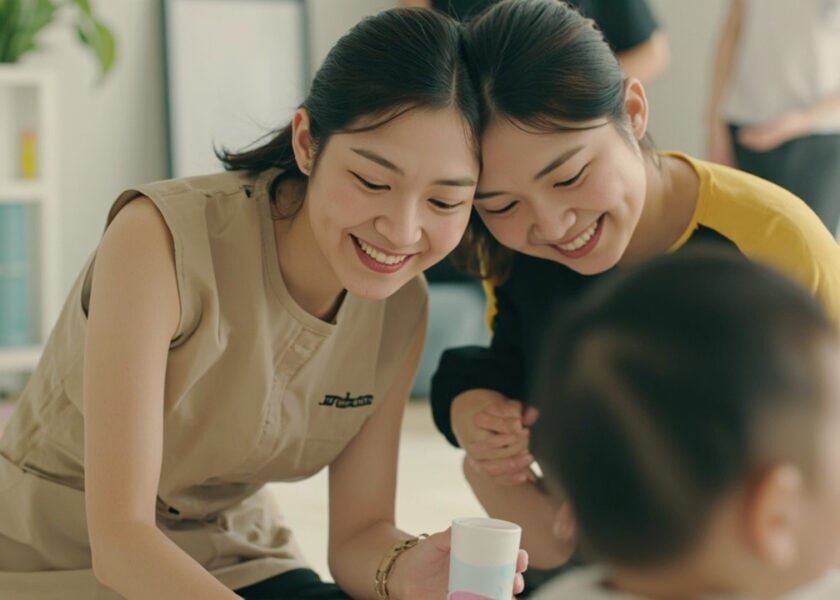
Now imagine something different. Imagine a caregiver who has been trained to observe before she responds. Who watches your child in those first mornings, not to assess whether they are adjusting fast enough, but to understand their particular rhythms.
How long does it take for them to engage with a new toy? What happens to their body when there is too much noise? Where do they go when they need quiet? Do they approach other children directly, or do they wait until the play has been going on for a while, and then enter from the edge?
This is not guesswork. This is the kind of attention that comes from knowing that every child arrives with a temperament, and that understanding that temperament is the foundation of responsive care.
Differentiated care does not mean permissiveness. It does not mean abandoning structure. It does not mean that every child gets whatever they want whenever they want it. It means that the structure itself is built around the child, that the caregiver uses her understanding of your child’s particular needs to shape the environment, the pace, and the expectations.
How Care Adapts to Different Temperaments
| Temperament | What They Need | What Differentiated Care Looks Like |
|---|---|---|
| Slow-to-Warm | Predictability, time to observe, consistent faces | Longer transition times, familiar arrival routines, freedom to observe before participating |
| Highly Sensitive | Calm environments, awareness of sensory triggers | Quiet spaces, early intervention when overwhelm approaches, calm rather than correction |
| Active/High Energy | Space to move, physical engagement | Movement built into the day, energy redirected rather than suppressed |
| Highly Curious | Exploration, genuine engagement with questions | Questions treated as invitations to learn, environments that reward investigation |
Any parent who knows their child is already doing most of this intuitively. What is different is the expectation that a caregiver can do it too. That a childcare relationship can be built around your child’s nature rather than around a generic standard. That individualized attention is not a luxury for the few, but a legitimate approach to quality care.
Why Small Ratios and Home Settings Matter
When you reduce the number of children a caregiver is responsible for, you do not just improve supervision. You create the conditions for genuine understanding.
In a home-based setting, care is inherently more flexible than a centre environment. There are no large groups to manage, no institutional schedules to maintain at all costs. The caregiver can adapt the day to the child.
She can take the walk that helps an active child regulate. She can create the calm environment that helps a sensitive child settle. She can follow the curious child’s lead into an exploration of how water flows, or how leaves feel, or why the neighbor’s cat walks the way it does.
The home is not just a location. It is a context that naturally supports the kind of individualized attention that children with distinct temperaments need.
The EduNanny Approach
EduNanny by BUTLER has built its model around the recognition that children are not interchangeable, that care must be responsive to the individual, and that small ratios make responsiveness possible.
As part of the ECDA Childminding Pilot, EduNanny operates with up to three infants in a caregiver’s care at any time. This is not accidental. It is deliberate design. With fewer children to manage, there is space to observe, to adapt, to notice. There is space to slow down when a child needs slowness, to provide the consistent presence that helps a slow-to-warm child feel secure, to notice when a sensitive child is approaching their limit and gently intervene before a meltdown occurs.
The home-based pathway through EduNanny deepens this further. The caregiver can adapt the day to the child in ways that large-group settings make difficult. She can take the walk that helps an active child regulate. She can create the calm environment that helps a sensitive child settle. She can follow the curious child’s lead into genuine exploration.
Trust and Transparency
EduNanny understands that trust requires transparency. When you invite a caregiver into your home, or send your child to a caregiver’s home, you want to know what is happening during the day.
Where relevant, CCTV measures are deployed so you can see for yourself. Regular communication is built into the model, not as an add-on but as a practice. You should know what your child ate, how they slept, what made them laugh, what challenged them. This is not information that parents should have to fight for. It should be part of the basic expectation of quality care.
Practical Support for Singapore Families
For parents in Singapore, there are practical dimensions to consider. The ECDA Childminding Pilot offers structures designed to make quality care accessible. Monday to Friday care blocks provide the consistency that children with certain temperaments particularly benefit from—the predictability that helps them feel secure.
Payments through CDA and Baby Bonus ease the financial reality that every family faces. And across Singapore, whether you are in Ang Mo Kio or Bishan, Clementi or Jurong, this model is available to families who want something different from the standard childcare experience.
Because the team at EduNanny knows that parents have questions at all hours, Thomas—the AI chatbot—offers support along the way. Whether you are wondering about a developmental milestone, navigating a tricky phase at home, or simply need a quick answer about your child’s care plan, Thomas is there. Not to replace the human relationship, but to support it, to make sure that the information and guidance you need is always within reach.
What Changes When Care Finally Fits
Parents notice the difference, once they find this kind of care. Once their child is finally in an environment that understood their temperament rather than fighting against it.
They notice that their child starts to look forward to the caregiver’s arrival instead of dreading it. They notice that the morning goodbye, which used to be a daily struggle, becomes easier—because the child has learned that the caregiver understands what they need, and they trust that the day will be okay.
They notice that their child sleeps better, eats better, plays more freely, because the environment is not depleting them with constant mismatch.
They notice their child becoming more themselves, not less. More curious. More confident. More secure.
Because when your care fits your child’s nature, the child does not have to spend all their energy surviving. They can finally spend it on growing.
Questions to Ask When Choosing Infant Care
If you are currently researching infant care or childminding for your child, here are some questions worth asking:
- How many children is each caregiver responsible for? Smaller ratios enable genuine observation and adaptation.
- What does the transition process look like? A slow, supported transition matters more for some temperaments than others.
- How does the caregiver observe and respond to individual needs? Look for answers that reflect genuine attention to your child’s specific temperament.
- What does communication look like day-to-day? You should feel informed, not anxious.
- Can the environment adapt to sensory needs, movement needs, and social preferences? Structure should flex to your child, not the other way around.
- How does the setting support children who need time to warm up? Paced, predictable transitions make a real difference.
Ask these questions not to find the perfect answer, but to understand how a caregiver thinks about your child. The quality of the answer will tell you whether your child is likely to be seen.
Your Child Deserves to Be Met Where They Are
Here is what EduNanny is built to do: not to provide a generic service to generic children, but to understand each family, each child, each temperament, and to build the care around that understanding.
To take the question that has been quietly haunting you—the question about whether anyone will truly see your child—and to answer it with something concrete. With trained caregivers who observe before they respond. With ratios that allow for attention. With home-based settings that flex to the child. With transparency that builds trust. With a model that was designed, from the beginning, around the recognition that every child deserves to be met where they are.
If you have been wondering whether your child is too sensitive, too slow, too active, too curious for the right care to exist, I want you to know: the right care does exist. It was built with your child in mind.
And it is ready for you to find it.
EduNanny by BUTLER is part of the ECDA Childminding Pilot, offering home-based infant care with small ratios, trained caregivers, and a model designed around your child’s individual temperament. Connect with the EduNanny team to explore how individualized care can make a difference for your family.
#ChildTemperament #DifferentiatedCare #InfantCareSingapore #HomeBasedChildcare #ChildmindingSG