The Questions Behind Singapore’s Childcare Decision
The Question Behind the Question
The question is never really about childcare. The question is about who your child will be when you are not in the room. The question is about whether you can trust someone else to notice what you notice, to respond the way you would respond, to love your child with the same quality of attention you try to bring every single day.
The question is about whether you are enough, and whether anyone else can be enough when you cannot be there.
I want to be honest with you about something. The existing conversation around childcare in Singapore is rich with emotion and light on framework. We talk about attachment theory until it becomes background noise. We talk about guilt until parents feel they are failing before they have even begun. We talk about quality signs until the lists become overwhelming, and parents freeze rather than choose.
What we do not talk about enough is the actual decision-making process itself—the comparison that parents need to make not between brands but between fundamental approaches to raising their children in those first crucial years.
So let us have that conversation. Not to tell you what to choose, but to give you the framework you deserve when the choosing becomes yours.
The Three Paths Singapore Parents Navigate
If you are pressed for time, here is the essential framework at a glance:
- Grandparent care offers biological continuity and deep family investment, but requires generational alignment on values and practices.
- Centre-based childcare provides structured environments with trained teachers and regulatory oversight, with peer interaction benefits balanced against higher illness exposure.
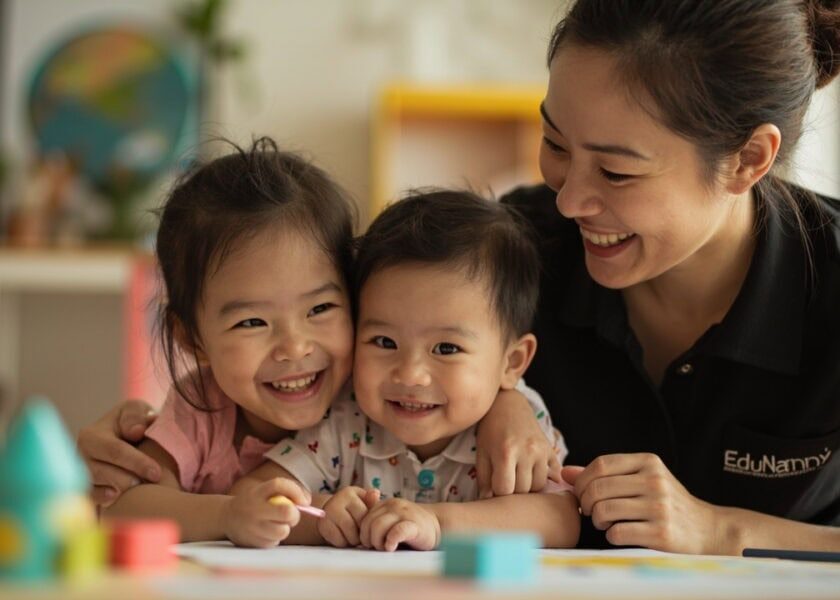
- Near-home care (home-based models like EduNanny) offers individualized attention with professional standards, ideal for families seeking warmth without institutionalization.
The right choice depends on your family’s specific circumstances, not universal principles. What matters most across every path is the quality of attunement, consistency, communication, and developmental responsiveness your child receives.
Grandparent Care, Centre-Based, and Near-Home: An Honest Comparison
Grandparent Care: When Family Becomes Caregiver
Consider the first path that most Singapore families navigate: grandparent care. It is woven into our cultural fabric so deeply that questioning it can feel like questioning the family itself.
When grandparents offer to care for a grandchild, they offer something irreplaceable: biological continuity, lifelong investment, a love that has already survived decades. Research consistently shows that secure attachments can form with multiple caregivers, and grandparents are uniquely positioned to provide that security.
But we must be honest about what this path requires:
- Generational alignment on feeding philosophies, sleep training, screen time, and the balance between protection and independence
- Physical capacity and energy that changes as grandparents age
- Navigation of territory where parental authority and grandparent wisdom intersect
Many Singapore families navigate this beautifully, with grace and communication and deep respect on all sides. Many others discover, perhaps too late, that love alone does not resolve these tensions.
The question for this path is not whether grandparents love your child. The question is whether the conditions are there for your child to thrive in their care, and whether the emotional labor of maintaining that arrangement falls on your shoulders or is shared.
Centre-Based Childcare: Structure and Its Trade-offs
The second path is centre-based childcare—a structured environment with trained teachers, curriculum frameworks, and regulatory oversight.
The advantages are real and documented. Children in quality centre-based settings benefit from peer interaction, exposure to routine, and teachers with professional development in early childhood education. ECDA-regulated centres provide certain baseline standards, and many Singapore centres exceed those standards with genuine dedication to early development.
But we must be equally honest here:
- Individual attention is necessarily distributed in average centre ratios, meaning less personalized responsiveness
- Higher exposure to illness during early immune development—a trade-off some families experience more acutely than others
- The transition can be genuinely difficult for both parent and child, and research on long-term effects is more nuanced than any marketing claim suggests
The question for this path is not whether centres are good or bad. The question is which centre, with which specific teachers, with which specific culture, and whether the transition process receives the attention it deserves.
Near-Home Care: The Third Path
Then there is the third path—the one that does not fit neatly into either category, and which deserves more serious consideration than it often receives.
Near-home care, sometimes called home-based or community-based models, attempts to capture the warmth and individualized attention of home care while incorporating professional standards and developmental intentionality.
Here is what I have observed about families who ultimately choose this path. They tend to share certain characteristics:
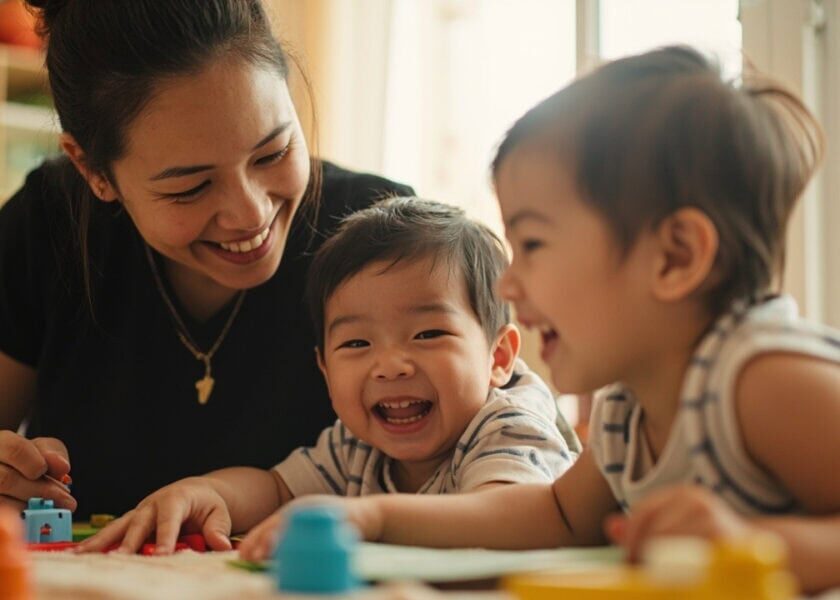
- They value the intimacy of home-based care, the idea that their child is not one of fifteen in a room but one of perhaps three at most.
- They want consistency—a caregiver who knows their child’s rhythms, fears, emerging words, and personality quirks, someone who notices the small things.
- They want professionalism without institutionalization, someone trained and supported by a system who brings warmth rather than protocol.
- They want transparency, the ability to know what is happening during the day, to communicate easily, to feel that the distance between home and care is bridged by trust.
These are not unreasonable desires. In fact, they describe what most parents want regardless of which path they choose. What differs is the likelihood of achieving them.
What Quality Care Actually Looks Like
I want to be clear about something. This is not an article about why one path is correct and others are wrong. I have seen children thrive in all three settings. I have seen children struggle in all three settings.
What matters, across every path, are certain non-negotiable principles that research and experience have taught us are the real predictors of developmental outcomes. Not the setting itself, but what happens within it.
1. Attunement
This word has become somewhat overused, but the concept remains essential. Attunement is the caregiver’s ability to notice what the child is feeling, to respond appropriately, and to communicate back to the child that they have been seen and understood.
A child who feels understood develops differently than a child who feels dismissed, even in the most beautiful physical environment.
Attunement is not about continuous eye contact or constant verbal engagement. It is about quality of responsiveness—about the moments that matter most, those moments of distress and discovery and need, being met with appropriate care.
When evaluating any childcare arrangement, ask not about the toys or the curriculum or the facilities. Ask about what happens when a child is upset. Ask how the caregiver responds to distress, because that is where attunement lives or dies.
2. Consistency
Young children build their sense of security through predictable patterns. They need to know what happens next, who will be there, what the rhythms of their day look like.
This does not mean rigid schedules or lack of flexibility. It means that the people and environments around them remain stable enough to be internalized as safe. When children experience frequent caregiver changes, disrupted routines, or unpredictable environments, the stress response system develops differently than when they feel anchored by consistency.
When evaluating childcare options, ask about turnover rates, how transitions are managed, and how much of the day follows predictable patterns.
3. Communication
Parents need to know what is happening with their child during the hours they are apart. Not every minute, not surveillance, but a genuine flow of information that closes the distance and builds trust.
This is where modern tools can serve a genuine purpose. Communication apps, regular updates, photographs that capture moments, notes about feeding and sleeping and the small discoveries of the day.
When parents feel informed, they are calmer. When caregivers feel trusted, they communicate more openly. This positive cycle benefits everyone—most of all the child who senses security in both directions.
4. Developmental Responsiveness
The question is not simply whether a child is safe and comfortable, but whether the environment is actively supporting their growth—not through worksheets or formal instruction, but through appropriate play, language-rich interactions, motor development opportunities, and social experiences that match where the child is and gently stretch them toward where they are going.
This is not about academic acceleration. It is about the thousand small experiences that accumulate into development: a caregiver who narrates what a baby is reaching for, who gets down on the floor during tummy time, who introduces new vocabulary during feeding, who notices when a toddler is ready to climb to the next level of physical challenge.
This kind of responsiveness requires training, awareness, and the time that comes from lower ratios.
Ratios, Expectations, and the Burden Singapore Parents Carry
I mention ratios deliberately, because this is where the differences between paths become concrete. The ECDA Childminding Pilot, under which EduNanny operates, maintains ratios of up to one to three infants in home-based settings.
Let me be precise about what this means: it does not mean that larger ratios are automatically harmful. It means that lower ratios make certain things possible that are more difficult at scale. A caregiver with three infants can notice more, respond more quickly, individualize more effectively, and build deeper knowledge of each child’s patterns and needs. Whether this matters more or less than the peer interaction of a centre setting depends entirely on your child and your priorities.
There is something else worth naming here. Singapore parents often carry a burden that is rarely acknowledged directly: the burden of expectation from extended family, from cultural norms, from the invisible committee of relatives and friends who have opinions about how children should be raised.
- Grandparent care is often assumed, not chosen. When parents choose otherwise, they must defend a decision that should require no defense.
- When parents choose centre-based care, they must navigate concerns about institutional environments versus home warmth.
- When parents choose home-based care from a service like EduNanny, they must explain why they are not relying on family and why they are paying for something that seems similar to what grandparents might provide free of charge.
Here is what I believe. The best choice is the one that your family can sustain, that your child can thrive within, and that does not require you to constantly explain or defend yourself. Parenting is difficult enough without adding the weight of other people’s assumptions. Whatever path you choose, choose it because it fits your family’s real circumstances, not because it meets someone else’s ideal.
Questions to Ask Before You Choose
So how do you evaluate a specific option? What questions should you ask that most comparison guides miss?
Caregiver Qualifications and Support
- What is the caregiver’s training and ongoing development? Not just certifications, but whether they are supported by a system that continues to develop their skills.
- What supervision and quality assurance structures exist?
- How are concerns escalated and resolved?
- What happens when the caregiver is ill? The answer reveals how seriously the service takes continuity.
Transition and Relationship-Building
- How does the arrangement begin? What steps are taken to build trust between caregiver, child, and parents?
- A service that rushes this process is telling you something about how it values relationships.
Physical Environment
- Is it safe for infants? Clean without being sterile?
- Is there natural light, space to move, age-appropriate materials?
- Does it feel like a place where a child can be a child, or does it feel like a scaled-down office?
Communication Systems
- How will you know what happened during the day?
- How can you reach the caregiver? How quickly can you expect responses?
- What information is shared routinely versus upon request?
Values and Operational Reality
- Ask about the service’s values and whether those values are operationalized or merely aspirational.
- Anyone can write a philosophy statement. The question is what happens on an ordinary Tuesday when a caregiver is having a difficult day.
- What systems exist to maintain quality regardless of individual variation?
EduNanny by BUTLER: Built Around Real Singapore Families
EduNanny by BUTLER was built with a specific understanding of what Singapore families actually need. Not a generic childcare solution, but a model that accounts for the realities of Singapore parenting: the dual-income household, the cultural complexity of extended family involvement, the high cost of living that makes certain choices financially impossible, and the desire for professional standards without the loss of warmth and personalization.
The ECDA Childminding Pilot created the framework, and EduNanny built within it a service designed around those realities.
The care blocks run Monday through Friday, structured around working parents’ actual schedules rather than arbitrary time divisions. The fee structures are designed to be accessible within the pilot framework, and families can utilize CDA and Baby Bonus funds where applicable—because financial stress should not be an additional burden on top of the emotional weight of this decision.
There are practical measures that reflect underlying values: CCTV systems where deployed provide transparency that builds trust; communication protocols ensure parents receive regular updates rather than having to guess what their child’s day looked like; the caregiver selection process prioritizes not just qualifications but the temperament and values that make for genuinely responsive care. These are not marketing features. They are operationalizations of principles that matter: transparency, communication, consistency, and developmental intentionality.
But I want to be clear: this is not a claim that EduNanny is right for every family. It is not. There are families for whom grandparent care is genuinely ideal, and who have the generational alignment and family dynamics to make it work beautifully. There are families for whom centre-based care provides exactly what they need, with teachers and environments that feel like extensions of home.
The question is not which is universally best, but which is best for you.
Thomas AI Chatbot: Support Between the Moments
There is one more thing worth mentioning, because it represents an innovation that reflects how EduNanny thinks about serving parents.
The Thomas AI Chatbot is a tool designed not to replace human connection but to support it. Parents have questions that arise between visits, between updates, at hours when the caregiver is not available. They want reliable information about developmental milestones, about feeding questions, about the normal anxieties that come with early parenthood.
Thomas provides a knowledgeable, responsive resource that parents can access anytime, without judgment, without having to sort through generic internet content or wait for a callback. This is not childcare. This is the infrastructure of support that makes good childcare more effective, by keeping parents informed and confident.
A Message to You in This Moment
You are trying to make a decision that matters enormously, with incomplete information, while everyone around you seems to have certainty you do not feel. You love your child in a way that is profound and sometimes overwhelming. You want to get this right, and the wanting itself sometimes feels like pressure rather than love.
Here is what I want you to know. You are capable of making this decision. Not because you will find the perfect answer, but because you are asking the right questions.
The very fact that you are reading this, that you are seeking a framework rather than just a recommendation, that you want to understand rather than just choose, tells me that you are already approaching this with the seriousness it deserves.
If you have considered all three paths and found yourself drawn to the idea of individualized, professional home-based care; if you value the low ratios that make attunement more possible; if you want transparency and communication rather than uncertainty; if you want your child’s caregiver to be supported by a system rather than isolated; if you want developmental intentionality grounded in research but delivered with warmth—then EduNanny deserves a conversation.
Not because it is perfect, but because it was built by people who understand the real trade-offs Singapore parents navigate, and who chose to design a service around those realities rather than around ideals that do not exist.
The right choice is the one you make with full awareness of the trade-offs, with honest assessment of your family’s circumstances, with attention to what your specific child needs. It may be grandparent care, and that can be beautiful. It may be centre-based, and that can be wonderful. It may be a home-based model like EduNanny, and that can be exactly right for families who need what it offers.
What matters is not the path but the quality of attention along it. Attunement, consistency, communication, developmental responsiveness. These principles do not belong to any single model of care. They belong to the caregivers and parents who commit to bringing them to life, day after day, in all the small moments that accumulate into a child’s sense of the world.
EduNanny exists because we believe that parents deserve real choices, honest frameworks, and services designed around their actual lives rather than idealized assumptions. We believe that childminding is a profession of dignity, requiring skill and training and support, and that the caregivers who do this work deserve to be part of systems that value them. We believe that infants thrive when they are seen, when their needs are met with attunement, when the adults in their lives are consistent and communicative and developmentally aware.
Whatever you choose, choose it with clarity. Choose it with the confidence that comes from having thought carefully rather than having been sold something. Choose it in alignment with your family’s real values, not the values you think you should have.
And if EduNanny is part of that choice, we will meet you with honesty, with transparency, and with genuine commitment to the children and families we serve.
This is the work that matters. It has always mattered. And you, in this moment of decision, are part of something larger than any single choice. You are part of raising the next generation of Singapore, with all the love and intention and imperfect, beautiful effort that requires.
Take the clarity you have found here. Use it. Trust yourself.
And know that the fact that you care this much already tells me that your child is in good hands, wherever those hands may be.
Ready to explore whether near-home care is the right fit for your family? EduNanny by BUTLER welcomes honest conversations with parents who are thinking carefully about their options. We believe the best decisions come from genuine understanding, not pressure.
Reach out to learn more about our approach, or read about who we are and the standards we hold ourselves to.