Why Your Child’s Caregiver Relationship Is the Most Important Decision
Why the Caregiver Relationship Is the Most Important Decision You’ll Make
There is a question that most Singapore parents never get around to asking—and that is remarkable, given how seriously they approach everything else.
They visit websites. They read reviews. They compare curricula and check licensing credentials. They ask about ratios and meal plans and screen time policies. They walk through facilities, note the natural light, inspect the washrooms, and quiz directors about emergency protocols.
They are meticulous. They are thorough. They are, in every meaningful sense, doing their homework.
And then, at the end of all that research, they place their child—sometimes just months old, still learning to trust the world beyond their parents’ arms—in the care of a person they have met perhaps twice, for a few hours each time.
This is not to alarm you. It is simply to reveal something important about the way we have been taught to think about childcare: we have built an entire infrastructure of standards, audits, and frameworks to evaluate everything except the one variable that will actually shape your child’s daily experience.
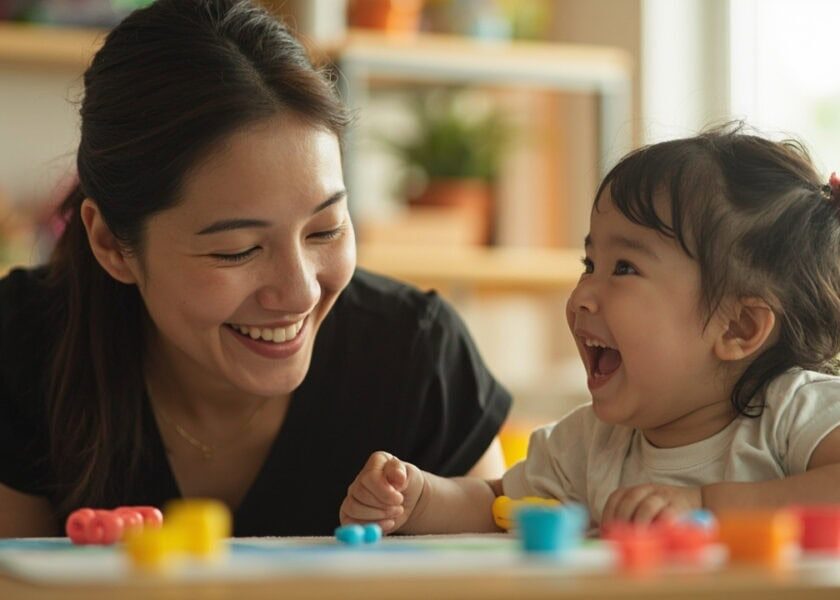
That variable is the specific human being who will hold your child when they cry, laugh with them when they discover something new, and be the consistent presence that helps them understand that the world is a safe place to explore. That variable is the caregiver-child relationship.
What Developmental Research Tells Us
When we talk about infant care in Singapore, we tend to talk about systems. We talk about whether a centre-based or home-based arrangement suits a family’s schedule. We talk about ECDA licensing and Childminding Pilot frameworks and CDA usability and Baby Bonus compatibility.
These are real and practical considerations. But they answer the question of where and when. They do not answer the question of who—and more importantly, what that who will mean for your child.
Here is why this distinction matters: the relationships children form with their caregivers in the earliest years do not merely supplement the love and security they receive from their parents. They provide something distinct and irreplaceable.
Through repeated experience with a responsive, consistent caregiver, a child learns that they can be separate from their parent and still be safe. That the world contains other trustworthy people. That their communications—their cries, their gestures, their earliest words—have power and meaning beyond the family home.
This is the foundation of what we call social confidence.
What Social Confidence Looks Like in Practice
A child who has experienced a secure, reliable bond with a caregiver outside the family tends to explore more freely, engage more readily with peers, and adapt more easily to new environments. Not because they have been taught these skills, but because they have felt them in their body—the felt sense of another person who responds to them, who stays, who remembers them.
This is the developmental dividend of a healthy caregiver relationship. It cannot be replicated by a better curriculum or a newer facility. It emerges only from the quality of human connection.
Why the Individual Caregiver Matters More Than the Facility
Consider this: two infant care centres can have identical licensing, identical curricula, identical safety records, and identical teacher-to-child ratios.
But if one centre has caregivers who are genuinely present—warm, consistent, emotionally attuned—and the other has caregivers who are merely competent and dutiful, the developmental experiences of children in those two settings will diverge in ways that no checklist can capture.
This is not a criticism of standards. ECDA frameworks, ratio requirements, and licensing standards matter. They establish that basic care is sound. They are the floor, not the ceiling.
What happens above that floor—in the texture of daily interaction, in the quality of presence a caregiver brings to each moment—is where your child’s experience actually lives. And that is determined not by the programme or the premises, but by the specific human being holding your child.
How Caregiver-Child Bonds Differ From Parent-Child Attachment
It is important to be clear here, because confusion on this point can lead parents to undervalue what their child’s caregiver relationship actually provides.
Infant care does not replace parental attachment. A child’s primary emotional foundation is built with their parents, and nothing in those early months or years changes that.
What is true is this: the caregiver-child relationship is its own developmental arena, with its own significance. Your child’s caregiver is not a backup system or a temporary substitute. They are an additional architect of your child’s sense of security and self.
Think of it this way: a child who has only ever felt safe with one person will be deeply bonded—but also deeply dependent on that one person’s presence. A child who has also formed a secure bond with a consistent, warm caregiver begins to understand that safety can extend beyond a single relationship. That trust can be built and rebuilt. That the world has more than one trustworthy person in it.
This is a profound developmental leap. And it happens not through instruction, but through experience.
What a Healthy Caregiver-Child Bond Looks Like Over Time
If you are wondering what you should actually be looking for, here is how these bonds develop in practice.
The First Weeks: Recognition and Wariness
In the beginning, your child may be uncertain. They may cling to you at drop-off, watching their caregiver with cautious curiosity. This is normal and expected. The bond does not arrive fully formed on day one. It builds.
During this phase, the caregiver’s role is simple but crucial: to be consistently warm, to never rush the child’s comfort, to meet every interaction with patience. Your child is learning: Is this person safe? Do they stay when I am not sure?
Weeks Two to Six: The First Signs of Trust
Over the following weeks, you may begin to notice something shifting. Your child may not stop crying immediately when you hand them over, but the crying may shorten. They may glance toward their caregiver during moments of distress, rather than only reaching for you.
Researchers sometimes call this “checking out” behavior—playing contentedly, then glancing up to confirm their caregiver is still there, before returning to their exploration. These are not small things. They are the earliest signs of trust extending beyond the family.
Months Two to Six: Genuine Connection
A healthy caregiver-child bond, over months, looks like:
- A child who runs to their caregiver at drop-off without hesitation
- A child who talks about their caregiver at home, who mentions things they did together
- A child who has internalized this person as part of their known, trusted world
- A child who naps easily in an unfamiliar setting because the caregiver’s presence has become a portable secure base
- A child who is, in the most fundamental sense, at ease
It also looks like a caregiver who knows your child—who can anticipate their cues before they become cries, who celebrates their small victories as though they were their own, who has learned the particular texture of that child’s personality and needs.
Signs to Watch for at Home
Beyond what providers can tell you, here is what you can observe on your own.
| Timeframe | What to Watch For |
|---|---|
| First 2–4 weeks | Does your child show any recognition of the caregiver? Reduced crying after handover? |
| Weeks 4–8 | Does your child glance toward their caregiver when unsure? “Checking out” during play? |
| Months 2–3 | Does drop-off become easier over time? Does your child mention the caregiver? |
| Months 3–6 | Does your child run to the caregiver at drop-off? Show genuine comfort and engagement? |
These are not guarantees—child development is not a formula. But they are meaningful signals, and they deserve your attention alongside the logistical questions.
Questions to Ask Any Infant Care Provider
If you are considering infant care—whether through home-based pathways, centre-based arrangements, or the ECDA Childminding Pilot—here is what you can look for and ask about.
Ask About Caregiver Continuity
- Who will be the primary caregiver for your child?
- How often does that primary caregiver change?
- What is the process for transition when a caregiver leaves?
Children form trust through repetition. A rotating cast of faces, however warm, will not produce the same developmental benefits as a consistent relationship with one person. This is one of the most important questions you can ask.
Ask About How They Observe and Support the Bond
- How do they know if a child is adjusting well?
- How do they handle it when a child is struggling to bond?
- What does daily communication look like?
We believe transparency is not just about access—though open communication channels matter—but about helping you understand what is actually happening in your child’s relationship with their caregiver.
Ask to Observe Interactions
Ask to see the caregiver interact with your child, more than once. Not a formal observation, but a casual visit, if possible. Watch how the caregiver responds to your child when you are not centre-stage. Watch whether your child gravitates toward them naturally over time.
How EduNanny Selects, Trains, and Supports Caregivers for Relational Depth
This is why EduNanny was built differently.
When we designed our approach to infant care and childminding in Singapore, we started with a question that most providers never ask: What does it take to form that kind of bond with a child, and how do we select, train, and support our caregivers to achieve it consistently?
The answer, we found, is not a curriculum. It is not a facilities upgrade. It is a fundamentally different approach to who we hire and how we invest in them.
Selection: Relational Capacity Above All Else
EduNanny’s caregivers are not selected primarily for certifications or credentials, though those matter. They are selected for relational capacity—for the ability to be genuinely present with a child, to respond with warmth and consistency, to find meaning and purpose in the daily texture of infant care.
We look for people who understand that their work is not about tasks—feeding, changing, supervising—but about presence. About being the person a child learns to trust.
This means our selection process is deliberate and rigorous. It goes beyond reviewing resumes. We assess how candidates respond to scenarios of emotional complexity, how they speak about children, and whether they demonstrate the patience and attunement that genuine caregiving requires.
Training: Beyond Safety Protocols
Our training goes beyond safety protocols and developmental milestones. Our caregivers learn to observe attachment behaviors, to understand the signs of a child who is building trust versus a child who is struggling to do so, to adjust their approach based on what a particular child needs in a particular moment.
They learn that every interaction—even something as simple as a nappy change—is an opportunity to communicate: I see you. I am here. You are safe.
Support: Because Caregiving Is Emotionally Demanding
We also support our caregivers in ways that many childcare settings do not. The emotional labor of infant care is real. A caregiver who is exhausted, undervalued, or emotionally distant will not form the bonds that children need, regardless of their intentions.
We believe that caring for caregivers is inseparable from caring for children. When caregivers are supported, respected, and emotionally sustained, they can bring their full presence to the relationships that matter most.
A Note to Parents Feeling Overwhelmed
If you are navigating infant care for the first time, or returning to work after your first child and wondering how to find the right support, I know the questions can feel overwhelming.
You may have already encountered an avalanche of advice—checklists and comparisons and frameworks that promise to lead you to the right choice. And some of that advice is useful.
But here is what I want you to carry with you, whatever decision you make: the relationship your child forms with their caregiver is not a secondary consideration. It is not something you figure out after you have settled the logistics.
It is the variable that determines whether your child experiences their early care as a place of security or uncertainty, of growth or mere waiting.
This does not mean you should feel paralysed by the choice. It means you should feel empowered to ask the questions that matter most—about continuity, about attunement, about how the people who will spend their days with your child are selected, trained, and supported.
If you are considering your options, we invite you to see our approach for yourself. Visit us. Meet our caregivers. Watch how they are with children. Ask us the hard questions—the ones about relationship and trust and continuity.
Let us show you what we have built and why.
Because when you choose infant care, you are not just choosing a service. You are choosing a person who will, in very real ways, help shape your child’s understanding of the world.
That is not a small thing. And it is not a thing we take lightly either.
EduNanny by BUTLER. Where your child’s relationship with their caregiver begins.
Learn more about EduNanny’s approach to childminding or read our story.