What Your Child Is Telling You About Quality Care
What Your Child Is Telling You: Five Key Signals
Before we explore how to read your child, here are the signals that quality care leaves on a child’s life:
- Ease in their body — A relaxed nervous system that moves through the world with fluidity
- Initiative in play — Active engagement, curiosity, and the drive to explore and create
- Warmth toward trusted caregivers — Specific, reciprocal connection that expands their relational world
- Integration of their day — The ability to share stories and weave experiences into narrative
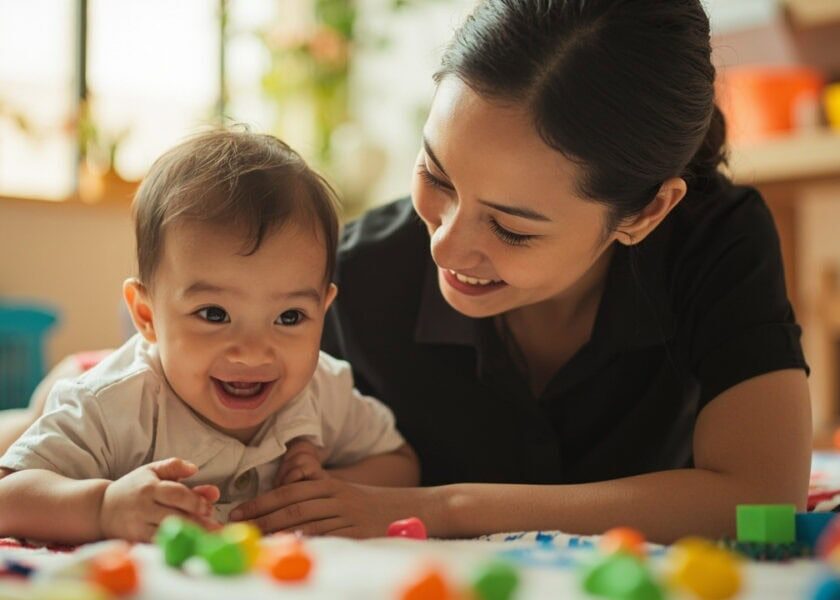
- Joy — Genuine, unbidden delight that erupts when basic needs for safety and connection are met
These are not abstract ideals. They are observable, recognizable signals that your child carries within them every single day. Learning to notice them is the heart of what this article offers.
The Silence Between: Understanding What Parents Actually Feel
There is a particular kind of silence that exists in the hours between dropping your child at their care arrangement and the moment you return to collect them. It is a silence filled with everything you cannot hear, everything you cannot see, everything you cannot know with certainty.
Every parent in Singapore who has made the decision to entrust their child’s early days to someone else has lived inside that silence. It is not dramatic. It is not filled with catastrophe or fear, most days. It is simply the quiet weight of having loved someone so completely that the hours apart feel significant, even when you have chosen that separation thoughtfully and with full confidence in your decision.
For parents navigating the infant care and childminding landscape, there is a particular tension that rarely gets named directly. You have likely done significant research. You have compared options. You have made a thoughtful decision based on values, on evidence, on the kind of future you want for your child.
And yet, there remains that quiet uncertainty. The hours between 8am and 6pm—sometimes earlier, sometimes later—are hours you cannot witness. You cannot hear the tone in which your child is spoken to. You cannot see whether they are met with patience or frustration. You cannot know, in the moment, whether the warmth you hoped for is actually present.
This is not a failure of parenting. This is the fundamental condition of entrusting your child to others during these critical early years. And it is why this article matters: because learning to read your child is the most reliable quality indicator available to you.
You chose quality care because you wanted your child to thrive. That was the hope at the center of it—the belief that the right environment, the right caregiver, the right early experiences would give your child a foundation that would serve them for the rest of their life.
But here is what the parenting books and the well-meaning advice and the glossy brochures do not always tell you: wanting your child to thrive and knowing whether they are thriving are two entirely different things. And that gap—that space between your hope and your certainty—is where the real work of parenting begins.
This is not an article about feeling guilty. If there is one thing this conversation does not need, it is another layer of parental shame heaped upon parents who are already giving everything they have. This is about something far more useful than reassurance. It is about equipping you with a framework for understanding what your child is already showing you.
Because children, it turns out, are extraordinarily honest beings. They cannot hide what matters most. And when you learn to read them, you will find the evidence you have been looking for.
Reading Your Child: Body, Play, and Connection
When your child returns from a day in quality care, pay attention to what happens in the car. Not to the big moments, not to the dramatic declarations, but to the small, almost invisible movements.
Does your toddler settle into the familiar rhythm of the journey home with a body that looks relaxed? Does your infant drift off to sleep in the carrier, trusting that the motion and the presence mean safety?
Or is there a different kind of settling—a tensing, a watching, a reaching back toward the window as if to confirm that the route is indeed leading home?
These are not metaphors. These are the body’s honest responses to where it has been and who has held it. Children whose days have been filled with attuned, responsive caregiving carry that experience in their nervous systems. They are calmer. They are more available for connection. They are, in the most literal sense, regulated by the care they have received.
Homecoming and Reunion
Think about the moments when you walk through your door at the end of the day. Watch your child in those first few minutes of reunion.
A child who has been in an environment of genuine warmth will often seek proximity, not with the desperate clinging of fear, but with the easy confidence of someone who knows that connection is reliable. They may run to you, or they may pause and smile and wait to be gathered.
Both are signs of healthy attachment. Both are evidence that the caregiver’s warmth translated into a felt sense of safety that your child carried through the hours.
This is not about your child never protesting separation. Separation protests are developmentally normal and, in fact, a sign that your child has formed a bond worth protesting. What you are looking for is the recovery—the way your child is able to transition from the intensity of missing you to the comfort of being back with you.
That recovery is a window into how secure they feel, and that security is built in the unseen hours.
Play as Evidence
Consider, too, what your child does when they play. Watch them with the small world they create with blocks, or dolls, or whatever materials capture their imagination.
A child who has experienced warm, engaged caregiving during the day will often reproduce elements of that caregiving in their play. You may see them rocking a stuffed animal with a tenderness that mirrors how they have been held. You may hear them speaking to their toys in the voice of a caregiver, offering comfort, setting limits, narrating the day.
This is not coincidence. This is your child processing and integrating what they have received. The care they experienced has become part of their internal working model of how relationships work.
Here is the paradox that quality care offers: the better the care your child receives while you are apart, the more available they are to connect with you when you are together.
The care does not compete with your relationship with your child. When it is done well, it complements and supports it. Your child is not dividing their love. They are multiplying their capacity to receive and give it.
A Framework for Observation: Five Signals That Show Thriving
So what do you look for? Here is a framework, not as a checklist to anxiety, but as a map for observation. These are the signals that children cannot hide when their care is genuinely excellent.
1. Ease
Not the absence of emotion—children should feel and express a full range of feelings—but an underlying ease that runs through their days.
A child who is thriving will move through the world with a kind of fluidity. They will be curious without being frantic. They will assert themselves without aggression. They will accept limits without collapse. This ease is the signature of a nervous system that has learned, through consistent, responsive care, that the world is manageable and that other people can be trusted.
You will not see this ease in a single moment. You will see it over time, in the patterns of your child’s days.
2. Initiative
Children who feel safe take initiative. They explore, they create, they problem-solve, they engage. They are not waiting passively for instruction or entertainment. They are active participants in their own learning and their own world.
This initiative is a sign that the care environment has been structured in a way that respects the child’s agency and supports their developing independence. When your child comes home and immediately wants to show you something, build something, tell you about something—that is initiative. That is a child who has been encouraged to be the author of their own experience during the day.
3. Warmth Toward Other Trusted Adults
This is particularly relevant if your child has been in the care of a specific caregiver over time. Notice how they respond when that person is present.
A child who has experienced warm, consistent care from a caregiver will show a distinct warmth toward that caregiver—not the indiscriminate friendliness of a child who has not formed specific bonds, but the specific, reciprocal warmth of a relationship that has depth. They may smile differently with that person. They may show them things. They may seek comfort from them in small ways.
This is not a betrayal of your bond with your child. It is an expansion of your child’s relational world, and it is a sign that the caregiver has earned your child’s trust through genuine, attuned presence.
4. Integration of Their Day
Children who have had coherent, consistent experiences will be able to weave those experiences into a narrative. An older toddler or preschooler may begin to tell you about their day spontaneously—something they ate, someone they played with, a song they learned, a moment of frustration or joy.
This ability to integrate and share is a cognitive achievement that depends on emotional safety. A child who is anxiously wondering about the reliability of their caregivers does not have the psychic space to integrate and remember their experiences. When your child can tell you a story about their day, that is a story made possible by a foundation of safety.
5. Joy
Not manufactured fun, not the relentless entertainment that has come to define too much of early childhood, but genuine, bubbling joy. The kind that erupts unbidden. The kind that comes from being fully alive in a body that feels good, in a world that feels safe, with people who have made space for delight.
Joy is not a luxury of childhood. It is evidence of development. It is evidence that your child’s basic needs for connection, stimulation, and security have been met in a way that allows them to reach for more.
When your child laughs freely, when they discover something wonderful and share it with you, when they skip or spin or climb with the sheer pleasure of inhabiting their own growing bodies—that is the clearest signal you will ever receive that something profound and good is happening in their days.
What Quality Care Actually Looks Like
Understanding what to look for in your child is only half the picture. The other half is understanding what creates the conditions for these signals to emerge.
Quality childminding is not primarily about activities or curricula. It is about relationships—specifically, about the ratio of caregivers to children that makes genuine attunement possible. When one caregiver is responsible for one, two, or three infants at most, something changes in the quality of attention those children receive. Small ratios are not an administrative convenience. They are the structural foundation for the kind of responsive caregiving that builds secure attachment and supports healthy development.
This is why the ECDA Childminding Pilot was created. Singapore recognized a truth that parents have always known: that the early years matter enormously, that the people who care for our children during those years carry a responsibility that extends far beyond supervision, and that we need pathways that make quality care accessible and affordable for families across this country.
Different Settings, Same Principles
Quality care is not a single shape. For some families, home-based care—where a trained childminder comes to your home or your child goes to a trusted home environment—offers the warmth and familiarity that works best. For others, a centre-based or community-based setting provides a combination of structure and relationship that serves their child well.
What matters is not the setting itself, but the principles operating within it: low ratios, trained caregivers, responsive interaction, and an environment that treats each child as an individual with their own needs, rhythms, and emerging personality.
What EduNanny Offers
EduNanny was built on a simple but radical premise: that the best place for a young child to receive care is in the kind of environment that feels like home, with the kind of attention that feels like love. This is not sentiment. This is developmental science translated into practice.
When you entrust your child to EduNanny, you are not handing them into a black box. Where deployed, CCTV measures are in place—not because we doubt our caregivers, but because we understand that you need more than trust. You need evidence. You need to know that the door you walked through is the door that keeps your child safe.
This is not micromanagement. This is partnership in its truest sense. We believe that transparency strengthens trust rather than undermining it.
We also believe that communication should be continuous, not transactional. You will not receive a daily report that lists activities like a product feature checklist. Instead, you will be part of an ongoing conversation about your child’s experience—about what they seemed to enjoy, what seemed to challenge them, where you might see the evidence of their day showing up in their play or their words or their behavior.
We do not claim to raise your child. You do that. You are your child’s first and most important teacher, their primary attachment figure, the architect of their earliest worldview. What we do is come alongside you in the hours when you cannot be there. We hold the space your child needs. We provide the responsive, warm, developmentally rich environment that supports everything you are building at home.
The infant ratio we maintain—up to one to three in our infant spaces—is not a number we chose for marketing purposes. It is a ratio that allows our caregivers to truly know each child. To notice the subtle shifts in mood that signal a need for comfort. To respond in the moment, consistently, the way a trusted attachment figure responds.
This ratio is expensive to maintain. We maintain it anyway, because we know what developmental science tells us, and we refuse to compromise on the structural conditions that make genuine attunement possible.
Support When You Need It
For those moments when you have a question at eleven at night, or during a weekend, or at a time when no one is immediately available to speak with you, we have developed the Thomas AI Chatbot to bridge that gap.
Thomas is not a replacement for human connection. It is an extension of our commitment to being present for you when you need us. Whether you have a question about your child’s development, a concern about something you observed, or simply need a thought partner as you navigate the complexities of modern parenting, Thomas is there—accessible, informed, and aligned with everything we believe about how children thrive.
Affordability and Accessibility
The costs of quality care can feel prohibitive, and we do not pretend otherwise. For families in Singapore navigating this landscape, the financial reality is something that deserves honest acknowledgment.
We have worked to ensure that EduNanny is accessible within the ECDA Childminding Pilot fee structures, and that families can utilize available subsidies and support mechanisms. CDA funds and Baby Bonus provisions are part of how Singapore has chosen to invest in its youngest citizens, and we have designed our services to be compatible with these pathways.
Quality care should not be a luxury available only to those with the most resources. The Pilot exists, in part, to demonstrate that high ratios, trained caregivers, and developmentally sound environments can be scaled in ways that serve families across Singapore. We are committed to that vision.
Choosing Infant Care: Questions Worth Asking
If you are currently researching infant care and childminding options for your family, here are the questions worth asking:
- What is the caregiver-to-child ratio? Lower ratios mean more individualized attention and responsiveness.
- How are caregivers trained? Look for training in child development, attachment, and responsive caregiving—not just safety protocols.
- What does a typical day look like? Quality care prioritizes relationship and free play over structured programming for infants and toddlers.
- How is communication handled? You should feel like a partner, not a customer receiving periodic updates.
- Are there transparency measures in place? This might include CCTV, open door policies, or regular parent gatherings.
- How does the caregiver respond to distress? Watch for attunement—the ability to notice, interpret, and respond to a child’s cues with warmth and consistency.
- What do the children look like? Are they easeful? Curious? Do they show initiative? Are they available for connection?
The Evidence You Have Been Looking For
Let me bring this conversation back to where it began. The silence between dropping your child and collecting them.
That silence is real, and it is significant, and we do not pretend otherwise.
But here is what we also know. That silence is filled with sound if you know how to listen.
Your child is speaking to you constantly. They are speaking through the ease in their body, the initiative in their play, the quality of their connection, the coherence of their stories, and the joy in their laughter. They are telling you, every single day, whether they are thriving.
They are telling you whether the care they receive is the kind that builds foundations.
You chose quality care because you wanted your child to flourish. And here is the truth that quality care, done right, offers you: your child will show you that flourishing is happening. Not because you are watching, but because they are living it. Not because you have engineered it, but because you have created the conditions for it to emerge.
The trust you extended when you made your childcare decision will be repaid, not in the form of reassurances or guarantees, but in the form of your child—fully themselves, increasingly capable, emotionally whole, and ready for everything the world will ask of them.
Begin the Conversation
If what you have read here resonates with the parent you are trying to be—if you believe that children deserve care that feels like home, that relationship is the foundation of development, that you deserve transparency and partnership in this work—we would like to hear from you.
EduNanny is here to offer not a promise, but a partnership. Not a transaction, but a relationship. Not a service that replaces what you do, but a presence that supports and enhances everything you are building with your child.
We are honored to walk alongside families in Singapore in this work. We know it is the most important work there is.
Your child is telling you something. Listen to them. Trust what you hear. And know that we are here, holding that same space for your child, in the hours when you cannot be there.
That is not a small thing. It is everything.
Ready to explore what quality care looks like for your family?
Connect with EduNanny to learn more about our approach to infant care and childminding within the ECDA Childminding Pilot. You can also reach us directly or learn more about our team.