What Your Child Shows You at Pickup Is the Evidence You Need
The Science of Attunement: What Your Child Is Actually Showing You
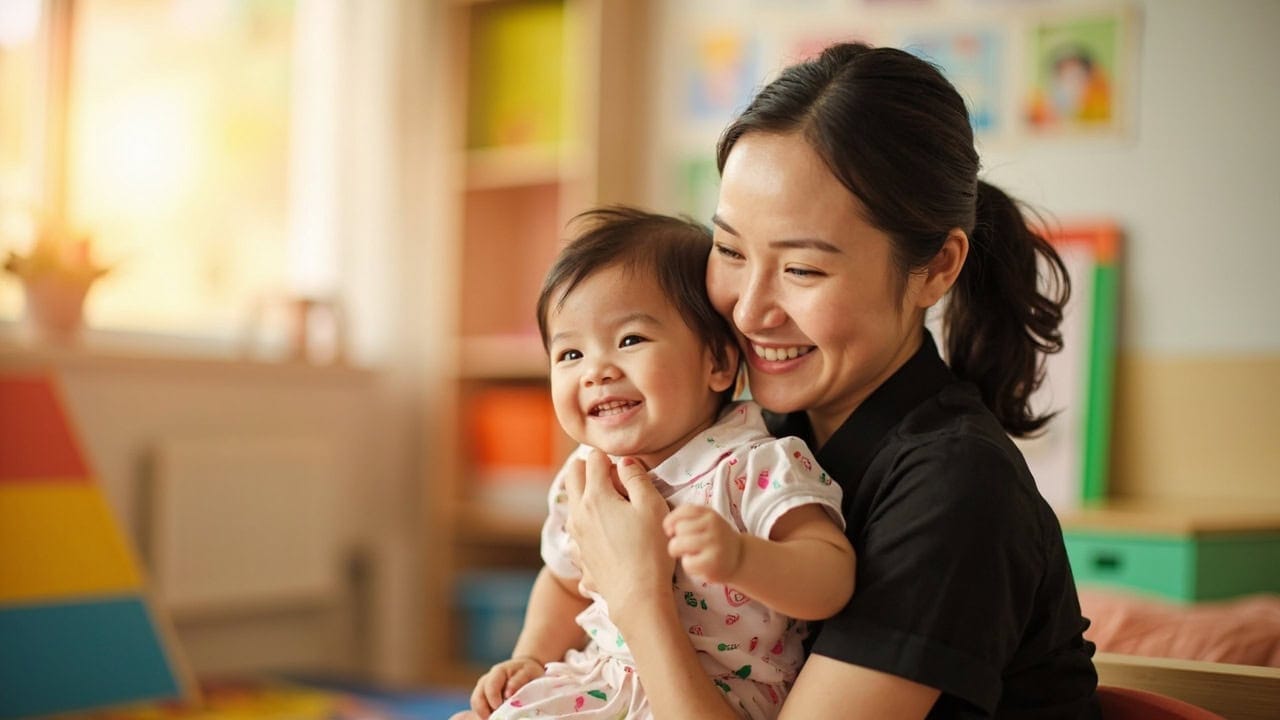
Let me take you somewhere specific. It is five-thirty on a Wednesday. You have just picked up your eighteen-month-old from her caregiver. She is clutching a small toy she did not leave the house with this morning—a paper butterfly, folded at the kitchen table by hands that spent the day with her. She does not hand it to you immediately. She holds it for a moment, then looks up at you, then shows you the butterfly. Then she climbs into your arms and rests her head on your shoulder in a way that feels easy, unhurried, like she is simply arriving somewhere familiar.
What you have just witnessed is not small. You have just seen evidence of something that developmental scientists have spent decades studying and confirming.
You have seen a child who is emotionally available. You have seen a child who has internalised a caregiver’s affection—she is carrying something the caregiver made as though it matters, because to her, it does. You have seen a child whose stress regulation system has not been maxed out by the day. You have seen a child who is capable of sharing her experience with you, because the experience was one worth sharing.
This is what secure attachment looks like in a late-afternoon hand-off. And it is not a mystery. It is not accessible only to those with special training. It is readable, by you, because you know this child better than anyone else in the world.
What Attunement Means—and Why It Matters
Attunement is the process by which a caregiver—or a parent—reads a child’s emotional and physical cues and responds in a way that matches what the child needs. When a caregiver is attuned to a child, something extraordinary happens. The child begins to develop what researchers call an internal working model of relationships—a kind of internal map that tells her, at a level below conscious thought, that she is safe, that her needs matter, that the world is a place where people respond when she reaches out.
Children who receive attuned care do not just feel good in the moment. They carry that sense of safety forward. And the remarkable thing, for our purposes today, is that this manifests in observable, parent-readable ways.
A child who has been in attuned care will often, at pickup, show what researchers call emotional availability—a willingness to engage, to be comforted, to show the full range of their feelings without fear. She will engage with you when you ask about her day, not because she has been coached to report, but because the day was interesting enough and safe enough to want to share.
Because the truth is, you already possess something remarkable. You possess a capacity, honed by the sheer act of loving your child, that no inspection report can replicate and no centre tour can fully replace. You have what developmental psychologists call attunement—the ability to read your child’s emotional weather, to sense shifts in their mood, to know when something is off and when something is right.
Reading the Signals: What Quality Care Looks Like at Pickup and Home
I want to tell you what quality care looks like when a child comes home, because specificity matters more than generalisations.
A child in quality care will, over time, begin to narrate the day in ways that reveal the richness of her experience. Not necessarily in long sentences—she may be two, she may be three—but she will find ways to communicate the texture of her day. She may hand you a piece of paper and say “my friend” or “teacher say.” She may sing a song she learned at circle time. She may ask, unprompted, to do something she did at care—singing a particular song, playing with a particular toy.
These are not decorations on a day. These are evidence of a child who has been engaged, who has been invited into meaningful activity, who has been seen and included.
What to Look For at Pickup
When you arrive to collect your child, pause for a moment before you speak. Observe:
- The quality of their arrival. Does your child come to you, or hang back? Do they move with ease, or with reluctance?
- Physical signs of wellbeing. Is your child alert and calm, or visibly tired in a way that suggests the day was overstimulating rather than productively engaged?
- Emotional openness. Does your child seem willing to engage, or withdrawn? Are they showing a range of feelings, or suppressing something?
- Their relationship with the caregiver. Does your child say goodbye with ease? Is there warmth in the farewell, or tension?
What to Listen For After Pickup
The hours after pickup offer a window into your child’s experience that no report can replicate. Quality care produces children who:
- Share unprompted. “Mama, we painted today!”—said without your asking, because the day contained something worth mentioning.
- Reference the caregiver by name as a person in their world, not a stranger.
- Carry forward the day’s learning. A new song, a new word, a new question about something they encountered.
- Settle into evening routines with relative ease. Not perfectly—children are children—but with a sense that the day left them in a place of security rather than depletion.
Conversely, a child who has spent the day in an environment where the ratio of children to caregivers is too high, where the day is characterised more by management than by engagement, will often come home depleted in a way that is hard to articulate but unmistakable to feel. She may be clingy and dysregulated. She may resist bedtime, as though the day has left her nervous system in a state of low-grade alert. She may not mention anyone by name, because no one has stood out.
Surface Signals vs. Deeper Patterns: What to Trust
Now let me be honest about what you might also see—and what it means when the picture is less clear.
Your child comes to you and is upset. Not dramatically upset, but withdrawn in a way that is different from his usual self. He does not want to talk about the day. He resists the usual bedtime routine. He seems fine once he is fed and rested, but there is a residue of something that lingers.
Here is what I want you to know: adjustment is normal. It is completely normal for a child, especially in the first weeks and months of a new care arrangement, to show signs of stress that have nothing whatsoever to do with the quality of the care.
Separation anxiety peaks and ebbs. Developmental leaps disrupt sleep and mood. A cold, a growth spurt, a small social scuffle with another child—any of these can produce a child who looks unsettled at pickup without it telling you anything reliable about the care itself.
Understanding the Difference
| Surface Signals | Deeper Patterns |
|---|---|
| The immediate, moment-to-moment states your child is in at any given pickup | The patterns that emerge over weeks and months of observation |
| Tell you about today—a single page from a longer book | Tell you about the ongoing story of your child’s wellbeing and growth |
| Can be influenced by tiredness, hunger, minor illness, developmental leaps | Reflect the consistent quality of the caregiver relationship and care environment |
| Worth noticing, but not worth over-indexing | Worth watching carefully—these reveal what is really happening |
Quality care produces both. Surface contentment in the moment, and a deeper trajectory of security and growth that becomes visible over weeks and months. The deeper signs are not complicated to read. They are not hidden. They are exactly the kinds of things you would be watching for anyway—because you are a parent.
Signs of a Child Finding Their Footing
Watch for these over time. They are signs that the care is working, even if individual days feel uncertain:
- The way your child’s relationship with the caregiver develops—she begins to mention the caregiver by name, not as a stranger but as a person in her world.
- The way curiosity returns after a period of hesitation.
- The way the transition to and from care begins to feel less like a wound and more like a rhythm.
- The way your child runs to the caregiver in the morning, without looking back at you, because he trusts that you are leaving him somewhere good.
Trusting Your Parental Instincts
Somewhere between the complexity of modern childcare and the weight of wanting the best for your child, Singapore parents have learned to distrust their own capacity. They second-guess their observations. They wonder if what they are seeing is meaningful, or if they are simply being an anxious parent reading too much into an ordinary afternoon.
I want to speak directly to this doubt: But I am not an expert. I do not have the training. What if I am wrong?
To that, I want to say something clearly and without hesitation: you are not wrong.
The instinct you have about your child is not a naive instinct. It is an informed one, built from thousands of hours of interaction, from the sheer gravity of caring about this one small person more than you have ever cared about anything.
No one—not a centre director, not a regulatory inspector, not a childcare expert—knows your child the way you do. What we are talking about today is not learning to read your child from scratch. It is learning to trust that the reading you are already doing is valid, meaningful, and more reliable than you have been giving yourself credit for.
This is, I think, one of the most underserved needs of modern Singapore parents. The need for someone to say: you are competent. Your observations matter. You are not a passive recipient of childcare reports. You are an active, capable reader of your own child’s experience.
The Ongoing Practice of Observation
The most confident parents I have worked with are not the ones who conducted the most thorough centre research. They are the ones who made observation a daily habit—not a surveillance, not a forensic audit of every interaction, but a gentle, open attention to what their child was showing them.
They looked at the afternoon not as a time to quiz and probe, but as a window that had opened naturally. And over time, they found that the window showed them everything they needed to know.
What you are observing is real. What your child shows you at the end of the day is meaningful. And quality childcare—the kind of care that truly deserves your trust—produces a child who can be read. A child whose behaviour carries information that is not hidden, not coded, not accessible only to trained professionals. It is right there, in the walk to the car, in the way your child climbs into the stroller, in the words they try to find for the hours you were not there.
The question is not whether your child is telling you something. The question is whether you have been taught to trust that you can hear it.
What Quality Childcare Looks Like: Ratios, Caregivers, and Partnership
Let me speak to the practical question that sits beneath all of this—the question of what quality childcare actually requires, and how to recognise it when you see it.
The Significance of Small Ratios
For infants and toddlers, the number of children per caregiver matters enormously. Fewer children means more attunement, more responsiveness, more of the back-and-forth that builds neural pathways at a rate that will never be matched later in life.
A one-to-three infant ratio means that for every three infants in care, there is one dedicated caregiver whose attention is not divided across ten or fifteen children. It means that the moments of attunement—the responsive feeding, the attentive soothing, the back-and-forth of early communication—are not rushed. They are not squeezed between administrative tasks. They are the work.
That ratio is not a regulatory checkbox. It is a condition of quality.
The Caregiver Herself
There is something easily overlooked in conversations about childcare quality. And that is the caregiver herself.
We talk a great deal about ratios, curricula, regulatory frameworks. We talk less about the person. About the woman—because in Singapore, most caregivers are women—who wakes up each morning and walks into a home where she will spend her day attending not to tasks but to a child. To the sound of her voice. To the quality of her attention. To the question of whether the child in her care is having a day that will, in some small but real way, accumulate into a sense of security and wonder that stays with that child for the rest of his life.
This is not sentimental. This is the work. And it is work that deserves dignity, recognition, and support.
A caregiver who is respected, who is trained, who feels part of something larger than a single family’s daily needs, is a caregiver who can be truly present. And it is that presence, that quality of presence, that your child reads and carries home in the way she climbs into your arms, in the way she mentions a name over dinner, in the way she turns to a caregiver in a moment of uncertainty and finds comfort there.
Transparency as Partnership
There is a question that sits beneath all of this, the question of trust and transparency that every working parent carries: How do I know what is happening when I am not there?
This is not an unreasonable anxiety. It is a legitimate need. The better you know what is happening in the day, the more effectively you can read what your child brings home. Transparency is not about surveillance of the caregiver. It is about equipping you to do what you are already doing—reading your child—with better information.
Questions to Ask When Researching Childcare
- What is the caregiver-to-child ratio, especially for infants?
- How does the caregiver respond to a crying infant? A distressed toddler?
- What does a typical day look like for a child my child’s age?
- How do you communicate with parents about the child’s day?
- What training do your caregivers receive?
- How do you handle a situation where my child is struggling to settle in?
- How consistent is the caregiver relationship? What is the turnover rate?
EduNanny Singapore: Built Around the Observation You Are Already Making
EduNanny is part of something significant in Singapore’s childcare landscape. It is part of the ECDA Childminding Pilot, a government-recognised pathway that acknowledges what many parents have always known—that home-based and community-based care, when it is of high quality, offers something that large-centre models cannot easily replicate.
Smaller ratios. More individual attention. A consistency of caregiver relationship that, for many children—especially infants and toddlers in their earliest years—makes a profound developmental difference.
EduNanny Singapore is built on a belief that I want to name plainly: we believe in the kind of care that becomes more visible the more closely you look.
We do not fear parents who observe carefully. We welcome it. Because we know what we offer, and we trust that when you bring your observational skill, your parental attunement, your willingness to look closely at what your child is showing you at the end of every day, you will see it too.
Our caregivers are trained, supported, and part of a community of practice that takes the work seriously. Our ratios are structured around what infants and toddlers actually need. Our communication with parents is built on the principle that transparency serves trust. And our fees are structured to be accessible to working Singapore families, with support for CDA and Baby Bonus usage.
Addressing the Doubt That Belongs to Working Parents
There is a particular kind of doubt that belongs to the working parent in Singapore. It is the doubt that says: Am I doing the right thing? Am I leaving my child in the right place? Will the hours I am not there add up to something that is okay, or will they add up to something I cannot take back?
I want to tell you that this doubt is not a sign that you are failing. It is a sign that you care enormously, and that you are paying attention in a world that does not make it easy to pay attention. The doubt is not your weakness. It is your competence, looking for somewhere to land.
What I want to offer you today is this: a different relationship with that doubt. Not the elimination of it—that is neither realistic nor desirable—but a redirection of it. Instead of asking the world to give you certainty from the outside, I want to invite you to trust the certainty that is already within reach.
The certainty that lives in your child’s behaviour. In the way he runs to the caregiver in the morning, without looking back at you, because he trusts that you are leaving him somewhere good. In the way she comes home and does not need to be managed into calm, because her day was calm enough to carry. In the way he asks to go back, not because he has been told to say it, but because the place feels like a place where good things happen.
These are not ambiguous signals. These are the clearest evidence you will ever receive. And they are available to you every single day, in the most ordinary moments, without an appointment, without a report, without a centre tour.
The Evidence Is Not Hidden
The evidence is not hidden. It never was. It is in your child’s hand, in the way she shows you what she made. It is in the car, in the way he babbles about his morning. It is in the evening, in the ease with which she settles into sleep, because the day earned that rest.
It is in the caregiver who knows your child’s favourite song, and in the way your child already knows this about the caregiver.
You are already reading your child. You have always been reading your child. I am simply asking you to trust that you are reading well.
That is the skill. That is what quality care makes possible. And that is what EduNanny Singapore is here to walk alongside you in—every afternoon, every pickup, every ordinary, extraordinary moment when your child shows you exactly who they have become in your absence, and you realise, with something that feels very much like certainty:
This is working.
If you are ready to explore what a thoughtfully designed childcare arrangement can look like for your family, we would be glad to hear from you. There is no obligation, no pressure—just a conversation about what matters most to you and whether we might be part of meeting it.
EduNanny Singapore is part of the ECDA Childminding Pilot, offering development-oriented childcare with trained caregivers, small ratios, and a commitment to transparency for working Singapore families. Learn more about EduNanny or read about our approach.