Why Singapore Parents Choose Quality Over Cost for Their Children
The Decision That Compounds: Why Your Child’s First Thousand Days Are Worth More Than the Price Tag
There is a particular kind of hesitation that Singapore parents know well. It arrives at the moment when you realize that childcare is not just about who will watch your child, but about who will shape your child. It is the pause before you sign the enrollment form, the conversation with your spouse that stretches past midnight, the call with your own parents where their eyes tell you they do not understand why you are considering spending more than they ever imagined spending on care for a baby.
That hesitation has a cost. Most parents do not think about it that way. They think about the monthly fees as the cost. They think about the deposits as the cost. They think about the difference between one centre and another as the cost. What they rarely calculate is what their hesitation is actually purchasing: a few more weeks of searching, a few more comparisons, a few more nights lying awake wondering if there is a better answer somewhere.
Here is what that hesitation buys: time in a period of development that does not wait.
The First Thousand Days: Where the Architecture Begins
The science here is not new, but it remains startling in its implications. In the first thousand days of life—from conception to approximately age three—a child’s brain forms more than one million neural connections every second. This is not a metaphor. This is the actual architecture of thought, of emotional regulation, of the capacity to learn and adapt and connect, being built at a pace that nothing else in human development will ever match.
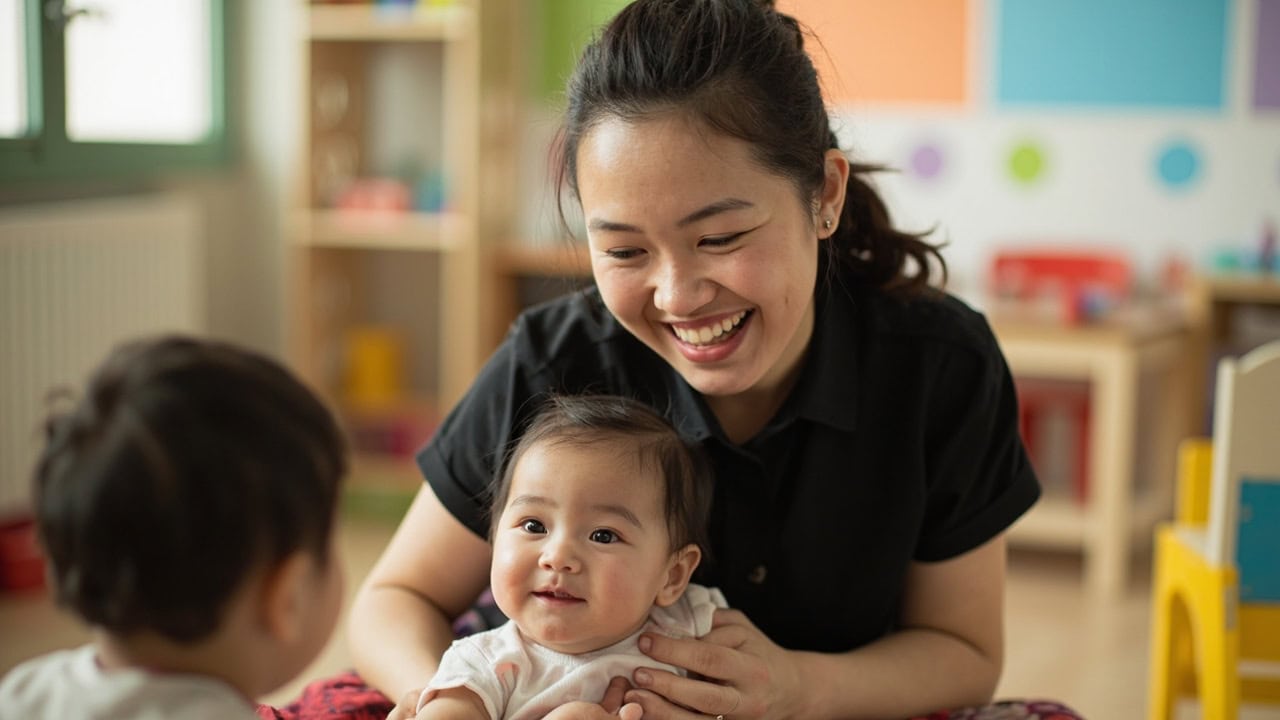
The quality of care during this window does not simply influence outcomes. It determines the range of outcomes that are even possible. The caregiver who responds to an infant’s cues with consistency and warmth is not providing a pleasant experience. That caregiver is literally wiring the child’s capacity for trust, for curiosity, for the kind of secure exploration that becomes the foundation for everything that follows.
What Research Shows About Quality Early Care
Children who receive high-quality responsive care in their earliest years show measurable advantages in:
- Language development: Rich verbal interaction during the first years builds vocabulary and communication foundations that accelerate learning later
- Executive function: The ability to focus, regulate emotions, and persist at tasks—capabilities that predict school success more reliably than early academic knowledge
- Social-emotional capacity: Secure attachment formed in infancy becomes the template for all future relationships
- Resilience: The confidence that effort leads to results, that adults are reliable, that she herself is worthy of attention and care
These are not soft outcomes. These are the capabilities that determine whether a child thrives in school, forms healthy friendships, handles failure without collapsing, and grows into an adult capable of building a life that feels meaningful.
When we use the word “spending,” we imply loss. We imply that money goes out and something comes in, and we must decide if the exchange is fair. This is the wrong frame. What you are doing when you choose quality infant care is not spending. You are investing in the only window where that investment can possibly yield its highest returns.
The child who has learned to trust that her needs will be met develops the emotional security to venture further, to ask more questions, to persist longer at difficult tasks. A developmental advantage gained at eight months does not simply persist. It multiplies. It opens doors that would otherwise remain closed.
The Singapore Reality: Why This Decision Feels So Hard
Now pause and consider what this means for a decision made by parents in Singapore. You are likely raising your child in a household where both parents work. You may be navigating the expectations of grandparents who provided childcare in an era when the formal sector barely existed and family was simply what you did. You are making this decision in one of the world’s most expensive cities, where the cost of living pressures every budget and every choice involves trade-offs that feel more immediate than any developmental outcome that lies years away.
This is the uniquely Singaporean tension: the moment when abstract knowledge about child development crashes into the concrete reality of monthly expenses, of CDA accounts and Baby Bonus savings, of comparing what a centre charges against what you remember your parents spending on anything at all.
The hesitation is not irrational. It is the rational response to an irrational situation, where the most important decision you will make for your child’s future is also the one that feels most difficult to justify in the present.
Two Ways of Thinking About This Decision
The consumption model (how most parents default to thinking): “I am buying a service. I should get what I pay for. The cheapest option that meets basic standards should be sufficient.”
This model fails because it treats childcare as a commodity when it is actually a developmental environment. You are not purchasing supervision. You are purchasing the quality of attention, the consistency of response, the richness of interaction that your child will experience during the most consequential developmental period of her life.
The investment model (what the research supports): You ask not “what is the minimum I must spend?” but “what is the quality of experience that will give my child the best possible foundation?”
This model changes the conversation. It does not make the decision easy, but it makes the decision clearer. It gives parents intellectual permission to prioritize quality over convenience, because they understand what they are actually purchasing: not a service, but a trajectory.
What Quality Childminding Actually Looks Like
If you are going to invest in quality care, it helps to know what you are actually investing in. Premium infant and childminding care is not simply a matter of paying more for the same service with nicer facilities. It is a fundamentally different approach to how your child’s days are structured and experienced.
The Elements That Matter
- Infant-to-caregiver ratios: Up to one-to-three ratios mean your child receives the attention that developmental science tells us is essential. When a caregiver is responsible for fewer infants, every cry is heard, every milestone is noticed, every need is met with promptness.
- Responsive interaction: Quality care is not about activities or curriculum for infants—it is about the quality of human response. A caregiver who makes eye contact, mirrors facial expressions, narrates what is happening, and responds promptly to distress is building neural architecture that no worksheet or flashcard can replicate.
- Consistency and continuity: Children develop trust through predictability. When the same warm, trained caregiver is present day after day, your child builds the secure attachment that becomes the foundation for all future exploration and learning.
- Transparent communication: For parents who are apart from their infant during work hours, trust is built through visibility—regular updates, documentation of milestones and routines, and in relevant settings, measures that give parents insight into their child’s day.
- Trained, supported professionals: Childminding is skilled work. When your child’s caregiver is trained, supported, and operating within a professional framework, you are not relying on individual luck or goodwill—you are accessing a system designed for quality.
Navigating Family Expectations and Common Concerns
There is also something to say about the role of grandparents in this conversation, because they are often the invisible pressure in the room. Many Singapore parents are navigating not just their own beliefs about quality care but the expectations of a generation for whom childcare was provided by family, without question, without cost, without the complicated calculus that modern parents face.
The decision to invest in formal quality care can feel like a rejection of what grandparents offered, even when it is nothing of the kind. It can provoke conversations that feel like criticism, even when they are simply about a changed world.
Choosing quality care for your child is not a statement that what grandparents offered was insufficient. It is a recognition that the world has changed, that the science of early childhood development has advanced in ways that create new possibilities, and that the children of this generation deserve the benefit of what we now know.
This is not rejection. It is gratitude expressed through different means.
Addressing What Singapore Parents Actually Worry About
“Can we really afford this?”
Singapore families face genuine constraints. The cost of living is real. Not every family has access to the options that some families have. This framing is not meant to add guilt to parents who are already carrying plenty. It is meant to offer a different way of thinking about the decision—one that acknowledges the financial reality while refusing to pretend that money is the only variable that matters. The question is not whether you can afford quality care, but whether you can afford the alternative.
“Will I feel guilty for choosing premium care?”
You have the right to choose quality without apology. Choosing premium care based on evidence is not indulgence—it is the highest-return decision a parent can make for their child’s future. The parents who feel hesitation about spending more are often the same parents who are most thoughtful about their choices. That thoughtfulness is not a weakness. It is exactly what quality parenting looks like.
“How do I know if it’s really worth it?”
You know by understanding what you are actually purchasing. You are purchasing the quality of attention your child receives during the period when one million neural connections form every second. You are purchasing the caregiver responsiveness that wires your child’s capacity for trust. You are purchasing the consistency that becomes the foundation for secure exploration. These are not abstract promises. They are the documented findings of decades of developmental research.
Practical Guidance: Questions to Ask When Evaluating Your Options
If you are in the process of researching infant care in Singapore, here are the questions that matter most:
- What is the caregiver-to-infant ratio? Lower ratios mean more individual attention. Ask specifically how many infants each caregiver is responsible for.
- Who are the caregivers, and what is their training? Quality care depends on skilled professionals, not just warm intentions. Ask about qualifications, ongoing training, and support structures.
- What does a typical day look like for an infant? The answer reveals whether care is truly infant-centred or simply scaled-down preschool.
- How does the programme communicate with parents? You should have regular, meaningful updates about your child’s day—not just photos, but insight into their development, their routines, their moments of growth.
- What happens when my child is unwell? Clear, compassionate policies protect both your child and the other children in care.
- How does the programme support continuity of care? You want your child to build relationships with consistent caregivers, not rotate through a revolving door of strangers.
EduNanny by BUTLER: An Investment Model Made Real
EduNanny by BUTLER enters this conversation with a specific purpose: to make the investment model accessible to families who want it but need the conditions that make it practical.
We are part of the ECDA Childminder Pilot, which means our approach is embedded within a framework designed to elevate the entire profession of infant and child care in Singapore. This is not a matter of offering a premium product at a premium price. It is a matter of operating within a structure that recognizes childminding as skilled, meaningful work that deserves investment and support.
What This Means for Your Family
- Fee structures designed for accessibility so that quality care is not reserved only for families with unlimited budgets
- Up to one-to-three infant ratios ensuring the attention that developmental science tells us is essential
- Monday through Friday care blocks that accommodate the rhythms of working families
- Community Development Authority funds and Baby Bonus can be applied, reducing the financial burden in concrete ways
- Transparent communication protocols built around trust: regular updates, clear documentation, and visibility into your child’s day
These are not peripheral details. They are the conditions that make it possible for the investment model to become a reality for families who would otherwise be priced out of the quality they want for their children.
A Decision That Sets the Trajectory
The decision you make in these early months will not be the only decision that matters. Parenting is a long story, full of choices that accumulate and compound in their own ways. But it is a decision that sets the initial trajectory. It is a decision that tells your child, through the experience you provide, that she is worth attention, that her needs matter, that the adults in her life will be there when she reaches out.
This is not a small thing. This is the foundation of everything else.
The hesitation you feel is understandable. But it is also, perhaps, a signal that you already know something important: that this decision matters more than the price tag suggests, that the right choice is not the cheapest one, and that your child is worth more than the minimum that fear or habit might otherwise dictate.
Choose, then, with that knowledge. Choose quality because you understand what it builds. Choose investment because you know what is at stake.
And know that in doing so, you are not just finding care for your child. You are building something that will last a lifetime—one neural connection at a time, one responsive moment at a time, one day of knowing that your child is safe and loved and learning at the pace that her extraordinary young mind was designed for.
That is not a cost. That is a return you cannot put a price on.
If you are navigating this decision and want to understand how EduNanny by BUTLER can be part of your child’s first thousand days, we welcome the conversation. No pressure, no hard sell—just a thoughtful discussion about what you are looking for and how we might support your family.
To learn more about our approach to quality infant and childminding, visit our website or get in touch with our team. You can also read more about our story and how the ECDA Childminder Pilot framework shapes the care we offer.