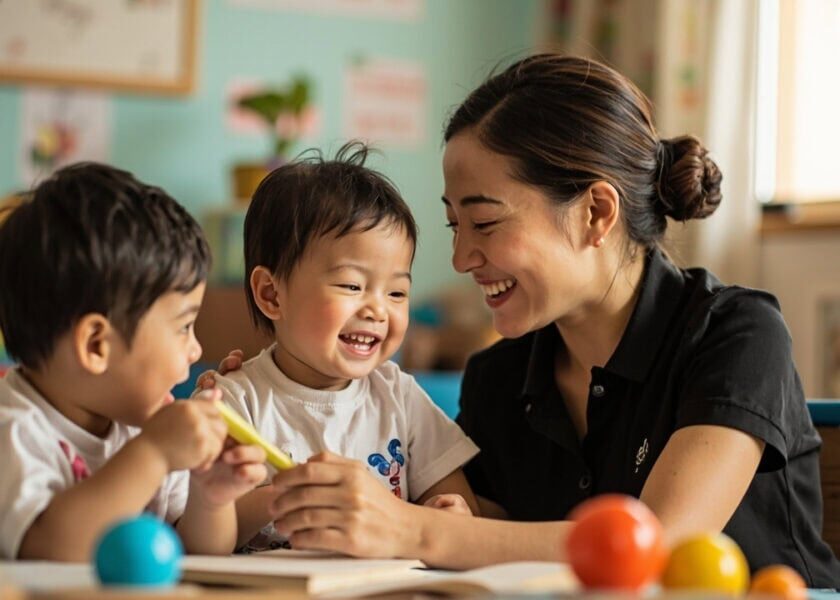
What Your Child Shows You After Pickup: Reading the Evidence of Daily Flourishing
The Gap Between What You Trust and What You Can Verify
Many parents in Singapore tell us the same thing: they have done their research, chosen carefully, and believe in their childcare arrangement — yet a quiet uncertainty persists. It is not distrust. It is something more honest than that — the genuine desire to understand your child’s experience, to feel connected to their development even when you were not there to witness it.
This gap between trust and verification is one of the most common experiences for parents navigating infant care and childminding. You have likely been given advice about choosing childcare, managing separation anxiety, and building relationships with caregivers. What you have probably not received is a guide to interpreting what your child shows you after a full day of good care.
That is the gap we want to help you close. Because quality childcare does not simply keep your child safe and occupied. When it is grounded in developmental understanding, responsive caregiving, and genuine engagement, it produces real, observable effects — effects you can learn to recognize with the same attunement you are already developing as a parent. You may not have been given this language yet. Now you will.
Reading Your Child After Pickup
Consider the evening hours. You pick up your child. Perhaps they are calm, perhaps slightly fussy, perhaps energized in a way that feels different from their morning temperament. What can you actually read in this moment? More than you might think — but only if you know what to look for and how to interpret it.
What Settled Looks Like
The first thing to understand is that a child who has spent the day in responsive, high-quality care tends to arrive home in a particular state. Not perfectly behaved, not artificially serene, but fundamentally settled. There is a baseline of ease.
You may notice it in their body — the way they hold themselves, the looseness in their shoulders, the absence of tension. You may notice it in how they move through space. A child who has been held appropriately, spoken to with attunement, and supported through the ordinary frustrations of the day arrives home available: available for connection, for play, for the kind of unregulated energy that looks like chaos but is actually the healthy expression of a child who feels safe enough to let go.
This baseline of ease is one of the most reliable signs that the day’s experience has been nourishing rather than merely tolerable. When you see it, you are seeing the residue of a caregiving environment that understood your child’s needs and met them.
What to Notice in Language
Language development emerges visibly through evening observation. If your child has been in a rich communicative environment during the day — one where adults narrate, comment, respond to babbling, expand on vocalizations, and engage in the back-and-forth that builds neural pathways — you will see effects.
Watch for new sounds and combinations, responsiveness to familiar words and your voice’s cadence, intentional pointing with an expectation that you will name what they see, increased desire for interaction, and comprehension that outpaces expression. When these signs are present, your child’s day included the communicative engagement that builds the foundation for later speech and learning. When absent, it may indicate the daytime environment needs more richness.
What to Notice Socially and Emotionally
Social-emotional development announces itself subtly but significantly. A key indicator is social referencing — your child glancing at you to gauge how to respond to something new, then returning to explore independently. This is not a lack of confidence. It is the hallmark of a child who has learned that adults are reliable sources of information and safety.
Watch also for social openness — greater interest in engaging with unfamiliar adults, more willingness to explore new social terrain. The goodbye at pickup may be easier than weeks before, and the reunion warm but followed by a quick return to play rather than prolonged distress.
This is not a sign your child does not love you or need you. It means they have developed enough security to trust temporary separation — one of the most meaningful gifts quality childcare offers.
What to Notice Physically
Motor development is often the most immediately visible domain. You may notice new reaching behaviors, improved head control, or the beginnings of rolling or crawling. You may notice how your child handles objects with greater precision or explores textures more deliberately.
These are the product of an environment that gave your child time, space, and encouragement to discover what their body can do. Quality infant care understands that motor development is inseparable from cognitive and emotional growth. The brain planning movement is also planning thought. Observe evening play for signs of fluid, persistent physical engagement.
Also notice fatigue patterns. A child appropriately tired from engaging, supported activity differs from one exhausted by overstimulation or under-stimulation. The first is the healthy fatigue of growth. The second signals a day that did not serve your child’s developmental needs.
What to Notice in Curiosity
Curiosity is one of the most fragile developmental qualities. A child in an environment that encouraged exploration — that set up interesting things to see and do, responded to their interests with enthusiasm, and gave them freedom to investigate — arrives home interested rather than just tired or content. They want to know things. They pull you toward objects, point at things across the room, and sustain attention in ways that suggest their curiosity has been fed rather than dulled.
When you see genuine interest, repeated investigation of objects, and delight in discovery, the daytime environment understood its role as a facilitator of wonder. A child who seems flat, passive, or uninterested in toys may be reflecting a developmental phase — or signaling an environment that has not found the right ways to engage their natural interests.
When Something Feels Different
Regression happens. Increased clinginess, heightened separation anxiety, difficulty being soothed — these too are information. They may reflect a transition, a growth spurt, or a phase. They may also reflect a daytime experience that was not quite attuned to your child’s emotional needs. The distinction matters, and careful observation over time makes it visible.
The key is observation without judgment, attention without anxiety. You are not looking for perfection — you are looking for patterns. Over days and weeks, you will see what becomes typical for your child, and you will notice when something shifts.
What Quality Childminding Actually Provides
In Singapore’s ECDA Childminding Pilot framework, quality care is structured around principles that produce the observable outcomes described above.
Consistent, trained caregivers. Quality care requires continuity. When your child sees the same caregiver day after day, they build the attachment security that allows them to explore, learn, and grow. This is not a soft ideal — it is a developmental necessity.
Appropriate ratios. Attunement requires space, and space requires limits. When a caregiver has fewer children to attend to, each child receives more responsive interaction, more language exposure, and more support for their individual developmental trajectory.
Structured flexibility. Children thrive on predictability, but they also need room to explore at their own pace. Quality care balances routine with responsiveness — predictable rhythms for meals, naps, and transitions, combined with open-ended play opportunities that follow the child’s lead.
Language-rich environments. Every interaction is an opportunity for development. Quality caregivers narrate, comment, expand on vocalizations, and engage in the back-and-forth that builds neural pathways. You see the results at home — in your child’s new sounds, their pointing, their hunger for interaction.
Physical exploration support. Quality care understands that movement is development. Children are given time, space, and encouragement to move their bodies, to reach for objects, to explore textures, and to discover what their bodies can do.
These elements work together. What you observe at home — the settled child, the new sounds, the reaching and pointing, the curiosity — is not coincidence. It is the fruit of intentional caregiving.
Building a Partnership with Your Child’s Caregivers
Observation and understanding become most powerful when shared. What you are learning to read at home can inform conversations with your child’s daytime caregivers. What they observe during the day can inform your understanding of what you see in the evening.
Together, these perspectives create a more complete picture of your child’s development than either could provide alone. When your child’s caregiver mentions a book they were especially drawn to today, and you notice them bring you that same book at home with new enthusiasm, you are seeing the connection between your child’s two worlds. When your caregiver shares that your child has been working on a particular motor skill and you notice the same progress in your living room, you are seeing evidence of consistent developmental support.
When you have a caregiver who welcomes your questions, shares observations willingly, and treats your child’s development as a shared project rather than their private domain, anxiety begins to dissolve. What replaces it is real confidence — built through observation, communication, and mutual investment in your child’s flourishing.
Questions Worth Asking
- What was my child most interested in today?
- Did you notice any new sounds, movements, or behaviors?
- How did nap time go — and how did they seem afterward?
- What did mealtimes look like — curious eating, or just going through the motions?
- How did they seem during pickup — easy or distressed?
These questions invite specific observations rather than generic reassurances. They open the door to the kind of partnership that makes childcare feel like a shared endeavor rather than a leap of faith.
Addressing What Parents Actually Worry About
We know parents in Singapore have legitimate concerns. Let us address some of the most common ones directly.
How do I know my child is safe and well-cared for?
This is the foundational question, and it deserves a direct answer. Safety is non-negotiable, and quality providers build their reputation on it. But beyond safety, consider this: a settled, curious, language-hungry, socially confident child is not just safe. They are flourishing. And flourishing is observable — in the body, in the sounds, in the way they move through space, in the quality of their engagement.
What if I notice something that concerns me?
Observation without a pathway to action is incomplete. When you notice something concerning — a change in baseline, a regression, a sign of distress — you need a caregiver who welcomes that observation as the beginning of a conversation, not the end of one. Quality childminding includes regular touchpoints where observations are shared, questions welcomed, and your perspective treated as essential information about your child.
What about cost?
Many families find that CDA and Baby Bonus funds can offset costs, making quality care more accessible than general perception suggests. The pilot framework is designed to be viable for families committed to quality early care.
What if I still feel anxious even with all this information?
Anxiety about your child’s care is not a failure of trust or a sign that something is wrong. It is the expression of love and investment. A framework for observation does not eliminate anxiety entirely — it transforms it. Instead of vague, passive worry, you have active observation. Instead of uncertainty, you have patterns to track. Instead of feeling disconnected from your child’s day, you have signs to read and a partner to discuss them with.
Practical Steps to Begin Tonight
Here is what we recommend as you begin to read your child more intentionally:
- Start with the baseline. Before looking for specific milestones, notice your child’s general state after pickup. Are they settled? Available for connection? This is the foundation for everything else.
- Track patterns, not moments. One evening of unusual behavior is not a trend. Look for patterns over days and weeks. What is typical on a typical day? What shifts when something changes?
- Keep a simple observation log. Brief notes about new sounds, new behaviors, changes in mood — can help you see patterns over time. You do not need to document everything.
- Ask specific questions at pickup. Instead of “How was her day?” try “What was she most interested in today?” Specific questions invite specific observations.
- Share what you notice at home. “She keeps pointing at books after pickup — I wonder if she had a lot of story time today?” This kind of sharing builds the partnership.
- Distinguish growth fatigue from depletion fatigue. A tired, satisfied child differs from an exhausted, dysregulated one. Learning this distinction helps you read your child’s day more accurately.
- Trust your attunement. You know your child better than anyone. If something feels off, pay attention. Use your observation skills to understand what might be happening.
The Hours You Do Not See
Your child’s development is not a mystery to be solved by experts and reported to you. It is a process in which you are already participating, every day, through the simple act of paying attention.
You are not helpless in the face of what you cannot see. You are not limited to hoping for the best and waiting for reports. You have something more powerful than either of those: the ability to read your child.
Every evening, as you sit with your child after pickup, you are gathering data. You are noticing the state of their body, the quality of their engagement, the sounds they make, the way they move through space, the expressions that cross their face when they encounter something familiar or new. You are, perhaps without naming it this way, doing the work of developmental observation.
The question is not whether you are capable of this. You already are. The question is whether you have a framework that helps you understand what you are seeing.
At EduNanny Singapore, we work to be the kind of childcare partner who actively helps parents read their child. We are part of the ECDA Childminding Pilot because we believe in the model of consistent, trained, in-home and community-based care that keeps the child at the center and builds real relationships over time.
We communicate transparently about what we observe because we believe parents deserve to be partners in their children’s development, not bystanders to it. We understand that transparency builds trust, and trust builds the kind of confidence that allows parents to engage with parenthood from a place of assurance rather than worry.
Your Child’s Everyday Flourishing
The first thousand days of your child’s life are not a period to be endured or managed. They are a period to be witnessed, participated in, and celebrated — even in the fragments available to you. Even in the hours after pickup. Even in the ordinary evenings when nothing dramatic happens and yet everything is happening: underneath the surface, in the wiring of your child’s brain, in the architecture of their social understanding, in the growing confidence of their body, in the expanding reach of their curiosity.
You are not missing those hours. You are receiving their residue, their evidence, their fruit.
Learn to read what your child shows you. Bring what you see into conversation with the people who share your child’s days. That collaboration — that shared attention to your child’s development — is one of the most powerful things you can offer them. Not because it will produce a particular outcome, but because it communicates something essential: that you are paying attention. That their growth matters. That the person they are becoming is worth watching, worth understanding, and worth celebrating.
We are here to be your partner in understanding your child’s development — to help you read what you see, to share what we observe, and to build with you the kind of informed, confident engagement that makes the early years not just manageable but deeply meaningful.
The hours you do not see are not lost hours. They are the hours shaping your child’s future. And now, you have something new to bring to those hours: the skill of reading what they leave behind, the confidence to trust what you observe, and the partnership of a care community that believes, as you do, that your child’s everyday flourishing is worth every moment of attention you can give it.
Welcome to EduNanny Singapore. Let us read your child together.
If you would like to learn more about how EduNanny supports families through the ECDA Childminding Pilot, or if you have questions about getting started, we welcome the conversation. You can also read more about who we are and what guides our approach to quality childminding in Singapore.