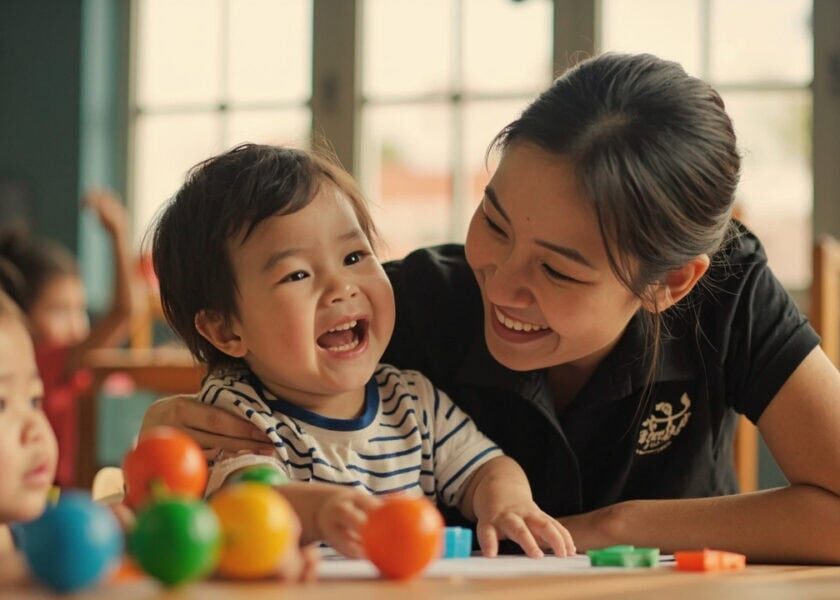
Why Your Child’s Caregiver Should Be Your Greatest Ally
The Gap Where Doubt Lives
For many parents in Singapore, this gap is where doubt lives. You chose a childcare arrangement. You did the research, visited the spaces, asked about qualifications and ratios and meals and sleep schedules. You made what felt like the best decision available, and you handed over the most important person in your life to someone else’s care for the best part of the day.
And now you are expected to simply trust that it is going well.
But trust without connection is just faith. And faith, without any way to tend it, tends to wither.
This is the tension that EduNanny Singapore was built to address—not by promising what no arrangement can fully deliver, but by recognizing that the gap itself is the problem to solve. Not the gap between you and your child’s caregiver, but the gap in how we think about what that relationship should be.
It’s Not a Transaction. It’s a Partnership.
The arrangement you made, the contract or enrollment you signed, the daily drop-off you have been dutifully performing—none of this is actually a service transaction. It is the beginning of a relationship. One of the most consequential relationships your child will experience in their early years.
And if you approach it as anything less, you are leaving something essential on the table.
Partnership changes this. Partnership creates continuity. When you know what happened during your child’s day, when your caregiver knows what you are working on at home, when both of you are paying attention to the same things and talking about them regularly, your child receives a unified message: we are all invested in who you are becoming. You do not have to be one person with your parents and another with your caregiver. We are, in the ways that matter, connected.
What Partnership Communication Actually Looks Like
Partnership communication is not a daily report slipped into your child’s bag or a weekly newsletter with carefully curated photos. These things have their place, but they are still one-directional—the caregiver telling you what they think you should know.
Partnership communication is a rhythm. A back-and-forth that builds over time.
It is the caregiver who notices that your child has been especially clingy in the mornings and asks whether anything has changed at home. It is the parent who mentions that their child has been struggling with a new developmental milestone and asks the caregiver to help them pay attention to it during the day.
When this rhythm takes hold, something shifts. You stop feeling like a customer and start feeling like a collaborator. You stop wondering whether you are being told the truth and start trusting that the person caring for your child is genuinely invested in their wellbeing.
The Gift of Shared Observation
Your child’s first steps, first words, first time they use a spoon with real intention—these moments do not only happen at home. They happen in care. They happen when your child feels safe enough to explore, to fail, to try again.
And the person who witnesses these moments has the choice to keep them to themselves, to note them clinically in a developmental checklist, or to recognize them as gifts—gifts that belong to you as much as to them, because you are both, in different ways, raising this child.
When you understand that your child’s caregiver is not a stranger performing a task but a person who is learning your child, who notices things you might miss, who has perspective you cannot have because you are not there during those hours—you begin to share that perspective with them, and they begin to share theirs with you.
This mutual exchange of observation and insight is the foundation of a thriving partnership.
Building Your Partnership Over Time
Partnership is not a single conversation or a single agreement. It is a living thing that grows, and that requires tending as your child grows.
In the early days of any care arrangement, partnership often looks like orientation. It looks like you spending time in the space, meeting the caregiver, asking questions that reveal your values and priorities. It looks like the caregiver asking questions too—not just about schedules and allergies but about your child’s temperament, their fears, what comforts them, what makes them laugh.
As the weeks and months pass, partnership evolves. It becomes the weekly check-in that is genuinely curious, not obligatory. The middle-of-day observation that shows someone was paying real attention. The conversation at pick-up that goes beyond logistics. The shared preparation when something changes—a new routine, a family transition, a developmental shift.
Your child knows what to expect. Your caregiver knows what to expect. And you can plan your life with a predictability that reduces a different kind of anxiety—the logistical anxiety of figuring out who is watching your child and when.
Navigating Friction Together
There will be friction in any relationship that matters. Partnership does not mean the absence of disagreement. It means having a framework for navigating disagreement with respect and with your child’s interests at the center.
There may come a day when you want to adjust the sleep schedule and your caregiver has concerns. There may come a day when the caregiver notices something about your child’s behavior that concerns them and must find a way to raise it sensitively.
These moments are not failures of the partnership. They are the partnership working. The question is not whether friction will arise but whether you have built enough trust and communication to move through it together rather than against each other.
When you have something you want to say to your caregiver—something that is not a complaint but a request, a concern, an observation—approach it as you would approach any important conversation with someone you respect:
- Be specific. Instead of “she seems unhappy,” try “I’ve noticed she cries at drop-off more than usual this week. Has that been your experience too?”
- Be curious rather than accusatory. Ask for their perspective before sharing your own.
- Assume positive intent. Your caregiver wants your child to thrive. Remember that you are on the same side.
- Be willing to receive feedback in return. Your caregiver sees your child in contexts you do not. They may notice things about your child’s social development or emotional regulation that you are simply too close to see clearly.
- Receive observations as gifts, not judgments. When they bring these insights to you, respond with gratitude rather than defensiveness.
Signs Your Partnership Is Working
How do you know when your childcare partnership is truly working? The signs are quiet and may not announce themselves with fanfare:
- Your child talks about their caregiver with familiarity, not just recognition. They mention things that happened during the day that you did not ask about—small things, specific things.
- They have a sense that this person is part of their world, not a stranger they see briefly each day.
- Pick-up conversations have a different quality. They are not interrogations or debriefs but genuine exchanges between two people who care about the same small person.
- You find yourself looking forward to these conversations, or at least not dreading them.
- You feel known by your caregiver, and you feel that you know them, too—not everything, but enough to trust that they have your child’s best interests at heart.
When these signs are present, something beautiful happens. The anxiety that so many Singapore parents carry—the guilt about not being present, the worry about what happens during the day, the fear that they are missing something irreplaceable—begins to soften.
Not because the questions disappear entirely, but because you have built a relationship that answers them as they arise. You no longer have to wonder whether your child is truly safe, truly nurtured, truly seen. You know.
What EduNanny Is Built to Make Possible
EduNanny Singapore was designed with this kind of partnership in mind. Not to hand you a list of features and leave you to figure out the rest, but to walk alongside you as you build something real with the person who spends their days with your child.
As part of the ECDA Childminding Pilot, EduNanny operates within a framework that values the quality of the relationship between parent and caregiver above all else.
Small Ratios, Real Attention
With small ratios—up to one caregiver for every three infants—EduNanny caregivers can truly observe, truly engage, truly know the children in their charge. When there are fewer children, the caregiver can pay attention. When the caregiver can pay attention, they have something real to share with you. When they have something real to share, the partnership has substance.
Accessibility Without Compromise
Thoughtful care should not be a luxury reserved for families with unlimited options. Through the use of CDA and Baby Bonus funds where applicable, EduNanny works to ensure that quality childminding remains accessible—because partnership should not depend on postcode or income.
Transparency as Trust Infrastructure
Communication and transparency are not add-ons at EduNanny. Where deployed, measures like CCTV provide an additional layer of assurance—not because trust is absent, but because transparency and trust work together, not in opposition.
Knowing that you can check in, that there is nothing hidden, that the space your child occupies is a space you can trust—these things matter. They allow you to let go of the low-grade vigilance that exhausts so many parents. They free you to be present when you are with your child, rather than spending those hours wondering what is happening when you are not.
Thomas: The Infrastructure of Partnership
And then there is Thomas, your AI parenting companion. Not a replacement for human connection, but a bridge to it.
Thomas helps you stay organized, stay informed, stay one step ahead of the questions that arise between check-ins with your caregiver. Thomas helps you prepare for those conversations, process what you have observed at home, and bring useful information to your caregiver when it matters.
Thomas is the infrastructure of partnership—quiet, persistent, supportive—ensuring that the relational work does not fall through the cracks of a busy life.
The Real Choice Before You
The most important professional relationship in your child’s early life may not be with a doctor or a teacher or a coach. It may be with the person who spends their days watching them learn to walk, who celebrates their first attempts at language, who notices when they are struggling and figures out how to help.
This person is your partner. They are not an employee to be managed or a vendor to be evaluated. They are an ally in the most important work of your life, and your child can feel the difference.
EduNanny offers more than childcare. It offers a structure within which genuine partnership can flourish—a model designed around the recognition that parents and caregivers are not on opposite sides of a transaction but on the same side of a child.
The alternative—the passive drop-off model, where you hand over your child in the morning and receive them back in the evening with minimal meaningful exchange—is not neutral. It creates distance. It leaves parents guessing, anxious, uncertain whether the care their child is receiving is actually good or simply adequate. It leaves children in the middle, performing different versions of themselves in different settings, without the continuity that helps them feel truly held.
The relationship you build with your child’s caregiver is itself a developmental asset. Children learn what relationships look like from the relationships they observe and experience. When they see their parents communicating respectfully and regularly with their caregiver, when they see their caregiver treating their parents as partners rather than bosses, when they experience continuity of attention and care across both settings—they are learning something profound about what it means to be known, to be valued, to belong to a web of caring adults who are paying attention.
This is the gift of partnership. Not just that your child is well-cared-for, but that your child understands, in ways they will carry into every future relationship, what it looks like when people work together on behalf of someone they love.
If you are a parent in Singapore exploring infant care or childminding options, you deserve more than adequate care. You deserve a model designed around genuine partnership—sustained, nurtured, and valued.
Explore what a partnership approach to childminding can mean for your family. Learn more about EduNanny Singapore or connect with our team to begin a conversation.