Why Professional Childcare Gives Your Child a Developmental Edge
Quick Summary: What Professional Childcare Gives Your Child
- A secure base for healthy exploration — trained caregivers become anchors, not barriers, helping your child venture confidently into the world
- Rich, responsive language — conversation, not just exposure, builds vocabulary and cognitive pathways in ways a television cannot
- Guided social learning — peer interaction teaches empathy, negotiation, and social cognition that adults cannot replicate
- Expert observation — trained caregivers notice patterns, track development, and may identify concerns early
- Consistent emotional attunement — low ratios mean your child receives genuine, undistracted attention
The Question Beneath the Question
There is a moment, every single day, that happens in car parks and at doorways across Singapore. It is the moment between the handover and the leaving. Your child has been somewhere else—somewhere you could not see, could not hear, could not verify with your own eyes. And in that moment, you lean down, and you ask, or you do not ask, but you wonder: Was my child okay today?
Not just safe. Not just fed and changed and comforted. But okay, in the way that matters. Was today actually good for her?
This is not an anxious question. This is a loving one. Every parent who has left their child in someone else’s care has carried it. It is the weight beneath the logistics, beneath the resumes and the ratios and the site visits.
Here is what many parents do not realize: the question was my child okay? is actually three questions in one.
The first is practical. Was she fed? Was she rested? Was she safe? These are the questions checklists answer, and they matter.
The second is emotional. Was she comforted when she needed comfort? Was someone truly paying attention to her? Did she feel seen?
But there is a third question, quieter and deeper: Was she growing?
Not just existing. Not just being kept. But developing. Building language. Learning to navigate other children. Becoming more curious, more confident, more capable.
This is the question that keeps parents up at night—not because they doubt their child’s safety, but because they want to know that the hours apart were good for her. That choosing professional care was not just a logistics decision, but a developmental one.
What Your Child Is Built to Do
Consider, for a moment, what your child is built to do.
From the earliest months, infants are wired for connection. They reach, they watch, they attach. But they are also wired for something else—something that works alongside attachment rather than against it. They are wired to explore. To pull themselves up on furniture and shriek at the texture of grass. To drop things from high chairs just to see what happens. To march toward a group of children at the playground with no plan, no caution, and complete, radiant curiosity.
This is not random behaviour. This is development in action.
Exploration is how children learn about their world. But exploration requires something to work. A child can only venture so far from what is familiar before the unknown becomes frightening. The child needs a base to return to—a person, a presence, a consistent anchor that says: you are safe, go ahead, I am here when you come back.
This is what developmental psychologists call a secure base. And here is what many parents do not realize: a skilled professional caregiver does not replace this. A skilled professional caregiver becomes one.
The ratios matter here. In infant care settings with up to one caregiver to three infants, your child receives genuine, undistracted attention. Not the divided awareness of a crowded room. Not the partial focus of someone managing five or six or eight. But actual, attentive attunement.
The caregiver notices when your child’s play shifts from confident to uncertain. She notices when the reaching hand needs a hold. She does not just supervise; she anchors.
And when a child knows, deep in the way children know things, that someone is truly there—that person becomes a launchpad. Not a barrier. A launchpad.
What Healthy Separation Looks Like
Healthy separation does not look like a child who has forgotten you. It looks like a child who trusts you enough to go—and who trusts her caregiver enough to venture out, knowing the return will be there.
Watch your child at the beginning of a care session. The child who runs toward the caregiver with excitement, who settles into play quickly, who waves goodbye without distress—that child is not missing you less. That child is feeling secure because of you. Because you chose a place where she can trust what waits for her.
This is what quality professional care builds: not independence as a replacement for attachment, but the kind of confident exploration that only becomes possible when a child feels genuinely held.
Language Built Through Relationship
Now let us talk about language, because this is where professional care often works in ways that are hard to see from the outside.
Every child in Singapore is growing up bilingual, or trilingual, or more. Language is everywhere—in the bus, in the hawker centre, in the way grandparents alternate between Mandarin and dialect without pausing.
But exposure is not the same as development. A child can hear words for years without absorbing their structure, their meaning, the way they connect.
What builds language is interaction. Responsiveness. A caregiver who narrates what a child is doing—“You are stacking the red block on top, look, it is balanced”—not because the child needs the information, but because the child needs to hear language in relationship.
Language used with them, about them, directed at them. This is different from language heard on a television or spoken across a room. This is language in conversation, in back-and-forth, in the rhythm of a morning where every reaching hand and pointing finger receives a response.
In a professional care setting with trained caregivers, this happens all day long. Not as a curriculum item, not as a scheduled activity, but as the natural texture of care. The caregiver speaks to your child as a person. She uses full sentences. She waits for the response, even when the response is a babble that means nothing yet.
Because those babbles are practice. They are experiments. And they matter.
Research on language development is consistent: children who hear more responsive language in their early years have larger vocabularies, stronger comprehension, and more sophisticated sentence structures as they grow. This is not a mystery. It is not luck. It is the result of thousands of hours of real conversation.
A professional caregiver has the time, the training, and the intentionality to provide those hours. She is not multitasking between your child and three other responsibilities. She is present, responsive, and building language in every interaction.
Where Social Skills Begin
We often think of early childhood development in terms of what adults provide—what we teach, what we model, what we say. But children learn from each other in ways that adults simply cannot replicate.
They learn through mimicry, through negotiation, through the raw experience of another small person wanting the same toy at the same time.
Peer interaction in infant and toddler settings is not incidental play. It is the first laboratory for social understanding.
A one-year-old learns, through repeated experience, that other children have intentions. That reaching for a toy might result in a response—not just from the toy, but from the child holding it. This is the beginning of empathy. This is where social cognition starts.
Not in lessons. Not in diagrams. But in the actual, messy, crying-and-sharing-and-crying-again reality of being with other children.
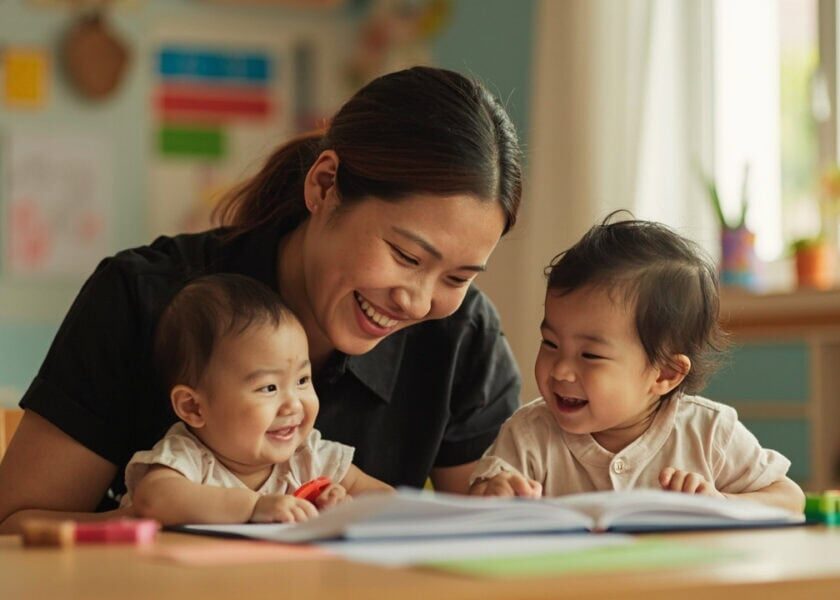
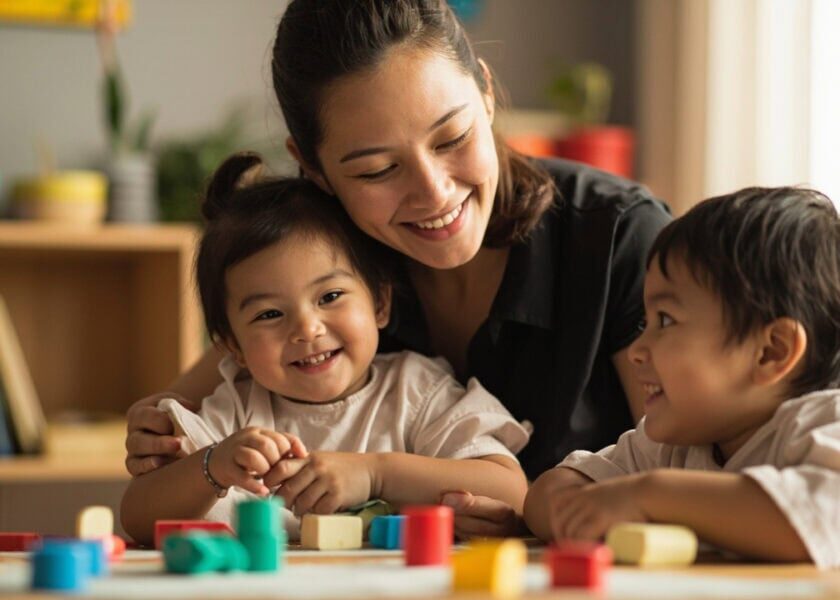
In a professional care environment, this happens daily, consistently, with trained support. The caregiver does not just watch. She guides.
- She helps a child who has been pushed down get back up and rejoin the group
- She helps a child who has taken a toy understand what the other child is feeling
- She names emotions, models responses, and creates space for children to practice
These are not abstract lessons. They are moment-by-moment coaching in what it means to be with others. And the ratios matter here too. With up to one to three infants, there is space for these moments to be handled with care rather than just managed.
Your child is not just being supervised alongside other children. She is learning to be a person in a community of peers—under the guidance of someone trained to make those lessons gentle and meaningful.
The Eyes That Notice
Perhaps the most invisible, and most important, thing that happens in quality professional care is observation.
Trained caregivers notice. They are trained to notice. Not in the way a loving but exhausted parent notices when something is obviously wrong, but in the way a specialist notices patterns.
Consider what a trained eye observes over days and weeks:
- Your child consistently turns away from new textures—she notes it
- Your child reaches developmental milestones in one area faster than another—she tracks it
- Your child responds differently to certain caregivers or peer groups—she records it
She may be the first person outside your family to identify a developmental pattern that deserves attention. Not because she is looking for problems. Because she is looking, period.
Professional training provides the eyes to see what is happening in your child’s development, and the knowledge to understand what it means. Early identification of delays, of preferences, of strengths—this is where support begins. And in a professional setting, there is documentation. There is communication. There are systems built to keep parents informed about what is happening during the hours apart.
This is not surveillance. This is attentiveness. This is the difference between a caregiver who watches your child and a caregiver who knows your child.
Choosing With Confidence
There is something important here that deserves to be named directly, because it is often left unsaid in conversations about professional childcare.
Choosing quality care is not a choice against your child. It is a choice for your child’s development. These are not the same thing.
A parent who enrolls their child in professional care is not stepping back from parenting. They are opening a door to a dedicated developmental environment that works alongside them. The caregiver is not a replacement. She is a collaborator. She is part of the village, even if that village does not look the way villages looked a generation ago.
This matters, because the narrative around childcare in Singapore often frames professional care as something parents do for themselves—because they have to work, because they have no other option, because Singapore is expensive and options are limited.
And yes, logistics are real. Life is real. But framing professional care primarily as a parental convenience misses something fundamental. It misses what the child is receiving. It misses that a high-quality care environment is actively building language, and social skills, and secure attachment, and cognitive pathways that will stay with your child for years.
This is not something parents are doing instead of parenting. This is something parents are choosing because they understand what it gives their child.
What to Look For
For parents researching infant care in Singapore, here is what matters when you are evaluating options:
Ratios matter. Ask about caregiver-to-child ratios. In infant care, lower numbers mean more attention. Up to one to three infants in quality settings means your child is not lost in a crowd.
Observe the interactions. During a visit, watch not the toys or the décor, but the caregivers. Are they on the floor? Are they speaking to children as people? Do they respond when a child reaches or points or babbles? The environment tells you about the philosophy. The interactions tell you about the care.
Ask about communication. How will you know what your child’s day looked like? What systems exist for updates? How are developmental observations documented and shared? Quality care welcomes these questions. It does not deflect them.
Trust your gut. After a visit, notice how you feel. Do you feel like your child could thrive here? Does the space feel warm, attentive, alive? You are the expert on your child. If something feels off, it probably is. If something feels right, trust that too.
EduNanny Singapore: Built on This Kind of Intentionality
EduNanny Singapore, operating under the ECDA Childminding Pilot, is designed around this understanding.
The caregivers are trained and supported. The ratios are structured to allow for genuine attention—not just supervision, but attunement. Communication systems are designed to bridge the gap between what happens in care and what parents know about their child’s day.
Not to create dependency. To create connection. To answer the question you carry at pickup before you have to ask it.
- Home-based care and community or centre-based options — pathways that meet families where they are
- Monday to Friday care blocks — structured around the rhythms of working families
- Pilot fee structures designed with affordability in mind — because quality care should not be available only to those with flexible finances
- Support for CDA and Baby Bonus funds — so financial logistics do not become barriers to quality
- Thomas AI Chatbot — a way to ask questions, get updates, and feel genuinely informed without hovering or doubting
For parents in Tampines and in Tiong Bahru, in HDB flats and in private estates, EduNanny is building something consistent: a care environment that takes development seriously. Not as a slogan. As a practice.
The caregiver-to-infant ratios reflect this commitment. The training reflects it. The communication systems reflect it. Day by day. Ratio by ratio. Observation by observation. Conversation by conversation.
When you understand what is happening during those hours apart, something shifts. The question changes. It stops being “Did I do the right thing?” and starts becoming “I can see exactly why this matters for her.”
Professional care, the right professional care, is not a compromise. It is a developmental environment. And understanding the difference changes everything about how you think about what you are choosing.
You are not choosing to leave her. You are choosing where she grows.
And when you understand what she is receiving—secure attachment, rich language, guided social learning, expert observation, consistent emotional attunement—the weight of that question changes. It becomes lighter. Not because the care is perfect. Nothing is perfect. But because you can see what is happening. You can trust the process because you understand it.
You can see it in the caregiver’s update. You can see it in the way your child runs back to greet her caregiver in the morning, or reaches for a toy she played with yesterday, or uses a word you did not realize she knew. This is what professional quality care gives your child. Not just supervision. Not just safety. But growth. Real, visible, documented growth that you can see and understand and celebrate.
If you are considering infant care or childminding options in Singapore, EduNanny Singapore invites you to explore what quality developmental care looks like in practice.
Visit EduNanny.sg to learn more about the ECDA Childminding Pilot, available care pathways, and how EduNanny supports families across Singapore—from Tampines to Tiong Bahru, and everywhere in between.
Your child is growing in there. And now you can see exactly how.
Tags: #SingaporeChildcare #InfantCareSG #EduNannySingapore #ECDAChildmindingPilot #ProfessionalChildDevelopment