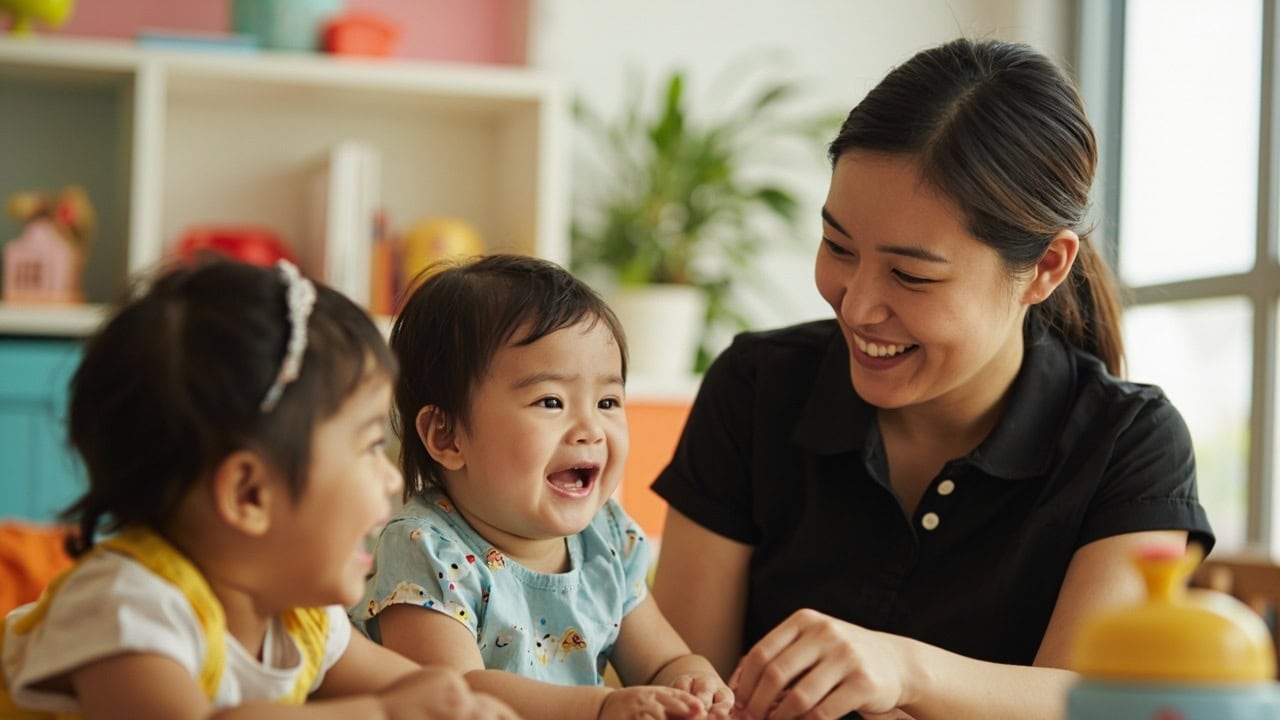
How Singapore Parents Can See Quality Childcare With Confidence
What This Article Gives You
Not a checklist. Not another emotional promise that quality will be there, that trust will come, that peace will find you. This is something more useful than reassurance. This is your eyes back.
Here is a concrete, observable framework for recognizing what quality actually looks, sounds, and feels like when you walk into a childcare room. So that when you leave, you know exactly what you have seen — and you can make your decision with confidence instead of hope.
What Quality Looks Like When You Walk Through the Door
The moment you step through the door of any childcare environment — centre or home-based setting — your senses are already working. You are taking in far more information than you realise. The question is not whether you are paying attention. The question is whether you know what you are looking at.
In Singapore, that is a skill that has been almost entirely absent from the conversation. Here is how to build it.
The Room Itself
Walk in on a Tuesday morning. Before the children arrive, notice what the room feels like — not just visually, but as a space for a small body.
A quality environment has a texture to it. Natural light, yes. But not harsh. Soft edges on the furniture. Materials you would trust a child’s hand against. Low, open shelving that says: this space belongs to the people in it. Rugs that invite sitting. Walls that feel alive rather than decorated.
Walk in again after the children have arrived. Notice whether the room feels settled. Whether children move through it with ease.
A room designed for children is never just about aesthetics. It is about what it feels like to be small in it — a place where small bodies and developing minds are genuinely taken into account.
The Sound Profile
Now close your eyes for a moment. Just slightly. And listen.
A quality childcare room has a sound profile. It is not silent — children are not meant to be silent. But the sound you hear should have a quality to it: a warmth, a rhythm. When children are genuinely engaged, their play has texture. There is the hum of concentration. The murmur of sharing. The occasional spike of excitement that resolves naturally.
Now listen past the children. Listen for the caregivers. Their voices should not be the loudest thing in the room. They should be a calm, warm presence — a counterpoint, not a performance. If the adults are the ones you hear first, that is a room where the children’s development is not the primary focus. If the children are the ones you hear first, and the caregivers are in it alongside them — you are in a different place.
This is what we mean by sensory observation. It is not intuition. It is not guessing. It is the deliberate use of your own experience as a human being in a space, to read what that space is actually communicating.
The Rhythm of the Day
This is where many parents check out during a visit, because they assume schedule equals rigidity. But the truth is more interesting. Rhythm in a quality childcare environment is a form of communication. It is the language caregivers use to tell children: there is order here, and you are safe inside it.
Watch what happens during transitions. When one activity ends and another begins, watch the children. In a room with intentional rhythm, children feel the structure. They do not resist it because it does not feel imposed — it feels like a tide they have learned to trust. They know what comes next. They are not anxious about what is coming because the day has a shape, and they have been included in that shape.
In a room without this kind of rhythm, you will see something different. Children who are restless before transitions. Children who are overstimulated because there has been no quiet building to a pause. Children who are not misbehaving — they are compensating for an environment that has not told them what to expect.
The schedule is not about control. It is developmental architecture. When you know to look for it, you can see it in the children’s bodies within minutes.
How to Read a Caregiver
This is the part of any childcare visit where most parents feel the most uncertain. How do you read a person in thirty minutes? How do you know if the warmth you are seeing is genuine or performed?
Here is what to watch.
Body Positioning
Watch how a caregiver positions their body. Not toward the visitor. Toward the children. Watch whether they narrate what is happening to a child who is not yet verbal — saying, I see you are working with the blocks. I see you found the blue one.
That narration tells you something enormous: this caregiver understands that language is not just for speaking. It is for thinking. It is for the child who is listening even when they cannot answer.
Watch whether they kneel. Not performatively, not theatrically. Watch whether their body instinctively lowers to meet a child’s gaze, because they understand that eye contact at a child’s level is not a technique. It is respect.
How They Respond to Distress
This is the moment that will tell you more than any brochure ever could.
When a child cries, do they reach for the child or do they reach for the phone to document? When a child falls, do they respond first and report second, or the other way around? Watch their hands. Watch whether they move with a kind of automatic tenderness — a muscle memory of care that comes from training and from something deeper. Watch whether their voice changes when a child is upset, dropping into a register of reassurance that says: I have you. You are not alone. I know this is hard.
Whether They Notice What Is Not Being Said
Watch whether the caregiver is responding to what is not being said. Watch whether they notice the child who is quiet and move toward them. Watch whether they register a shift in mood before the child has expressed it.
A trained caregiver who has worked with infants and young children develops a kind of peripheral awareness — they are always scanning, not because they are worried, but because they are paying attention to everything. That attentiveness does not look dramatic from the outside. It looks like someone who knows their children. And that knowledge is only possible when there are enough children and enough trained adults in the room to allow for it.
Questions That Reveal Philosophy
Observation during a visit tells you what is happening. The right questions tell you why. Here are the questions that reveal philosophy rather than just policy.
- How do you handle a child’s individual sleep and feeding schedule? — If the answer is flexible and individualised, that signals developmental respect. If it is “we follow the group schedule,” that is a different philosophy.
- Can you tell me about a child’s day — not the group’s, but one child’s? — A caregiver who can answer this specifically has the attention-to-individual ratio that produces real quality.
- How do you communicate with parents between visits? — This is not about daily photos. It is about whether the communication is proactive, specific, and developmentally meaningful.
- What happens when a child is upset or distressed? — Listen for the instinct. Listen for whether the answer prioritises the child’s emotional regulation or administrative documentation.
Watch the Children — They Are the Most Honest Data
This is the part of a childcare visit where most parents look at the toys or the walls or the caregiver’s qualifications. But the children are the most honest data in the room.
Watch their faces. Watch whether they are the kind of calm that comes from safety, or the kind that comes from suppression. These look similar from a distance, but they are completely different. A child who is safe and engaged has a kind of brightness behind their eyes — a curiosity that is active, not just compliant. They are not just watching the room. They are exploring it.
Absorption and Return
Watch how they play. Watch whether they lose themselves in play and come back. That rhythm — absorption and return — is one of the most important signs of healthy development in a young child. It means the environment is secure enough for them to go deep, and the relationships are strong enough for them to come back.
Social Learning in Action
Watch whether they share. Whether they negotiate. Whether a caregiver has to intervene or whether the children have learned to work it out together. That capacity to work it out together is not innate. It is taught, and it is caught, and it only happens in an environment where social learning is valued and modelled by the adults in it.
Autonomy Within Limits
Here is a quality that is almost never discussed in childcare marketing, but which you can see the moment it is present: the environment’s relationship with autonomy. Not freedom — autonomy. The understanding that even the smallest child has preferences, has opinions, has a will that deserves to be respected within appropriate limits.
Watch whether children are allowed to choose. A juice cup. A place to sit. A toy to bring to the circle. Watch whether the caregiver asks rather than directs, whether they suggest rather than assign. A quality environment gives children the experience of having some control over their world, because it knows that this experience is not a luxury. It is the foundation of confidence, of self-regulation, of the belief that one’s actions matter.
Watch whether this autonomy is balanced — not chaotic, not permissive, but genuinely respectful. That balance is one of the hardest things to achieve in infant and childcare, and when it is there, you can feel it. It feels like a room where children are both loved and trusted. Both held and allowed to reach.
What you are really watching, when you watch all of this, is whether the environment was designed for the child or for the adult’s convenience. Every decision — the layout, the schedule, the caregiver’s tone, the way feeding and sleep are handled — reveals which priority it serves. And once you know to look for that question, you will be surprised at how quickly the answers become visible.
What Quality Looks Like When the Conditions Are Right
The conditions that allow for the quality described above are not accidental. They are designed.
The ECDA Childminding Pilot creates a framework within which the ratios, the training, the oversight, and the culture of care can function in the way that actually produces quality rather than the appearance of it. In the infant programme, up to three infants per caregiver means that a caregiver is not managing. They are noticing. They are responding. They are present in a way that is only possible when there is enough space in the room — and enough space in the adult’s attention — to actually see each child.
Within this framework, whether you choose a home-based pathway or a centre-based one, the underlying philosophy is the same: the child’s individual rhythm is not an obstacle to be managed. It is the architecture of the day. Every infant has a care profile. Every child’s patterns are tracked, understood, and respected. When you ask a caregiver in a setting built on these principles about a child’s day, they will not give you a general summary. They will tell you about that child. Because the structure allows them to know each one, and the training has taught them to notice what matters.
This is what differentiates quality that is designed to be seen from quality that is merely promised.
When You Return to a Childcare Visit
There is something that sits underneath all of this that Singapore parents carry more than they say. The pressure. The weight of wanting to get this right. Many families are navigating dual-income households, managing work demands that do not pause for childcare decisions, dealing with extended family opinions, and reading enough online information to make your head spin.
You are not just choosing a childcare provider. You are making one of the first and most consequential decisions about who will help you raise your child. And yet the tools you have been given to make that decision have been inadequate. A tour that feels like a performance. A brochure full of stock images of happy children. A checklist that tells you whether there are fire extinguishers and whether the kitchen is clean, but says nothing about whether your child will be seen.
Here is what I want you to carry with you.
- Notice the light and who it serves.
- Listen to the sound and what it tells you about the children’s experience.
- Watch the transitions and understand that rhythm is not rigidity — it is language.
- Watch the caregivers and read not their words but their bodies, their instincts, the way they move toward a child who has not yet asked for anything.
- Watch the children and let their faces tell you whether this is a place where they are developing or merely being kept.
Quality has always been visible. It has simply been waiting for parents who know how to see it. And the truth is, you already have the instincts for this. You have spent your entire life reading rooms, reading people, understanding what is really happening beneath the surface of a social interaction.
What this article has done is not teach you a new skill. It has told you that you already have it. You have always had it. And you deserve to use it where it matters most — in the place where your child spends their day.
Choosing childcare is one of the most personal decisions a family makes. At EduNanny, we believe parents deserve environments designed around the child — not around convenience. Learn more about our approach, or reach out to begin a conversation about what your family needs.