Why Movement Builds the Neural Foundation for School Success in Singapore
What Singapore Schools Are Actually Assessing
For years, the conversation around school readiness in Singapore has centred on academic preparation — letter recognition, number sense, the ability to follow instructions, the social confidence to raise a hand in class. Parents have responded with remarkable commitment. Enrichment classes begin before children can reliably tie their shoes. Worksheets are completed at the dining table before breakfast.
The investment of time, money, and hope is enormous, and it is not misplaced. Academic preparation matters. But it is built upon something else. Something that Singapore schools have quietly been assessing all along — through physical screening, through teacher observations, through the simple, daily reality of a child who must exist in a body for six hours a day.
The foundations that allow a child to sit, to attend, to write, to regulate, to move through a school day with their nervous system intact — these are sensory-motor foundations. They are not built through workbooks. They are built through movement, through play, through the thousand small sensory experiences of early childhood.
Sensory Processing and Regulation
Sensory processing is the capacity of the nervous system to take in information from the body and the environment — through sight, sound, touch, movement, and the internal senses that tell us where our body is in space — and to organise that information into adaptive responses.
When a child can sit comfortably through the noise of a classroom, transition between activities without distress, tolerate the feel of a starched uniform or the brightness of a hall light — they are demonstrating sensory regulation. This is not a soft or abstract skill. It is a neurological function that sits at the very foundation of a child’s ability to learn.
Motor Coordination
Motor coordination follows closely. Gross motor skills — running, jumping, climbing, maintaining postural control against gravity — build the core strength that eventually allows a child to sit upright in a chair without fidgeting.
Fine motor skills — the refined grasp, the pincer movement, the wrist stability needed to control a pencil — develop through thousands of hours of sensory-rich play: digging in sand, manipulating play dough, threading beads, tearing paper, pouring water. These are not activities that prepare a child for school in the abstract. These are the activities that build the very muscles and neural pathways that writing, drawing, and cutting require.
The Neurological Link Between Movement and Cognition
Underneath both sensory processing and motor coordination is something we rarely discuss in parenting circles but that developmental science has long understood: the neurological link between physical movement and cognitive development.
When a child moves, they are not merely exercising their body. They are building the neural infrastructure that makes sustained attention, working memory, and executive function possible. The cerebellum, the basal ganglia, the sensorimotor cortex — these structures develop through movement and they are the ones that make thinking possible.
This is the hidden curriculum of early childhood. And it is the curriculum that no worksheet can teach.
The Developmental Windows That Do Not Stay Open
What makes this especially urgent is that the developmental windows for sensory-motor foundations do not stay open indefinitely.
In the first three years of life, the sensory systems of the brain are developing with extraordinary speed and extraordinary sensitivity to experience. This is not to say that development stops after age three — it does not — but the efficiency with which these pathways are established, the depth of the networks that form, the ease with which regulation becomes an automatic capacity rather than a conscious effort — these are shaped most powerfully in the earliest years.
A child who has not had sufficient opportunity to move, to explore, to experience a wide range of sensory input in a supported and responsive environment arrives at Primary One with a sensory-motor system that is simply less developed than it could have been. And this is not a failure of the child. It is a gap in what we prepared them for — a gap most parents discover only when it is already a struggle.
It is also worth noting that this is not a reflection of parenting inadequacy. Singapore parents are extraordinarily committed. The gap lies in what the system has prepared them to prioritise — and what it has left unaddressed.
What School Readiness Actually Requires
When Singapore schools conduct physical screening before Primary One, they are not merely checking height and weight. They are quietly assessing several key areas of your child’s development:
- Postural control and core stability — can this child sit upright for extended periods?
- Fine motor coordination — can this child hold a pencil with control?
- Sensory regulation — can this child manage the sensory demands of a classroom?
- Physical stamina — can this child sustain attention through a full morning?
- Body awareness — can this child navigate spaces, manage transitions, and regulate their physical responses?
These are the questions that determine whether a child will thrive or struggle in those first months of formal education. And these are the questions that no enrichment class, no worksheet, no amount of letter recognition can answer.
A child who is academically ahead but sensorially and regulatorily underprepared will struggle in ways that are invisible to everyone except the child living them. They are not unintelligent. They are not lazy. They are experiencing a genuine mismatch between the demands of school and the readiness of their nervous system to meet those demands.
What Preparation That Actually Works Looks Like
Preparation that builds school readiness begins with a different understanding of what early childhood is for.
Early childhood is not a waiting room before school. It is not a place to accelerate academic content so that the real learning can begin. It is a unique developmental period in which the sensory-motor foundations of all future learning are being laid — not through instruction, but through embodied experience. Through a child who is moving, exploring, failing, trying again, adapting, regulating, and building the internal architecture that will carry them through every year of formal education that follows.
The Daily Sensory-Motor Curriculum of Quality Childcare
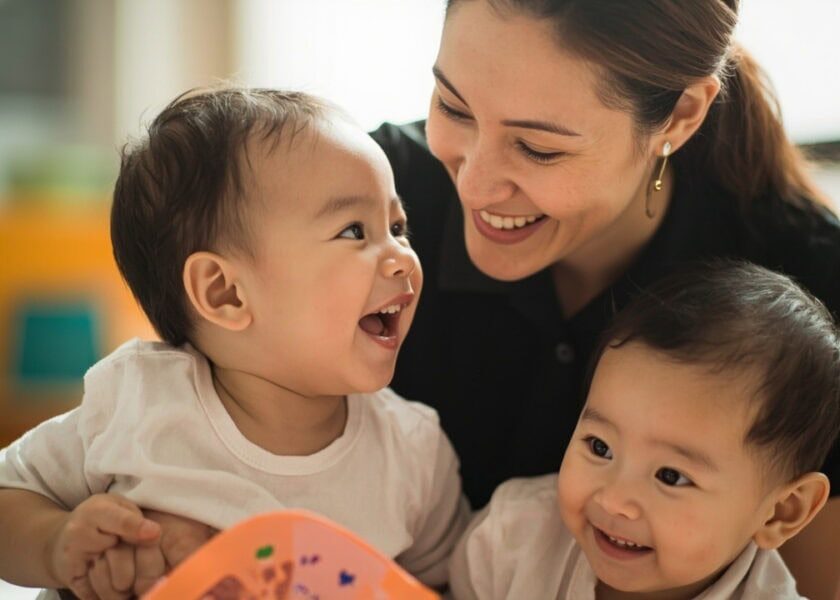
When an infant or toddler in a quality care setting spends their morning moving between activity stations — building with blocks that require grip strength, manipulating sensory materials that refine tactile discrimination, climbing structures that challenge balance and body awareness, engaging in pretend play that integrates sensory input with social and emotional processing — they are not simply being entertained. They are building the sensory-motor platform that school readiness requires.
The best infant and childcare programmes are built around what developmental science tells us about how children grow. They create environments rich in the sensory experiences that develop neural pathways. They structure movement opportunities that build motor coordination progressively. They allow unstructured play that gives children the space to explore, adapt, and self-regulate at their own pace.
Critically, they do this every single day — consistently, over time, through the full arc of early childhood — which is the only way these foundations can truly be built.
The Role of the Trained Caregiver
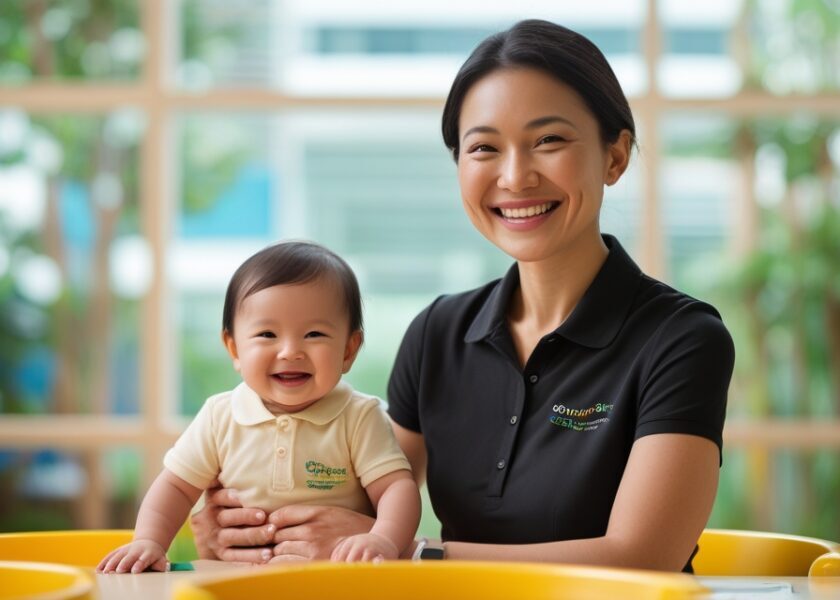
The caregiver in such a setting is not merely a supervisor. They are an active participant in this developmental work.
A trained caregiver observes. They notice which children seek out movement and which avoid it. They note which children become dysregulated in noisy environments and which remain calm. They see which toddlers have the hand strength to manipulate small objects and which are still working toward that capacity.
They understand that a child who struggles with transitions is not being difficult — they may be experiencing a genuine sensory regulation challenge that requires a patient, adaptive response. This is daily, invisible work. The work of noticing, responding, creating experiences that gently expand a child’s capacity, and building the sensory-motor foundations that will serve that child not just in Primary One, but in every year of learning that follows.
EduNanny Singapore: A Partner in the Earliest Years
EduNanny by BUTLER is built around the understanding that the early years are the most consequential years for sensory-motor development. Through the ECDA Childminding Pilot, EduNanny offers Singapore families access to childminding care that puts quality, trained caregivers alongside the children who need them.
The pilot makes this accessible — not as an aspiration, but as a practical reality for families navigating the real costs and logistics of quality care. Pathways exist both in home-based settings, where a child receives individualised attention in a familiar environment, and in community and centre-based settings, where collaborative learning enriches the developmental experience.
The infant ratios in quality programmes through this pilot reflect the seriousness of the commitment: where there are infants, there is the space for the responsive, individualised care their development requires. Monday to Friday care blocks give families the consistency that children’s developmental routines depend on. And for families navigating the financial reality of quality care, the pilot fee structures, combined with the usability of CDA and Baby Bonus funds, make this more accessible than many parents expect.
Communication and Trust
Throughout every interaction, EduNanny is guided by a commitment to transparency. Communication with families is ongoing, honest, and substantive — not a daily summary of meals and naps, but a real partnership in understanding each child’s developmental journey. Where deployed, security measures including CCTV reflect the non-negotiable trust that must exist between a care provider and the families they serve.
What EduNanny Is Actually Building
All of this — the pedagogy, the ratios, the training, the communication, the trust — exists for one purpose. Not to fill a childcare slot. To build something in a child that will outlast every worksheet, every enrichment class, and every milestone of the school years that follow:
- The sensory-motor platform that makes learning possible
- The regulatory capacity that allows a child to engage with the world without being overwhelmed by it
- The physical, neurological, and emotional foundations that will carry them through Primary One and beyond
Choosing the Right Infant Care in Singapore
If you are researching infant care or childminding options for your child in their earliest years, here are the questions worth asking:
- How does this programme build sensory-motor development? Look for daily movement opportunities, sensory-rich environments, and play-based activities that develop both gross and fine motor skills.
- What is the caregiver-to-child ratio? For infants, lower ratios mean more individualised attention and better observation of developmental needs.
- What training do the caregivers have? Trained caregivers can identify sensory-motor developmental needs and respond appropriately.
- How does the programme communicate with families? Look for substantive, ongoing communication about your child’s development, not just daily logs.
- What does a typical day look like? Quality programmes balance structured activities with unstructured play and include ample opportunity for movement.
If you are wondering whether your child may already be showing signs of sensory-motor gaps — difficulty sitting still, trouble with pencil grip, overwhelm in noisy environments, fatigue after short periods of seated work — a trained caregiver in a quality programme will notice these signs and can help you understand whether your child needs additional support. The earlier these patterns are identified, the more effectively they can be addressed.
The Readiness That Matters Most
Every parent in Singapore wants their child to be ready for school. That desire is not in question. What we are only beginning to understand — and what EduNanny has made it its purpose to address — is what readiness truly means.
It means a child who can sit, attend, write, and regulate. A child whose nervous system is not overwhelmed by the sensory demands of a classroom. A child whose body is a platform for learning, not a barrier to it. A child who is not academically ahead but sensorially and regulatorily behind — and therefore struggling in ways that are invisible to everyone except the child who is living them.
This is the readiness that matters most. And this is the readiness that requires the right partner in the earliest years.
EduNanny Singapore is that partner. Not because they offer a shortcut — there is no shortcut. But because they offer the only thing that actually works: consistent, expert, developmentally informed care in the years when it matters most.
Your child’s readiness for Singapore’s schoolrooms begins long before they step into one. It begins in the first thousand days. And it begins with the people you trust to care for them during those days.
That is the readiness no worksheet can build. And that is the readiness EduNanny Singapore is here to provide.
To learn more about EduNanny’s ECDA Childminding Pilot, explore our approach to childcare, or speak with our team, we welcome you to reach out.