What Trained Eyes See in Singapore Childcare Centres
A Framework for Seeing: What This Guide Gives You
After years of working with families across Singapore, we have learned something important: parents are not lacking in care or concern. They are lacking in a professional framework for recognition. They are not careless. They are un-equipped.
And there is a significant difference.
This guide will give you that framework. When you finish reading, you will know how to:
- Read a caregiver’s responsiveness in real time
- Understand what children’s behaviour actually signals
- Distinguish a busy room from an engaged room
- Spot individual attention in a group setting
- Ask questions that reveal philosophy, not just policy
- Evaluate consistency across visits without being intrusive
You will leave your next childcare visit knowing something you did not know before—not just how you felt, but what you saw.
What Your Instincts Are Already Telling You
Walk into any childcare room and within thirty seconds, you will form an impression. This is automatic. Your nervous system is designed to read rooms, to sense tone, to pick up on emotional weather.
But what most parents do not realise is that this impression—this gut feeling—is picking up on real data. It is just unprocessed data.
You are registering the emotional atmosphere of the room. You are noticing whether the space feels alive or merely occupied. You are sensing the quality of the interaction—or the absence of it.
Your instincts are telling you something true. You simply need to learn how to translate.
This is not a checklist. Not a scoring system. This is a way of seeing.
The Three Practices of Observation
The moment you step into a childcare room, pause before you speak. Do not smile and nod. Do not reach for the brochure. Stand still for ten seconds and just observe.
Not the furniture. Not the decorations. Not the posted curriculum on the wall. Observe the people.
Practice One: Watch the Caregiver’s Hands and Posture
Watch a caregiver for thirty seconds without them knowing you are watching. What are their hands doing? Are they resting near a child, available, warm? Or are they folded across their chest, braced?
Are they looking at the children or looking past them toward the next task?
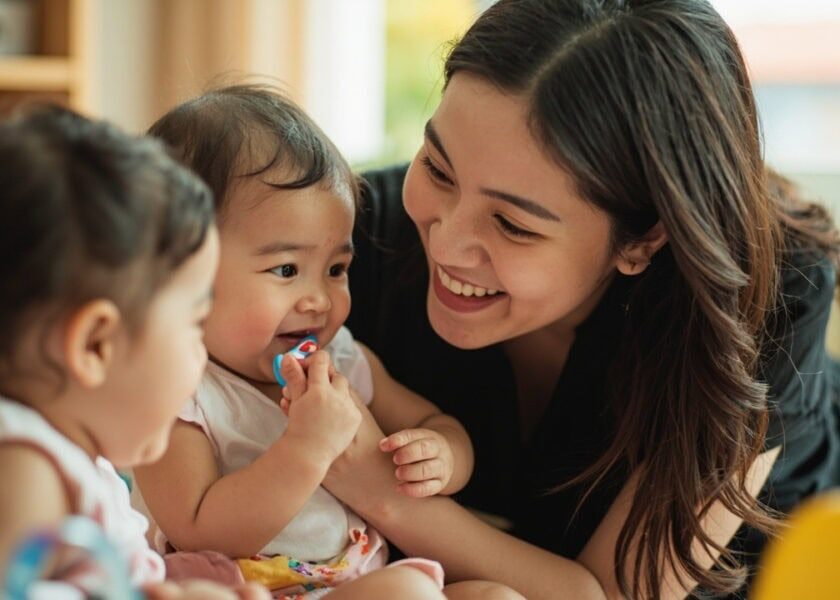
When a child approaches—and in a high-quality room, children will approach caregivers freely, without hesitation—a caregiver in a responsive environment will shift their body toward that child. They will crouch or bend. They will use the child’s name. They will not simply acknowledge the approach. They will complete the circuit of attention.
That is what responsiveness looks like in real time. It is not a policy. It is a posture. A quality of presence.
Practice Two: Watch the Children
This is where the trained eye sees things that most parents miss.
A room full of children who are quiet and compliant is not necessarily a high-quality room. It may be a room where silence has been purchased at the cost of agency.
But a room where children are talking to each other, making eye contact, negotiating over blocks, carrying toys from one area to another, crying when they are hurt and being comforted by another child—that is a room where something important is happening.
The first signal you are looking for: the children should look like themselves.
They should have faces that are fully expressed. They should be allowed to be bored, frustrated, joyful, angry, and tender, all within the rhythm of the day.
A room where children are only smiling is a room where something is being managed. A room where children are fully themselves is a room where something is being nurtured.
Practice Three: Listen to Language
Language is not just a nice-to-have. It is infrastructure.
In a high-quality infant or toddler environment, you should hear adults speaking to children in complete sentences. Not baby talk. Not commands. Not the verbal equivalent of barking orders.
You should hear what researchers sometimes call extended wait time—adults who ask a question, then pause, then genuinely wait for a response, then respond to what the child said.
You should hear children being named. You should hear children being narrated to: “I see you are putting the blue block on top of the red one. That is a tall tower.”
This is not empty chatter. This is the literal scaffolding of thought. When a caregiver names what a child is doing, they are helping that child build the architecture of causality, sequence, and meaning.
If you walk into a room and you hear mostly directives—stop, no, don’t, sit down, come here—and very little else, you are seeing a caregiving environment that is managing behaviour rather than building language.
Both may keep children safe. Only one is making them smarter.
Practice this during your visit: spend two minutes just listening to the verbal environment. Ask yourself:
- Are caregivers speaking in complete sentences or fragments?
- Do you hear narration of what children are doing, not just directions about what they should do?
- Is extended wait time present—genuine pauses for children’s responses?
- Are children named individually, or referred to only as groups?
This is not about perfection. It is about patterns. You will not hear flawless responsive language in every moment of a busy morning. But you should hear it regularly.
Finding the Individuals
One of the most important questions you can ask yourself during a visit: where are the individuals?
Pick one child in the room. Any child. Watch that child for two full minutes.
During that two minutes, does an adult make eye contact with that specific child? Does a caregiver kneel down to their level, use their name, and respond to something they are doing or feeling?
If you watch ten different children for two minutes each, you should see individual attention distributed across several of them. It does not need to be all ten. But it should not be none.
Individual attention is the marker that separates childcare that is processing children through a program from childcare that is genuinely knowing them.
When you see a caregiver who notices that a particular child has not touched their snack, who notices a slight change in mood, who notices that a toddler is trying to put on their own shoe and offers quiet encouragement rather than taking over—that caregiver is practicing the art of the individual.
Reading the Room: Beyond Surface Signals
You have heard parents say, “The place was so clean.” Or, “There were so many toys.” These are surface signals. They matter, but they are not diagnostic.
Intentional Design vs Just Furnished
Look at the activity areas. In a well-designed early childhood environment—based on decades of research validated across cultures—children should have access to different zones:
- A quiet area for books or solitary play
- A constructive area for building, manipulating, creating
- A physical area for gross motor movement
- A creative area for art, sensory play, open-ended materials
You do not need to see all of these in every infant room. But you should see intentional design. You should see that the space has been thought about, not just furnished.
Busy vs Engaged
There is a critical distinction between a busy room and an engaged room.
A busy room has children in it, moving through activities, rotating through stations, being entertained. An engaged room has children who are deeply involved in something.
You will know the difference because engaged children often do not notice you. They are absorbed. There is a quality of concentration on their faces. They are not waiting for instruction. They are initiating. They are discovering.
A room where every child is always being directed to the next thing is a room that has confused activity for engagement.
A room where children are sometimes doing nothing in particular—just pouring water from one container to another, just stacking cups, just sitting and watching—is a room where real learning is happening.
Play without a visible product is not wasted time. It is the most important work a young child does.
What Trained Caregivers Do When Not Directly Interacting
When you see a caregiver who is not currently speaking to a child, notice what they are doing.
Are they glancing around the room in a slow, deliberate sweep? That is a trained practice called environmental scanning. It means the caregiver is reading the room—the emotional tone, the proximity of children to each other, the state of the materials, the signs of an impending conflict.
A caregiver who is scanning is a caregiver who is preventing rather than reacting. That is the difference between a room that feels calm because problems are being solved before they escalate, and a room that feels calm because problems are being suppressed until they explode.
Are they kneeling or sitting rather than standing? Physical posture matters enormously. A caregiver who stays at adult eye level is a caregiver who is seeing the world from their own perspective. A caregiver who comes down to children’s level is a caregiver who is seeing it from the children’s.
When you are on the floor, you see what they see. You are in their world.
When Things Go Wrong: Philosophy Becomes Visible
Here is a practical question to carry into every visit: what happens when something goes wrong?
When a Child Falls or Cries
When a child falls and cries, what happens?
Do multiple caregivers rush over, creating a crowd that may actually escalate the child’s distress?
Or does one caregiver approach calmly, name what happened, offer comfort at the child’s pace, and allow the child to return to play when they are ready?
Neither response is wrong, but they reflect very different training and philosophy. The second response demonstrates confidence in the child’s resilience and knowledge of how to support rather than overshadow.
When Children Conflict
When two children fight over a toy, what happens?
Do you hear a caregiver command them to share?
Or do you see a caregiver approach, observe the situation, perhaps offer a language solution—”You were using that first. I will hold it here until you are ready”—and give the children space to resolve the social complexity themselves?
Sharing is a developmental skill that toddlers are still learning. Commanding sharing does not teach it. Creating conditions where sharing becomes possible does.
The second approach takes more skill, more patience, more confidence. It is the mark of a caregiver who understands child development.
Why These Moments Matter
These moments—falling, conflict, frustration, disappointment—are not disruptions to quality. They are quality. They are the moments when you can see what a caregiver actually believes about children.
You cannot manufacture these moments on a tour. But if you are lucky enough to see even one, pay close attention. It will tell you more than any brochure ever could.
Consistency: Quality Is Not a Snapshot
You may visit a childcare on a Tuesday morning and find it warm, calm, and alive with engagement. That is one data point.
What happens if you come back on a Thursday afternoon? What happens on a rainy day when the children have been inside for longer than usual?
Quality is not a performance that can be sustained for one tour. It is a culture. And cultures reveal themselves over time, in different conditions, under different pressures.
Ask about staff consistency. Ask how long the caregivers have been in the room. Ask about the ratio of lead teachers to assistant teachers. Ask what happens when a caregiver is sick and how the centre handles coverage.
These are not intrusive questions. They are the questions of a parent who understands that quality is a practice maintained across time, across staff changes, across the ordinary disruptions of human life.
Questions That Reveal Practice, Not Just Policy
When evaluating any childcare, ask questions that get beneath the surface. Not “What is your curriculum?” but:
- What happens when my child is upset?
- What happens when they do not want to eat?
- How do you handle a child who is struggling to sleep?
- What does a typical morning actually look like?
- How do you support a child who is transitioning from home?
- Can I see the room where my child will spend most of their time?
- How do you communicate with parents about daily experiences?
These are the questions that reveal whether you are being sold a philosophy or whether you are being shown a practice.
What EduNanny Offers Singapore Families
EduNanny participates in the ECDA Childminding Pilot, and that participation is not incidental.
It reflects a belief that infant and toddler care is not a lesser version of early childhood education. It is its own discipline, requiring specific training, specific ratios, and specific understanding of how children develop in the first years of life.
In our home-based care model and our community and centre-based pathways, we maintain ratios of up to one caregiver to three infants. That is not a government minimum we are reluctantly meeting. It is a design choice we made because we believe that the number of children one adult can truly know, truly respond to, and truly support is small.
Quality at this age is not about scale. It is about the depth of attention that is possible when a caregiver is not spread across too many small lives.
Reliability and Accessibility
Our care operates Monday to Friday in structured care blocks. Singapore parents need reliability. They need to know that when they drop their child at eight in the morning, the environment that child enters is the same environment they will find at noon.
We build our schedules around that reliability. We build our staffing around it too.
We know that Singapore parents carry financial weight when they make these decisions. So we have designed our pilot fee structures to be accessible. CDA and Baby Bonus funds are usable with us. We want the conversation about quality to include every family in Singapore, not only the ones for whom cost is not a constraint.
Transparency as Practice
We welcome your scrutiny. We want you to come to our visits with trained eyes. We want you to watch our caregivers. We want you to watch the children.
Where we deploy communication tools, transparency measures, or CCTV systems, we do so not because we have something to hide but because we believe parents deserve to be in relationship with what is happening with their children during the hours they are in care.
You should not have to wonder. You should not have to guess whether your child had a good day or a hard one. You should be told, shown, included.
That is not an added feature. It is a reflection of how we understand the relationship between parents and caregivers—as a partnership built on information, not on trust without evidence.
Come and Look Closely
EduNanny exists because we believe every family in Singapore deserves access to infant care that can withstand scrutiny. Care that does not need to be explained away or defended. Care that is proud to be observed, proud to be understood, proud to be known.
We are not asking you to trust us blindly. We are inviting you to look closely, ask hard questions, and choose from a place of genuine understanding.
That is what we mean when we talk about partnership. Not a word on a brochure. A practice between families and caregivers, built on the daily, visible evidence of quality.
The children in a high-quality care environment are not performing. They are not performing for their caregivers, and they should not need to perform for you.
They should simply be allowed to be entirely, completely, unmistakably themselves.
When you see that—when you walk into a room and see a child who is frustrated and is allowed to be frustrated, a child who is proud and is allowed to be proud, a child who is tired and is held with gentleness—that is when you will know.
Not because someone told you to trust it. Because you will see it. With your own trained eyes.
The Standard Every Singapore Parent Deserves
You came into this article without a framework. You are leaving it with one. Not a rigid one. Not one that reduces everything to scores or checklists.
A way of seeing. A habit of attention.
The next time you walk into a childcare room, you will pause. You will observe before you react. You will watch the caregiver’s hands, the children’s faces, the quality of language in the room. You will look for individual attention. You will notice whether the children look like themselves. You will read the room’s emotional weather. You will ask questions that reveal practice, not just policy.
And you will leave that visit knowing something you did not know before—not just how you felt, but what you saw.
That is the difference between choosing with hope and choosing with insight. Both involve courage. Only one involves power.
You deserve to feel powerful in this decision. Not because the stakes are not high—they are. Not because you should not trust your instincts—you should. But because the combination of your heart and your trained eyes is more reliable than either one alone.
Parents in Singapore are not inadequate. They are underserved by content that tells them how to feel without teaching them how to look.
That ends here.
If you are exploring childcare options in Singapore and want to visit an environment designed for informed observation, we invite you to schedule a visit with us.
Come with your questions. Come with your trained eyes. Come ready to see what quality looks like when it has nothing to hide.
Because you deserve to feel powerful in this decision. And you are now equipped to be.