From Doubt to Understanding: A Singapore Parent’s Guide to Reading Your Child’s Development
The Moment Every Singapore Parent Knows
There is a moment, quiet and almost private, that most parents in Singapore know well. It happens at the gate of a childcare centre, the door of a home-based care environment, or the threshold of a familiar room where a trusted caregiver waits. You lean down to kiss your child’s forehead. You say the words that are supposed to sound confident. And then you walk away carrying a question you may not even fully articulate to yourself: what is happening to my child right now?
This is not an irrational fear. It is the mathematics of love. You have known this child since before they drew breath. You have learned their cries and their laughs and the precise temperature of comfort they need. You are the centre of their world, and they are the centre of yours, and leaving that centre—even for hours, even with full trust—requires a kind of faith that does not come easily to anyone who loves deeply.
Here is what this article is designed to give you: not reassurance that sounds hollow, but understanding that holds up under scrutiny. Not a sales pitch, but a framework for knowing. Because the answer to the question—what is happening to my child right now—is knowable. And once you know how to read it, something shifts. Worry becomes awareness. Doubt becomes confidence. The hours of separation transform, in your mind, from absence into investment.
How Early Brain Development Shapes Your Child’s Future
The science of early childhood development has advanced so dramatically in the past two decades that it would take a lifetime to read even a fraction of what researchers now understand. But the essential truth at its core is not complicated—and once you understand it, everything about quality childcare becomes illuminated.
In those early years, a child’s brain is not merely developing. It is constructing. It is building the architecture that will govern everything from how they process stress to how they learn language to how they form relationships for the rest of their lives. And this construction is not passive. It happens in direct proportion to the quality of interaction, stimulation, and response that the child receives from the adults around them.
What Builds a Child’s Brain
This is why the first thousand days are so often described as a window of extraordinary opportunity. But we should be careful with that phrase, because it can accidentally imply that without extraordinary measures, something precious will be lost. That is not the truth.
What builds a child’s brain is the ordinary magic of attentive care. It is the caregiver who responds when a baby coos. It is the hand that steadies a toddler learning to climb. It is the voice that names an emotion and thereby makes it manageable. These are not exotic interventions. They are the fundamental currency of human development, and when they happen consistently, they leave marks on a child’s neural architecture that researchers can actually see.
What Scaffolding Means in Practice
Developmental psychologists use the word scaffolding to describe what excellent caregivers do. Just as construction workers erect scaffolding to support a building while it grows strong enough to stand on its own, caregivers provide temporary support that helps a child master skills slightly beyond what they could achieve alone.
The goal of scaffolding is not to do things for the child. The goal is to do things with the child, progressively withdrawing support as they become capable. The caregiver does not speak for the toddler learning to ask for what they want. They model the words, invite the attempt, and celebrate the effort until the child can do it independently.
Understanding scaffolding changes what you should look for when evaluating a childcare setting. You are not simply looking for a clean space or a cheerful face. You are looking for evidence that the adults understand the difference between doing things for children and doing things with them:
- The toddler who is given a spoon and encouraged, not fed
- The infant whose vocalisations are echoed back with warmth, as if every gurgle is a contribution worth responding to
- The caregiver who steps in to help not a moment too soon and not a moment too late
When this is happening consistently, you can see it—not in test scores or progress reports, but in the way children move through their days. In the confidence that grows in their bodies. In the words that start to emerge, and the social gestures that become more sophisticated, and the way they begin to manage small frustrations without falling apart.
Reading Your Child’s Development: Four Domains to Watch
While development is deeply integrated in a child—you cannot have one domain growing in isolation from the others—there are four observable domains where parents can learn to see progress: language, cognition, motor skills, and social-emotional growth. Understanding what quality looks like in each domain gives you eyes to see what is actually happening during the hours you cannot be there.
Language Development: More Than Words
Language is often the first domain where parents notice change, and for good reason—it is measurable, observable, and deeply connected to everything else that is growing.
In the first year of life, before a single recognisable word is spoken, a child’s brain is doing enormous preparatory work. They are listening to the rhythm and melody of speech around them. They are learning that sounds cluster into meanings. This process is not visible to the naked eye, but its results become visible quickly.
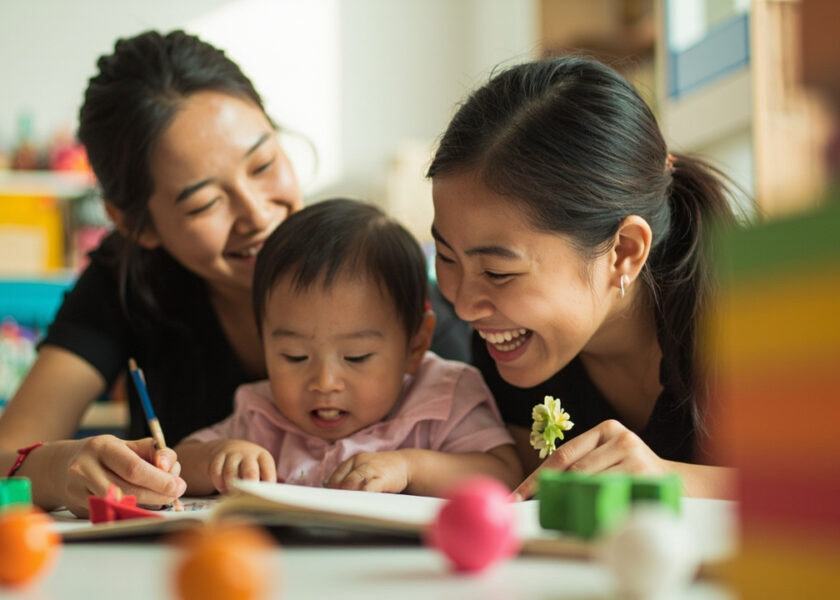
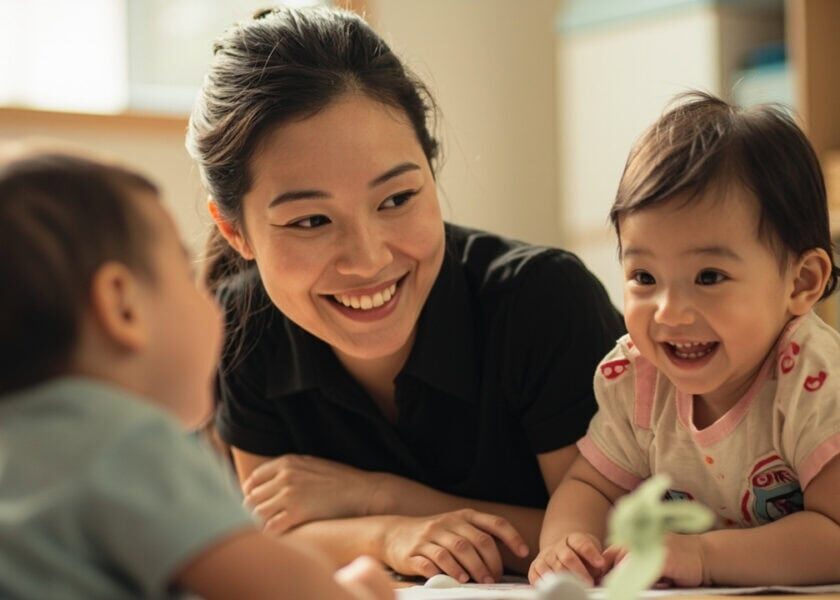
The first concrete sign parents often report is the shift from babbling to intentional sound-making. In a quality childcare environment, caregivers do not just hear this babbling and move on. They lean in. They respond as if the child has said something meaningful, because for the child, they have. This back-and-forth—what researchers call a serve-and-return interaction—is the fundamental building block of language acquisition.
Between twelve and eighteen months, single words begin emerging—usually nouns first: mama, dada, milk, ball, no. But here is something important that many parents do not realise: a child can understand far more than they can say, sometimes by a ratio of three or four to one. The eighteen-month-old who only says ten words may comprehend a hundred. This is called the comprehension-production gap, and it is completely normal.
By twenty-four months, you may start to hear the two-word combinations that signal a new cognitive leap: more milk, daddy go, shoe off. By thirty months, sentences are growing longer, more complex, more grammatical.
What quality language environments look like: Caregivers talk to children in real sentences, not baby talk—genuine, rich, age-appropriate language. They respond to children’s attempts at communication with enthusiasm and elaboration. When a child points and says ball, the caregiver might say, “Yes, that is a red ball! You like bouncing it, don’t you?” They read books, sing songs, and engage in storytelling.
Cognitive Development: Thinking Takes Shape
Cognitive development in the early years is not about academic preparation. It is about the basic tools of thinking: attention, memory, problem-solving, cause and effect, and the beginnings of logical reasoning.
In infants, cognition shows up in elemental ways. A baby learns that their crying brings comfort. That a mobile above their head moves when they kick. That the face appearing over them is familiar and welcoming. These seem like small things, but they are the foundational logic of the world.
In toddlers, cognitive development becomes more visible. You will start to see symbolic play, where a child uses one object to represent another—a block becomes a phone, a stuffed animal becomes a character in a story they narrate. This symbolic thinking typically emerges between eighteen and twenty-four months, signalling that the child is beginning to represent reality mentally.
You will also see problem-solving behaviours that reveal logical thinking:
- The eighteen-month-old who drags a chair to the counter to reach a cookie
- The two-year-old who realises that turning the knob with both hands works better than one
- The two-and-a-half-year-old who begins to sort objects by colour or size
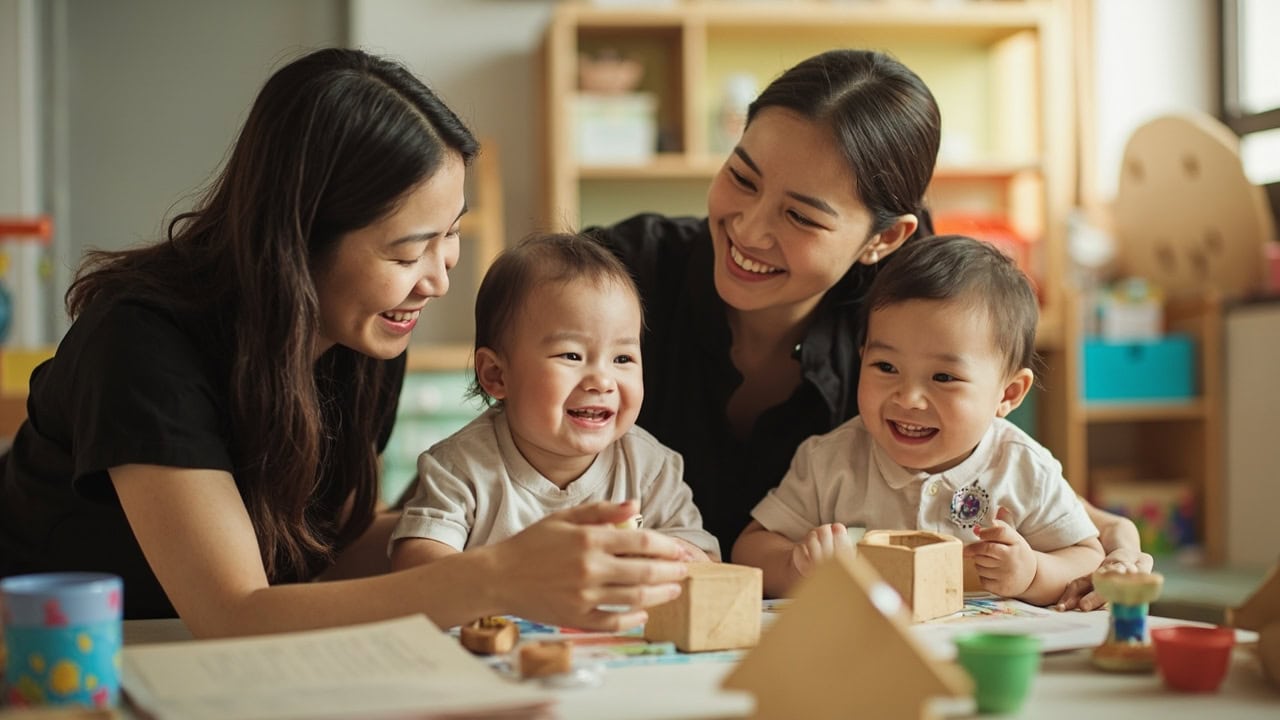
What quality cognitive environments look like: An environment that offers open-ended play materials—blocks, sand, water, art supplies, dress-up clothes—not because these are magical in themselves, but because they invite thinking. Caregivers who get down on the floor and follow the child’s lead, who observe what a child is trying to do and offer just enough challenge to extend it without overwhelming.
Motor Development: Visible Growth
Motor development has the advantage of being perhaps the most visible domain. You can see it in the body.
In the first year, you witness a sequence that never loses its wonder. The infant who could not hold their head up suddenly lifts it when lying on their stomach. Rolling comes, then sitting, then crawling. And then, finally, the moment that stops parents’ hearts: the first independent step.
But gross motor development does not stop after walking. It accelerates. The toddler who has just learned to walk begins to run, to climb, to jump, to balance—driven by a developmental imperative powered by the sheer joy of discovering what a body can do.
Fine motor development is slower and more subtle. It involves the small muscles of the hands and fingers, and it is critical for writing, drawing, using utensils, eventually dressing. In quality childcare environments, fine motor development is supported through activities that seem simple but are carefully designed:
- Scribbling with crayons
- Tearing paper
- Manipulating play dough
- Pouring water from one container to another
- Using child-sized tongs to pick up objects
What quality motor environments look like: A physical environment that is both safe and challenging—enough space to move, enough obstacles to climb, enough materials to manipulate. Caregivers who are present enough to prevent dangerous falls while allowing the small tumbles that teach children the limits of their bodies. And outdoor time, because outdoor play accelerates both gross motor and sensory development in ways that indoor spaces cannot fully replicate.
Social-Emotional Development: The Foundation Under Everything
Social-emotional growth is the domain that often feels most elusive—and most urgent. Parents wonder: will my child feel secure? Will they form attachments? Will they learn to be with other children, to share, to resolve conflict?
These are not small concerns. Social-emotional development is the foundation upon which everything else rests. A child who is anxious, who does not feel safe, who has not developed a secure attachment to at least one consistent caregiver, will struggle to learn. The research on toxic stress and its effects on early brain development is unambiguous.
This is why caregiver continuity matters so much. When a child is cared for by the same adult or small group of adults over time, they develop what attachment researchers call a secure base—a person from whom they can explore the world, knowing they can return for comfort when needed.
In the first year, you will see the foundation being laid: the infant who calms when a familiar face appears, the emergence of social smiling, of eye contact, of the back-and-forth that signals genuine connection.
In the toddler years, social development becomes more complex:
- The child who begins to show empathy—distress at another child’s crying that is distinct from their own discomfort
- The two-year-old who starts to engage in parallel play, working alongside other children but not yet truly collaborative
- The beginnings of true social play: sharing, taking turns, negotiating, collaborating on imaginary scenarios
You will also see the hard parts: the tantrums that come from a developmental mismatch between ambition and ability, the aggression that often comes not from malice but from frustration. What you want in a quality childcare environment is not the absence of these behaviours—all children exhibit them—but the presence of adult responses that help the child name what they feel, regulate what they feel, and eventually find words and strategies for what they feel.
Why These Domains Are Not Separate
Language, cognition, motor skills, and social-emotional development are deeply interconnected. A child who is developing language is also developing cognition. A child who is mastering motor skills is building the neural pathways that will support emotional regulation. A child who is learning to socialise is simultaneously learning language and refining motor control.
This interconnection is why quality childcare works. It is not that excellent caregivers are running four separate developmental programmes. It is that they are creating an environment where every moment contains potential for growth across multiple domains simultaneously.
Consider: a caregiver who reads a book to a toddler is simultaneously building language, expanding cognition, supporting attention, modelling social interaction, and creating a moment of emotional warmth that tells the child’s brain: you are safe, you are valued, the world is interesting.
The Partnership Between Parents and Caregivers
Understanding development is valuable, but parents still need a practical answer: when I pick my child up in the evening, how do I actually know what has been happening?
The answer lies in partnership. Quality childcare is not a service you purchase and then hope for the best. It is a collaborative relationship between the adults who share responsibility for your child’s development. And like any good partnership, it requires communication, transparency, and mutual respect.
What Partnership Looks Like
First, it means regular updates that go beyond the transactional. What did my child eat, did they sleep, did they get a rash—these are necessary details, but they are not developmental information. You want to know: what is my child interested in right now? What new skill have they been practising? How are they navigating social dynamics? What did they seem proud of today?
Second, it means access. In an age where many childcare environments offer real-time updates through apps and cameras, parents have legitimate expectations for transparency. Communication protocols and observation tools help parents stay connected to their child’s day. These are not modern conveniences. They are trust-building infrastructure.
Third, it means asking questions and receiving thoughtful answers. A quality caregiver will not just report that your child had a good day. They will be able to tell you why they think so, what specific behaviours they observed, how your child compared to their own baseline, where they see growth and where they see areas that need more attention.
Parents should never feel like they are leaving their children in a black box. You should be able to see in, and your caregivers should be eager to show you what is happening—because what is happening is good.
Monitoring Development and Raising Concerns
All children develop on their own timeline. The child who walks at ten months and the child who walks at fifteen months are both within the range of typical development. The child who speaks their first word at eleven months and the one who speaks at eighteen months are both on track. Normal variation is enormous, and it is normal.
But sometimes, variation falls outside typical ranges. Sometimes a developmental delay is present, and early identification matters because early intervention is more effective. This is why quality childcare environments do not just report progress. They monitor it. They track developmental milestones. And they communicate with parents when something seems to warrant closer attention.
The caregiver who notices that your two-year-old is not yet combining words and raises it sensitively is not criticising your parenting or diagnosing a problem. They are doing exactly what you want them to do: paying close enough attention to notice what is happening and trusting you enough to share it.
Questions you should ask your caregiver:
- Do you track developmental milestones?
- What do you use to monitor progress?
- If you ever had a concern about my child’s development, how would you communicate that to me?
The EduNanny Approach: Where Development Is Built
At EduNanny, we understand that every dimension of quality childcare—scaffolding, language expansion, cognitively rich play, social-emotional security—depends on one foundational thing: the caregiver relationship.
Our childminding programme, registered with ECDA under the Childminding Pilot, is designed around the principle of continuity. We are not running a revolving door of caregivers. We are building relationships. And we maintain small ratios—one caregiver for every three infants in our home-based pathway—to ensure that the depth of relationship is possible.
This is not an accident of philosophy. It is a deliberate design choice grounded in what attachment science tells us children need.
What Parents Can Expect
When you choose EduNanny, you are choosing a developmental environment, not just a childcare service. That means:
- Intentional caregivers who understand scaffolding and are trained to support development at the edge of each child’s capabilities
- Language-rich environments where every interaction is an opportunity for growth
- Open-ended play that invites thinking, problem-solving, and creativity
- Outdoor time that develops motor skills and sensory integration
- Consistent relationships where children feel secure enough to explore
- Transparent communication that keeps you connected to your child’s progress
- Professional milestone tracking that monitors development and flags concerns early
Making Quality Care Accessible
For parents in Singapore navigating this decision, there are practical realities that make quality care more accessible than it has ever been. The ECDA Childminding Pilot offers pathways that are both home-based and centre-based, giving families options that suit their circumstances.
The ratios are designed to ensure that every child receives enough attention. Fees within the pilot structure are affordable, and payment mechanisms including CDA and Baby Bonus are usable, removing some of the financial friction that has historically made quality early care feel out of reach.
Monday to Friday care blocks provide the consistency that developmental science tells us children need. And the service is available across Singapore, because every child deserves access to environments where they can grow.
The Hours Are Not a Gap
Let us return now to the moment we began with. The moment at the gate, or the door, or the threshold. The moment of parting that carries within it all the love and fear that parenting holds.
Here is what we have learned, in all the research, all the practice, all the conversations with parents and caregivers and developmental specialists: that moment does not have to be defined by doubt. It can be defined by understanding.
You can learn to read development. You can learn to ask the right questions and interpret the answers. You can learn to see the signs of growth in your child’s language, in their thinking, in their movement, in their social world. And when you can see it, you can trust it.
The hours of childcare are not a gap in your child’s life. In a quality environment, they are hours of active construction. They are hours of scaffolding, of serve-and-return, of open-ended play and social exploration and the quiet, patient work of building a human being. The caregivers who do this work are not substitutes for parents. They are partners in the most important work there is.
You are not failing your child by working. You are not abandoning them by choosing quality childcare. You are making a decision that, when made well, creates conditions for your child’s development that supplement and reinforce your own extraordinary parenting.
The partnership you build with a quality caregiver is not a compromise. It is an alliance. It is two sets of adults agreeing that this child matters, that this moment matters, that the construction happening now will last a lifetime.
When you pick your child up at the end of the day and they run toward you with something new in their face—a word you have not heard before, a gesture of connection, a confidence in their body that was not there yesterday—know that you are seeing the evidence. The quiet growth that happens every day in quality childcare is not invisible. It is happening. And now, you know how to see it.
Next Steps for Singapore Parents
If you are ready to explore what quality, developmentally intentional childcare looks like in practice, we invite you to learn more about the EduNanny Childminding Pilot.
Whether you are returning to work, seeking supplemental support, or simply wanting your child to have access to an environment that actively builds their capabilities, we are here to answer your questions, walk you through your options, and help you make a decision you can feel confident about.
Your child’s development is not happening somewhere you cannot see. It is happening right now, and now you know how to read it.
#EarlyChildhoodDevelopmentSingapore #ChildmindingPilot #EduNannySingapore #InfantCareSingapore #QualityChildcareSG #ChildDevelopmentMilestones #AttachmentParentingSG #ECDAChildminding #SingaporeParents #DevelopmentalMilestonesToddler