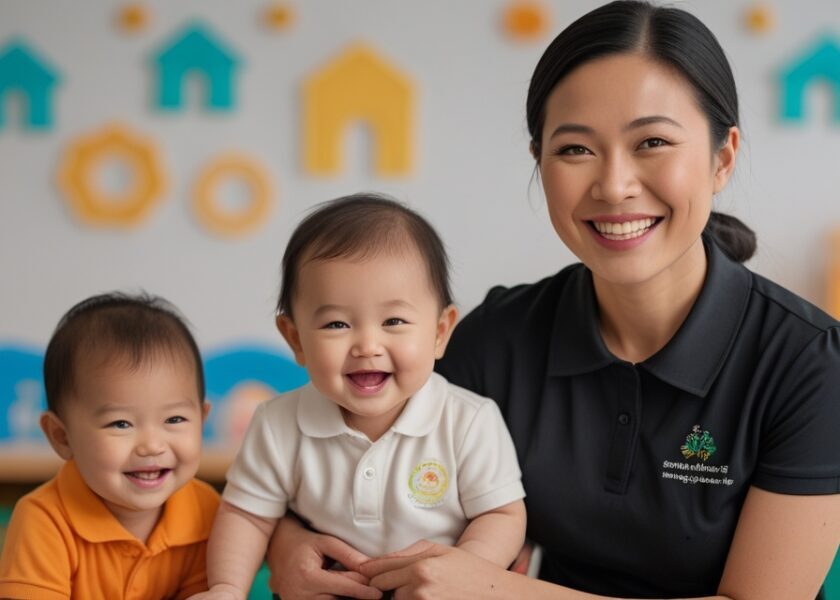
When Your Child Reaches for Their Caregiver, They Are Reaching for Trust
The Quiet Moment That Changes Everything
There is a moment — quiet, unannounced — when you will notice your child reaching for someone who is not you.
It happens in the doorway of the nursery, at the gate of a playground, or in that transitional stillness between morning handover and afternoon pickup. Your child extends their arms toward a caregiver who has become, over weeks and months, familiar in a way that belongs to neither family nor friendship.
And in that moment, you feel something shift inside you. Something you cannot immediately name. A small, private sting that sits somewhere beneath gratitude, beneath relief, beneath the practical architecture of your working life.
You might call it jealousy. You might call it guilt. But perhaps what it truly is — the feeling underneath — is a question you have been carrying since the first time you left your child in someone else’s arms:
Am I still the most important person in my child’s world?
This is the question we want to speak to today. Not to dismiss it, not to smooth it over with reassurances that feel hollow, but to sit with it honestly — because it deserves honesty. And because, once understood, it transforms everything about how you think about the person caring for your child.
Here is what science tells us, and what experience confirms: you are not in competition with your child’s caregiver. You never were.
What Your Child Actually Needs
In the first thousand days of life — from the quiet cellular choreography of gestation through the astonishing unfolding of language, movement, and social awareness — your child’s brain is building the architecture it will carry into adulthood. This is not metaphor. This is developmental science, repeatedly confirmed across cultures and circumstances.
What your child experiences in these early years shapes not just their immediate wellbeing but the foundation of their capacity to trust, to learn, to love, and to regulate the full and difficult range of human emotion.
Primary and Secondary Attachment: The Distinction That Matters
At the center of this architecture is attachment. You may have encountered this word in parenting articles, in pediatrician conversations, in the quiet negotiations of your own conscience. But attachment is not simply a feeling. It is a system — a biological system — that your child’s developing brain uses to understand the world as safe or unsafe, to predict whether their needs will be met, to learn that they can reach for someone and someone will reach back.
Psychologists speak of secure attachment as the foundation upon which all other development rests. And they are right. But here is what is often left out of the conversation:
Secure attachment is not built by a single person.
Your child forms a primary attachment to their parents — the figures who are most consistently present in the earliest months and years. This primary bond is irreplaceable. It is where your child first learns what love feels like in a body, what safety means in a nervous system. Nothing supersedes it.
But your child also forms secondary attachments — bonds with consistent, responsive caregivers who are present over time, who learn your child’s particular rhythms, who become trusted figures in their expanding emotional world.
These secondary bonds are not competition for your position. They are, in fact, evidence that your child’s attachment system is working exactly as it should. A child who can form a secondary attachment to a trusted caregiver is a child who has internalized the lesson that the world is populated by reliable people, that love is not scarce, that there are arms that will hold them when they need holding.
This is not a lesser thing. This is your child’s first lesson in the extraordinary human capacity for connection.
What This Means When You See Your Child Reaching for Their Caregiver
The caregiver who has stayed — who has learned your child’s particular way of asking for comfort, who knows that your child needs three pats before sleep and then silence, who recognizes the early signs of hunger or frustration before they become tears — this caregiver is not taking your place. They are building something alongside you. They are part of the consistent world your child needs.
Every time your child reaches for their caregiver and is met with warmth, your child is building the neural pathways that will allow them to reach for life — for teachers, for friends, for future partners, for their own children — with the secure knowledge that people can be trusted, that love is available, that the world is not indifferent.
Your child’s caregiver is not replacing you. Your child’s caregiver is teaching your child that there are people in this world who can be trusted — and who taught your child that lesson first? You did. You are the original secure base. You are the reason your child has the capacity to form secondary attachments at all.
The Hidden Cost of Caregiver Turnover
But this is only true if the secondary attachment is stable. This is where we must speak about what is, frankly, one of the most significant failures of the childcare industry — and one of the most meaningful commitments of quality care.
When a caregiver leaves — when a consistent, trusted figure disappears from your child’s life — the damage is not trivial. It is not simply an inconvenience.
For your child, who does not yet have the cognitive architecture to understand employment transitions or staffing changes, it is a loss. It is the experience of a reliable person becoming unreliable. It is a small crack in the foundation of trust that your child is building.
What Research Tells Us
Research in developmental psychology has consistently shown that caregiver instability in the early years is associated with:
- Increased stress responses in young children
- Difficulties in forming future attachments
- Behavioral challenges that can persist long after the change has passed
This is not about spoiling a child or creating dependency. This is about neurobiology. A young child’s nervous system is calibrated to seek consistency. When that consistency is disrupted, the stress response activates. Repeated disruptions do not toughen a child. They wear down the systems meant to support resilience.
This is the hidden cost of high turnover in childcare. It is rarely discussed because it is invisible — because it happens in a child’s interior world, not in any observable tantrum or measurable test. But it is real, and it matters.
What Caregiver Continuity Makes Possible
Because when a caregiver stays — when your child has the same trusted face morning after morning, season after season — something profound becomes possible.
Your child begins to develop what researchers call a secure base with that caregiver. This is not just familiarity. It is the knowledge, written into neural pathways, that this person will respond when I reach for them.
This is the foundation for exploration, for curiosity, for the courage to move away and then return. Consider what this looks like in practice:
- Your child plays confidently in the knowledge that their caregiver is there
- Your child sleeps peacefully because the body has learned that the world is consistent
- Your child shows you, the parent, who they are becoming — because they feel secure enough to be themselves
When Caregivers Stay, They Hold Families
Consistent caregivers learn the particular dynamics between siblings — the alliances, the rivalries, the ways two children in the same home can need different things at the same moment.
For siblings, having the same caregiver across years means having a shared witness, a shared history, a stable figure who knows both of them and holds the complexity of their bond. It means that when your children look back, they will share memories of the same person who held them, who sang to them, who celebrated their small victories and soothed their big sorrows.
This is a gift that cannot be quantified but can be felt — in the ease with which your children play, in the security with which they navigate the world, in the depth of their capacity for relationship.
EduNanny’s Approach: Why Continuity Is Structural, Not Incidental
EduNanny was built on the understanding that caregiver continuity is not a nice-to-have feature. It is the structural foundation of quality care.
Operating within the ECDA Childminding Pilot, EduNanny offers both home-based care and community or centre-based pathways, with infant ratios of up to one to three — meaning your child receives the focused attention that early development demands. The pilot structure includes care blocks designed around Monday to Friday rhythms, with fee structures thoughtfully considered for accessibility. CDA and Baby Bonus funds can be utilized, making quality care not only emotionally sound but financially feasible for families across Singapore.
What makes these structural facts meaningful is what they enable. Because EduNanny’s staffing model is designed for retention, this stability is not accidental. It is structural. It is the reason you can trust the system, not just a single caregiver. It is the reason that when you hand your child over at the start of the day, you can do so with something other than anxiety — with the knowledge that your child is not just being watched, but held in a web of consistent, trained, present care.
Built for Transparency and Partnership
Trust is built in small moments. That is why EduNanny has built transparency into its practice:
- Communication channels that keep you informed about your child’s day
- Measures that ensure you can see into your child’s life in your absence
- A culture that treats you as partners rather than clients
These are not add-ons. They are expressions of the same philosophy that drives caregiver retention: that your child deserves a consistent, competent, caring adult, and that you deserve to know exactly who that adult is and what your child’s life looks like in your absence.
Support That Extends Beyond the Day
Questions do not stop when your child is in care. They multiply. They arrive at strange hours. They are too small for a pediatrician appointment but too important to dismiss.
That is why EduNanny offers the Thomas AI Chatbot — a tool designed not to replace human guidance but to extend it, to give you reliable answers when you need them, to hold the questions that do not wait for business hours. Because parenting in the early years is relentless in its uncertainty, and support should be equally relentless in its availability.
What to Look for When Choosing Infant Care in Singapore
Here are the questions that matter most, based on what developmental science tells us about what children actually need:
- How long do caregivers typically stay? Ask about staff retention. This is not a minor detail — it is the structural foundation of quality care.
- What are the infant-to-caregiver ratios? Fewer children per caregiver means more focused attention, more responsive interaction, more opportunity for your child to form a genuine bond.
- How are transitions handled? When caregivers do change, how is your child supported through that transition? Who is there to catch them?
- Can I communicate easily with my child’s caregiver? You should know what your child’s day looks like. You should feel like a partner, not a client.
- What training do caregivers receive? Consistency matters, but competence matters too. Your child needs a caregiver who understands early development.
- How does this fit our family’s values and rhythms? Quality care is not one-size-fits-all. The best fit is one where your child feels held and your family feels supported.
Common Questions Answered
“Will my child love their caregiver more than me?”
No. Your child’s primary attachment to you is not diminished by secondary attachments. What you are observing when your child reaches comfortably for their caregiver is evidence that your child is developing normally — that they have learned to trust, to bond, to reach for consistent people. This is what you wanted for them. The capacity to form secondary attachments does not compete with your bond; it grows from it.
“What if the caregiver leaves?”
This is a legitimate concern, and it is one of the most important questions you can ask any childcare provider. Caregiver turnover is not just inconvenient — it has real developmental consequences for young children. When evaluating care options, ask specifically about staff retention rates, how transitions are handled, and what systems are in place to ensure continuity for your child.
“How do I know quality care when I see it?”
Quality care is consistent care. It is a caregiver who knows your child’s particular rhythms, who has learned their cues, who has been present long enough to understand them as a whole person. It is also transparent care — a provider who welcomes your questions, who keeps you informed, who treats you as a partner in your child’s life.
Your Child, Reaching for the World
Let us return, one final time, to that moment.
You are standing there. Your child is reaching for their caregiver. You feel that small sting — that flicker of something that might be jealousy or fear or the ancient ache of watching your child need someone else.
Your child reaching for their caregiver is not evidence that you have failed or been replaced. Your child reaching for their caregiver is evidence that your child has learned how to love — how to form bonds, how to trust, how to reach for a consistent world and find it reaching back.
The person your child reaches for has been shaped, in part, by you. The trust you modeled is the reason your child can trust. The love you gave is the reason your child has love to give. You did not diminish your child’s capacity for bond by sharing it. You expanded it.
And now your child has something extraordinary: not one secure base but two. Not one person who knows them but two, working in concert, in complement, in a partnership that is invisible to the child but profound in its effects.
Your child’s emotional world has not been divided. It has been enlarged.
Not Replacement. Not Competition. Expansion.
Your child is not choosing between you and someone else. Your child is building the capacity to hold the world — and they will carry that capacity into every relationship they ever form, every challenge they ever face, every moment of their lives when they need to reach for someone and trust that someone will reach back.
That is what quality care makes possible. Not just care. Not just safety. The quiet, profound gift of a consistent adult who stays — who becomes part of your child’s story, who holds your child’s trust, who works alongside you in the most important work there is: raising a human being who knows they are loved.
So the next time you feel that small, private sting — pause with it. Name it. Understand it. And then let it go.
You are, and will always be, the most important person in your child’s world.
The rest is not competition. The rest is village. The rest is the system working exactly as it should.
Your Next Step
If you are exploring infant care or childminding options in Singapore, learn more about how EduNanny’s approach to caregiver continuity creates the conditions for secure attachment, confident exploration, and the quiet, lasting peace of knowing your child is held by someone who stays.
Because when you choose quality care, you are not choosing a service. You are choosing a person who will stay.
Connect with EduNanny to discover what caregiver continuity really means for your family — or read more about our approach to development-focused childminding in Singapore.