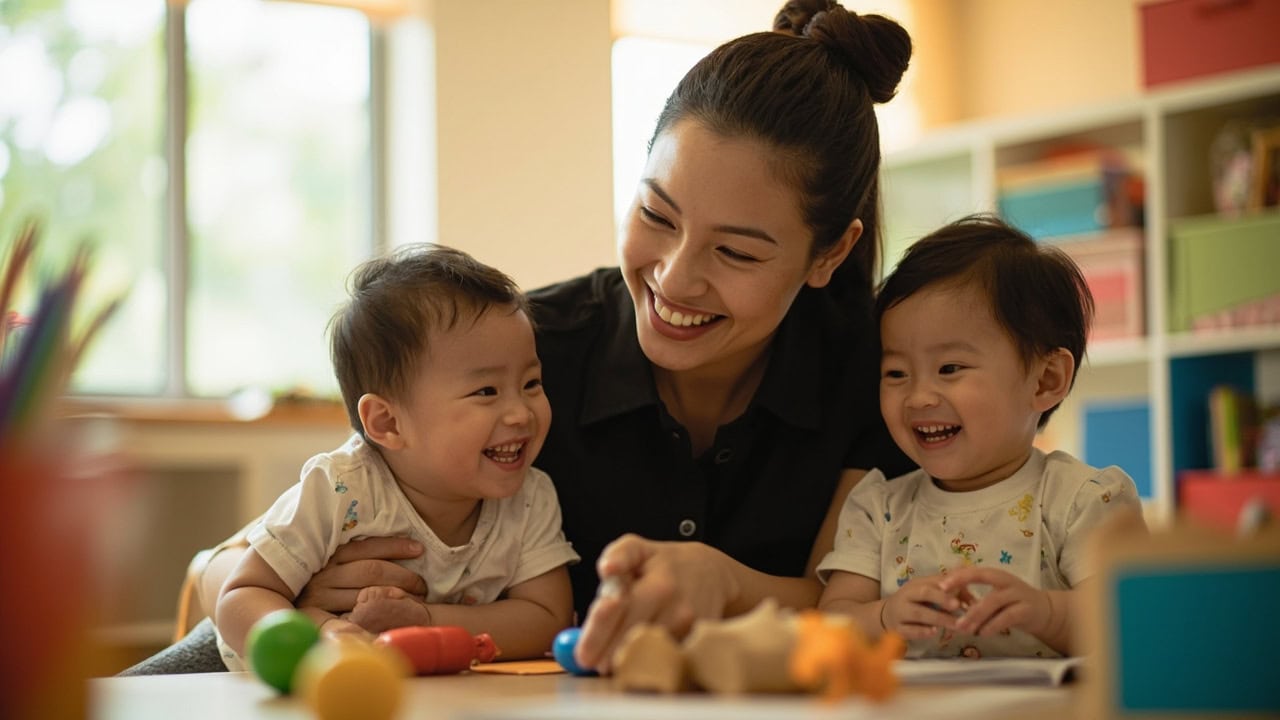
When Your Child Is Known Not Just Supervised
The Fear Every Working Parent Carries
Singapore has built an extraordinary society. One where opportunity is real, education is rigorous, and ambition is respected. We are proud of this. And yet, in building all of that, we have created a landscape where young families often feel they must choose between their careers and their children. Where the first thousand days of a child’s life — those days that neuroscience tells us shape everything that follows — happen largely without the parents who love them most.
This is not a failure of Singapore. It is a reality of modern parenting in any advanced city. The question is not whether parents will return to work — many will, and that is legitimate. The question is: what happens to their children while they do?
There is a fear that lives beneath the surface of every parent who leaves their infant in someone else’s care. It is not about competence. It is not about trust in the way we usually mean it — that is, trust that the caregiver is skilled and well-intentioned. It is something more specific, more tender.
It is the fear that their child will become a number. A face in a group. One of several small bodies moving through a routine designed for averages.
It is the fear that no one will notice:
- That their child doesn’t like the left side of the cot
- That their child goes rigid and still before crying — a half-second warning that means drop everything and come close
- That their child only eats well when the pace is slow, when food arrives one piece at a time, not piled on a spoon
- That their child has a friend — a specific, chosen friend — and needs that friend nearby to feel secure
These are not big things. These are small things. And small things are where a child lives.
What Professional Observation Actually Looks Like
Let me tell you what professional observation looks like when it is done well. This is not supervision. It is not watchfulness in the vague sense of keeping children safe. It is the disciplined, sustained attention that builds a picture of a child over time — a picture that is specific, accurate, and alive.
Sleep Architecture
A trained caregiver knows not just that a child sleeps, but how. They track the exact sequence — the micro-awakenings, the way a child’s body softens differently on different days depending on what they experienced that morning. They know that this child needs twenty minutes of winding down with a song before the crib, and that on days when the wind-down is rushed, sleep comes anyway but comes hard, and the child wakes in a different shape.
They notice that this particular child always stirs at the forty-minute mark, and that this is not a sign to pick them up but a sign to pat the cot once. They learn that child’s sleep signature — and act on it.
Eating Rhythms
They know the pace. They know the way a child pauses between bites not because they are full but because they need a moment to taste, to process, to decide. They know the difference between a child who is full and a child who is stalling because the room is too loud and eating feels like too much.
They notice which children eat better with a gentle commentary — “Here comes the carrot, here comes the rice” — and which children need silence, need calm, need the focus that comes only when no one is narrating. They adapt. Because they have noticed.
Social Pairings
They know not just that a child plays with others, but who. Which child makes this particular child braver. Which child calms them. Which child provokes a needed response. They watch the way children choose each other across a room, and they honor those choices because they understand that a child’s sense of safety in a group is often anchored by one specific small person.
When that friend is absent, a good caregiver notices the difference in that child’s day — and responds accordingly.
Comfort Rituals and Sensory Preferences
They know the exact way a child needs to be held after a fall. The fabric that matters. The pressure that helps. The song that doesn’t just calm but actually transports. They learn these things because a child in distress needs to be reached in the specific way that reaches them.
They also know the sensory landscape of each child. Which children need to move before they can sit still. Which children are calmed by texture, by weight, by the feeling of something specific in their hands. They notice which children register every sound in a room and which children have learned to tune it out. And they understand that these are not behavioral problems — they are temperamental patterns, and they deserve to be met with knowledge, not correction.
Why This Is Professional Discipline, Not Just Kindness
I want you to understand something clearly: this kind of knowing is not accidental warmth. It is not just a matter of having a good heart or loving children. It is a professional discipline.
Anyone can love a child. But knowing a child — knowing them in the way I have just described — requires training. It requires the caregiver to slow down and observe rather than simply act. It requires them to notice, to record, to reflect. It requires them to ask questions:
- What happened before this?
- What does this child need right now?
- What does this behavior mean in the context of this particular child’s temperament?
And to keep asking until the answer becomes clear.
It requires a culture of attention. An environment where noticing is valued, where observation is documented, where the caregiver’s knowledge of each child is treated as a professional asset rather than an optional extra.
This is what separates adequate care from individualized care:
| Adequate Care | Individualized Care |
|---|---|
| Meets a child’s needs as they arise | Anticipates, notices, and responds to the child as a unique person |
| Supervises — keeps child safe and occupied | Observes — tracks patterns, rhythms, and preferences over time |
| Applies general best practices | Adapts to the specific child’s temperament and needs |
| Responds to obvious distress | Reads subtle signals before distress escalates |
| Knows the child is in their care | Knows the child |
What This Means for Your Child’s Brain
When a child is known, they are secure. This is not a soft idea. It is neurological.
When an infant’s caregiver knows how to read their distress, how to respond in the specific way that reaches them, the infant’s stress response system learns something crucial: that the world is manageable, that needs are met, that someone sees me and knows what I need.
This is the foundation of what attachment researchers call felt security. And felt security is not about whether a parent is present. It is about whether a caring adult is attuned.
A child who is attuned experiences felt security even in a group setting. A child who is supervised but not known may experience the same group setting as a place of persistent low-grade anxiety — where needs go unmet not because anyone is unkind, but because no one has learned what those needs are.
This is the difference that matters. Not just for your peace of mind — though that matters too — but for your child’s developing brain. In those first thousand days, every experience of being understood or misunderstood, being seen or overlooked, is wiring the architecture your child will carry for life.
Why This Is Within Reach in Singapore
For parents in Singapore, the question of quality infant care is not abstract. You live in a city where full-time childcare is often a practical necessity. Where the demands of work and career do not pause for the early years. Where the cost of living means two incomes are frequently essential, not optional.
Singapore’s Early Childhood Development Agency (ECDA) has developed the Childminding Pilot to create pathways for quality home-based care. This pilot enables caregivers to care for up to three infants with dedicated training, reasonable fees, and structures designed for individualized attention rather than volume.
What this means for you: professional, individualized infant care is not something that belongs only to families with significant means. It is within reach for families across Singapore through subsidies, the Child Development Account, and Baby Bonus funds. The structural conditions for real knowing — small ratios, trained caregivers, home-based settings — are available.
Whether you choose EduNanny or another provider, the pilot framework makes it possible to find care where your child is known, not just supervised.
How to Know If Your Child Is Being Known
Here are the questions you can ask — and the answers you should listen for:
Questions About Sleep
- What does my child need to fall asleep?
- How long are their naps? Do they vary, and have you noticed why?
- What does your wind-down routine look like? How do you adapt if they seem overtired or under-tired?
Questions About Eating
- What pace does my child eat at? Have you noticed what helps them eat better?
- What do you do if they seem to be stalling rather than full?
- Do they eat differently on different days? What have you noticed?
Questions About Social Connection
- Who does my child gravitate toward? Have you noticed any friendships?
- How does my child respond to other children? Are there any patterns you’ve observed?
- What helps my child feel secure in the group?
Questions About Sensory and Comfort
- What comforts my child when they’re upset? Have you noticed what works best?
- Have you noticed any sensory preferences — textures, sounds, movement that helps or overstimulates?
- What does my child’s cry sound like when they’re tired versus hungry versus frustrated? Have you learned to tell the difference?
A caregiver who has built real knowledge will have answers. They will have observations. They will light up when they talk about your child because they have been paying attention. They will say things like “she does this thing when…” or “he’s been working on…” — specific, individual, yours.
A caregiver who cannot answer these questions — or who becomes defensive when asked — is a caregiver who has not built the knowledge they should have built.
Addressing Common Parent Concerns
Can I really trust someone else with my infant?
Trust is earned, not demanded. We believe that transparency matters when you are leaving your child with someone else. Our communication measures include CCTV access where deployed, so you can see what is happening in the care environment. We do not believe trust should require blind faith. We believe it should be built, and then reinforced, and then made visible.
What if the caregiver doesn’t notice something important?
This is exactly why we train for observation, not just supervision. A caregiver who has been taught to notice patterns — who has been trained to ask “what happened before this?” and “what does this child need?” — will catch things that a caregiver who is simply keeping children safe will miss.
Is home-based care as good as a centre?
Different settings suit different children and families. What we can say is that home-based care with small ratios creates structural conditions that centres often cannot match: one caregiver, three infants maximum, an environment where the caregiver can truly know each child because the numbers allow it. Where observation is possible because the setting is small. Where individualized attention is not a philosophy but a structural reality.
How do I know if this is the right choice for my family?
The right choice is the one where you feel your child is known. Where you leave at the end of the day with genuine peace of mind, and where you return to hear specific, accurate things about your child’s day. Where the caregiver lights up when they speak about your child, because they have details, patterns, a picture of your child as a specific, individual, irreplaceable person.
That is the standard by which any care arrangement should be measured.
What EduNanny Does Differently
EduNanny operates within the ECDA Childminding Pilot because we believe in what this framework makes possible. But we also believe that structure alone is not enough. The ratio of one caregiver to three infants creates the conditions for individualized attention — but someone still has to do the work of actually paying attention.
Our caregivers are trained to build an individual profile for each child in their care. Not a static document filed away, but a living understanding that grows over time. They learn to track sleep architecture, to note eating rhythms, to observe social pairings, to identify comfort needs and sensory preferences.
They are trained to ask the questions that lead to real knowledge — not just “Did the child eat?” but “How did the child eat? What pace suited them today? What was different?”
This is not something that happens by accident. It is built into how we select, train, and support our caregivers. It is part of the professional discipline we require. Because we believe — and the research supports this — that knowing a child well is not a personality trait that some people have and others do not. It is a skill. Skills can be taught. Skills can be developed. Skills can be expected.
We also believe that parents are partners in this process, not passive recipients of information. When you choose EduNanny, you gain a caregiver who is observing your child — and you gain communication that keeps you connected to what is being observed.
Every Child Deserves to Be Known
Let me close with a thought about what we are really doing here.
Every child deserves to be known. Not just watched. Not just kept safe. Known. And I mean that in the deepest sense of the word. Known the way a parent knows a child — with attention, with memory, with care — but held by hands that are also professional, that are trained, that understand what they are seeing.
This is not a small ambition. It is enormous. It means taking seriously the idea that the first thousand days matter, that infant care is not babysitting, that a childminder is not a stopgap but a significant figure in a child’s early life. It means treating the caregiver’s knowledge of a child as a professional achievement, not a personality quirk. It means building systems and selecting people and creating environments where individualized attention is possible, where ratios allow it, where training makes it real.
We are not asking you to trust blindly. We are asking you to look for this. To ask your caregiver: What does my child need to fall asleep? What pace does my child eat at? Who does my child gravitate toward? What is my child working on right now — what skill, what growth?
These are not invasive questions. They are the questions of someone who wants to know if their child is known. And a caregiver who cannot answer them is a caregiver who has not built the knowledge they should have built.
But a caregiver who can answer, who lights up when they speak about your child, who has details, who has patterns, who has a picture of your child as a specific, individual, irreplaceable person — that is a caregiver who is doing what we believe every child deserves.
EduNanny Singapore exists because we believe in that. Because we believe that Singapore’s children deserve to be known in their earliest, most formative years. Because we believe that parents in this city, who work so hard, who love so fiercely, deserve to leave their children with people who will see them, who will learn them, who will hold their particularity with care.
You love your child. That is not in question.
The question is whether the people caring for your child while you work are equipped to love them in the specific way your child needs.
We think they should be. We think they can be. And we have built something — a program, a culture, a standard — that makes that possible.
Your child is not a number. Not here. Not with us.
Every child in our care is a person. Known. Attended to. Held in their particularity.
That is the work. That is what childminding can be. And that is what EduNanny Singapore is here to build.
If you are exploring infant care options in Singapore and want to understand how EduNanny’s approach can support your family, we invite you to reach out. Learn about our caregiver training, our fee structures, and how the ECDA Childminding Pilot can work for your situation. Ask us the questions that matter to you. We will welcome them.
Because the standard should be high. Your child deserves nothing less than someone who knows them — really knows them — the way you do.