The First Thousand Days: Why Your Child’s Language Future Is Being Built Right Now
That First Sentence Changes Everything
You are in the kitchen, or on the commute, or maybe just folding laundry. And your child — perhaps eighteen months old, perhaps two — comes up to you and says something. Not a single word you have been decoding for months. An actual sentence. Or something close enough that you both understand it completely, and the world tilts, just slightly, toward something you did not expect. You look at each other, and something has shifted.
That moment is what we are here to talk about today. Not because it is miraculous — though it is. But because of what it tells us about the invisible architecture being built inside every young child in Singapore, long before they sit in a Primary One classroom. Long before anyone measures them. Long before anyone gives it a name.
The language your child is building before Primary One is not a warm-up act for real learning. It is the real learning.
And if you are a parent navigating Singapore’s particular, intense, beautiful multilingual landscape — if you have ever lain awake wondering whether your child will be strong enough in English, fluent enough in Mandarin, connected enough to your home language, and whether the hours they spend in someone else’s care will help or hurt all of that — then this article is for you.
What Is Actually Happening Inside Your Child’s Brain
A newborn enters the world equipped to distinguish between the sounds of any language on earth. By the time that child is twelve months old, something remarkable has happened. The brain has already begun to specialize, to tune itself to the specific languages surrounding that child, and to let go of the sounds it no longer hears. By three years old, a child’s brain has already established the foundational architecture for language that will largely persist for the rest of their life.
This is what neuroscientists call the critical period — a window of sensitivity when the brain is uniquely equipped to absorb the patterns, rhythms, and structures of language. I want to be careful here, because I am not saying this window slams shut at three. It does not. But the density of language acquisition happening in these early years — the sheer volume of neural pathway construction, the speed and efficiency of it — is unlike anything that comes after.
The first thousand days are not a metaphor. They are a developmental fact.
What This Means for You as a Parent in Singapore
Singapore is one of the most linguistically complex societies on earth. You are raising a child in a place where English is the working language, where Mandarin carries social and academic weight, where your own heritage language may be the language your parents speak at home, where dialects carry warmth and identity, and where the pressure to be bilingual is not just cultural aspiration but something that feels, at times, like a prerequisite for your child’s future success.
And you are doing all of this while working. While trusting other people to care for your child. While navigating the impossible feeling that every choice you make in these early years is load-bearing.
That is not a small thing. That is a heavy thing. And quality childcare does not add to that weight. It is designed, when it is done well, to carry some of it with you.
Active Language Scaffolding Versus Passive Exposure
There is a difference — and it is a significant one — between passive language exposure and active language scaffolding. And it is the difference I want you to hold onto when you are evaluating any childcare setting, whether it is a centre or a home-based programme.
Passive Exposure
Your child hears language around them. They hear the television, they hear adults speaking, they hear songs and rhymes. This is not nothing — ambient language exposure does shape the ear, familiarizes the child with the music of a language, with its cadence and rhythm.
But passive exposure alone is not language development. It is background. And if we are honest, many childcare settings, through no malicious intent, operate largely in this mode. Children are spoken to, certainly. But they are not always spoken with.
Active Language Scaffolding
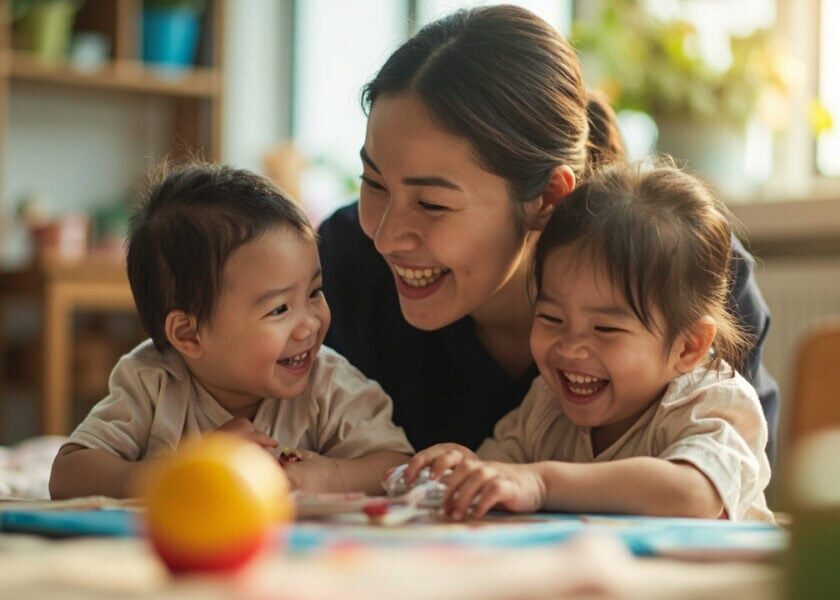
Active language scaffolding is something different. It is a trained educator or childminder who notices that your child is reaching for a word and offers it — not in a drill, not in a flashcard, but in the natural flow of play.
It is a caregiver who hears your two-year-old say “more milk” and responds not just by giving the milk, but by leaning in and saying, “You want more milk? Yes, you had a big drink and now you are thirsty again. Here is more milk.”
In that one exchange, the adult has modeled a question, a sentence structure, a new vocabulary word — thirsty — and a verb conjugation — you are thirsty — and the emotional attunement that tells your child that their communication matters and is received.
That is scaffolding. And it happens not once, not as a planned activity, but dozens of times across a quality care day.
Why Peers Matter Too
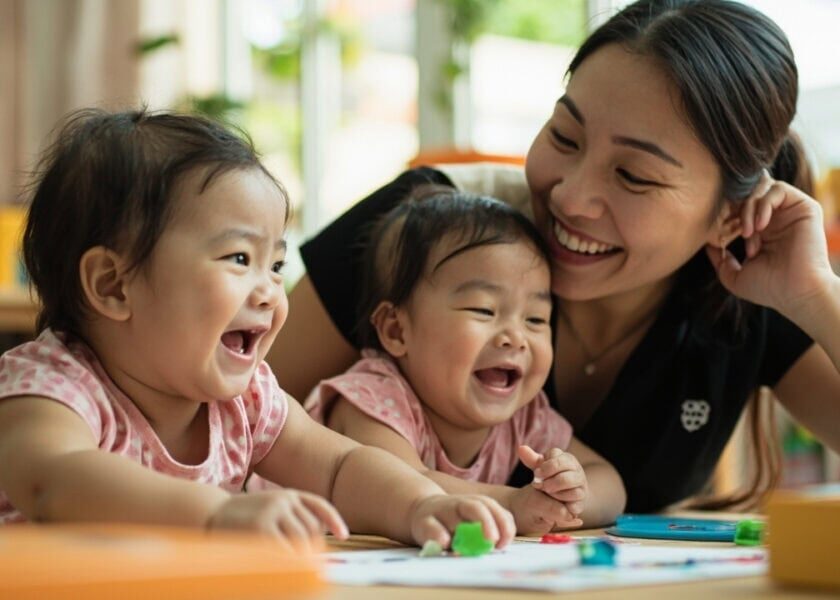
Children do not only learn language from adults. They learn it from each other. In a quality childcare setting, your child is surrounded by other children who are also building language — and this proximity creates what early childhood educators call a language community.
Children at the same developmental stage, negotiating, requesting, sharing, refusing, laughing — building language that is practical, social, urgent, and real.
The child who has been in quality childcare for six months often has a communicative confidence that surprises parents. They are not just using more words. They are using language to navigate relationships, to solve problems, to assert themselves, to negotiate. And that capacity — to use language not just to label the world but to act in it — is one of the most significant predictors of school readiness and social confidence that we have.
Language as Emotional Infrastructure
Language is not just communication. It is self-regulation. It is emotional infrastructure. When a child has the language to say “I am angry because you took my toy,” they have a tool for managing that emotion that does not require hitting or screaming. And this emotional dimension of language is being built in these early years at a pace that will never be matched again.
Singapore’s Multilingual Reality: More Advantage Than Obstacle
You are not raising a bilingual child. You may be raising a trilingual child. Your child may be hearing English from you, Mandarin from a grandparent, Hokkien from a domestic helper, and Malay from a neighbour’s child at the playground.
The research tells us something that may surprise you: children in multilingual environments do not get confused. They build what linguists call a unitary language system that can distinguish between languages from as young as infancy, provided they have enough quality exposure to each one.
What this means for you, practically, is that the fear that childcare will interfere with your home language is understandable, but it is often misplaced — especially when the childcare setting you choose is one that understands multilingual development.
A quality childminder or educator in Singapore who knows your child’s home language, who values it, who does not treat it as a problem to be managed but as an asset to be nurtured, is not diluting your child’s bilingualism. They are reinforcing it.
Because what builds language is interaction. Response. Meaningful exchange. The more contexts in which your child encounters language as a living, purposeful, emotionally relevant thing, the stronger each language grows.
When a childminder tells you — and in quality services this happens through structured daily communication — that your child learned the word for “ant” in Mandarin today because they found one on the playground, that is not a courtesy. That is you seeing the architecture being built. That is the bridge between what happens in your home language environment and what happens in your childcare environment becoming visible and continuous.
What to Look For: A Parent’s Practical Guide
When you visit a childcare setting — whether it is a centre or a home-based childminder — here is what you are actually looking for.
Listen for the Quality of Conversation
Not the volume. You want to hear if adults are responding to children in complete sentences. You want to hear if children are being given time to answer — if there is a pause, a wait, a respect for the child’s processing. You want to hear if the setting is narrating the day in multiple languages, even casually. Not as a performance. As a natural, warm, constant feature of how the adults in the room engage with children.
Observe Language in Play
- Is story time a real conversation, where children are asked what they think might happen next?
- Is it a reading at children — or a conversation with them?
- Is a child who is not yet verbal being engaged face-to-face, with language offered alongside gesture and expression?
- Does the childminder or educator notice when a child’s language has shifted — when they are trying a new sound, attempting a new phrase — and respond with encouragement, not correction?
Ask Direct Questions
Not “Do you support language development?” Every setting will say yes. Instead, ask:
- “How do you handle it when a child is more comfortable in a language other than English?”
- “Can you tell me about a recent moment when a child’s language surprised you or moved forward?”
- “How do you communicate with families about what their child is learning?”
- “What does a typical day look like in terms of conversation, stories, and language-rich activities?”
These questions will tell you more than any brochure ever could.
Quality Childcare Complements Your Efforts
Let me speak directly to one of the most common anxieties Singapore parents carry: the worry that time in childcare will pull their child away from their home language and cultural identity.
This fear is understandable. But what the evidence and experience consistently shows is this: quality childcare complements your home language efforts rather than competing with them.
Language grows through interaction, not through isolation. When your child spends time in a setting where their home language is acknowledged, valued, and woven into daily interactions, they are not losing connection to their heritage language. They are expanding it. They are learning that this language — the one grandma speaks, the one that carries family stories and cultural memory — is important enough for adults outside the family to engage with.
The risk is not quality childcare. The risk is childcare settings where your child’s language realities are ignored, or worse, discouraged in favour of English-only environments. That is why asking about multilingual awareness during your visit matters.
Why Ratios Matter
Under Singapore’s ECDA Childminding Pilot, quality services operate with ratios of up to one childminder to three infants. This is not a logistics detail. It is a language ratio. It is the ratio that makes conversation possible.
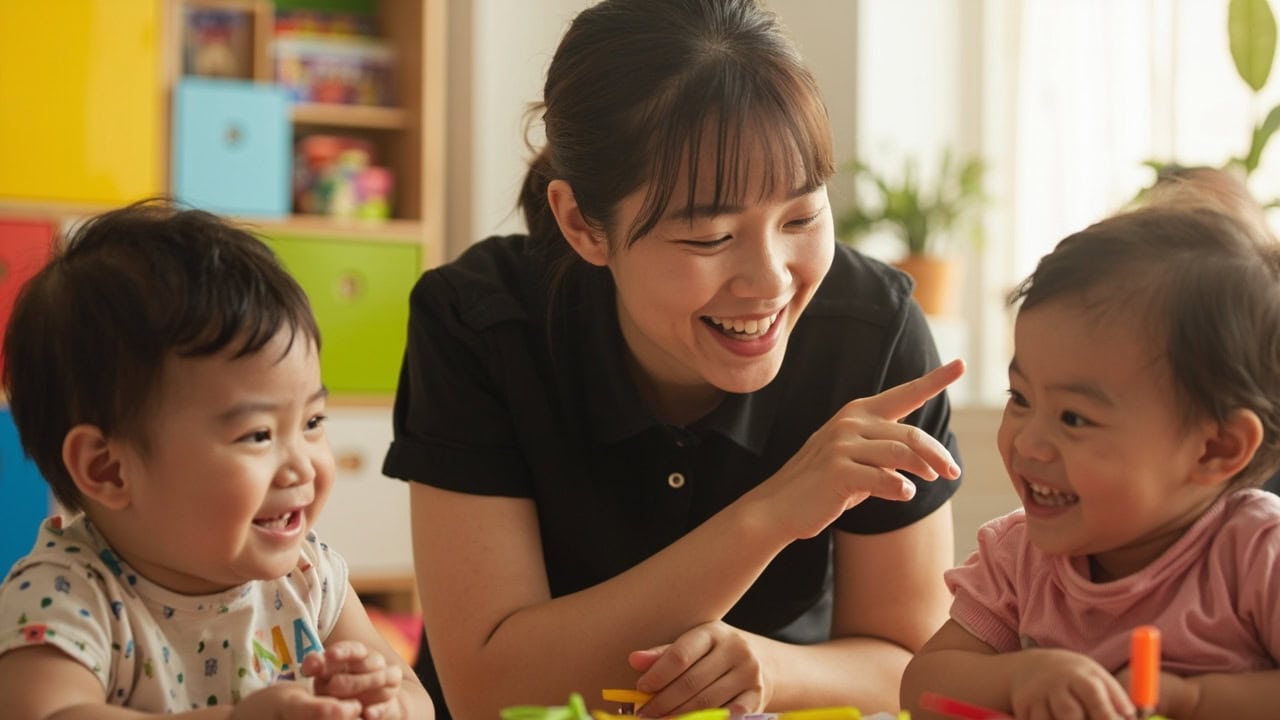
With fewer children, a trained childminder can do what a classroom of fifteen children and one teacher cannot: notice the language your child is reaching for, meet them there, and extend it. They can hear when your toddler attempts a new sound and celebrate it. They can respond in Mandarin when your child initiates in Mandarin, then bridge to English when needed.
What This Looks Like in Practice
Services built on this understanding — with small ratios, trained childminders, daily communication rhythms, and a genuine respect for Singapore’s multilingual reality — create the conditions for exactly the kind of language scaffolding described throughout this article. The ECDA Childminding Pilot makes this standard of care accessible to more families than many parents expect, with funding options including CDA and Baby Bonus support.
The Moment That Tells You It Is Working
There is a thing that happens when a child comes home from quality childcare and starts talking differently. Not just more. Differently. More confidently. With sentences that have architecture, with words that surprise you, with a kind of communicative joy that says: I know how to be heard, and I know how to listen.
That is what quality language development looks like in practice. Not a child who can recite vocabulary lists. A child who uses language as a tool — to connect, to negotiate, to understand, to belong.
You brought your child into this world. You are raising them in one of the most demanding, multilingual, high-expectation environments on the planet. And somewhere in the back of your mind, you carry the worry — quietly, sometimes loudly — that you are not doing enough for their language, their identity, their ability to move between worlds.
You are doing enough. And you do not have to do it alone.
The words your child is building right now — in Mandarin and in English and in whatever beautiful, irreplaceable language your family speaks at home — those words are not the product of worksheets or enrichment classes alone. They are the product of every conversation that has ever been had with them, around them, and sometimes even over them while they were sleeping. Every time a caregiver got down to their eye level and said something that mattered. Every time someone listened to what they were trying to say and helped them say it better.
Quality childcare is not a replacement for your family. It is a partner in the work that you are already doing — the most important work there is.
The language your child is building before Primary One is not a rehearsal. It is the foundation. And foundations, as any builder will tell you, are everything.
Ready to Learn More?
If what you have read resonates with what you are looking for — a childcare approach that understands Singapore’s multilingual reality, that prioritises genuine language scaffolding over passive supervision, and that sees your family as a partner rather than a customer — we invite you to learn more.
Visit EduNanny Singapore to speak with our team and ask the questions that matter most to you. We believe the right choice should feel clear, not stressful. And we believe you will know quality when you see it.
Because you already know what to look for. You have been paying attention all along.
EduNanny Singapore offers development-focused childminding for families who value quality care, multilingual awareness, and genuine partnership in their child’s early years. Learn about our approach or get in touch to start a conversation.