Supporting Your Children’s Individual Growth and Their Sibling Bond
Quick Summary
- Why the sibling bond matters more than most parents realize
- How quality childcare nurtures both individual identity and sibling connection
- What to look for when choosing care for multiple children in Singapore
- How EduNanny’s approach addresses the real tensions parents face
The Two Desires Every Parent Carries
You want your older child to feel seen. To know that she is not simply a training ground for the younger one, that her discoveries and frustrations and joys matter in their own right. You want your younger child to have space to become himself, not merely a sequel to a story that began before he arrived.
And at the same time—and this is the part that most parenting advice does not quite know how to hold—you want them to love each other. You want them to be close. You want them to have a bond that is their own, something that existed before you and will continue long after you are no longer the center of their world.
These two desires—the flourishing of the individual and the deepening of the sibling bond—are not opposites. But they feel like they might be, especially in those mornings when one child needs you and the other is watching, when you cannot be fully present to both at once.
This is the tension that EduNanny Singapore was built to understand.
What Quality Childcare Does for Siblings
We are not a childcare service that sees children as units to be managed. We are a childminding service that sees families as systems—and siblings as one of the most important relationships a child will ever form.
A Shared Emotional Foundation
The first thing quality childcare does for siblings is something that sounds simple but is actually profound: it gives both children the same emotional environment. Not a neutral environment, not a cold or institutional one, but a warm, consistent, predictable world where they both feel safe.
When children share this foundation, they are not competing for it. They are both standing on the same ground, and from that ground, they can reach for each other.
Sibling rivalry, when it appears, often has its roots not in the children themselves but in insecurity. A child who feels uncertain of her place, who wonders whether there is enough love to go around, will protect herself in ways that look like jealousy. But a child who knows—who feels in her body, not just in her logic—that she is loved and secure, can afford to be generous. Can afford to let her brother sit on the caregiver’s lap. Can afford to share the attention because she does not believe it will ever truly run out.
What Children Learn by Watching
Children learn how to be siblings partly from their parents, and partly from watching other children—and from watching the adults who care for them—navigate difference, conflict, and connection.
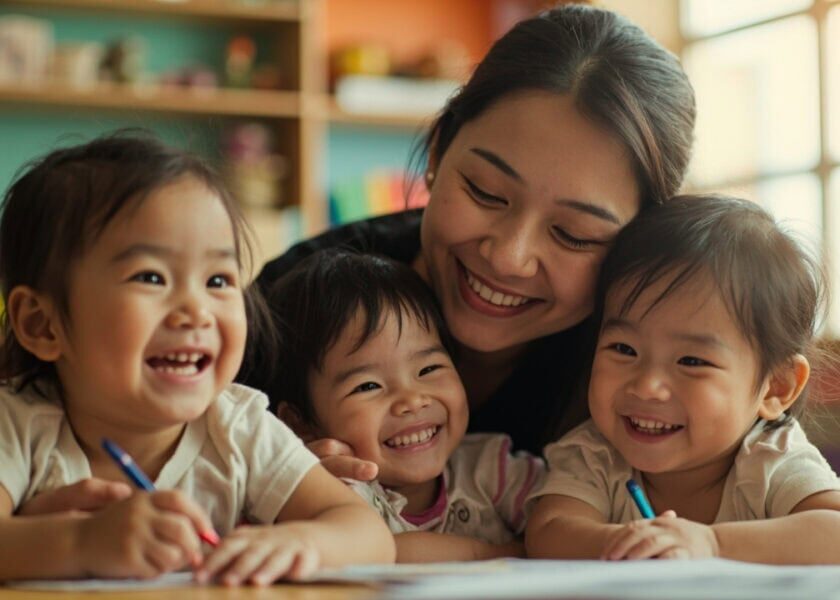
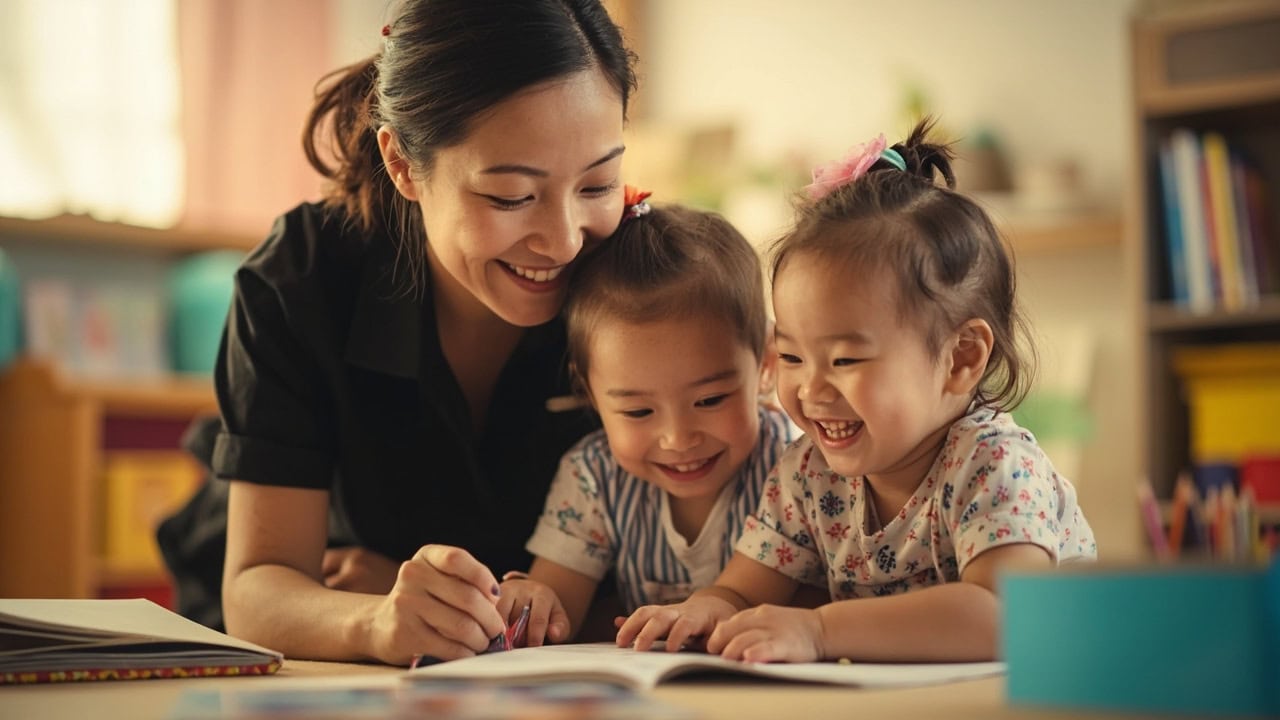
In a well-run childminding environment, children observe something invaluable: adults who respond to different needs without treating those needs as burdens. They see a caregiver give individual attention to one child while another plays contentedly nearby. They learn, through this observation, that attention is not a finite resource that must be grabbed. They learn that one person’s turn does not mean another’s loss.
This is not a lesson that can be taught in words. It has to be felt, repeated, embodied in the texture of daily life. When it is done well, childcare is one of the most powerful influences on how your children will relate to each other for the rest of their lives.
The Home-Based Difference
EduNanny’s home-based and community-based pathways are designed with this in mind. When children are cared for in smaller settings, with ratios that allow each child to be known deeply, they experience something different from large centre environments. They experience being remembered.
The caregiver knows that your daughter prefers her yoghurt slightly colder, that your son is going through a phase where he needs to be the one to open the door. This knowledge does not replace what you know as a parent. It deepens it. It means that your children are carrying the same emotional signature at home and in care, and that shared signature becomes the language through which they understand each other.
With ratios of up to one to three infants in our programme through the ECDA Childminding Pilot, caregivers have the capacity to genuinely learn each child—not just their schedule and their allergies, but their rhythms, their fears, their particular way of expressing joy.
Why Ratios Matter for Siblings
When your younger child and your older child are both in EduNanny’s care, they are not in a competition for the caregiver’s awareness. They are both receiving it, in forms that are appropriate to who they are.
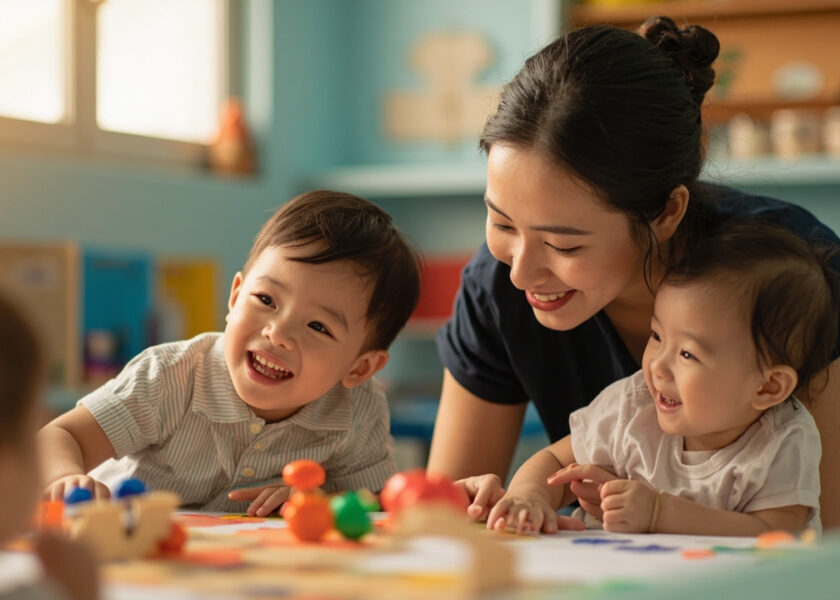
The toddler is given the independence and challenge that she is ready for. The infant is given the sensory warmth and responsive presence that her stage of development requires. And because they are sharing this environment, they are also learning from each other’s experiences. They are watching each other grow. They are beginning, in the most foundational way, to understand that they are part of the same story.
Addressing Your Concerns: Trust and Transparency
There is a question that sits beneath all of this, and it is the question that many parents with multiple children carry without ever fully voicing it: will the caregiver know each of my children as an individual?
It is a reasonable fear. You have seen, perhaps, the caregiver who clearly prefers one energy level over another, who relates more naturally to quiet children or active ones. You have wondered whether your more reserved child will fade into the background, whether your more demanding one will consume the attention.
These fears are not weakness. They are the evidence of a parent who cares deeply about both children and does not want either of them diminished.
EduNanny’s childminding model is built on the recognition that knowing a child takes time and space. This is not a feature we added as a selling point. It is the logical consequence of a model that believes in the dignity and specificity of every child.
What Transparency Looks Like
When your children are in EduNanny care, you are not left wondering what happened in your absence. Our commitment to transparency means that you receive honest, thoughtful updates about each child’s day. Where CCTV measures are deployed, you have the assurance of knowing that your children are in a space where accountability and openness are built into the structure.
For parents with multiple children, who carry the doubled weight of divided attention and divided worry, these are essential. You should be able to ask, at the end of the day, how both children were—and to receive an answer that reflects two distinct people, not a generic summary.
Reframing the Guilt
There is guilt in divided attention, and it would be dishonest to pretend otherwise. Quality childcare does not eliminate this guilt—nor should it, because the guilt is the evidence of your love. But it does reframe it.
When you know that your children are in an environment where both of them are seen, where both of them are nurtured, where both of them are given what they need to grow as individuals and to grow together, the guilt does not disappear but it transforms. It becomes less a weight and more a quiet acknowledgment: you are doing your best, and your best now includes a partner who takes this responsibility as seriously as you do.
EduNanny understands that parents who choose us are not looking for a substitute for themselves. They are looking for an extension of their care. A place where the values they hold—of patience, of attention, of seeing each child as a full human being—continue to operate even when they are not in the room.
What to Look For: A Practical Framework
What should you look for when you are evaluating childcare arrangements for a family with multiple children?
| Area | What to Ask | Why It Matters |
|---|---|---|
| Individual Attention | Do they ask about each child separately? Do they understand siblings as distinct individuals? | Children need to be known, not just managed |
| Environment Scale | What are the caregiver-to-child ratios? Is the setting home-based or centre-based? | Human scale allows for genuine relationship |
| Conflict Navigation | How do caregivers handle disagreement between children? | The right approach models healthy sibling relationship skills |
| Shared Routines | Do children eat, play, and rest together in ways that create shared memories? | Routine builds the foundation of sibling bonds |
| Family View | Does the caregiver see your family as a whole system? | Siblings are connected; care should honor that connection |
Questions Specific to Singapore Parents
- Ask not just whether the caregiver is qualified, but whether they are curious. Whether they ask questions about each child individually. Whether they understand that siblings are not simply two children in the same space but two people whose relationship is itself worthy of attention and care.
- Ask whether the environment feels calm enough for each child to be known. Large centres have their place, but they are not designed for the kind of deep individual and relational attention that siblings need.
- Ask about the ratios. This is not a bureaucratic question. It is a question about whether your children will be faces in a crowd or individuals in a circle.
- Ask how the caregiver handles conflict between children. The wrong answer is to separate children whenever there is friction. The right answer is more nuanced: to help children name what they are feeling, to model negotiation, to see conflict not as a failure but as a natural part of relationship that can be navigated toward understanding.
- Ask about shared routines. Do the children eat together, sleep according to rhythms that respect both individual needs and the group dynamic, have a daily flow that creates the ordinary shared experiences that bonds siblings over time?
- Ask whether the caregiver sees your family as a whole. Not two children who happen to share your last name, but a system in which each person’s growth is connected to everyone else’s.
EduNanny’s Commitment to Singapore Families
We know that raising siblings in Singapore is not simple. The costs are real. The schedules are demanding. The city moves fast, and the pressure to choose between quality time with your children and the income that supports them is relentless.
But we also know that Singapore parents are not looking for easy answers. They are looking for honest ones. They are looking for childcare that takes the sibling bond seriously, that understands its fragility and its power, that is willing to be a partner in something that goes far beyond logistics.
EduNanny was founded on this understanding. We are part of the ECDA Childminding Pilot because we believe that home-based and community-based care is not a compromise—it is an alternative that is, for many families, precisely what is needed. Our fee structures are designed to be affordable within the pilot framework. Your Child Development Account can be used, and Baby Bonus provisions apply, because we do not want cost to be the reason a family settles for care that does not meet their children’s needs.
Monday to Friday, across Singapore, EduNanny caregivers are doing the work that most people do not think about until they need it: holding the space where your children learn to be themselves and to be with each other. This is not a small thing. It is one of the most important things you will ever entrust to another person.
You Do Not Have to Choose
If you are a parent with multiple children, you already know something that many people do not learn until it is too late: the sibling relationship is one of the longest relationships your children will ever have. It will outlast their childhood. It will shape their emotional lives in ways you may never fully see.
And it is something you can either leave to chance or actively nurture—and the choice of childcare is one of the most significant ways you can nurture it.
You do not have to choose between your children. You do not have to accept that divided attention means diminished love. You do not have to wonder whether your children will grow up close or distant based on forces beyond your control.
You can choose a partner who sees what you see: two children who are deeply individual and deeply connected, who deserve care that honors both of these truths. You can choose childcare that knows that the sibling bond is not a byproduct of sharing parents and a home—it is something that has to be built, carefully, daily, by people who understand how much it matters.
That is what EduNanny Singapore offers. Not just care. Not just supervision. A shared foundation for your children to stand on together, so that they can reach for each other from a place of security rather than scarcity.
You love your children as individuals. You love them as siblings. You want both of these loves to flourish, and you know—with a clarity that no piece of advice can give you but that you carry in your chest every morning at handover—that this is possible.
We are here to help you make it real.
To learn more about how EduNanny supports families with multiple children, connect with our team or explore our approach to childminding.