What Your Child’s Drop-Off Tears Are Really Telling You
What Your Child Is Actually Feeling
When a young child cries at drop-off, they are not crying because something is wrong with the care you have chosen. They are crying because, at this stage of their lives, they have not yet learned that people and places can be trusted to remain.
Their internal world is still being built. Every object, every person, every routine is either present or gone — and in their mind, gone can feel like gone forever. This is not irrational behaviour. It is the architecture of early emotional development, and when understood correctly, it is extraordinarily beautiful.
The psychologist John Bowlby spent decades studying what he called attachment — the deep emotional bond between a child and their caregivers. His work was later extended by Mary Ainsworth, who identified something remarkable: children who experience responsive, consistent, loving care in their earliest years do not become more dependent. They become more confident. They explore further from the people they trust. They take on the world with greater curiosity, because somewhere deep inside, they have internalised the understanding that there is a safe base to return to.
This is what attachment researchers call the secure base. And here is what matters most: the secure base is not a location. It is not only the home. It is not only you. The secure base is a felt sense of safety that a child carries inside them, built through thousands of small moments of being held, responded to, and comforted.
When your child is in quality care and cries at drop-off, the question is not whether they will stop crying. The question is whether the adults around them will respond in a way that builds — rather than erodes — that internal sense of safety.
The Neuroscience of Separation
In the early years, a child’s brain is undergoing its most intensive period of construction. Neural pathways that will govern emotional regulation, stress response, and social intelligence are being laid down at a rate that will never be matched again in their lifetime.
When a child experiences a stressful separation — and drop-off can be genuinely stressful — their stress response system activates. Cortisol rises. Their body readies for distress.
But here is what quality care changes: when a trusted, trained adult responds to that distress with calm, consistent presence — not dismissing the child’s feelings, not amplifying them with adult anxiety, but meeting them where they are — something remarkable happens.
The child’s stress response system begins to learn a new pattern. It learns that distress has a resolution. It learns that big feelings can be held by capable hands. It learns, through repetition, that goodbye is not abandonment and that the people who love them will always, always come back.
Repeated, responsive caregiving does not prevent a child from ever feeling upset. What it does is build the neurological infrastructure for recovery. And recovery — the ability to be distressed and then return to calm — is one of the most important capacities a human being can develop.
What Quality Childminding Actually Looks Like
Not all childcare is the same. The research on this is unambiguous. The difference between care that promotes secure attachment and care that creates chronic stress is not the fact of separation. It is the quality of the caregiving relationship and the environment’s capacity to respond to each child as an individual.
A ratio of one caregiver to three infants is not an administrative detail. It is a statement about what is possible when an adult has the bandwidth to truly attune to your child — to notice when they are tired before they are overtired, to notice when they are hungry before they are fractious, to notice the small cues that tell you a child is about to escalate and to intervene with calm before the storm arrives.
Key Indicators of Quality Responsive Care
- Emotional attunement: Caregivers notice and respond to your child’s emotional cues — not just their physical needs.
- Consistent presence: The same trusted adults care for your child, session after session, building familiarity and trust.
- Warmth without intrusion: Caregivers comfort without forcing comfort, allowing your child to regulate at their own pace.
- Transparent communication: You receive regular, genuine updates about how your child is doing — not just what they ate, but how they seemed.
- Partnership with families: Your role as the parent is honoured and extended into the care environment, not replaced.
The Trajectory: From Tears to Confidence
There is so much anxiety and confusion around what is normal. Let us be clear about what to look for.
Red Flags That Deserve Attention
- Your child consistently seems worse after weeks of care — not occasionally upset after drop-off, but genuinely more anxious, more withdrawn, more dysregulated than their baseline.
- Caregivers dismiss your child’s distress or seem uncomfortable with emotional expression.
- There is little or no communication about how your child is doing during the day.
- The environment feels chaotic or your child seems invisible — not noticed, not seen.
- Your instincts tell you something is wrong. Always trust that.
What Healthy Separation Looks Like Over Time
In the first week or two, your child may cry at drop-off. This is developmentally normal. Their world has expanded, and that is both exciting and frightening.
In the first month, the crying at drop-off typically decreases — not because your child has stopped loving you, but because they have begun to build trust in the new environment. They have learned, through repetition, that drop-off is not the end.
Over the following weeks and months, you may notice something extraordinary:
- Your child begins to wave goodbye with genuine enthusiasm.
- They point to their caregiver with recognition and ease.
- They come home talking about something they did during the day — a song, a game, a new friend.
- They are not just tolerating the separation. They are growing through it.
This trajectory — from tears, to trust, to genuine comfort and even joy — is not a sign that your child has simply learned to suppress their feelings. It is a sign that your child has learned that they can feel big feelings and still be okay. It is a sign that their stress response system is learning regulation. It is a sign that the secure base you are building, with the partnership of your chosen caregivers, is working.
What the ECDA Childminding Pilot Means for Singapore Families
The pilot programme approved by ECDA, which allows EduNanny to operate under the Childminding framework, represents a recognition at the regulatory level that home-based and community-based care can offer something genuinely valuable: the intimacy, the consistency, and the individual responsiveness that young children need to thrive during separations.
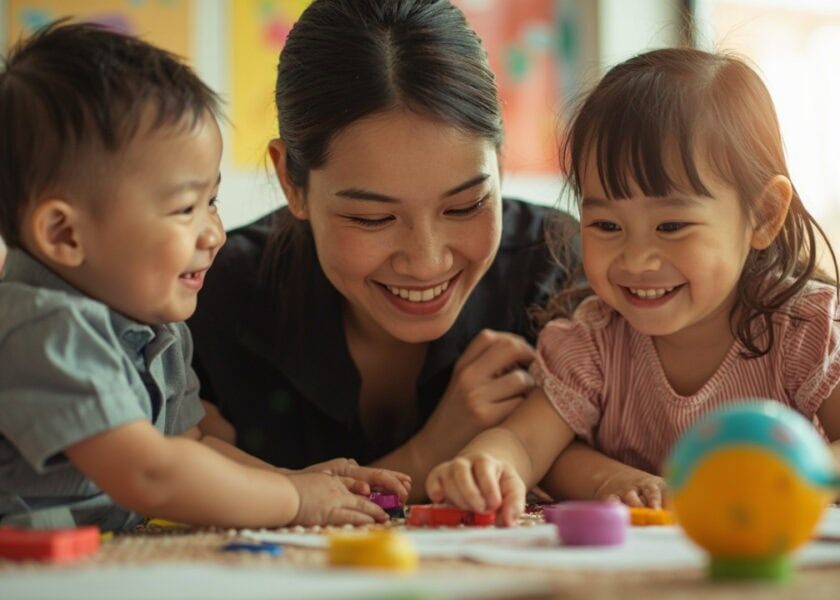
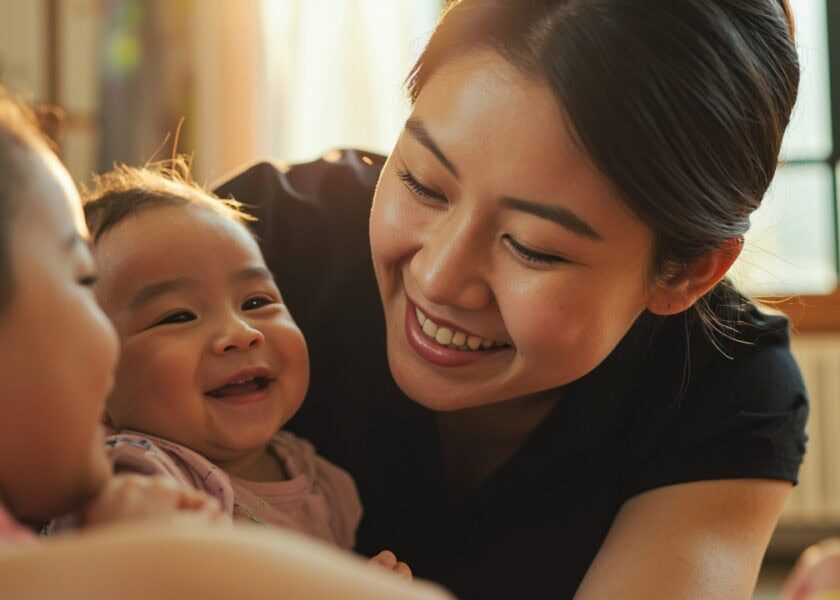
When your child is in a childminding environment with a low ratio of children to caregivers, they are not one of many whose needs are averaged into a routine. They are seen. They are known. And when they cry at drop-off, there is a familiar face — your face, in a sense, because you have chosen this caregiver and built the trust with them — that bends down, picks them up, and says, in every way that matters: I have got you. Your mummy and daddy will be back, and we are going to have a wonderful day while we wait.
Releasing the Guilt We Do Not Need to Carry
There is a narrative in our culture that good mothers — and I use that word deliberately, because this guilt most often falls on mothers — do not choose childcare if they can possibly avoid it. That the ideal of parenting is seamless presence. That separation in the early years is a deprivation. That any tears at drop-off are evidence of a failure somewhere in the system.
This narrative is not only wrong. It is harmful.
It makes parents feel that their very real need to return to work, to pursue their careers, to contribute to their families, is somehow a betrayal of their children. And it blinds parents to the extraordinary opportunity that thoughtful, quality childcare actually represents.
Your child is going to grow up in a world that will ask more of them emotionally than any generation before. They will need to regulate their own nervous systems in environments of constant change. They will need to form healthy attachments not only with their families but with teachers, mentors, teammates, and eventually their own partners and children.
The ability to separate from the people who love them, to trust new environments, to recover from distress — these are not optional skills. They are the foundation of emotional wellbeing. And they are built, not prevented.
For the Parent Considering This Decision Right Now
If you are reading this and you are in that place — the place where you have found a childcare arrangement that feels right, where the caregiver has the training and the warmth, where the environment is safe and responsive, but where something inside you is still hesitating because of the tears, the guilt, the fear that you are somehow letting your child down — I want you to know something.
The fact that you are worried about this at all is a sign of how much you love your child. The fact that you are doing this research, reading about attachment science, asking whether quality care is the right choice — that is the work of a parent who cares deeply and is trying to make the best decision they can.
You are not failing your child by returning to work. You are not failing your child by choosing childcare. You are making a choice that millions of parents around the world make every single day — a choice that, when made with care and supported by quality, does not damage attachment. It strengthens it.
The first goodbye is not the end of your bond with your child. It is the beginning of their confidence. It is the first act of trust — your trust in your child, your child’s trust in the world, and the trust you place in the caregivers who will hold this space for your family.
Your Child’s First Goodbye Is Not the End of Anything
When you choose quality care for your child, you are not outsourcing your parenting. You are expanding your child’s emotional world. You are giving them the gift of additional trusted adults who love and respond to them. You are giving them the gift of a consistent, warm, developmentally rich environment where they can learn to be independent precisely because they feel so secure.
And you are giving yourself the space to be the parent you want to be — present, patient, and whole — when you come home at the end of the day.
That is not a compromise. That is wisdom. And it is one of the most important developmental decisions you will ever make.
EduNanny was built on the understanding that confident children are not made by preventing all separations. They are made by handling every separation with the care that each child deserves.
Every caregiver in the EduNanny network is trained not just in the mechanics of infant care — the feeding, the sleeping, the safety — but in the art of emotional attunement. They understand that when a child cries at drop-off, the child’s nervous system is not broken. It is communicating. And their job is to receive that communication with the calm, warm confidence that says: I understand. I am here. You are safe.
The EduNanny programme maintains a ratio of one caregiver to three infants. This is by design. It is what makes genuine attunement possible — the bandwidth to notice the small cues, to respond before escalation, to be truly present with each child in their care.
When you drop your child off at EduNanny, you are not handing them over to a stranger. You are placing them in a trusted extension of your own care. And when you walk out that door, you are not abandoning your child.
You are trusting the process — the science, the training, the relationship, and the love — that will carry them through the hours until you return.
Ready to Explore Quality Childminding in Singapore?
Every family deserves to feel confident in their childcare choice. If you are considering childminding for your child and would like to understand what thoughtful, responsive care looks like in practice, we welcome the conversation.
Your child’s first goodbye is not the end of anything. It is the beginning of their confidence. And we would be honoured to be part of that story.
Learn more about EduNanny’s ECDA-approved Childminding Pilot, or get in touch to discuss your family’s needs.