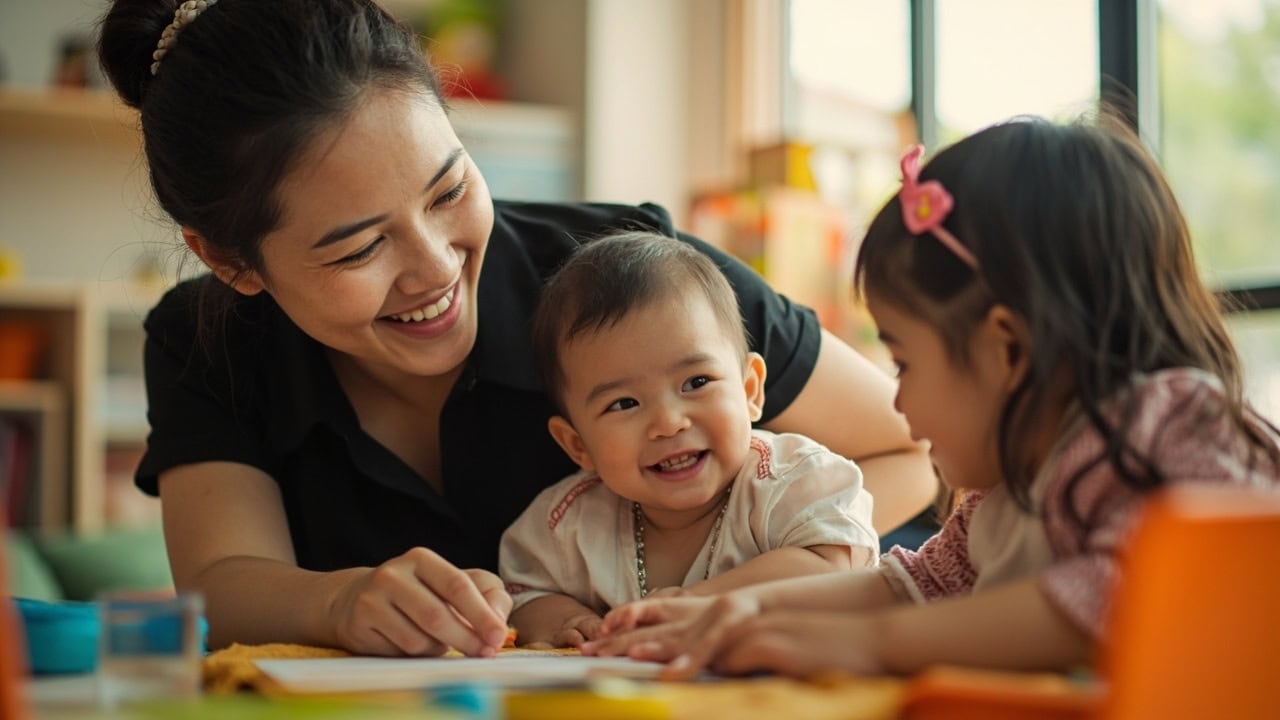
Your Child’s Brain Is Learning From Every Goodbye
Understanding Separation Anxiety: What Science Tells Us
To understand why this moment is so hard, you need to understand what is happening inside your child’s brain.
In the first years of life, the human brain is not yet capable of understanding object permanence in the way older children and adults do. When you leave the room, your infant genuinely does not know — in the deep, pre-logical way that governs their emotional world — that you still exist. They experience your absence not as temporary, but as a kind of void. The world becomes uncertain. Unsafe. And their response is not a rational calculation that you will return — it is a full-body, full-nervous-system alarm that says: I need you here. Now.
This is separation anxiety, and it is not a behavior problem. It is a developmental milestone — one of the clearest signs that your child has formed a healthy, secure attachment to you.
The Secure Base: Where Everything Begins
This response is governed by something developmental psychologists call the secure base — a concept first articulated by attachment researcher John Bowlby and later expanded by Mary Ainsworth and many others who followed.
The secure base is not a place. It is a relationship. It is the knowledge, felt in the body before it is understood in the mind, that there is one person — or a small set of persons — to whom I can turn when the world feels frightening or uncertain. The secure base is where your child starts from. It is the foundation from which they explore, grow, and eventually, learn to separate.
Here is what most parents do not know: the secure base is not diminished by quality separations. It is strengthened by them.
Why the Goodbye Builds Rather Than Breaks
When your child experiences a consistent, predictable cycle of separation and reunion — when you leave, and you return; when the goodbye is honest and the hello is warm — they are building something inside their brain. They are learning, through repetition, that departures are survivable. That the person they love comes back. That the world can feel uncertain and then become certain again.
Neuroscientists call this stress-response calibration. When a child experiences manageable anxiety — followed by a caregiver who is warm and consistent, followed by the parent returning — their nervous system learns that discomfort is not permanent. It learns that other adults can be trusted. That the world is largely safe. That they themselves are capable of surviving difficult moments.
This is the foundation of emotional regulation. This is what will allow your child, years from now, to sit with disappointment, to handle conflict, to walk into a new classroom and feel nervous and do it anyway.
The capacity to separate — to leave the secure base and know you can return — is not a sign that your child doesn’t need you. It is the evidence that your bond has done its work.
Your child’s brain is not being harmed by this moment. It is being built by it.
What Quality Childcare Looks Like in Practice
Not all childcare is the same. Not all caregivers understand the science of what is happening in these early separations. And the difference between care that works with your bond and care that inadvertently undermines it can be profound.
The Handover Ritual: More Than a Transition
Imagine a morning drop-off. A parent arrives with a toddler who is already clinging, already crying, already making it clear that they do not want this to happen.
A lesser environment might respond with impatience — a quick handoff, a murmured reassurance that is really a dismissal, a closing of the door before either parent or child is ready. The message, whether intended or not: What you are feeling is inconvenient. We need to move on.
But in a quality environment, the response is different. The caregiver kneels down. They acknowledge the child’s distress — not with pity, not with urgency, but with calm presence. They might say: I see you’re really upset. Your mummy is going to work, and you wish she could stay.
They do not lie and say everything is fine. They do not suggest sneaking away. They give the child the dignity of having their feelings seen, and then they help the parent complete the goodbye with honesty and warmth.
This is called a handover ritual, and it is one of the most important daily practices in early childhood care. The handover is an emotional transfer. When done well, it communicates to the child: The person I trust is handing me to another person who is also trustworthy. I can be okay in this space.
Your Anxiety Is Contagious — And That Matters
Parental anxiety is contagious. Children read their parents’ emotional states with astonishing precision, long before they have the words to articulate what they see.
If you walk into the childcare center tense and worried, if your goodbye is laden with guilt and hesitation, your child will internalize that message. They will learn that this place — the place where you leave them — is something to be feared.
That confidence is not a luxury. It is a biological need for your child. When you leave them feeling calm, they receive that calmness. When you leave them feeling guilty and afraid, they receive that too.
Watch the Reunion
When you return, watch how your child responds to seeing you. This tells you everything you need to know about whether your child is thriving in your absence.
- The child who runs to you, who reaches up, who wants to be held and then settles — that is a child who has been secure in your absence.
- The child who shows you their painting, who tugs your hand toward the sandpit, who is already looking forward to tomorrow — that is a child whose brain is growing in exactly the way it should.
How Other Relationships Support Rather Than Replace Yours
Research on attachment in childcare settings consistently shows that the quality of the caregiver-child relationship matters enormously. But here is what is often missed: the quality of that relationship does not replace the parent-child bond. It exists in relationship to it.
A child who has a secure attachment to their parent can form multiple healthy attachments — to caregivers, to teachers, to peers. The parent’s bond is not threatened by these other relationships. It is, in fact, the foundation that makes them possible.
Normal Adjustment vs. Signs Worth Watching
There is a difference between the normal difficulty of separation and a signal that something is wrong. As a parent, you need to know what to watch for.
Signs That Your Child’s Adjustment Is Normal
- Tears and resistance at drop-off that gradually decrease over the first few weeks
- A child who, when you return, is happy to see you, seeks comfort, and then returns to play
- A child who may be tired or clingy in the evenings but who is eating, sleeping, and meeting developmental milestones
- Increasing confidence in the childcare environment over time — who runs to the caregiver in the morning, who plays independently for longer stretches
Signs That May Warrant a Conversation
- Consistently refusing to eat or sleep at childcare — not just adjusting, but genuinely distressed
- Regression in milestones they had already achieved — toilet training, speech, motor skills
- Shutting down rather than crying — withdrawing, becoming unusually passive, showing no emotional response
- Reunion behavior marked not by relief but by lingering distress, or your child seeming not to recognize you as a source of comfort
These are not guarantees of a problem, but they are signals worth exploring with your caregiver.
Practical Strategies for the Morning Goodbye
Small shifts can make the transition smoother for both of you.
Before you leave: Give yourself time. Rushing creates tension, and your child will feel it. Arrive a few minutes early. Walk in together — let your child see you talking with the caregiver. Let them see that this is a person you trust.
During the goodbye: Kneel down to your child’s level. Make eye contact. Use simple, honest words: I love you. The caregiver will take care of you. I will be back after snack time, after your nap. Do not lie about how long it will be, but do not dwell on the departure either. Make it brief, warm, and certain. Then go.
After you leave: Trust your child’s capacity to adapt, to learn, to build the neural pathways that will serve them for a lifetime. Trust that the caregiver standing in that doorway is trained for this exact moment — and that the tears your child is crying are not the tears of a child who has been abandoned, but of a child who is learning that the world contains more than just you.
That is not a failure. That is growth.
Separation Anxiety Across the Ages
Separation anxiety does not look the same at every stage. Understanding what is developmentally appropriate for your child’s age can help you contextualize what you are seeing.
| Age Range | What Separation Anxiety Typically Looks Like |
|---|---|
| 0–6 months | Babies this young have not yet developed strong object permanence. Separation anxiety is not yet present, though infants are attuned to familiar voices and touch. Consistent caregiving helps build the foundation for later attachment. |
| 6–14 months | This is when separation anxiety typically first emerges. Your baby may cry intensely when you leave and be difficult to soothe — this is a sign their attachment to you is deepening. Peak intensity often occurs around 10–18 months. |
| 14–24 months | Toddlers may display more pronounced clinginess and protest at drop-off. They may also begin to show stranger wariness alongside separation distress. This is normal and indicates healthy cognitive and emotional development. |
| 2–3 years | Separation protests may become more verbal. Your toddler may negotiate, stall, or beg you not to leave. Consistency in your goodbye routine is especially important at this stage. |
| 3–5 years | Preschoolers understand object permanence but may still struggle with the emotional experience of separation. They may worry about when you are returning rather than whether. Separation anxiety at this age often reflects broader developmental leaps. |
The EduNanny Approach: Honoring Your Bond
EduNanny exists because we believe that the goodbye should not have to be this hard — not because we want to diminish the parent’s role, but because we want to honor it completely.
We were built on a simple premise: that Singapore parents deserve care that understands what it means to hold a parent’s most precious trust. That the relationship between a parent and their child is sacred, and that our job is to work within and around that relationship, never against it.
What This Looks Like in Practice
- ECDA Childminding Pilot participation — a commitment to regulated, quality standards
- Home-based and centre-based pathways — because every family’s needs are different
- Ratios of up to one to three infants — because a caregiver who is overwhelmed cannot be present, and a caregiver who is present can do what no ratio of six or eight ever could
- Accessible fee structures — designed so that quality care is a reality, not an aspiration, with simple ways to use your CDA and Baby Bonus
Beyond the logistics, beyond the ratios and the subsidies and the credentials, EduNanny is committed to something harder to measure but no less real: a philosophy of care that places the parent-child bond at the center of everything we do.
Every EduNanny caregiver is trained not just in the practical skills of infant and child care, but in the science of attachment. They understand secure base behavior. They know how to read a child’s emotional cues. They know how to create a handover ritual that is honest, warm, and trusting — one where the child feels seen, the parent feels confident, and the transition happens not as a break but as a bridge.
Transparency When It Matters Most
We know that transparency matters. That when you are at work, at a meeting, on the train home, you need to know that your child is okay — not in theory, but in reality.
That is why communication is built into the EduNanny experience. You will receive updates. You will know what your child ate, how they slept, what they did during the day. Where CCTV measures are deployed, you have the ability to see for yourself. We do not hide. We invite you in, even when your child is not physically with you.
Support Between Visits
For the moments when you have a question — in the middle of the night, when you are lying awake wondering if today was hard — the Thomas AI Chatbot is available through EduNanny.
It is not a replacement for human care, and it is not a replacement for the conversation you will have with your caregiver. But it is a resource — a way to ask questions, to find reassurance, to get practical guidance on everything from separation anxiety to sleep schedules to the hundred small concerns that arise when you are navigating the first years of your child’s life.
Finding Care That Honors Your Role
If you are searching for infant care or childminding in Singapore, here are the questions worth asking — not just about credentials and ratios, but about how this care understands the relationship between you and your child.
- How do caregivers handle the morning handover? Do they encourage honest goodbyes, or do they suggest sneaking away?
- What does a typical day look like? Is there predictable routine — because predictability is the architecture of security for young children.
- How do caregivers respond to a distressed child? Are they trained in reading emotional cues and supporting without dismissing?
- What does communication look like? Will you know how your child’s day went — not just that they were fine, but what they did, how they ate, how they slept?
- How does the caregiver speak about your role? Do they position themselves as a partner with you, or as a replacement?
The right childcare does not compete with your bond. It protects it. It receives your child from your hands and holds them with the understanding that this child belongs to you — and that their job is to care for them until you return.
You Are Not Failing. You Are Doing the Hardest Work.
That moment that every parent knows in their body. The moment when your child’s hand slips from yours. The moment when you turn around and the world feels uncertain, and the doubt creeps in, and you wonder if you are doing the right thing.
I want to tell you that you are.
Not because childcare is perfect. Not because every day will be easy. But because the fact that you feel this way — that the goodbye is so hard, that the guilt is so real, that you lie awake worrying about whether you are doing enough — means that you are the kind of parent your child needs. It means that your love is present. It means that the bond between you is real and deep and worth every moment of this difficulty.
The goal was never to eliminate that difficulty. The goal was never to raise a child who doesn’t need you.
The goal was to raise a child who knows, in their bones, that they are loved — and who can carry that knowledge into the world, even when you are not there to remind them.
That is what EduNanny is here to do. Not to replace you. Not to compete with you. But to hold the space between you and your child with the care and the reverence it deserves. To be the trustworthy hands that receive your child when you have to let go. To honor the goodbye, and the reunion, and everything that happens in between.
Singapore parents, you are not failing. You are doing the most difficult, most important work in the world — and you are doing it in a city that does not always make it easy.
We are here because we have seen the reunion. We have seen the child who runs to their parent and then turns back to wave at their caregiver. We have seen the parent who walks in anxious and leaves relieved. We have seen the bond not weakened but strengthened by the quality of the separation.
If you are standing at that doorway right now — if you are hesitating, if you are doubting, if you are wondering whether you can do this — you can. Not because the goodbye will ever be easy. But because the love behind it is real, and it is strong, and it will carry both you and your child through every separation, every reunion, and every moment in between.
You are not alone in this. We are here. And we have got you both.
Every family deserves to walk out that door feeling confident — and to return to a child who runs into their arms. If you are ready to explore what quality, relationship-centered care looks like, we would be glad to hear from you.