The Morning Drop-Off That Reveals What Quality Childcare Means
The Morning Drop-Off: Where Every Day Begins
The drop-off is a transaction that looks simple but carries enormous weight. You hand your child to someone. You leave. Your child is in a new environment, with new people, new sounds, new routines.
For the first few minutes — perhaps the first few days, perhaps longer — there is a calibration happening. Your child is taking stock. They are reading faces, measuring voices, watching how people move. They are asking, without words, a question that is not about childcare at all: am I safe here?
In quality care, this question is answered quickly. Not because children are distracted or consoled, but because the environment is built around the reality of how children experience new spaces.
What Small Ratios Actually Mean
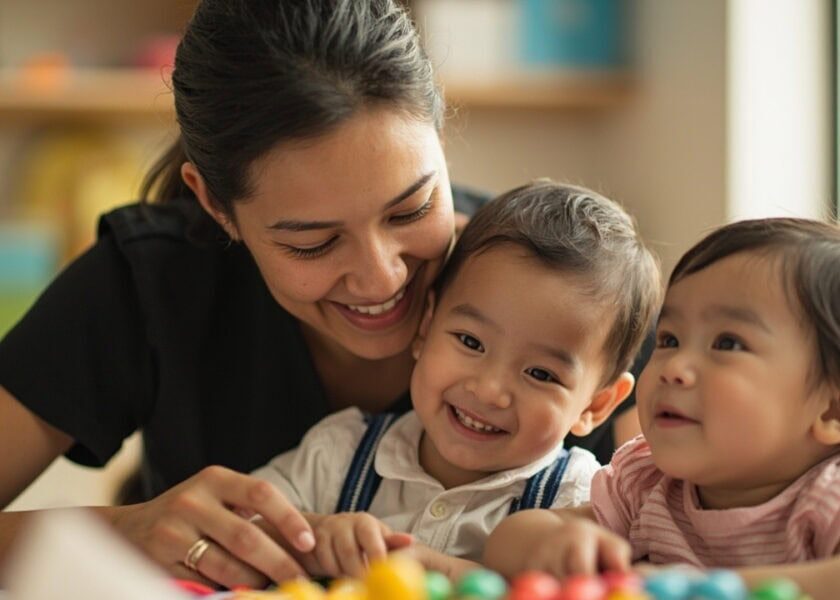
At EduNanny, that means small ratios. When there are three infants for every one caregiver, your child is not lost in a crowd. When your child looks up, they find a face that is already watching. When they reach out, there is a response.
This is not a luxury. It is the foundation on which everything else is built.
The caregiver who receives your child each morning has already been thinking about them. She knows — or is learning — the small things that matter: the way your child prefers to be held, the object they carry for comfort, the expression that means hunger and the one that means something else entirely. She does not follow a script. She reads the child in front of her and adapts.
This is what responsive care means — not a checklist of activities, but an ongoing conversation between caregiver and child, conducted in the language of touch, eye contact, tone, and timing.
What a Good Transition Looks Like
When this is done well, the transition does not end with tears that need to be suppressed. It ends with your child looking up — perhaps reluctantly, perhaps with a small measure of trust already forming. It ends with the caregiver’s attention shifting, gently, toward the next child who needs the same thing — and your child watching that care being given to someone else, and learning something important in the watching.
They are learning that care is not only for them. They are learning they are part of a small community.
This is the first hour. And already, so much has happened.
A Morning in Practice: What It Actually Looks Like
The hours that follow have a rhythm, though not the rigid, clock-driven kind that many of us imagine when we think of institutional childcare. For infants and young children, time moves differently.
There are blocks of activity — feeding, sleep, play, exploration — but within those blocks, there is flexibility. A child who is deeply engaged in stacking blocks is not interrupted because the schedule says it is time to move on. A child who is upset is not left to cry because the routine calls for group time. The schedule serves the children; the children do not serve the schedule.
Supervision vs. Quality Care
This is one of the most meaningful distinctions between quality childcare and mere supervision.
Supervision asks: is the child safe? Is everyone accounted for?
Quality care asks something more:
- Is this child engaged?
- Is this child learning?
- Is this child being seen?
- Is this child regulated — that is, are their emotions being met with enough steadiness that they can move from frustration to curiosity, from overwhelm to calm?
The Invisible Curriculum
At EduNanny, these questions are not rhetorical. Caregivers are trained to notice what is happening beneath the surface of a child’s behaviour.
This is what researchers call the invisible curriculum. It is not the songs or the storybooks, though those matter. It is:
- The way warmth becomes a felt sense of security
- The way a caregiver’s consistent presence teaches a child that absence is not permanent, that people return, that the world is predictable enough to navigate
- The way being met with patience during a tantrum teaches a child something about their own worth
A Concrete Example
Consider a morning at EduNanny. Your child has settled from the drop-off. She is sitting on the floor with a set of wooden toys — simple things, nothing electronic, nothing that lights up or makes noise on its own. She is experimenting. She drops a block. She watches where it goes. She picks it up and drops it again.
She is building an understanding of gravity, of cause and effect, of her own power to change the world. She is also — without knowing it — building the neural pathways that will later support scientific thinking, problem-solving, the ability to persist when something is hard.
The caregiver nearby is not directing this play. She is present, available, and understands that her role is not to entertain or to accelerate but to witness and, when needed, to extend.
When your child looks up at her, she meets that gaze. She smiles. She names what she sees: “You dropped the block. It fell down.”
This is not idle chatter. It is language being paired with experience, which is how children learn the meaning of words. It is also connection — the child learning that her actions matter to someone, that she is being thought about by another person, that she is not alone in the universe.
When Frustration Arrives
Later, there may be frustration. Another child takes a toy. Your child is not yet two; she does not yet have the language or the social skills to negotiate. She cries.
The caregiver moves in — not to scold, not to separate, not to rush — but to be present. She may crouch down to your child’s level. She may use a calm voice. She may offer words for the feeling: “You wanted that toy. You feel sad because she took it.”
In that moment, your child is learning that big feelings are survivable. That an adult will stay with them in the storm. That they are not alone with their distress.
This is emotional regulation being taught not through lecture but through experience. And it is happening not because the caregiver read a manual, but because she is trained, present, and skilled in the particular art of infant and toddler care.
The Long View
Now multiply that morning by months. By years. By the hundreds of small interactions, the hundreds of moments of being seen and responded to, the hundreds of times a child has been helped to navigate a feeling and come out the other side feeling whole.
This is what your child is doing at childcare. This is what quality care makes possible.
The Caregiver: More Than a Caretaker
We should speak about the caregiver herself, because she is the heart of any childcare arrangement, and in Singapore, her work is not always understood or valued as it should be.
The professional childminder at EduNanny is not simply a caretaker. She is:
- An early educator
- A bridge between your family and the world your child is beginning to navigate
- A person who holds significant responsibility for your child’s development during some of the most formative years of their life
She has trained for this work. She understands infant development, attachment, language acquisition, the importance of play, the meaning of behaviour. She is not a last resort or an underqualified placeholder. She is a professional, and her professional skill is what makes quality care possible.
Why Small Numbers Matter
At EduNanny, caregivers work within a framework that takes this seriously. They are supported, trained, and given the conditions they need to do their work well.
Low ratios — that one-to-three for infants — are not just a policy statement. They are the practical reality that allows a caregiver to:
- Actually know each child
- Notice what is happening with them
- Respond with genuine attention rather than divided consciousness
This is what EduNanny understands, and why the ECDA Childminding Pilot matters: it is an attempt to professionalise and support the kind of childcare that Singapore’s families actually need.
Why This Matters for Singapore Parents
Singapore’s families face pressures that are unique and intense. The cost of living, the demands of dual-income households, the extended family structures that once provided informal childcare and now stretch across borders and oceans — these realities do not wait for policy solutions.
Parents need care they can trust. They need care that their children genuinely benefit from, not just survive. And they need it to be accessible — within reach financially, flexible in its delivery, and aligned with the values they hold for their children’s earliest years.
What EduNanny Offers
- Multiple pathways: Whether home-based, community-based, or centre-based, there are options that match different family structures and preferences
- Accessible fees: Pilot fee structures are designed to be within reach, and the usability of CDA and Baby Bonus means the government’s financial architecture to support Singaporean families can actually be accessed for childcare expenses
- Working-life alignment: Monday to Friday care blocks align with the rhythms of working life
These are practical answers to practical questions. But the deeper answer is the one we have been exploring: the quality of the experience itself.
Because parents do not just need somewhere to send their child while they work. They need somewhere that is good for their child.
And good, for an infant or toddler, means being known. Being responded to. Being in an environment that understands how children develop and structures every hour around that understanding.
How Do You Actually Know?
You may be wondering how you would ever actually know whether this is what your child’s day looks like. How do you verify what you cannot see?
This is a fair question, and EduNanny takes it seriously. Communication and transparency are built into the approach — not as marketing language but as a genuine commitment to keeping parents connected to their child’s experience.
Tools for Transparency
Where deployed, CCTV measures offer a window into the daily life of the centre. Caregiver reports and updates give you language for what unfolded during the day. The Thomas AI Chatbot, available through EduNanny, offers parents a way to get answers, to process concerns, to stay engaged with their child’s development even in the midst of busy lives.
These tools are not substitutes for trust — they are supplements to it. They acknowledge that you deserve to know what is happening, and they give you the means to find out.
What to Look For in Any Childcare Setting
The truth is that the childcare decision should not require blind faith. It should not be made on the basis of a glossy brochure or a reassuring conversation alone. It should be made on the basis of understanding — of knowing what you are choosing, and why, and what it will mean for your child.
When evaluating any childcare arrangement, consider asking:
- What is the caregiver-to-child ratio?
- How do caregivers respond to distress — is it individualised or routine-based?
- What does a typical day look like for the children?
- How are parents kept informed?
- Do the caregivers stay — is there consistency?
From Trust to Recognition
There is a version of the childcare conversation that focuses entirely on the parent: parent guilt, parent trust, parent confidence, parent peace of mind. And those things matter. Parenting is hard, and the hours apart from your child can be some of the most emotionally complex of your life.
But there is another way to think about this, and it is the better way.
When you understand what your child is experiencing at childcare — when you can picture the caregiver crouching down to meet their eyes, the wooden block falling and being named, the moment of frustration and the patient voice that helps them through it — the decision changes. It stops being about your anxiety and starts being about your child’s reality.
You are no longer asking: can I trust this place?
You are asking: is this place good for my child? Is my child growing here? Is my child known here?
And when the answer is yes — when you can see the quality, when you can feel the fit — then the decision is not a leap. It is a recognition.
What This Means for You
Your question — what happens after I leave? — is not a question to be medicated or minimised. It is a question that deserves an answer.
Quality care is identifiable. It has features you can observe and ask about — small ratios, responsive caregivers, a schedule that serves children, transparency with parents. These are not promises. They are practices.
The invisible curriculum is real. The warmth, consistency, and patience your child receives in those early years accumulates into something lasting. Children who are securely held become children who can hold themselves steady.
You can know. The best childcare settings do not ask for blind faith. They invite your understanding. They welcome your questions. They show you what they do, not just tell you.
And when you find a place that can give you that answer — not in vague promises but in the texture of daily experience — something shifts. The fear becomes curiosity. The doubt becomes clarity. The hours apart, instead of being a source of worry, become something else entirely: hours in which your child is growing, learning, being held in steady and skilled hands, and becoming whoever they are meant to be.
A Place That Understands
EduNanny exists because children deserve to be in environments that understand them. Because parents deserve to go to work knowing that their child is not merely supervised but genuinely cared for — in a way that matches what they would do themselves if they could be there.
Because the early years are not a rehearsal for later life. They are life itself, and they matter enormously.
That is what a day at EduNanny looks like. That is what quality childminding in Singapore can offer. And that is why this work — thoughtful, skilled, deeply human — matters more than we sometimes allow ourselves to say.
Ready to See for Yourself?
If what you have read here resonates with what you are looking for, we invite you to take the next step. Visit EduNanny, ask your questions, and see whether the experience matches what you have just read.
The best way to know is to witness it firsthand.
Book a visit or enquiry today.
EduNanny is a development-oriented childminding service committed to quality care for Singapore families. Learn more about us or explore our programmes.