What Your Child’s Caregiver Sees That You Cannot
The Gap Between What You See and What Is Happening
A parent who picks up their child at the end of the day may see a child who seems happy, or tired, or hungry, or content. They may hear new sounds, notice a new gesture, sense a shift in temperament. But they are seeing the result of hours they did not witness.
The work—the real, profound, developmental work—has been happening all day long, in ways that require trained observation to truly understand.
Consider the first word your child speaks at home. You may marvel at it as a sudden breakthrough. But trained caregivers know that this moment was weeks in the making—practiced in childcare, shaped through hundreds of responsive interactions, building on a foundation of language exposure that happened when you were not in the room.
Or consider a social gesture that emerges unexpectedly at home—something your child learned by watching other children, by experiencing the conditions for connection that a caregiver thoughtfully created. This did not happen in isolation. It happened across hundreds of hours of patient, responsive care.
The gap between what parents see and what is actually happening is not a problem to be solved by wishing it away. It is a reality to be understood. And that understanding is exactly what quality caregivers can provide.
Why the Early Years Are Different
In the first years of life, a child’s brain forms connections at a pace that will never be matched again. A two-year-old’s brain is more than twice as active as an adult’s. Your child’s brain forms one million neural connections every second in the earliest months.
This is not metaphor. This is architecture. It is a brain being built—room by room, window by window—in response to every interaction, every sensation, every moment of being held, spoken to, played with, comforted, and curious.
Here is what makes this so difficult for parents: most of this construction is invisible. Not invisible because it does not matter—it matters enormously—but invisible because it happens in ways that are not easily seen without training.
It happens in the breath before sleep. In the focus of a baby’s eyes tracking a mobile. In the silence of a room where a caregiver is quietly narrating what a child is reaching toward. It happens in the small, incremental steps of development that do not announce themselves, that do not come with fanfare, that are easy to miss unless you know what you are looking for.
This is not a failure of parenting. This is the nature of development itself—continuous, layered, and often invisible until it suddenly becomes visible.
What Trained Caregivers Actually Do
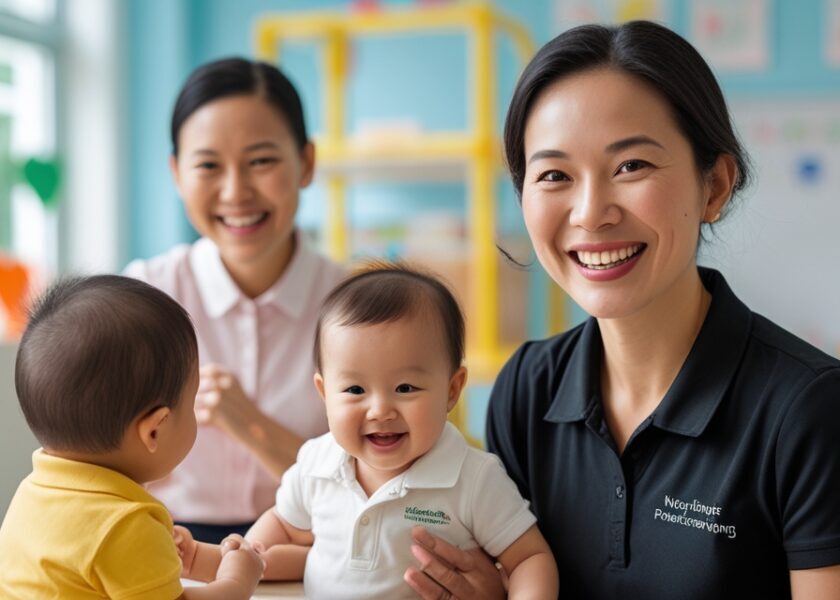
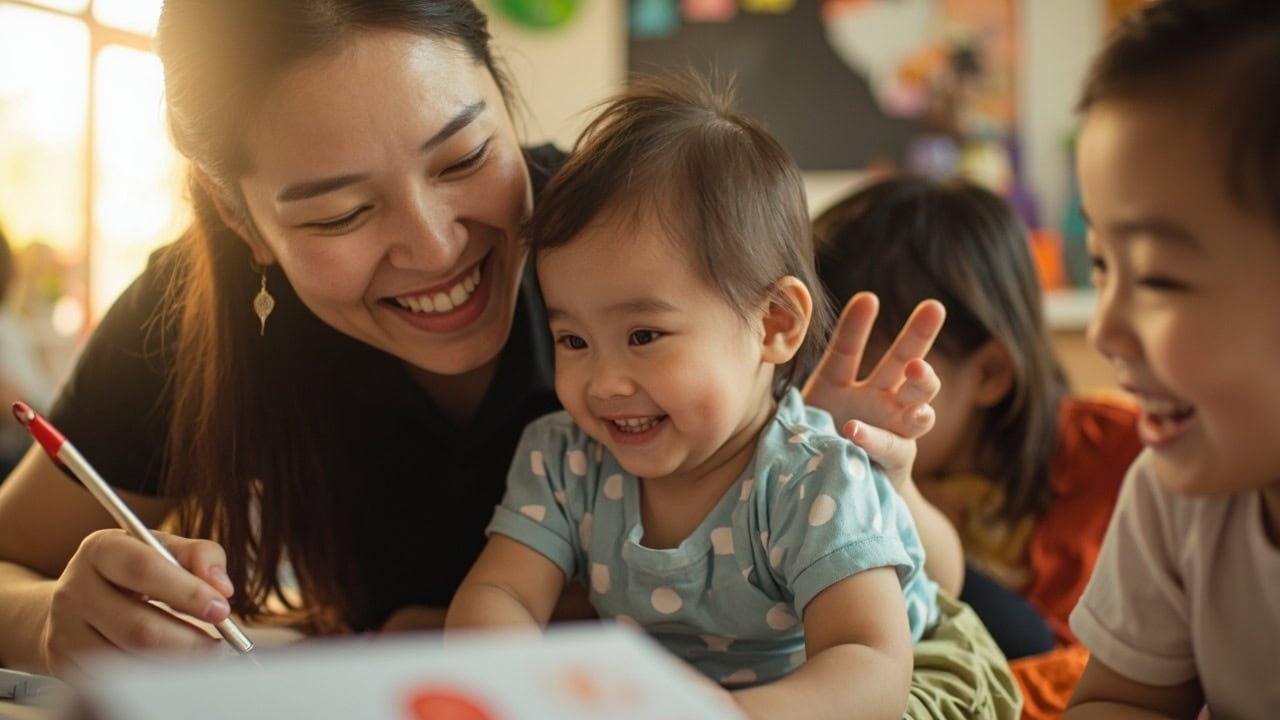
A trained caregiver does not simply watch a child. A trained caregiver reads a child. They notice the subtle signs of developmental progress that would be invisible to an untrained eye—what a particular type of cry means versus another, what a certain posture indicates about a child’s comfort or curiosity, what a seemingly simple interaction reveals about cognitive or emotional state.
Think of a trained caregiver as a developmental interpreter—the bridge between the hours you cannot see and the understanding you need to feel confident in your child’s care.
When you drop off your child and head to work, you are not leaving them with a stranger. You are entrusting them to someone who will see what you cannot see and help you understand it.
They notice the moments when a child is stretching toward a new ability, when they are on the verge of something and need support, when they need space to explore on their own. They see:
- A twelve-month-old practicing the pincer grip—the emerging hand control that will eventually allow writing and self-feeding
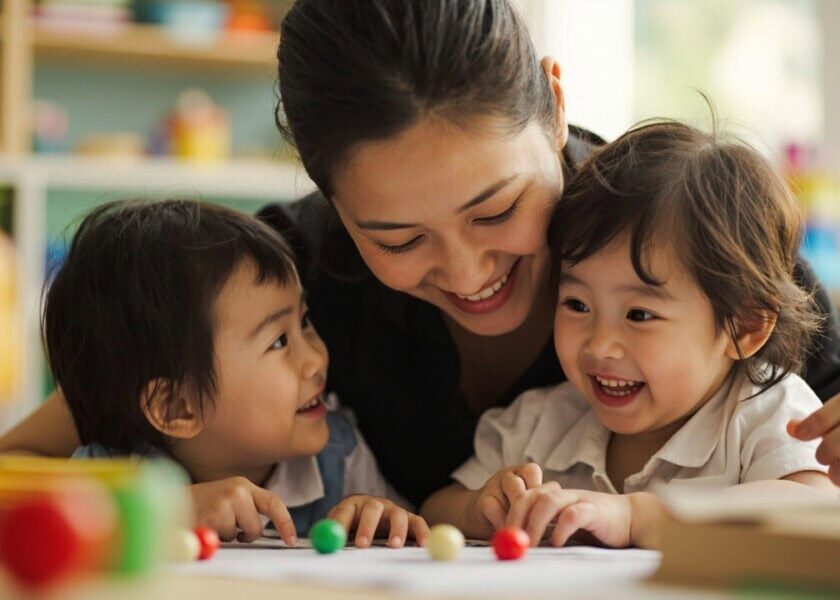
- A group of toddlers moving from parallel play toward cooperative interaction—a social milestone that looks simple but represents months of developmental preparation
- A baby’s face change when a familiar caregiver enters the room—a micro-expression of recognition and trust that reveals the secure attachment forming beneath the surface
- The way a baby learns to modulate their voice
- The way a toddler begins to solve problems
- The way a child’s play reveals emerging social understanding
This is not intuition. It is trained skill—the kind of expertise that comes from understanding child development, from knowing the milestones and the pathways by which children reach them, and from having the time and attention to truly observe.
For parents, this kind of understanding changes everything. It changes the questions you ask at pickup. Instead of “Did she eat well? Did he sleep?” you begin to ask “What was she interested in today? What did you notice him working on?”
It changes how you see your child’s behaviors. You begin to understand that what looks like a small thing at home is often the culmination of weeks of developmental work. And it changes your relationship with your caregiver. Instead of trusting blindly, you are partnering thoughtfully, with shared language and shared understanding.
The EduNanny Approach
EduNanny operates within Singapore’s ECDA Childminding Pilot—a framework designed to expand quality infant and child care options for Singapore families, reflecting a genuine commitment to making that care accessible and standards-driven.
Within this context, EduNanny is built around a clear belief: that caregivers should be trained observers, not just supervisors. This shapes how care is structured, how caregivers are developed, and how families are included as partners in their child’s growth.
- Infant ratios are maintained at up to one caregiver to three infants, designed to ensure that every child receives the attention and observation that developmental science tells us they need
- Fee structures aim to make quality care achievable for more families
- CDA and Baby Bonus funds can often be used to offset costs, reducing the financial pressure that so often adds to the emotional weight of parenting
- Care pathways include both home-based and community options, recognizing that different families have different needs
- Monday through Friday care blocks provide the consistency that working parents require
- Communication measures, including transparency protocols and CCTV where deployed, reflect a commitment to trust earned through openness
At EduNanny, caregiver training emphasizes developmental observation as a core skill—not as an afterthought, but as a fundamental part of what quality care means. Caregivers learn to track progress, recognize milestones, and communicate findings to parents in language that is both meaningful and actionable.
Questions to Ask and Signs to Look For
If you are researching infant care or childminding options in Singapore, here are the questions that go beyond the basics:
Questions to ask potential caregivers or services:
- What do you notice about my child’s development—not just their routine, but their learning?
- How do you communicate observations to parents?
- What is your training in child development?
- What does a typical day look like in terms of observation versus just supervision?
- How do you track developmental progress over time?
Signs of quality observation:
- Caregivers who can describe your child’s interests and engagement in specific terms
- Feedback that goes beyond “they ate well” to what they were curious about
- An understanding of your child as an individual with their own developmental trajectory
- Openness to questions and willingness to share observations
Addressing common parent concerns:
“How do I know my child is actually developing, not just being kept safe and comfortable?”
Safety and comfort are foundations, not the whole picture. Quality care goes further. Trained caregivers are actively observing your child’s developmental progress throughout the day—not as a checklist, but as a continuous process of understanding your child as an individual. Ask your caregiver what they noticed your child working on today. Ask what made them pause and pay attention. These are the questions that reveal whether observation is happening or merely supervision.
“What if I don’t understand developmental terminology?”
Good caregivers translate. Part of trained observation is the ability to communicate what you see to parents in language that makes sense. You should not need a psychology degree to understand your child’s day. The goal is clarity, not jargon.
“What if my child seems ‘behind’?”
Developmental progress is not always linear, and every child follows their own path. Trained caregivers can help you understand whether what you are seeing is within typical range, whether it reflects a developmental leap that happened recently, or whether there is genuinely something to discuss with a pediatrician.
Understanding Enables Informed Confidence
When a parent truly understands what is happening in their child’s early development—when they have been given the language and the vision to see the growth that is occurring even in their absence—something shifts.
The anxiety does not disappear entirely, because parenting always involves some uncertainty. But it transforms. It becomes the healthy, engaged attention of a parent who is participating in their child’s development rather than merely worrying about it.
This is the difference between blind trust and informed confidence:
- Blind trust says, “I hope my child is okay.”
- Informed confidence says, “I know what my child is learning, and I understand the people who are helping them learn it.”
Blind trust leaves parents isolated in their worry. Informed confidence connects them—to their child’s development, to their caregiver, to the process of growth that is happening all around them.
The early years are short. They are shorter than any of us expect, and they matter more than any of us can fully measure. When we look at a child in those early years, we are looking at a person whose brain is being built, whose sense of trust is being formed, whose relationship with the world is being established, whose potential is being shaped in ways that will echo through their entire lives.
Every parent in Singapore knows this. Every parent carries it with them—in the weight of their responsibility, in the care they take in choosing childcare, in the questions they ask, in the love they give.
But knowing something and seeing it are not the same thing. And for too long, parents have been asked to trust in what they cannot see—to believe that the invisible work of early childhood is happening well, without the tools to verify it, without the language to understand it, without the partnership to participate in it.
EduNanny was built to change that. Not to replace the parent, but to stand beside them. Not to claim the credit for a child’s growth, but to help parents understand what that growth looks like and how it happens. Not to eliminate the uncertainty of parenting, but to transform it into something more bearable and more beautiful—into informed participation, into shared understanding, into the confidence that comes not from blind faith but from genuine knowledge.
When you drop your child at EduNanny, you are not leaving them with a stranger. You are entrusting them to a trained observer, a developmental interpreter, someone who will see what you cannot see and help you understand it.
You are becoming part of a partnership dedicated to your child’s growth. And you are giving yourself the gift of seeing, finally, what has been happening all along.
Begin the Conversation
If you are searching for infant care or childminding in Singapore and want to understand what quality observation can offer your child, we invite you to learn more about the EduNanny approach.
The early years are short. Give yourself the confidence to see them clearly.
To learn more about EduNanny, visit our website. For questions about our services, get in touch.