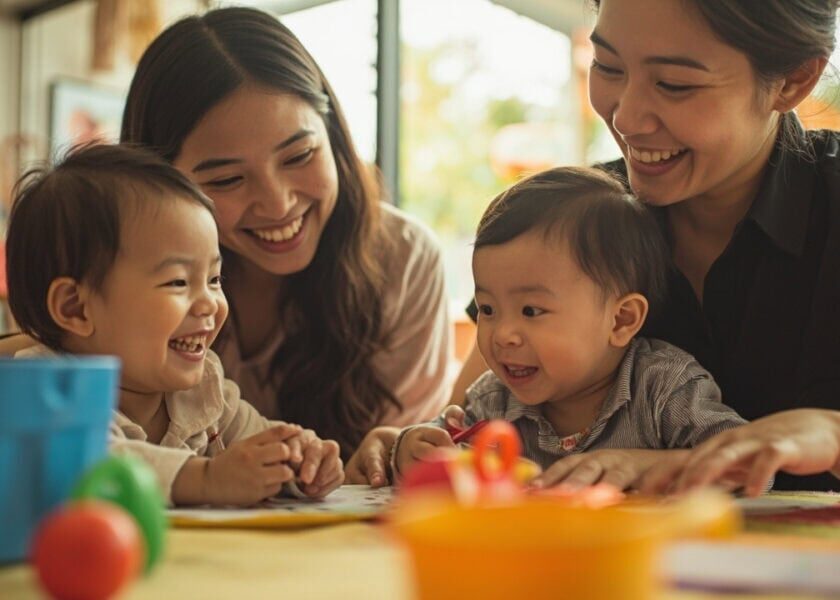
What Quality Childcare Teaches Beyond Reading and Counting
The Invisible Curriculum: What Your Child Is Really Learning in Childcare
Not the curriculum. Not the themes for the month. Not whether they coloured inside the lines or remembered their teacher’s name. If you are standing in the lift after dropping your child at childcare, what you are really wondering is this: Is my child okay? Is someone paying attention to who they are becoming?
That question — the one that sits beneath all the practical logistics of childcare — is, I believe, the most important question a parent can ask.
Here is what I have observed, speaking with hundreds of parents across Singapore. We are remarkably good at asking the right questions about education. We ask about teacher qualifications, student-teacher ratios, curriculum frameworks, and enrichment programmes. We research. We compare. We visit. We ask about Mandarin exposure and whether the food is nut-free and catered by a dietitian.
But the most important thing your child is learning in quality childcare — the thing that will matter most in five years, in ten years, in twenty — is not reading. It is not counting. It is not a worksheet, however thoughtfully designed.
The most important thing your child is learning is how to be human. And that learning happens in a dimension that is almost entirely invisible to us — until, suddenly, it is not.
- Quality childcare builds emotional vocabulary — teaching children to name and understand their feelings
- Peer interaction develops empathy and relational skills that cannot be replicated at home
- Caregiver guidance transforms everyday conflicts into lessons in conflict resolution
- Consistent, attuned environments help children develop self-regulation skills
- The invisible curriculum is deliberate, not accidental — it requires trained caregivers and thoughtful design
What Emotional Intelligence Actually Means for Your Child
In child development research, we call this the development of emotional intelligence. What we are really talking about is a set of skills that determine whether a child can navigate the social world with confidence and care:
- The ability to recognize what you are feeling — awareness of your own emotional states before they overwhelm you
- The ability to name it — having the language to articulate inner experience, which is the first step to managing it
- The ability to manage the impulse that comes with big feelings — learning to pause, breathe, and choose a response
- The ability to notice what another person is feeling — empathy in action, not just as an abstract concept
- The ability to respond with kindness — rather than indifference or aggression when someone else is struggling
- The ability to enter a group of unfamiliar children and feel belonging — not just social anxiety
- The ability to resolve a disagreement without a teacher intervening — genuine social competence
- The ability to walk into a new classroom and think — there is a place for me here
These are not soft skills. These are not optional extras. These are the skills that predict, more reliably than any academic metric, how well a child will adjust to school, how satisfying their friendships will be, how resilient they will be when life inevitably becomes hard.
The research on this is robust. The Harvard Centre on the Developing Child calls them “executive function and self-regulation skills” — and describes them as among the most critical capacities a child can develop. Not because intellectual ability does not matter, but because emotional regulation and social competence are the platforms upon which all learning ultimately rests.
A Story of Two Children
Let me show you what this looks like in practice.
Imagine two children at play, both four years old, both bright and curious. One has spent their mornings in an environment where an experienced caregiver notices the subtle shift in a child’s posture when frustration begins to build — and names it, quietly, before it escalates.
“I see your shoulders are going up. It looks like you are feeling really frustrated that Kenji took the red truck. That is such a hard feeling.”
That child is learning, every single day, that feelings have names. That big feelings are not dangerous. That someone understands what is happening inside them, even when they cannot say it in words yet.
The other child encounters the same conflict and has no one nearby who names what is happening. The feeling rises, the impulse follows, and the resolution is either silence or a cry that no one really attends to because there are too many children and not enough attuned attention.
Both children will enter Primary One. Both will learn to read. Their report books will look similar. But the child who knows the vocabulary for their inner life will sit in a classroom differently. They will ask for help differently. They will notice when a classmate is struggling differently. That vocabulary — that is not trivial. That is the foundation of everything.
Why These Skills Cannot Be Taught Through Instruction
These skills are not taught through instruction. You cannot put them on a worksheet. You cannot assign them as homework. Your child will not come home and announce, “Mummy, today I learned how to manage my frustration.”
Instead, these skills are caught, not taught. They are absorbed through the texture of daily experience — through hundreds of small interactions, repetitions, and modelled responses in an environment that is safe enough, consistent enough, and attentive enough to become a genuine school for the heart.
A Morning in Quality Childcare: The Architecture of Emotional Growth
So what does this look like in practice? What is actually happening, on a typical morning, in a childcare environment that is designed with emotional development as a priority?
Morning Snack: The Art of Noticing
A caregiver sits with four children during morning snack. One child is quietly watching the others eat. The caregiver notices and says, gently, “Jun Wei, you are watching Qian Hui eat her biscuits. Does it look nice?” Jun Wei nods. “Would you like to try your own?”
Someone noticed what Jun Wei was doing. Someone wondered alongside him. Someone gave language to a moment of quiet curiosity that might otherwise have passed unnoticed.
Block Play: Conflict as Curriculum
Later, two children are building with blocks. A tower collapses. One child bursts into tears. The other steps back, unsure. The caregiver does not rush in to solve the problem. She bends down, close to both children, and says, “Oh no, the tower fell. That is so disappointing, isn’t it? Can you tell me what happened?”
Slowly, with gentle questions, she helps both children narrate the event — not to assign blame, but to help them see that the tower’s fall was an accident, that no one meant to upset anyone, and that building again together is possible. This is conflict resolution. This is emotional validation. This is teaching children that conflict does not end relationships.
Circle Time: Empathy Through Stories
At circle time, a caregiver reads a picture book about a little rabbit who feels left out. She pauses at the page where the rabbit sits alone and asks, quietly, “How do you think the rabbit feels right now?” And three or four small voices offer guesses — “sad,” “lonely,” “nobody wants to play with him.”
“Yes,” the caregiver says. “That is what it can feel like when we leave someone out. Have any of you ever felt like that?”
And the room goes quiet, because every child has, and someone has just given them permission to say so.
These moments may seem small. They are not small. They are the curriculum that shapes a child’s inner life. They are the moments that, accumulated over months and years, produce a child who walks into Primary One not just academically ready but socially anchored. A child who knows what to do when they feel left out. A child who notices when someone else is left out. A child who believes, deep in their bones, that they belong and that their feelings matter.
Why Social-Emotional Skills Are Harder to Build at Home
Let me be honest with you, because I think one of the most powerful things we can do as adults who care about children is to acknowledge something that many parents feel but rarely hear articulated: these skills are actually harder to provide at home than academic preparation. And that is not a criticism of parents. It is the truth about what young children actually need.
Think about it. A parent at home can sit with their child and do a worksheet. They can practise letter formation. They can count objects. These are valuable activities, and there is nothing wrong with them.
But a worksheet does not teach empathy. A counting game does not teach a child how to manage the disappointment of losing a game without falling apart. Only peer interaction can fully teach a child how to be a good friend, because the lessons of friendship — sharing, waiting, forgiving, negotiating, empathising — can only be learned in the presence of other children who are equally imperfect, equally impulsive, equally learning.
This is not a diminishing of the home. It is an enlargement of what childcare can be. When you choose a childcare environment that understands this, you are not outsourcing your child’s development. You are providing your child with experiences that you, however much you love them, cannot provide alone. You are giving them a community.
And that word matters. What your child is learning in quality childcare is not just a set of individual skills. They are learning that they are part of something. That there are people who depend on them and whom they can depend on. That the group has a rhythm, a warmth, a set of expectations they can trust. That belonging is not something you earn by being the fastest or the cleverest — it is something you receive by being present, by being yourself, by being part of the daily fabric of a place that is glad you are there.
The research tells us that children of working parents develop normally, thrive emotionally, and form secure attachments when the care environment is warm, consistent, and attuned. What children need is not the presence of a specific adult at every moment. What children need is the presence of adults who see them, who respond to them, who are genuinely interested in who they are becoming. That is what quality childcare provides.
What to Look For: A Practical Guide for Choosing Infant Care
So how do you know if the childcare you are considering is actually providing this? Here is what to look for.
1. The Ratio Is Everything
The number of children per caregiver is not just a logistical detail. It is the difference between a child being seen and being overlooked. In environments where the ratio is kept deliberately low — one to three, for instance, in infant care — every cry, every hesitation, every quiet moment of uncertainty is noticed and responded to. That is not a luxury. That is the mechanism by which emotional attunement happens.
2. How Adults Talk to Children
Do caregivers use feeling words? Do they narrate what they observe in a child’s face or behaviour? Do they slow down when a child is upset rather than hurrying to fix the problem? Do they treat every conflict as a teaching moment rather than a disruption to manage? These are the signatures of a place that understands what it is actually doing.
3. The Daily Rhythm
Young children develop self-regulation within predictable, unhurried routines — not because rigidity is good, but because knowing what comes next gives a child the internal security to stretch themselves emotionally. Transitions, which are often the moments of greatest dysregulation for young children, should be handled with care and warmth, not efficiency.
4. How They Communicate With You
Does the centre communicate with you about your child’s social world — not just what they ate and whether they napped, but who they played with, what their friendships are beginning to look like, how they navigated a difficult moment? That kind of transparency is not a bonus. It is evidence that the centre is paying attention to the whole child.
5. What They Say About Feelings
Look at how the environment talks about feelings to you, the parent. Is there documentation on walls? Are caregivers comfortable discussing emotional milestones alongside physical and cognitive ones? A centre that treats social-emotional development as integral — not separate — from the overall curriculum is a centre that truly understands early childhood.
EduNanny: Built on the Belief That Every Child Is a Whole Person
EduNanny by BUTLER was designed to create exactly this kind of environment. Operating within Singapore’s ECDA Childminding Pilot, EduNanny offers both home-based and centre-based pathways because families are not all the same, and the best fit is the one that works for your family’s particular rhythm.
In infant care, ratios are kept to one to three — meaning every sound, every expression, every small unfolding moment is within the attentive reach of a caregiver who knows that child’s particular personality, particular needs, and particular joys. The care operates Monday through Friday in structured blocks that give families the predictability they need and children the consistency they need to feel secure.
Fees are structured within the pilot’s accessible framework, and eligible families can utilise Child Development Accounts and Baby Bonus schemes. In centres where CCTV measures are deployed, parents have direct visibility into their child’s day. Communication is ongoing, thoughtful, and specific — because you deserve to know not just that your child is safe, but who they are becoming while you are at work.
Beyond the ratios and the fee structures and the communication tools, there is something else that EduNanny represents. EduNanny is built on a belief — a deeply held one — that every infant and young child in Singapore deserves to be seen as a whole person. Not a bundle of developmental milestones. Not a future Primary One student to be optimised. A whole person, with feelings, with curiosity, with a social heart that is already reaching out toward other people.
That belief shapes how caregivers are trained, not just to manage routines but to read a child’s face. It shapes how the environment is designed, not just for safety but for emotional exploration. It shapes how parents are included, not as customers to be updated but as partners in a child’s development.
Choosing With Confidence: Your Child’s Long Arc Begins Here
Let me speak to something that may live just beneath the surface for many parents — a tension that is particularly acute here in Singapore. We want our children to succeed academically. We invest enormously in their intellectual development. And all of that is, in its place, worthwhile.
But alongside that investment, there is a quieter worry. A worry that our child is losing the ability to read a social situation — to know when someone is sad, to know how to invite themselves into a game without being pushy, to know how to lose gracefully and win generously. A worry that in our rush to prepare them for a competitive world, we are accidentally leaving behind the part of them that makes them human.
That worry is not a weakness. That worry is wisdom. It is your parental instinct — the one that tells you that the child who can manage their own heart will go further than the child who can solve the most maths problems.
Your child is not just learning to be a student. Your child is learning to be a person — a friend, a classmate, a sibling, a teammate. They are learning what it feels like to belong to a group. They are learning that their feelings are valid and manageable. They are learning, in a thousand small moments across every single day, how to navigate the most complex skill any human being will ever need: the skill of being in relationship with other human beings.
That learning is not happening in a worksheet. It is not happening in a flashcard. It is not happening in a screen. It is happening in the moments I described earlier — the caregiver who names a feeling, the child who learns that a fallen tower is not the end of the world, the circle time where a picture book opens a door into someone else’s heart.
When you choose childcare, I encourage you to trust your instinct. Ask the questions you already know are important — about ratios, about caregiver training, about safety and nutrition. But also ask the question that sits at the centre of everything:
Who is my child becoming in this place? Is someone paying attention to that? Is someone treating it as seriously as the curriculum?
If you are currently researching infant care or childminding options in Singapore, visit EduNanny and see this philosophy in action. Ask to observe how caregivers speak to children. Notice whether the environment feels warm, unhurried, and attentive. Ask them about their approach to conflict, to emotional development, to belonging.
Because you already know, in your bones, that the question you asked in the lift on that Tuesday morning — what is my child actually learning while I am gone? — is the right question. The only remaining question is whether the place you are considering can give you an answer you trust.
Thank you for reading. Thank you for caring so much. And thank you for trusting that the invisible work of raising an emotionally whole child is the most visible investment you will ever make.