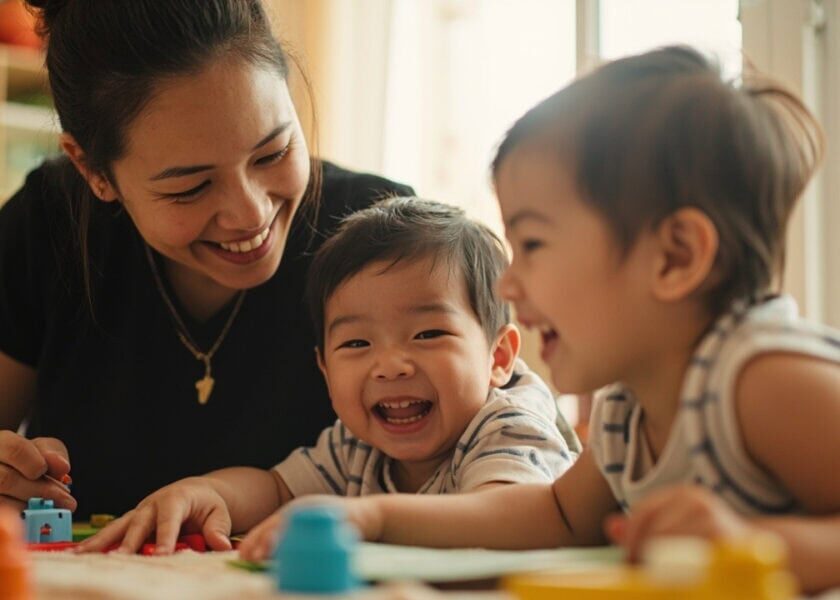
She Is Being Built: What Quality Infant Care Looks Like
What Quality Childcare Looks Like: A Day in the Hours You Cannot See
There is a particular kind of imagination that activates the moment you pull away from the childcare gate. You know the one.
It is the imagination that populates the hours you cannot witness with scenes you did not choose. Perhaps your child is crying. Perhaps she is sitting alone. Perhaps he is being fed something you would not have chosen, or left to stare at a screen, or simply waiting—waiting for something, or someone, or the clock to reach three o’clock.
These imaginings are not irrational. They are simply the mind doing what it must when it cannot see. And so the distance between drop-off and pickup becomes, for a parent, an act of faith.
But what if we could open that space? Not with surveillance, or suspicion’s cousin, but with something more generous—a quiet revelation of what a quality childcare day actually contains. Not as a promise. Not as a claim. Simply as a description of hours that matter, of architecture invisible, of the daily construction of a child.
Let us walk through one of these days together.
Before the Door Opens: The Prepared Environment
In a quality setting, the day has already begun before your child arrives.
Room temperature adjusted. Sensory stations arranged. The storybook opened to its first page, weighted slightly so it stays open to the right illustration. Small calibrations that a child notices without knowing she notices—that the world she is entering has been shaped for her arrival.
This is not decoration. This is the first sentence of the day’s grammar.
When you visit a childcare setting, you may not think to notice these details. You notice the toys, the walls, the ratio of children to caregivers. But the prepared environment—the invisible architecture of intentional space—is often where quality begins. It says: someone thought about what your child needs before she knew she needed it.
The Rhythm of the Day: Why Routine Is Developmental Scaffolding
There is a rhythm to quality care that most parents never see written down, but that their children feel in their bodies. It is the rhythm of activity and rest, of noise and quiet, of challenge and consolidation.
When the door opens, there is often a brief recalibration. The child crosses a threshold, and she knows it. She may look back. She may hesitate. A skilled caregiver does not rush this moment. She kneels. She names what she sees—“I see you brought your blue sock today, you must feel ready”—and she offers a bridge between the parent’s world and the child’s new terrain.
This bridge is not sentimental. It is neurological. The child’s nervous system is calibrating to a new environment, and the quality of that calibration determines whether the next several hours are spent in exploration or in anxiety. A child who feels held at the border can let go of the hand she was holding.
Routine is developmental scaffolding. It is the structure that allows a child to predict what comes next, which frees her mind to engage with what is happening now.
Consider this: a child who knows that circle time follows snack time does not spend those twenty minutes of snack anticipating and worrying about what comes after. She eats. She talks with her friends. She notices the texture of the banana, the sound of milk pouring. She is present, and presence is the soil in which learning grows.
The Transition to Quiet
And then there is the transition. From active to quiet. From group to individual space.
A quality setting understands that children are not machines that run on high stimulation. They need margins. They need to process. And so the day offers them a breath—a story read in soft light, a moment of looking at picture books alone, a gentle conversation between two children on a small sofa.
These are not filler moments. They are the consolidation periods when the brain files away what it has learned, when sensory experiences become memories, when the self settles back into its body after the excitement of the morning.
This rhythm—active, rest, active, rest, active, rest—is one of the invisible gifts a quality setting gives a child. It teaches her that life is not a single flat note. It has tempo. It has dynamics. And she can move through it, not because she is being managed, but because she has been given a map.
The Sensory Curriculum: Why Your Child’s Body Is Her First Classroom
A child’s first curriculum is her body. It is through movement that she learns that she is a self who can act upon the world and have the world act upon her.
Let us pause on what happens in those sensory and motor moments, because they are often the most undervalued by parents who have been told, implicitly, that learning begins with letters and numbers.
- When a one-year-old pours water from one container to another, she is learning gravity, volume, causality, patience, trial and error, the relationship between force and outcome
- When she climbs a low structure and reaches the top, she is learning risk assessment, pride, the body’s capabilities, the joy of mastery
- When she squishes playdough between her fingers, she is building the hand strength that will later hold a pencil, turn a page, zip a jacket
In a quality setting, these sensory experiences are not accidents. They are designed—thoughtfully, developmentally, with the child’s emerging capacities in mind. The materials are chosen for variety: smooth and rough, wet and dry, cold and room-temperature, loud and soft. The spaces allow for mess that would be unacceptable at home but that is essential for learning.
The caregivers understand that a child covered in paint or water or sand is not a child who has made a mess. She is a child who is making a brain.
Motor Foundations for Later Learning
Motor development, too, is tended with care. The outdoor space is not an afterthought. It is a curriculum.
The child climbs, runs, jumps, balances, navigates, experiments. She falls. She gets up. She falls again. She does not fall as far, or as hard, or as often, because her body is learning, moment by moment, how to hold itself upright in the world.
Parents sometimes wonder whether these physical hours are taking away from academic preparation. The answer, grounded in decades of child development research, is the opposite:
- The child who has learned to control her hand can later control a pencil
- The child who has learned to listen carefully to sounds in the environment can later distinguish between letters
- The child who has learned to navigate social space—to wait, to share, to read a friend’s face—has the attention and empathy that reading comprehension requires
Quality childcare does not rush childhood. It builds the foundation on which later capacities stand.
The Social World: Learning to Be a Person Among Persons
Now let us speak of something harder to see but no less real: the social world of the childcare day.
A child in quality care does not just play beside other children. She begins, slowly, to play with them. She learns that others have desires and intentions that may not align with her own. She learns negotiation—not the adult version, but the primal, foundational version:
“I want the red cup.”
“I was using it.”
“You can have it when I am done.”
“Okay.”
These exchanges, repeated a thousand times across a year, build the architecture of social intelligence. They teach the child that the world contains others who are not her, who have needs and feelings and rights, and that relationship is possible.
Watch Two Children Build Together
Watch two children building with blocks together. Watch the negotiation, the collapse, the reconstruction, the shared laughter.
This is not peripheral to the day’s work. This is the day’s work. The child is learning, in real time, how to be a person among persons. She is learning that she can be frustrated and still connected, that conflict need not mean ending, that repair is possible after rupture.
Caregivers in quality settings understand this. They do not intervene at every conflict, but they do intervene at the right moments—when a child is about to be hurt, when a negotiation has broken down into pure distress, when a child needs a word or a gesture to move forward. Their role is not to prevent all friction. Friction is where learning happens. Their role is to hold the space with enough safety that the friction can be productive rather than traumatic.
And there are gentler social moments too:
- Two children sharing a picture book, one pointing, the other naming
- A caregiver singing a song and watching which child joins in first
- A small circle of children watching a caterpillar inch its way across a leaf, whispering together
These are the moments of belonging, of being part of a small community that notices things together, that shares wonder. A child in quality care learns that she is not alone in the world, that others have seen what she has seen, that together is a way of being.
The Quality of Human Attention: Being Witnessed, Being Known
Every child in a quality setting is known. Not catalogued, not assessed, but known—in the way that a caregiver knows which children need more time to warm up, which need more physical activity before they can sit still, which are hungry before they say so, which are overwhelmed before they begin to cry.
Attunement is a word that can sound abstract. Let us make it concrete. A child reaches for a block and drops it. She looks at the caregiver. This is not a random glance. It is a question: Did you see what I did?
A caregiver who is attuned sees this glance and responds—not with effusive praise, which can make a child dependent on external validation, but with quiet acknowledgment.
“You dropped it. Listen—it went clang.”
The child nods. She was seen. She was witnessed. Her action mattered to someone who was paying attention.
This moment happens dozens of times a day in quality care, and each one builds something. It builds the child’s sense that her experience is valid, that she exists in the awareness of others, that the world is a place where her presence registers. It builds the foundation of confidence that is not arrogance—but the quiet self-assurance of a child who knows she is real.
Watch a skilled caregiver with a group of infants. She is holding one, feeding another, glancing at a third who is just learning to crawl toward a toy. Her attention is divided but not scattered. She is tracking several children at once, reading their states, adjusting her own responses. This is not multitasking in the superficial sense. It is the professional expertise of someone who has learned to hold many children in mind simultaneously, to notice the small shifts that signal big feelings, to be present without being intrusive, to respond without over-functioning.
What to Look For: A Parent’s Guide to Quality Infant Care in Singapore
Singapore’s families are changing. More parents work. More households have two incomes not out of preference alone but out of necessity. More families are navigating the tension between economic reality and the desire to raise children with presence and care.
When parents research infant care, they are not just comparing prices or locations. They are asking:
- Will my child be safe?
- Will she be seen?
- Will the hours be filled with intention or merely with activity?
- Will I be able to trust what I cannot witness?
These are not irrational anxieties. They are the reasonable concerns of people who love their children and must leave them in someone else’s care for significant portions of the day.
Environment and Preparation
- Is the space prepared before children arrive, or does it feel chaotic?
- Are materials arranged with intentional variety—different textures, temperatures, sounds?
- Is there a sense of calm, or merely of activity?
Arrival and Transitions
- How does the caregiver respond when you drop your child off?
- Does she kneel to your child’s level, or does she speak only to you?
- Does she give your child time to transition, or rush the moment?
Routine and Rhythm
- Is there a predictable daily structure—activity, rest, activity, rest?
- Can the caregiver explain why this rhythm matters?
- Do transitions feel smooth or abrupt?
Sensory and Motor Experiences
- Are children given opportunities for messy play—water, sand, paint, playdough?
- Is outdoor or gross motor time scheduled, not afterthought?
- Does the caregiver engage with children during these activities, not just supervise?
Social Interactions
- How does the caregiver respond when children conflict?
- Does she intervene appropriately—or over-intervene?
- Are there moments of shared attention—reading together, exploring together?
Communication and Trust
- Does the setting offer regular updates about your child’s day?
- Can you ask questions and receive thoughtful answers?
- Do you feel that transparency is valued, not merely tolerated?
The Invisible Curriculum: Why It All Matters
The child who has learned to trust that the world can hold her—that routines give her security, that caregivers respond when she signals, that other children can be friends, that her body is capable, that her presence matters—this child carries something with her into every room she will ever enter.
She carries the knowledge that she is not alone by accident but by design, that the world can be navigated, that others can be trusted, that she has what it takes.
And the parent—the parent who drops off in the morning and imagines scenes of abandonment and returns to find a child who runs toward her, smiling, flushed with the day she has had, full of small stories she cannot quite tell but that have shaped her nonetheless—this parent carries something too.
She carries the knowledge that the hours apart were not empty. That the gap between drop-off and pickup was not a void but a space filled with intention, with care, with the daily work of building a person.
EduNanny by BUTLER: A Pathway Built for This
EduNanny by BUTLER was built to hold the tension between what parents need and what Singapore’s childcare landscape has historically offered. Through the ECDA Childminding Pilot, EduNanny offers a pathway that is home-based and community-anchored, structured and yet intimate.
With ratios of up to one caregiver to three infants, the attention we have described—the attunement, the witnessing, the quiet curriculum—is not an aspiration. It is a design specification. Each child is known because the numbers allow for knowing. Each child’s day has rhythm because the setting is small enough to observe and adapt in real time.
The pilot is designed to be accessible. Fee structures are structured with affordability in mind. Parents can access CDA and Baby Bonus funds for eligible care. Monday through Friday care blocks offer the regularity that families need to build their own rhythms around.
EduNanny invests in transparency measures because we know that parents are not being difficult when they worry. They are being human. They are parents. Communication systems allow regular updates. Where deployed, CCTV measures offer an additional layer of assurance—not surveillance for its own sake, but a window that parents can look through when their imagination needs grounding in reality. These are not substitutes for trust. They are the scaffolding on which trust can be built.
A Final Word
This is what quality childcare offers: not a promise, but a description. Not a sales pitch, but a window. Not the assurance that every moment will be perfect—no human system achieves perfection—but the evidence that the people holding your child are paying attention, that the structures are in place, that the day is designed, that the hours matter.
EduNanny by BUTLER exists because Singapore’s families deserve this. Because children deserve to be known. Because parents deserve to leave their children not with anxiety but with peace—not the peace of blind faith, but the peace of informed trust.
We cannot show you everything. No window is complete. But we can show you enough. Enough to wonder. Enough to trust. Enough to know that between drop-off and pickup, your child is not merely minded.
She is being built.
And that building—that quiet, daily, invisible construction of a human being—is, in the end, the most important work any of us will ever do. It happens in the hours you cannot see.
We are honored to hold them.
Ready to learn more about EduNanny by BUTLER? Explore our infant care options, speak with our team, or start your application through the ECDA Childminding Pilot. We are here to answer your questions and help you find the right fit for your family.
#infantcaresingapore #childmindingSG #qualitychildcare #EduNannySG #earlychildhooddevelopment