The Honest Observation That Transforms How You Know Your Child
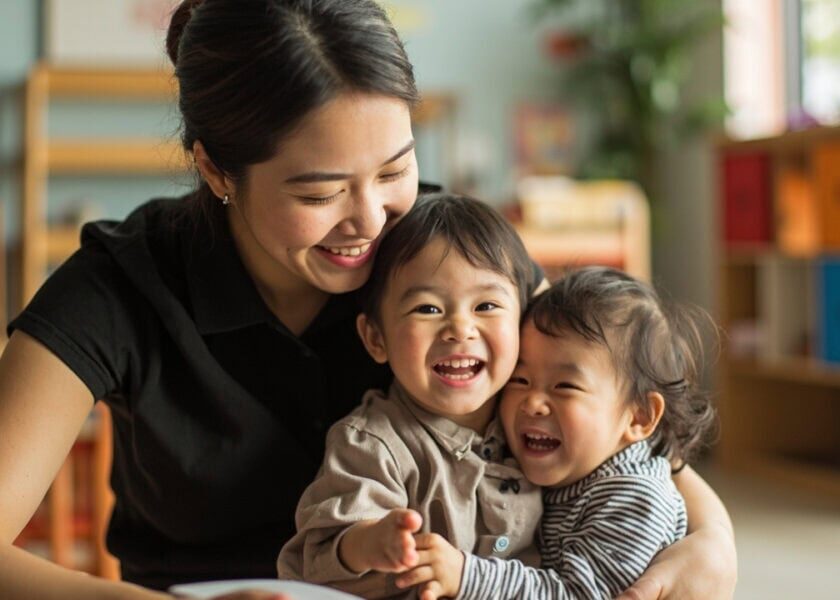
The Window: What Skilled Caregivers Actually See
The conditions that quality infant care creates are not the same conditions that exist in a family home at the end of a working day. This is not a criticism of parents. It is an observation about context.
When you are with your child at the end of a long day, you are often tired. You are thinking about dinner, about tomorrow’s meeting, about the email you forgot to send, about whether your child ate enough at lunch and drank enough water. You are performing the role of parent, and that performance—however lovingly undertaken—can sometimes stand between you and your child in ways you do not even notice.
A caregiver in a well-structured environment has different conditions. She has a smaller group of children. She has deliberate time for observation. She has designed the space to invite certain kinds of play, to reveal certain kinds of development. She is not managing the aftermath of a commute or the pressure of a household. She is doing one thing: she is present with your child in a setting that allows your child to show her who they are.
What she sees is extraordinary.
She sees the eighteen-month-old who builds a tower of blocks with a focus and deliberation that the same child never shows at home, where the blocks are scattered among toys and attention is pulled in a dozen directions.
She sees the two-year-old who, when frustrated, goes to the exact same corner of the room and sits with a book until she is ready to come back—not because she was taught to do this, but because she has discovered that this is how she self-regulates, and the caregiver has seen it happen four or five times and now knows to give her that space without saying a word.
She sees your child’s social personality. The way your child initiates contact with another child. The joke that lands perfectly. The way your child navigates disappointment or shares a toy or claims a corner of the room as their own.
These are not minor details. These are the building blocks of who your child is.
A quality caregiver is not a supervisor. She is an observer who has been trained to see development, who has the time and conditions to notice what is happening, and who has the honesty to tell you about it in a way that is useful rather than merely reassuring.
The Bridge: How Communication Builds Your Intuition
But the gift is not complete until it reaches you. And that reaching happens through communication.
There is a particular kind of conversation that happens in great childcare relationships, and most parents do not recognise its significance until they have been in one for a while. It is not the check-in that says “she slept well” or “he ate his lunch.” It is the conversation that goes deeper.
The one where your caregiver tells you, with genuine curiosity and attention, what she observed about your child’s morning. The one where she asks you a question about something your child did at home that might explain something she saw at care. The one where you leave the handover feeling like you have been handed a piece of a puzzle you did not know was missing.
This kind of communication is not natural. It has to be cultivated.
It requires a caregiver who understands that her role is not just to keep children safe and stimulated, but to be a translator between your child’s inner world and your understanding of it.
It requires a parent who is open to receiving that translation, who does not feel threatened by what the caregiver sees, who understands that another attentive pair of eyes on your child is not a judgment on your own attention but a complement to it.
When this communication works—when it is honest, specific, and regular—it builds something precise in the parent: you are learning to read your child. You are taking the observations of another attentive adult and using them to build a richer, more textured model of who your child is. You are starting to see patterns. You are starting to anticipate. You are starting to understand your child not just in the moments when you are together, but in the moments when you are apart.
The Restoration: What This Knowing Does for You
Modern parenting in Singapore is intense. The pace is relentless. The expectations are high. The distance between what we want to give our children and what our daily lives allow us to give can feel enormous. Many parents carry a quiet grief about this distance, a sense that they are missing something, that the hours apart are hours lost.
But the partnership reframes this. It does not eliminate the distance, but it transforms what happens in that distance. Instead of time spent apart being time missed, it becomes time gathered. Every observation your caregiver shares is a piece of your child that you now possess. Every handover conversation is a gift. Every honest report is a building block in the structure of your understanding.
You know your child more deeply because of this childcare, not despite it.
This is not a consolation. It is a revelation. And it is available to any parent who chooses a childcare partnership built on honesty and real attention, rather than one built on mere supervision and polite updates.
This knowledge gives you something else: confidence. Not the confidence that comes from having all the answers, but the quieter confidence that comes from knowing, deeply and specifically, who you are raising. That knowledge allows you to respond to your child with accuracy rather than anxiety, to trust yourself because you have trusted the process, to walk into a paediatrician’s appointment and speak about your child with the kind of grounded familiarity that no book can give you.
What to Look for and What to Ask
Not all childcare is the same. Here is what to look for when you are evaluating your options, and the questions that will reveal whether you have found the right partner.
Will my child feel safe and loved?
This is the question that keeps parents awake at night. Quality infant care does not replace the love you give your child. It extends it. A skilled caregiver creates an environment where your child can explore, fail, try again, and succeed—all with someone who is paying close attention. The safety you are looking for is not just physical safety, though that matters. It is the safety of being known. Of being seen. Of mattering to the adults in the room.
Will I miss out on my child’s development?
You will not miss it. You will receive it differently. The handover conversation is not a consolation prize. It is a window. And the more honestly and specifically that window is opened, the more you will feel present in your child’s daily life, not less.
What to look for in a caregiver or centre:
- Infant ratios that allow for attention. In infant rooms, ratios of one to three or better mean every child can be seen and known. Ask about this specifically.
- Observation that goes beyond the schedule. Updates about sleep and meals are baseline. Look for communication about your child’s emotional life, social development, and emerging personality.
- Handover that is a conversation, not a transaction. You should leave the handover with something you did not have when you arrived. If you are only receiving information you already knew, the partnership is not working.
- Transparency about how care is delivered. Ask about training, ratios, environment design, and how the caregiver describes her role. A confident provider will welcome these questions.
How do I know if a caregiver is truly observing versus simply managing?
Ask questions that go beyond the schedule. Ask about your child’s mood, their social interactions, the way they solve problems, the moments when they were most themselves. A caregiver who is truly observing will have answers. She will have noticed. She will want to tell you.
What if I feel guilty about needing childcare?
Many parents in Singapore carry this guilt. It is understandable. But consider this: every honest observation your caregiver shares is a piece of your child that you gain, not lose. The partnership means that the hours apart are not empty. They are filled with someone else’s attentive presence, and that presence is given back to you in the form of understanding. Guilt is the feeling that you are failing. What you are actually doing is choosing a path that lets you know your child more deeply than you could alone.
Back to the Door
You are standing at the door again. It is morning. Your child is inside, already absorbed in play, already themselves in a way that you are only beginning to understand. The caregiver looks at you and says something small. A sentence that contains a truth about your child that you did not know before.
And in that moment, you feel it: not anxiety, not guilt, not uncertainty. You feel recognition.
You recognise who your child is. Not just in the fragments you catch in the evenings and on weekends, but in the full texture of their days. You know them because you have been paying attention, and because someone else has been paying attention too, and because together you have been building something that neither of you could have built alone.
EduNanny by BUTLER offers both home-based and centre-based childminding through the ECDA Childminding Pilot, with infant ratios designed to ensure every child is seen, known, and honestly reported to parents.
We understand the financial realities that Singapore parents face. Our programme is structured to be affordable, and we make it possible to use the Child Development Account and Baby Bonus where applicable. High-quality infant care should be available to any parent who wants to know their child more deeply.
If you are ready to explore a childcare partnership built on honest observation and real attention, we would welcome the conversation.