Building Your Village: How Singapore Parents Honor Grandparents While Embracing Professional Care
Why Grandparents Are Central to Singapore’s Story
Singapore has one of the highest rates of grandparent involvement in childcare in the world. This is not an accident. It reflects something valuable about how Singapore families work: a belief that grandparents belong in a child’s life, not as peripheral figures who visit on Sundays, but as active participants in the daily miracle of growing up.
Think about what this means for your family. Your parents or in-laws carried your child’s first blanket. They remember the precise weight of your newborn at two weeks old. They have memorized the particular sound your child makes when he is tired versus when he is hungry, and they know—deep in their bones—how to soothe him because they once knew how to soothe you.
This is the foundation we are building on. Not a problem to be solved, but a relationship to be understood and, where possible, strengthened.
Understanding the Gap Between Generations
We live in a time when information moves faster than ever before. A new parent can access research on early brain development while waiting for her morning coffee. We know more about the first thousand days of a child’s life than any generation before us—not because we are smarter, but because we stand on the shoulders of researchers, scientists, and early childhood educators who have dedicated their lives to understanding how humans learn and grow.
This knowledge is a gift. It allows us to make choices with intention, to approach childcare not as something that just happens but as something we shape with care and awareness.
But here is what we sometimes forget in our social media threads and late-night reading sessions: our parents did not raise us without intention. They made choices too. They read what was available to them. They listened to pediatricians and elders and their own inner knowing.
The difference is not effort or love or dedication. The difference is simply the information available at the time—and the cultural moment in which they made their decisions.
When a grandmother tells you that babies need to cry themselves to sleep to strengthen their lungs, she is not trying to harm your child. She is repeating what she was told by someone she trusted, in a time when that advice was offered freely, when the research we have now simply did not exist.
What if we stopped viewing these differences as conflicts to be resolved and started seeing them as different chapters in an ongoing story? Our parents wrote the opening pages. We are continuing the narrative. And our children, one day, will add their own.
This reframing does not mean abandoning your values or accepting every traditional practice without question. It means recognizing that love has traveled through every generation, adapting its language but never its essence. The fierce devotion your mother-in-law shows your child is the same love that raised your spouse.
How to Bridge the Gap
When conversations with family feel stuck, practical strategies can help reframe the dynamic without anyone feeling judged or dismissed.
Ask Questions Before Offering Answers
Before telling your parents that their approach is outdated, try asking them to share their own story.
- What did their parents believe about raising children?
- Where did those beliefs come from?
- What did they carry forward, and what did they leave behind?
You might be surprised by what you discover. Many grandparents, when given the space to reflect, recognize that they, too, made choices that differed from their own parents’ approaches. They, too, updated their thinking as new information became available.
This kind of conversation positions everyone in the family as part of a continuum of learning rather than as opponents in a debate. It says: “We are all doing our best with what we know. And we are all open to learning more.”
Distinguish Between Alignment and Grace
There are areas where alignment genuinely matters:
- Child safety and injury prevention
- Developmental milestones and health concerns
- Consistency that helps your child feel secure
These are the non-negotiables, and it is fair to hold them firmly while still holding them gently.
But there are also many areas where grace is the better choice. If your mother-in-law gives your toddler a biscuit before dinner, and it matters to you that meals are respected, address that directly. But if she sings a lullaby in Hokkien that you do not understand and your child drifts off peacefully in her arms—that is a place to breathe. Let the small difference be exactly that: small.
Not every difference is a crisis. Some of them are simply the beautiful, messy proof that your child is loved by more than just you—that her world is wider and warmer than it would be if she knew only your way of doing things.
What Quality Childminding Actually Looks Like
When we talk about professional childcare in Singapore, it helps to be clear about what “quality” means—not as a buzzword, but as a set of concrete characteristics that serve your child and your family.
Key Indicators of Quality Infant Care
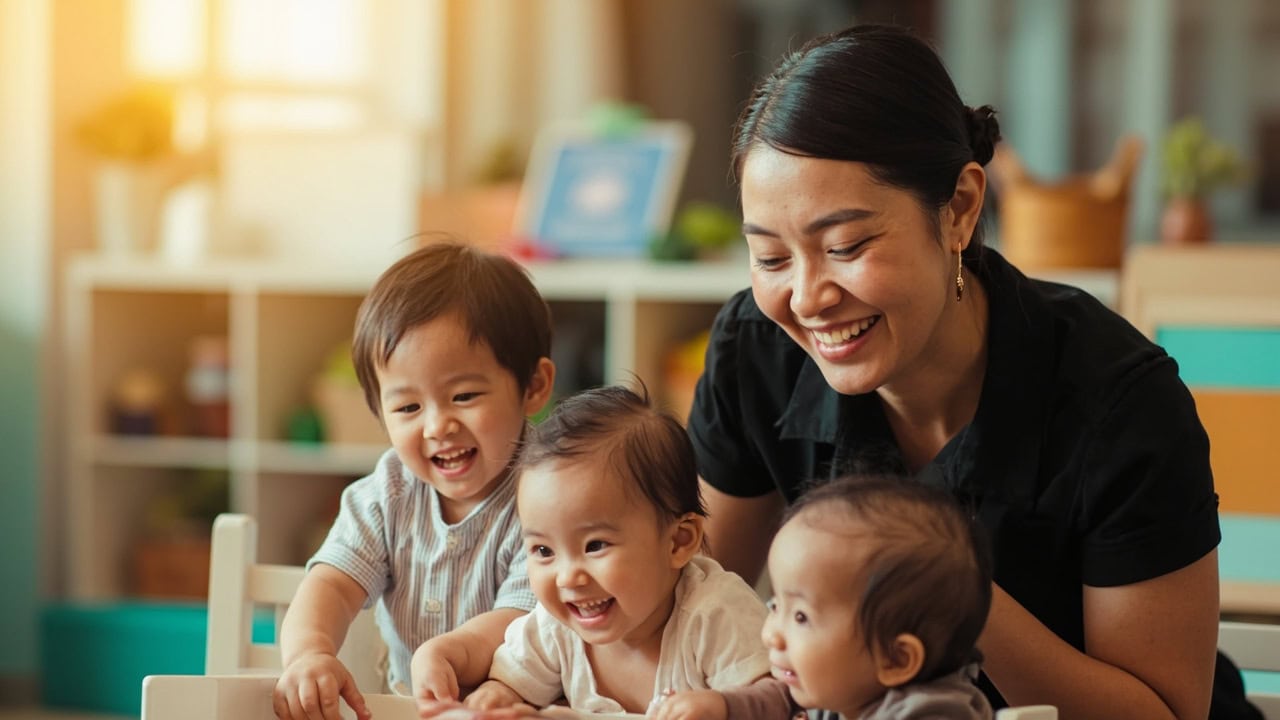
- Small group ratios: In home-based settings, a ratio of one caregiver to three infants allows for attentive, focused care. Your child is not one of many; she is seen and known.
- Trained and registered caregivers: Professional childminders working within established frameworks receive training that covers child development, safety protocols, and communication with families.
- Transparent operations: Where measures like CCTV are in place, this reflects a commitment to openness that builds trust—not surveillance, but partnership.
- Regular communication: Daily updates about feeding, sleep, milestones, and small moments of sweetness. You should never wonder how your child’s day went.
- Developmental alignment: Caregivers who understand contemporary child development and can support—not replace—the approach you are building with your child at home.
Here is something worth considering: when grandparents see that your child’s caregiver is trained, communicates openly, and operates with professionalism, something shifts. The conversation changes.
Instead of feeling evaluated by their own children, grandparents can feel supported alongside them. They see that professional care is not a criticism of their own abilities but simply a different resource—one that exists in a world more complex than the one they navigated.
Consider this story that circulates among parents in Singapore. In one family, the grandmother cares for the toddler on Tuesday and Thursday afternoons while both parents work. On other days, a childminder comes to their home.
The grandmother initially felt, as many grandparents do, that she was being replaced rather than supported. But over time, the childminder began sharing small observations—a new word the child learned, a milestone reached, a moment of unusual sweetness during the day. The grandmother began looking forward to these updates.
And then something unexpected happened. She found herself adopting some of the language the childminder used. “Let’s use our words,” she started saying, in her beautiful Malay-English. The child’s parents nearly cried the first time they heard it.
This is what becomes possible when we stop seeing generational differences as problems to be solved and start seeing them as conversations to be had.
Addressing Common Concerns
“Will professional care mean my parents feel replaced?”
It can, if introduced clumsily. But when framed as an addition to your village rather than a subtraction, many families find the opposite: grandparents feel relieved to have support, not replaced. They can focus on the relationship itself—the cuddles, the stories, the love—rather than bearing sole responsibility for every care task.
“I feel guilty for wanting different care than what my parents provided.”
Guilt often signals that we care deeply. It does not signal that we are wrong. You are not rejecting your parents’ love when you make different choices—you are building on the foundation they laid. Every generation has done this.
“How do I talk to my parents about this without hurting them?”
Start with appreciation. “Mum, I want Emily to have the relationship with you that I had with you. I don’t want childcare to get in the way of that.” Then share your reasoning as information, not correction. “I read some research about how children process separation, and I think having consistent, professional care on the days I’m not there might actually help Emily look forward to your visits even more.”
And be patient. These conversations rarely resolve in one sitting. They are ongoing, evolving discussions between people who love the same child.
“What if I’ve tried talking and it hasn’t worked?”
Perhaps you have brought up research articles only to be met with dismissal. Perhaps you have been told, “You turned out fine,” and felt that sentence close a door rather than open one.
Your feelings are valid. It is genuinely hard to navigate these waters. It is hard to be the parent who knows things and also the child who loves someone who does not share your knowledge base. If direct conversation feels stuck, professional support that works alongside your family—not instead of it—can sometimes shift dynamics in ways that conversation alone cannot.
Your Village, Your Choice
Singapore parenting rarely happens in isolation. It happens in the context of families—complicated, loving, evolving families where different generations bring different strengths to the same child.
Villages require more than one kind of person. They require the old and the young. The experienced and the informed. The traditional and the innovative. All of them, together, raising children in the way that humans have always raised children: imperfectly, lovingly, and with the deep belief that the next generation deserves our very best.
There is a moment—perhaps you have already had it—when your child does something unexpected. She laughs at something only she finds funny. He says a word for the first time, in the accent of someone he spends time with, not you. She draws a picture of a family that looks nothing like the family you imagined but looks exactly like the family she knows.
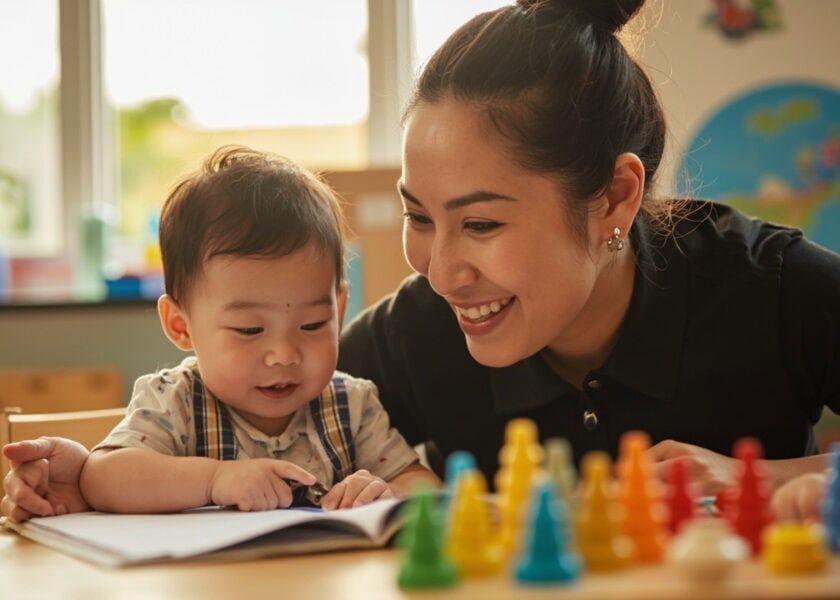
And in that moment, you realize something: your child is not a product of your choices alone. He is shaped by everyone who loves him. By the grandmother who sings in Cantonese and the childcare professional who reads picture books with him and the father who makes up silly songs and the mother who worries constantly and does her best.
The generational gap you feel is not a divide. It is a doorway. And what lies on the other side is your child, growing up loved by more people than he could ever count, shaped by wisdom old and new, belonging fully to a family that is bigger and more generous than any one of you could build alone.
You do not have to build this village alone. That is not weakness. That is wisdom.
Walking Alongside Your Family
EduNanny by BUTLER was built with a deep understanding of Singapore family life. We know that grandparents are involved. We know that parents want the best for their children. And we know that sometimes, having a trained, qualified childminder who can bridge the gap between generational approaches and contemporary understanding makes everything easier—not because family is pushed aside, but because professional care complements family care rather than competing with it.
Our childminders are part of the ECDA Childminding Pilot, trained and registered through channels that meet Singapore’s quality standards. They operate in home-based settings with ratios of up to one to three infants. Where transparency measures are in place, we offer trust that builds reassurance—not just for parents, but for grandparents too. Because ultimately, grandparents want to know that their grandchildren are safe, loved, and well-cared for, whether that care comes from them or from someone else.
Parenting is not a destination. It is a daily practice. And every day, you deserve support that meets you where you are.
If you are ready to explore how professional childminding can complement your family’s approach—honoring the love your parents bring while supporting the choices you are making for your child—we invite you to connect with us and learn how EduNanny can walk alongside your family.