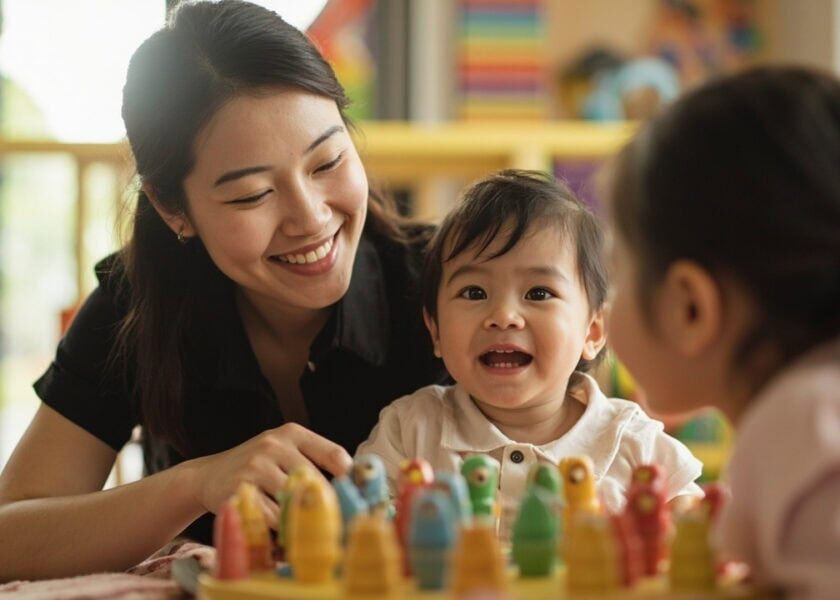
What You Cannot See Alone: The Case for Developmental Partnership
What You Cannot See: The Hidden Dimension of Quality Infant Care in Singapore
There is a moment, familiar to every parent, when you watch your child sleep and think about everything you do not know. Not from lack of love, not from absence of attention, but simply because you are human, and humans cannot see themselves through their own eyes.
You know the sound of your child’s laugh better than any symphony. You know the precise pressure that calms her when she is upset. You know which stuffed animal she reaches for at the end of a long day.
And yet, there are hours in every day when you are not there, and something is happening in those hours that shapes who she is becoming. Something important. Something you cannot see.
This is not a failure. This is the nature of parenthood itself.
You chose this. You wanted this. And in the quiet hours of reflection that find every parent eventually, you have already sensed the shape of something you cannot quite name. A gap, perhaps. Not a gap in your love, never that. But a gap in your knowledge, your expertise, your ability to read every signal your child sends into the world when you are not the one receiving it.
What you are looking for—whether you have found the words for it yet or not—is a partner. Not a replacement. Not a rival to your understanding. A partner who brings something you cannot bring, and who values what you alone can offer even more.
That partner is what EduNanny Singapore has spent years learning how to be.
This article explores why the knowledge gap between parents and caregivers is natural, what trained observers actually see in your child, how developmental partnership works in practice, and how to choose quality infant care in Singapore with confidence.
Where Honest Conversations Begin: Your Reality in Singapore
You are raising a child in Singapore. You are navigating the complex mathematics of dual-income households, the expectations of extended families, and the pressure of a society that celebrates both ambition and parenthood—often without acknowledging the tension between them.
You are likely working, or planning to return to work, and the question of who will care for your infant during those hours is not a logistical puzzle you are solving. It is an identity question you are living. It is a question about trust, about safety, about whether you can ever truly feel at peace when your child is in someone else’s arms.
We understand. We have spoken with hundreds of Singapore parents, and the undercurrent in every conversation is the same: I know my child. But do I know enough? Am I enough?
What Singapore Parents Are Actually Looking For
Here is what we have learned from listening. Parents in Singapore are not looking for supervision. They have already found that, in some form or another.
What they are looking for is someone who sees their child the way they see their child—but with additional clarity. Someone who can say:
- Your daughter is developing a remarkable sense of fairness. I watched her mediate a dispute over a toy block today, and she is only eighteen months old.
- Your son is going through a language explosion. He has added twelve new words this week.
- Your child is beginning to show signs of separation anxiety that signals a developmental milestone, not a regression.
- Your child’s eating patterns today reflect a growth spurt you will notice tomorrow when his shoes no longer fit.
These are not details. These are the building blocks of a life.
The Limitation of Intimacy: Why Love Alone Cannot See Everything
The truth is that every parent experiences what developmental psychologists call the limitation of intimacy. You love your child too much, too closely, to see her with the kind of distance that reveals patterns. You are inside the relationship, and from inside a relationship, everything looks like noise.
The professional caregiver, the trained observer, is not closer to your child than you are. No one will ever be closer than you are. But she is positioned differently, and that difference is not a lesser position. It is a complementary one.
This is what we mean when we speak of developmental partnership. It is not a marketing phrase. It is a precise description of what actually happens when a trained caregiver and an engaged parent work together to understand a child.
Our EduNanny caregivers are trained to understand the stages of infant and early childhood development—language, motor skills, social-emotional capacity, and cognitive processing. They know that a two-year-old who is not yet stacking blocks may be developing in other ways that are less visible but equally important. They know that a twelve-month-old who resists being held by unfamiliar adults is displaying a healthy attachment pattern, not a problem to be solved.
What Developmental Partnership Looks Like in Practice
Philosophy without practice is just theory, and parents do not have time for theory. You need to know what this will actually feel like—what it will actually mean in the texture of your daily life.
The EduNanny Model in Singapore
When you choose EduNanny, you are choosing a model of care that operates within Singapore’s ECDA Childminding Pilot framework, whether through home-based arrangements or community and centre-based pathways depending on what suits your family.
Our caregiver-to-infant ratios are maintained at a maximum of one to three, which means your child is not one of seven or eight in a room. Your child is one of three, and each of those three receives the kind of attention that allows a trained caregiver to notice what matters.
Beyond Reports: Developmental Conversations
The care operates on structured blocks, typically Monday through Friday, with communication built into every aspect of the arrangement. Where deployed, CCTV measures provide additional transparency—not as surveillance, but as assurance.
You will receive regular updates, but more than that, you will receive conversations. Developmental conversations. Your EduNanny caregiver will share observations that go beyond what your child ate for lunch or how long she napped.
She will tell you that your child spent twenty minutes today watching a butterfly outside the window, and that this sustained attention is a sign of developing concentration. She will tell you that your child reached for another child’s hand today—tentatively, for the first time—and that this is the beginning of something significant in her social development.
These are the conversations that change how you see your child. Not because you did not love your child before, but because you now have additional eyes—trained eyes—helping you understand what you are already witnessing.
Technology as Additional Support
Beyond the human partnership, we offer Thomas, our AI-powered chatbot, as an additional layer of support. Thomas does not replace the human caregiver, but it can answer the questions that arise at two in the morning—whether your ten-month-old’s sleep regression is normal, whether your fifteen-month-old’s limited diet is a phase or a concern, whether your child’s attachment behaviors are within typical range.
Because questions matter. They are how parents learn, and parents who ask questions are parents who grow alongside their children.
Practical Support for Singapore Families
The practical dimensions matter too. EduNanny operates within the pilot fee structures that make quality care affordable for Singapore families. You can access your child’s CDA funds for payment, and Baby Bonus arrangements apply where relevant.
Premium care should not require wealth. It should require only the commitment to give your child the best possible foundation.
Addressing the Vulnerability: Why This Partnership Can Feel Uncomfortable
Here is where we need to pause and address something that many childcare conversations avoid, because avoiding it does a disservice to parents.
This partnership can feel vulnerable.
There is a moment—and every parent who has embraced a quality childcare arrangement knows this moment—when someone else tells you something about your child that you did not know. And your first instinct, if you are honest, is defensiveness.
That is not quite right. She is not like that at home. He does not act that way with me.
We want to acknowledge this feeling, because it is not a sign of weakness or poor parenting. It is a sign of how much you love your child. You have built an identity around knowing her. You have invested years in understanding who she is, and the suggestion that there are dimensions of her experience you have not seen can feel, at first, like a gentle criticism.
Receiving the Gift
But consider what is actually happening in that moment. A trained caregiver is offering you a gift. She is offering you a fuller picture of your child. She is saying: here is what I observed, and here is what I think it means, and I wanted you to know because you are her parent and this knowledge belongs to you.
The families who benefit most from EduNanny are the families who learn to receive this gift. They ask questions. They share their own observations. They begin to see the caregiver not as a report-back mechanism but as a thought partner in the ongoing project of understanding their child.
And over time, something remarkable happens. The parent who was initially defensive begins to look forward to these conversations. They begin to realize that the caregiver’s observations are not corrections to their parenting but additions to their understanding.
The Power of Coherence
The child senses the coherence. She knows that her parents and her caregiver are communicating, are aligned, are working from the same understanding of who she is and who she is becoming.
And that coherence is itself a form of security. The child who grows up knowing that her parents and her caregivers were aligned, were communicating, were working together, is a child who carries that security into every relationship she will ever have.
The Structure Behind the Partnership
EduNanny is structured the way it is for this reason. Not as a collection of individual caregivers assigned to families, but as a network of trained professionals operating within a consistent framework of values and practices.
Our caregivers are not isolated. They are supported by ongoing training, access to developmental resources, and a structure that allows them to share insights and learn from one another. When you partner with EduNanny, you are not just partnering with one individual. You are partnering with an organization that has thought deeply about what it means to observe, understand, and support child development.
Developmental Childcare vs. Supervision-Only Care
We are not the only childcare option in Singapore. You know this. There are many paths, and every family must choose the path that works for their circumstances.
But we want to be clear about what distinguishes developmental childcare from supervision-only childcare, because the difference matters more than you might think.
| Supervision-Only Care | Developmental Partnership |
|---|---|
| Your child is safe, fed, changed, entertained | All of the above, plus developmental observation |
| Daily reports on meals and naps | Conversations about emerging patterns and milestones |
| Caregiver as keeper | Caregiver as thought partner |
| You receive updates | You receive insights that deepen your understanding |
| Child is cared for | Child is seen, understood, and supported |
Supervision is necessary but not sufficient. Your child deserves more than sufficient. Your child deserves a caregiver who sees her as a whole person, a developing person, a unique individual with her own trajectory, her own patterns, her own emerging self.
That is what EduNanny offers. Not just hours of care, but developmental partnership. Not just a report at the end of the day, but an ongoing conversation about who your child is and who she is becoming.
The First Thousand Days: Choosing Quality Infant Care in Singapore
You are not looking for childcare because you want to spend less time with your child. You are looking for childcare because you want your child to have every possible advantage, and because you understand—perhaps more clearly than any generation before you—that the early years are not just a prelude to life.
They are life itself.
The first thousand days of your child’s existence are not waiting for the real story to begin. They are the real story, and every day within them is shaping who your child will become in ways that cannot be undone, cannot be rewound, cannot be recovered if missed.
This is not pressure. This is possibility. And it is the reason we take our work so seriously.
Questions to Ask Any Childcare Provider
If you are researching childcare options, here are the questions that matter most:
- What is your caregiver-to-child ratio? Lower ratios mean more individualized attention and observation.
- How do you communicate developmental observations to parents? Look for ongoing conversations, not just daily logs.
- What training do your caregivers receive in child development? Not just safety certification, but understanding of developmental milestones.
- How do you handle the emotional dimension of partnership with parents? Quality providers understand that this relationship requires sensitivity.
- Are your fees structured within ECDA pilot frameworks? Understanding funding options helps you plan sustainably.
Signs of Quality Developmental Care
You can often identify quality care by what you hear from your caregiver. A quality provider will tell you:
- What your child seemed interested in today
- How your child interacted with other children
- What skills your child practiced or attempted
- How your child’s mood or behavior might connect to a developmental shift
A supervision-only provider will tell you what your child ate and when she slept. Both matter. But only one helps you understand your child better.
The Partnership We Are Building Together
Here is what we want you to carry with you when you leave this conversation—whether it is a conversation on a page or a conversation in a room.
You know your child. You know her in ways no one else ever will. But you also do not know everything, and that is not a flaw. That is the human condition, and the greatest gift you can give your child is to surround her with people who know things you do not know, who see things you cannot see, and who will tell you about them with respect and care.
The partnership we are offering is not about us. It is about her. It is about giving your daughter or your son the benefit of multiple loving, trained perspectives. It is about building a team around your child that includes you, that includes us, that includes the daily rituals of care and observation and communication that accumulate into understanding.
Our caregivers are not babysitters. They are developmental partners. They are the trained eyes that complement your loving eyes. They are the voice that tells you what your child is becoming, so that you can understand her more fully and support her more effectively.
They are not replacing you. They are making you better at being you.
When you partner with EduNanny, you are joining a network of families and caregivers who believe that childminding is not a stopgap solution to a logistical problem. It is a profession. It is a calling. It is the work of nurturing the next generation, and it deserves to be treated with the dignity and the expertise that such work requires.
The child who grows up knowing that her parents and her caregivers were aligned, were communicating, were working together, is a child who carries that security into every relationship she will ever have. She will know what partnership feels like, because she experienced it in the earliest, most formative years of her life.
That is what we are building. Not just childcare. A foundation. Not just care. Understanding. Not just a service. A partnership that lasts, that deepens, that gives your child everything she needs to become whoever she is meant to be.
And that, in the end, is why we do this work. Not because childcare is our business. Because children are our purpose.
And we would be honored to walk this path alongside you.
If you are ready to explore what developmental partnership could look like for your family, we invite you to begin a conversation with us. Every child’s journey starts with people who care enough to see them clearly.
Learn more about EduNanny Singapore and our approach to developmentally-focused childminding, or connect with our team to discuss what partnership could look like for your family.