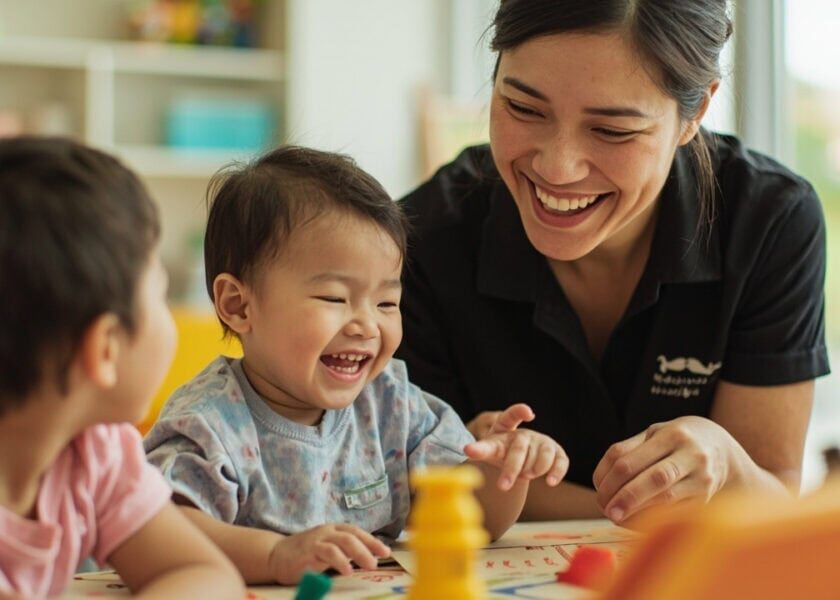
The Childcare Relationship Singapore Families Deserve
The Morning Moment Every Singapore Parent Knows
There is a moment, every morning, that millions of Singapore parents know intimately. You wake before your child does. You have already reviewed the day in your mind: the meetings, the deadlines, the presentation you stayed up finishing, the PTA message you have not replied to, the doctor’s appointment next week you still need to book, the groceries that ran out three days ago.
And then your child wakes, and you enter that brief, luminous window where you are simply, fully present—bathing them, dressing them, watching them discover that the shoe goes on the wrong foot and finding it endlessly funny. You kiss their head. You breathe them in.
And then the clock moves you forward. By the time you reach the office, you are already three tasks behind.
This is the invisible architecture of modern Singapore parenthood. Not the dramatic moments—the birthday parties, the milestones, the photographs we post online—but the quiet, relentless weight of managing a life while trying to be present for one.
The mental load. The decision fatigue. The background hum of worry: Are they eating enough? Did they sleep well? Do they miss me? Am I doing this right?
We do not talk about this enough. And the places we trust most to help us carry it—childcare being chief among them—have largely been designed around a transaction, not a relationship.
It does not have to be this way.
The Invisible Weight: Understanding What Singapore Parents Carry
Ask any parent in Singapore about their childcare decision, and you will hear exhaustion—not in their words, but in the hedging, the qualifiers, the quick pivot to justifying a choice they should not need to justify.
Singapore parents make enormous decisions under conditions that would make anyone second-guess themselves. Grandparents who want to help but whose philosophy diverges from yours. Extended family who question why you are not staying home. Colleagues who imply that choosing childcare means choosing ambition over motherhood. A workplace culture that talks about family-friendly policies while scheduling meetings at pickup time.
And beneath it all, the mounting evidence that your child would be fine—thriving, even—while simultaneously carrying the guilt that “fine” does not feel like enough.
The Guilt We Carry
Let us talk about it honestly, because Singapore parents carry guilt the way the city carries heat: constantly, everywhere, without anyone explicitly asking us to.
- The guilt of working.
- The guilt of not working.
- The guilt of choosing centre-based care.
- The guilt of choosing home-based care.
- The guilt of wanting your career and your child and feeling torn between them.
- The guilt of putting your child in childcare and then feeling relieved when you drop them off—and then feeling guilty about the relief.
Into this landscape, we have largely been offered childcare as a service transaction. You pay. They watch. You receive daily updates that confirm nothing went wrong. You feel vaguely reassured, vaguely guilty, and vaguely unheard.
Why Your Childcare Choice Is a Developmental Decision
Research across neuroscience, developmental psychology, and early childhood education has converged on a truth that most parents sense intuitively but rarely have the language for: the first thousand days of a child’s life—roughly from conception until they turn three—lay down the architecture of everything that follows.
Neural pathways form at a speed the brain will never match again. Attachment patterns—the way a child learns to trust, seek comfort, and explore the world with confidence or hesitation—are established in every interaction, every response to their needs, every moment spent with adults who know them deeply.
This is why the question of who cares for your child during these days is not a logistical question. It is developmental. It is neurological. It is one of the most consequential decisions a parent makes—made while running on four hours of sleep, scrolling through reviews at midnight, and fielding well-meaning but exhausting advice from every direction.
The Reframe That Changes Everything
What if the model itself was the problem?
What if the goal was not to find someone to care for your child while you are away, but to find a partner who will care alongside you?
When the adults in a child’s life are aligned—when the parent and caregiver share not just information but intention, not just updates but observations, not just schedules but values—something powerful happens. The child experiences continuity of care that feels like safety. They encounter the same words, the same gentle redirections, the same rhythms. The world stops feeling like disconnected experiences and starts feeling like a place where people know them and love them in consistent, caring ways.
They do not have to hold the confusion of two separate universes. They can simply be themselves, growing in the care of adults who are talking to each other, learning from each other, adjusting to each other.
Not as rivals. Not as strangers. But as co-architects of the same small life.
What Partnership Looks Like in Practice
Partnership shows up in real moments, real conversations, real exchanges that compound over time into something your child feels even when they cannot name it.
- A caregiver who notices your child is going through a developmental leap and shares that observation with you before you arrive stressed about a regression you do not understand.
- A parent who tells the caregiver their child has been having nightmares, and comes in the next morning to find the caregiver has already adjusted the nap routine to help with overtiredness.
- A weekly touchpoint—not a report card, but a conversation—where you set goals together. Language development this month. Potty readiness when they show readiness. Social confidence in the playground.
Beyond the Daily Report Card
Most parents receive a daily report that reads like a logistics update: what they ate, how long they slept, whether there were any incidents. Useful information. Cold comfort.
Partnership-based communication is different:
- Observational, not just factual: “She spent twenty minutes building a tower today—she is really into destruction-and-reconstruction right now.”
- Bidirectional: The caregiver shares what they noticed. You share what you noticed at home. Together, you form a fuller picture.
- Forward-looking: “We have been working on sharing at circle time. Can we reinforce the ‘waiting for your turn’ language at home this week?”
This is not administrative overhead. This is emotional infrastructure. It is the system that allows you to trust the process—and, more importantly, trust yourself.
The Cultural Dimension: Navigating Singapore’s Expectations
In Singapore, the landscape of childcare is shaped not just by individual choices but by intergenerational expectations. Grandparents often expect to play a central role. Extended family often has opinions. There is sometimes-unspoken tension between the childcare we want for our children and the childcare our families assume we will accept.
When Family Questions Your Choice
You know this conversation. You have had it, or you will have it, or you are avoiding having it right now.
Part of what a genuine partnership approach offers is a third space—a trained, professional, ECDA-recognized framework that you can present to family members who are questioning your choices.
“We are part of a childminding pilot that gives us a structured program, regular communication, and a small caregiver ratio. The caregiver is trained. We get updates every day. We are partners in his care.”
That sentence changes the conversation. It is not defensiveness. It is clarity.
Confidence is not just a feeling. When you feel like you are making a choice you can defend—not because you are justifying yourself, but because you have genuine confidence in what you have chosen—that confidence changes how you show up as a parent. It reduces the low-grade anxiety that comes from uncertainty. It frees up the mental energy that guilt was consuming.
EduNanny Singapore: The Architecture of Partnership
Here is what matters to understand about how EduNanny Singapore is structured, because the difference between aspiration and architecture is everything.
EduNanny, under the umbrella of BUTLER, is part of the ECDA Childminding Pilot. This is a government-recognized pathway that operates under a different model from traditional centre-based care.
What This Means Structurally
- Small ratios: In infant care settings under this pilot, ratios can be as low as one caregiver to three children. That is not a marketing claim. That is a structural reality that changes what is possible in a day.
- Personalized attention: The childminder is not a childcare worker in the conventional sense—they are a trained professional who works within the family’s broader ecosystem.
- Partnership infrastructure: A framework that recognizes the relationship between parent and caregiver as central, not peripheral.
What Small Ratios Mean for Your Child
It means your child is known. Not as one of twelve in a room, but as a named person with preferences, with rhythms, with a particular way of asking for help. When there are only three children in a caregiver’s care, your child does not have to compete for attention. Developmental leaps are noticed. Subtle shifts in mood are registered. The caregiver knows that your child hates having their sleeves pushed up, or needs three books before they can settle for sleep, or lights up when another child shares a toy.
That knowledge shapes the daily note, the touchpoint conversation, the goal you set together. It flows between home and childcare in a way that feels continuous rather than fragmented.
What Partnership Means for You
It means your relationship with your child’s caregiver is not an afterthought. EduNanny has been structured to sustain that partnership over time, through regular touchpoints, through communication practices that invite your input, through a culture that treats parents as collaborators rather than clients.
You are not receiving a service. You are entering a relationship.
The Thomas AI Chatbot, for instance, is not just a communication tool—it is an accessibility mechanism. It makes the partnership easier to maintain when you are tired, when the day has been long, when you need to send a quick note but do not want to make a big thing of it. Technology in service of relationship, rather than relationship reduced to technology.
Addressing the Real Concerns
Is This Affordable?
There is an assumption that choosing something like EduNanny is a luxury—available only to those who can afford to pay more for something nicer.
I would be doing you a disservice if I did not acknowledge that cost is real and that not every family has the same range of options.
But the Childminding Pilot exists, in part, to make this kind of care accessible. Within the pilot fee structures, with CDA and Baby Bonus usability factored in, this is not an exclusive luxury. It is a subsidized pathway, recognized by ECDA, designed for Singapore families.
The question is not whether you can afford partnership. The question is whether you know this option exists, and whether you understand what you would be choosing if you took it.
Practical Ways to Show Up as a Partner
Partnership is a verb. It is something you do.
- Start with communication: Not just reading the daily report, but responding to it. Asking a question. Sharing something from home. “She has been obsessed with the mailman lately, can we talk about that?” “He has been fighting bedtime, any patterns you have noticed?” This is not micromanagement. This is collaboration.
- Continue with participation: Attend touchpoints, but also engage in the rituals of the program. Understand the pedagogical approach. Know why the caregiver redirects rather than scolds, why they prioritize outdoor play, why they follow the child’s lead during certain activities. When you understand the philosophy, you can reinforce it at home. You become a consistent presence across both environments.
- Extend to voice: A true partnership has two voices. Your observations at home matter. Your values matter. Your preferences matter. A childcare model built on partnership will ask you what matters to you. It will make space for your answers.
What Partnership Actually Gives You
Partnership distributes the guilt. When you are in genuine dialogue with the person caring for your child, when you show up at pickup and have a real conversation about what they ate and how they played and what they are working on—the guilt does not disappear. But it softens.
Because you are still there. Not physically in every moment, but architecturally present in the structure of your child’s day.
The caregiver is not a replacement for you. The caregiver is an extension of you.
The Evening Moment—and What Follows
There is a moment, at the end of many days, when Singapore parents collect their children from childcare and watch them run toward them with unselfconscious joy—the whole body running, the arms reaching up, the face breaking into the smile that belongs only to you.
In that moment, everything else falls away. The emails, the meetings, the mental load, the guilt, the second-guessing. There is just you and this child who has been waiting for you, who has been living their whole day, and who is now bringing all of it to you in one breathless run.
What EduNanny is offering—what genuine childcare partnership is offering—is the chance to step into that moment without anxiety about what happened during the hours you were apart. The chance to trust the day. The chance to feel like you know your child as well as you did before you dropped them off, because the communication has been real, the collaboration has been active, and the relationship has been sustained.
Once you see childcare as partnership rather than transaction, you cannot unsee it. You start noticing the difference in your child—the way they are more settled because the worlds they move between are not strangers to each other. The way they do not have to be two different people in two different places.
You start noticing the difference in yourself. You ask better questions. You expect better answers. You become a more informed, more confident, more present parent—not because you have more time, but because you have better support.
This is not a perfect solution, because no such thing exists. Not a guilt-free experience, because parenthood does not work that way.
But it is something more modest and more powerful: a genuine relationship with the people caring for your child. A seat at the table of your child’s daily development. A partner in the work of raising a human being.
You are not just dropping off your child. You are entrusting them to a partnership you have chosen.
And that makes all the difference.
If you are researching infant care or childminding in Singapore and want to understand what a genuine parent-caregiver partnership could look like for your family, we invite you to learn more about EduNanny Singapore and the ECDA Childminding Pilot.
Because you deserve more than a service. You deserve a relationship. And your child deserves to be known.