What True School Readiness Looks Like for Singapore Children
What School Readiness Actually Means
You are asking, “Is my child ready for Primary One?” And everyone is telling you to prepare them academically—to fill their minds with letters and numbers, to accelerate their learning, to make sure they are not behind before they have even begun.
This is not the answer that will serve your child. This is the answer that serves programmes with tuition fees to collect.
What your child needs, what Primary One teachers will tell you they need, what years of research in child development have shown us over and over again, is something that cannot be taught in a classroom before the age of six. What your child needs is readiness itself.
Readiness is not a programme. Readiness is not a checklist. Readiness is a capacity—a way of being in the world that allows your child to walk into a new classroom, with a new teacher and new children and new expectations, and not just cope but flourish.
Readiness Is:
- The ability to manage the disappointment of getting something wrong and try again
- The ability to ask for help when they need it
- The ability to make friends and navigate social complexity
- The ability to sit with the discomfort of not knowing and remain curious anyway
- Emotional regulation that keeps them present and learning
- Social confidence that lets them take healthy risks
- A love of learning that has not yet been dented by pressure
- The quiet inner knowledge that they are capable
In Singapore, we have built an extraordinary culture of educational investment. We want the best for our children, and we pour resources and energy and hope into giving them every advantage. This is beautiful.
But somewhere in the noise of enrichment classes and preparatory programmes, we have lost sight of something essential: the foundation matters more than the acceleration.
Research consistently shows that children who arrive at Primary One with strong emotional regulation, secure social skills, and genuine curiosity outperform children who arrive with academic head starts—often by the middle of Primary Two, when the early academic advantage has equalised.
Your child’s brain, in these years before Primary One, is not merely a container waiting to be filled. It is a living system that is building itself—building the architecture of how it will manage emotion, form relationships, respond to challenge, and experience the world of learning.
That architecture is built through experience. It is built through the quality of care your child receives, the consistency of their environment, the richness of their daily interactions, and the degree to which they feel safe, known, and valued.
This is what school readiness truly means. It is not what your child knows. It is who your child is becoming.
The Real Risk of Academic Head Starts
Let us be direct, because you deserve honesty.
There are programmes out there that promise to prepare your child for Primary One by giving them a head start in academics. Some of these programmes are good. But here is the risk, and it is a real one:
You can give your child academic content before they are ready for it, and in doing so, you can inadvertently teach them that learning is something stressful, something that must be performed, something that comes with pressure and evaluation. You can give them the answers and miss the curiosity. You can get them to write their name and undercut the confidence that comes from genuine mastery.
You might see your child arrive at Primary One able to read simple books but unable to sit still, unable to manage frustration, unable to sustain attention when the material becomes challenging. You might see a sharp drop in motivation and confidence once formal schooling begins, because the early success was fragile—a trick of memory rather than a genuine love of learning.
The irony is painful: parents seeking to give their children an advantage can, inadvertently, give them a disadvantage.
What you want—what your child genuinely needs—is not to start first. What you want is to build the capacities that make starting meaningful. You want your child to arrive at Primary One not as a child who already knows things, but as a child who knows how to learn, who knows how to recover, who knows how to belong.
This is the real head start. This is the one that lasts.
How Quality Childcare Builds Readiness
Now, you might wonder: how does a quality childcare environment build this? How do daily routines and caregiving relationships actually construct the readiness that Primary One requires?
Let us paint this picture, because this is not abstract. This is lived out, every single day, in the small moments that make up a child’s life.
The Morning Arrival
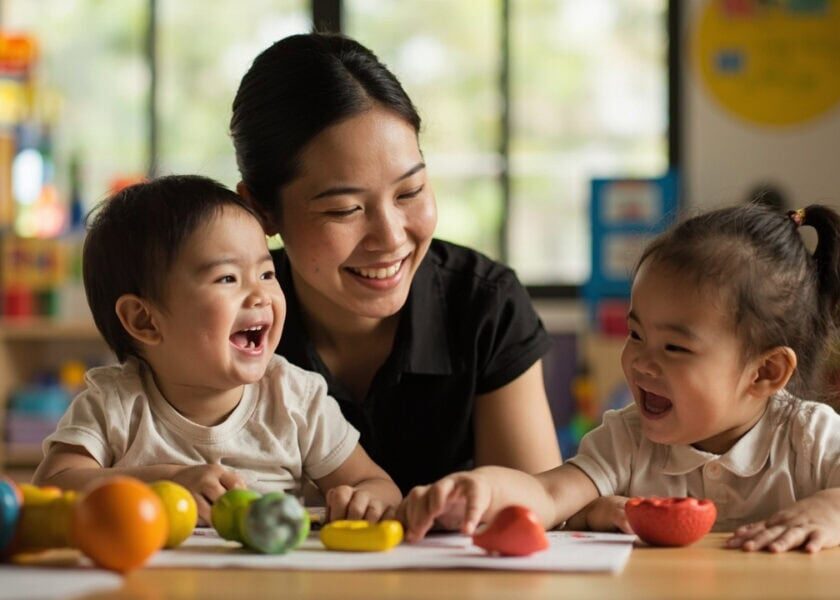
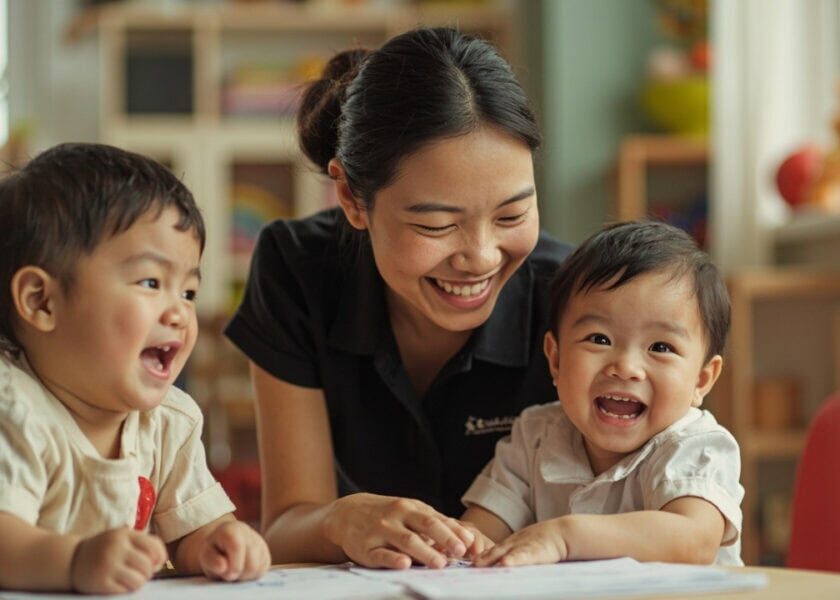
Your child arrives at childcare. There is a familiar face, someone who knows how they take their milk, who notices when they are tired before they start rubbing their eyes, who greets them with the specific warmth they need. Your child feels, in that moment, that they belong here. They are known. They are safe.
This is the foundation of everything that follows.
Rhythm and Predictability
Through the morning, there is rhythm. Snack time, play time, rest time. Rhythm is not rigidity—it is predictability, and predictability is the soil in which security grows.
Your child begins to internalise the knowledge that the world has structure, that transitions happen, that they can move from one activity to the next because they trust that what comes next is manageable. This is the beginning of the self-regulation they will need to sit in a Primary One classroom.
Learning with Peers
Then there are the other children. Guided by attentive caregivers, your child learns to share, to wait, to feel the sting of disappointment when a toy is taken and the skill of recovering. They learn that other children have feelings too, and that their actions have consequences.
These are not lessons delivered from a textbook. These are social skills built in the rough-and-tumble of real relationships, with an adult nearby who can help when emotions overwhelm.
The Moment That Matters Most
And when your child does become overwhelmed—when the frustration of a block tower falling apart becomes too much—there is someone there who sees it. Not dismissively, not with impatience, but with genuine attunement.
This is the moment that matters most. This is the moment where your child learns that big feelings are survivable, that someone will help them through, that they can fall apart and be put back together.
This is the beginning of emotional regulation. This is the foundation of the capacity to manage themselves in the challenging environment of formal schooling.
None of this is accident. None of this is coincidence. This is what quality childcare does, when it is designed with developmental science at its heart and delivered by caregivers who truly understand what children need.
What to Look For in Your Child
When the time comes for you to evaluate your child’s readiness for Primary One, here is what you should be looking for. These are the signs that your child is genuinely prepared—not with perfection, but with the foundations that will carry them forward.
- Confidence in separation—not the absence of any feeling, but the ability to separate and reunite, to trust that goodbye is not permanent and return will come.
- Emotional resilience—the capacity to become upset and then recover, to be frustrated and then try again.
- Social ease—the ability to play alongside other children, to share, to negotiate, to feel comfortable in peer relationships.
- Curiosity—an eagerness to explore, to ask questions, to engage with new things.
- Growing independence—the willingness to try things for themselves, to manage small tasks, to feel a sense of pride in what they can do.
These are not perfect measures. No child will display all of them all the time. But if you see these qualities taking root, you can trust that your child is building what they need.
And if you see gaps, that is not a cause for panic. It is a signal that there is still time, still opportunity, still a year ahead in which quality care can make a profound difference.
Common Questions Parents Ask
“Will my child be behind if they don’t do enrichment?”
The research is clear: enrichment without developmental readiness misses what schools actually value. A child who can recite their alphabet but cannot manage frustration or sustain attention will struggle more than a child who arrived with social confidence and emotional resilience. The academic content will come. What matters is that your child is ready to receive it.
“What if my child still seems anxious about Primary One?”
Some anxiety around a major transition is normal and healthy. What matters is whether your child has the inner resources to manage that anxiety—whether they have secure attachment, emotional resilience, and the confidence that comes from knowing they are capable. These are exactly what quality childcare builds.
Why EduNanny
EduNanny by BUTLER was built for this. Not as an afterthought, not as a convenient service, but as a considered answer to exactly what Singapore families need at this critical juncture.
Grounded in National Standards
EduNanny operates within the ECDA Childminding Pilot, and this matters. It means we are part of a deliberate national effort to offer families a credible, supported pathway for quality childcare that is grounded in developmental best practice. We built our approach around what children actually need, and we built it to give parents confidence that their child is in a programme that understands readiness.
Pathways That Fit Your Family
Our model offers home-based care and centre-based pathways, because families are different and one size does not fit all. For some families, a familiar home environment with a dedicated caregiver makes the most sense. For others, a centre-based setting offers the community and structure they need. Whatever the pathway, the commitment to developmental quality is the same.
Small Ratios, Deep Knowing
The ratios in our home-based model are small by design. With up to three children per caregiver, your child is not one of many. They are one of a few. The caregiver knows your child—not in a superficial way, not as a duty, but in the way that matters. They know your child’s rhythms, your child’s particular challenges, the small things that make your child light up. They know when your child needs comfort and when they need a gentle push.
This is not a convenience. This is the quality that makes readiness possible.
Accessible to Singapore Families
We understand that financial considerations are real for Singapore families. The pilot fee structures are designed to make quality childcare accessible, and we support the use of CDA and Baby Bonus for eligible families. This is not charity—it is recognition that all children deserve environments where they can build the foundations for school success, and that cost should not be a barrier to quality.
Transparency You Can Trust
Leaving your child in someone else’s care requires trust, and trust requires information. Where our services are deployed, communication with parents is ongoing and meaningful—not perfunctory updates, but real engagement with your child’s day and development. Some of our centres have CCTV measures in place, because we believe parents should feel confident in what they cannot see directly. We want you to know what is happening. We want you to feel connected to your child’s world, not separated from it.
The Year Ahead Starts Now
There is a choice available to you that is different from what the market is loudly offering. There is a choice to invest in your child’s readiness rather than their acceleration. There is a choice to trust that the daily rhythms of a quality childcare environment, the responsive care of a knowledgeable caregiver, the social world of peers, and the support for growing independence will build what Primary One actually requires.
There is a choice to give your child not a head start in content, but a foundation in capacity.
And that choice is not the harder choice. It is not the riskier choice. Research and experience and the testimony of teachers and the stories of children all point in the same direction: the children who are ready—truly ready—thrive.
The year before Primary One is not just any year. It is a year of building. It is a year of laying foundations. It is a year in which every morning greeting, every shared meal, every moment of comfort offered and received, every small triumph of independence, every peer interaction navigated with care, is constructing something that will carry your child forward for the rest of their schooling and beyond.
You cannot control what Primary One will ask of your child. But you can ensure that they arrive with the capacities to meet it. You can ensure that they know how to belong, how to learn, how to recover, how to try.
That is what quality childcare does. That is what EduNanny does. And that is what choosing for readiness really means.
If you are considering your options for the year ahead, we invite you to speak with us. Let us walk this important year alongside you and your child.
Every child deserves to arrive at Primary One ready—not just academically, but fully. Learn more about EduNanny and what we offer for families in Singapore.