How Quality Childminding Reveals Who Your Child Really Is
The Knowledge You Cannot Learn Alone
There is a particular kind of knowledge that no book gives you. No app, no parenting forum, no amount of well-meaning advice from people who have already raised children. It is the knowledge that lives in your body—in the way you learn to read your child’s face in the half-second before a cry breaks through, in the quiet certainty that grows between you when you have spent enough time simply being with them.
This knowledge does not arrive all at once. It is earned. Slowly. Through the experience of caring for your child and of allowing others to care for them alongside you.
If you are a parent in Singapore navigating infant care and childminding, this article speaks to you—not as a lecture or false reassurance, but as recognition. Because you already know more than you think you do. And the right kind of care, the right kind of partnership, can help you learn faster, more deeply, and with far more confidence than you might have thought possible.
What Quality Childcare Teaches You About Your Child
Let me start with a moment you probably recognise. It is early morning. You hand your child over to someone—a caregiver, a childminder—who will spend the hours of your workday with this small person you love more than your own breath.
In that moment, there is a transfer. Not just of responsibility, but of attention. Of noticing.
Because while you are in meetings, at work, or caught in that particular Singapore traffic—your child is being observed. Is being known.
Perhaps you have already experienced this. Your child begins to do something that surprises you—a gesture you have never seen before. A way of turning away, or leaning in, or reaching for one toy over another.
And in that moment, something clicks. You think: I did not know they did that. I did not know they were ready for that.
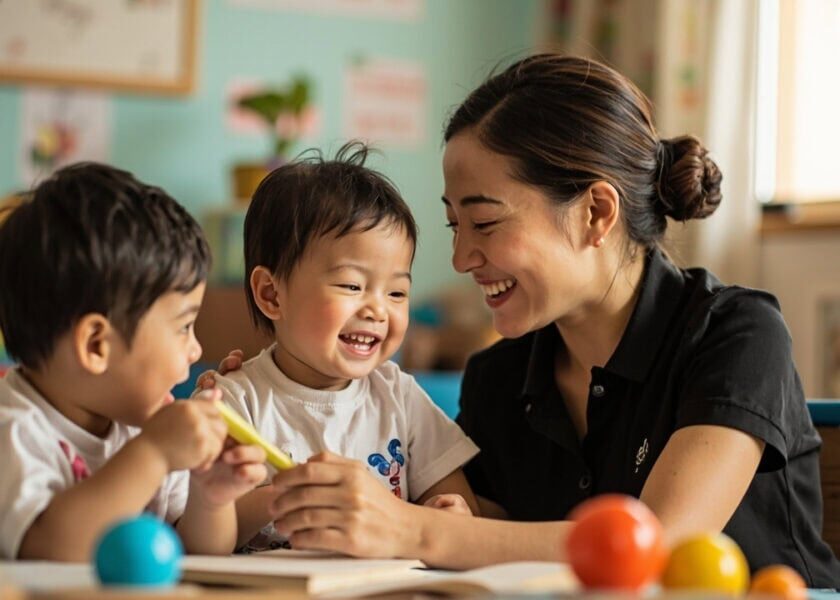
If you have chosen your care arrangement well, your caregiver has noticed it too. She says, “You know, she has been doing this all week,” or “He really calms down when we go outside.” And suddenly your child is not a mystery you are solving alone. They are a person whose patterns and preferences are being mapped by more than one pair of loving eyes.
This is not a small thing. In Singapore, where many parents return to work within weeks of their child’s birth, this shared noticing is transformative. It means that your child’s development is not something happening in a black box while you are away.
Through sustained quality care, you also begin to understand your child’s temperament—their particular mix of boldness and caution, their response to stimulation, the conditions under which they thrive and the conditions under which they unravel. These are not things you know when you bring your baby home from the hospital. You learn them. You learn them by watching how your child reacts to the world, and through the observations of someone who has seen them across many different days and moments.
The first thousand days matter—not as a slogan but as a genuine window of extraordinary neurological and emotional growth. Quality childminding means those days are days you are present for, even in your absence.
Why Sustained Partnership Changes Everything
Anyone can watch your child for a day. A quality childminding arrangement—one built on genuine expertise, real training, small ratios, and attentive care—watches your child over weeks and months.
It notices the development of a pincer grip before it becomes a full grasp. It sees the moment a child moves from parallel play to genuine interaction with another. It feels the shift in a child’s emotional register when a new sibling arrives, or when a favourite caregiver is away.
This longitudinal knowledge—the understanding that comes only from sustained, attentive presence—transforms childcare from a service into something far more valuable. It becomes a mirror. It reflects your child back to you with a clarity that is hard to achieve when you are the only one watching.
Here is what is most remarkable about this process, and most underappreciated in how we talk about childcare choices: that knowledge belongs to you.
The day your caregiver tells you, with genuine delight, that your son spent the entire morning building a tower and then destroying it and then building it again—and that he did not get frustrated even once—you feel something shift. You feel validated.
You think: So this is who he is. This is the child I have. This is the child I am learning to understand.
That feeling of understanding, that sense of quiet competence that grows in you as a parent, is not a luxury. It is the very thing that makes you a more confident, more attuned, more effective guide for your child.
What Quality Childminding Actually Looks Like
Quality childminding means something specific. Not just supervision. Not just safety—though safety is the foundation on which everything else rests.
Quality childminding means:
- A caregiver who notices, who documents, who shares observations in a way that builds your understanding rather than simply reporting
- Ratios that allow for genuine attention—small enough numbers that every child is seen, heard, and known
- Communication structures that close the loop between the hours you spend at work and the hours your child spends in care
- Consistency—the same caregiver over time who learns your child’s rhythms, preferences, and patterns in depth
- Expertise that is warm, not clinical. Real training applied with genuine care
In Singapore, the ECDA Childminding Pilot has created pathways for both home-based and centre-based care, and both have their place. Both serve families whose needs and circumstances are different. Both can be done with the quality that Singapore parents are right to demand.
The pilot matters—not simply as a policy initiative, but as an acknowledgment that the childminder is not a stopgap. The childminder is a professional who holds the rhythms of a child’s day with the care that a parent would, and when that care is excellent, becomes a genuine partner in the child’s development.
A Partnership Built on Knowledge
Some childcare arrangements understand this. They are built on the belief that infant care is not a transaction—it is a relationship, and relationships require time, communication, trust, and genuine expertise to flourish.
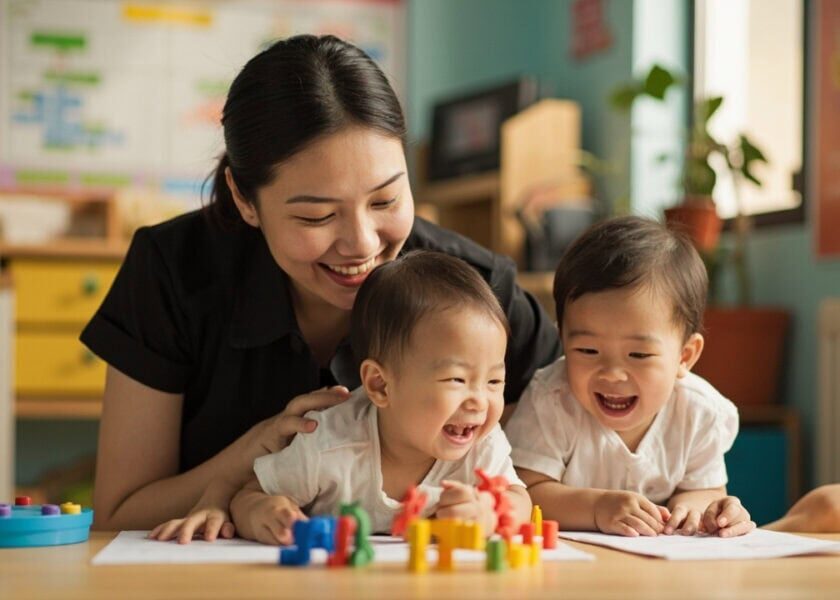
The best arrangements mean your caregiver is trained to observe, to document, to communicate—to notice the things that matter and share them with you in a way that builds your own understanding. Ratios are designed to allow for that observation—for up to one-to-three infant care that means every child gets the attention their development requires.
Communication structures, including transparency measures such as CCTV where deployed, are not about surveillance. They are about trust. About closing the loop between the hours you spend at work and the hours your child spends in care.
In Singapore—where practicality and aspiration sit side by side—quality care should not be the exclusive privilege of families with significant means. Community Care and Development Account funding can be used, Baby Bonus funds can be directed where eligible, and care blocks are built around the actual working week of actual Singapore families.
Addressing Your Real Concerns
If you are researching infant care right now, you probably have questions. Let me address some of them directly.
Will my child be safe?
Safety is the foundation. Quality care begins with rigorous standards, trained caregivers, and environments designed for infant safety. Ask about training, ratios, and safety protocols. These are not optional extras—they are the baseline.
Will I feel connected to my child’s day?
You should. Communication is not a bonus—it is an essential part of quality care. You deserve to know what your child’s morning was like before you pick them up.
How do I know if this is the right choice?
The right care arrangement will teach you things about your child. It will notice things and tell you about them. It will reflect your child back to you with clarity and warmth. If you feel more confused after a childcare arrangement than before, that is information worth paying attention to.
Can I afford quality care?
In Singapore, funding structures exist to make quality care more accessible. Community Care and Development Account funding, Baby Bonus eligibility, and thoughtfully structured fee arrangements all help close the gap.
When you visit a care setting, notice whether the caregiver notices. Ask about ratios. Ask about communication. Notice whether your child will have the same caregiver over time. And trust your gut—you are looking for a partner in understanding your child. If something feels warm, attentive, and genuinely interested in your child, that is worth a great deal.
The Gap Between Love and Certainty
Every parent has felt it. That gap between the depth of their love and the certainty of their knowledge.
You love your child absolutely. You would move mountains for them. And yet there are moments when you wonder whether you are reading them correctly. Whether you are responding to their needs in the right way. Whether the choice you made about childcare was the right one.
That gap is not a failure. It is the space where learning lives.
Quality childminding, done with intention and expertise, fills that space with something extraordinary. It fills it with knowledge—not the abstract knowledge of experts, but the lived, specific, day-by-day knowledge of a caregiver who has been with your child long enough to know them, and who is generous enough to share what they know with you.
It is not a promise that everything will be perfect. It is the far more valuable gift of knowing your child well enough to trust the process. Of understanding their temperament well enough to have patience with their struggles. Of recognising their developmental readiness well enough to encourage their growth without rushing it.
You are already further along than you think. The knowledge is waiting. It has been waiting—in the way your child reaches for one toy over another, in the way they turn toward a familiar voice, in the small daily observations that a skilled caregiver will notice and return to you as a gift.
Begin that journey. Quality care, done with intention, will meet you there.
EduNanny is a Singapore-based childminding and infant care service built on the belief that quality childcare is a partnership. Learn more about our approach to development-oriented care, or get in touch to explore whether EduNanny might be the right fit for your family.