Growing Together: The Singapore Family Guide to Childcare and Growth
The First Goodbye Is Not the Last Thing That Changes
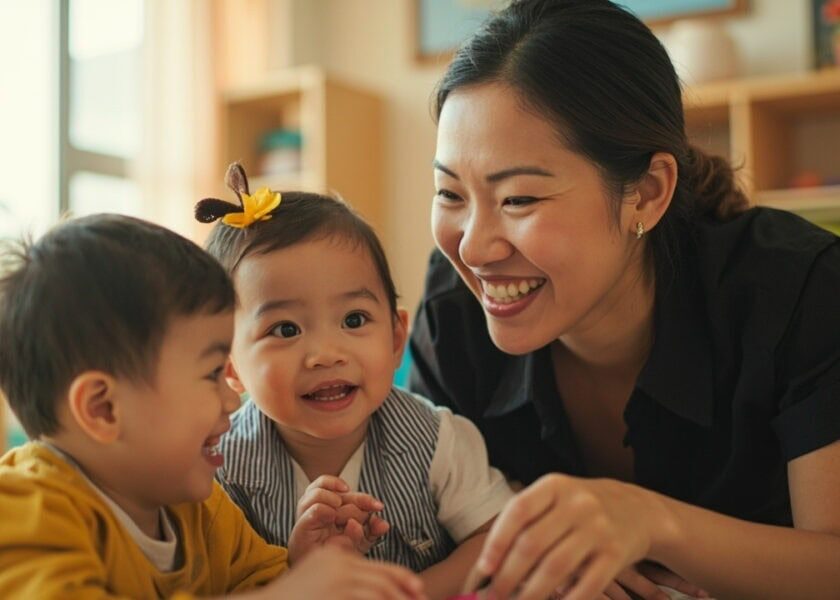
There is a moment every parent remembers. It comes the first time you leave your child in someone else’s care — the walk to the gate, the weight in your chest, the turning back that isn’t quite turning back. You tell yourself this is for them. You tell yourself they need this, that you need this, that it is the right decision even when it does not feel comfortable.
But here is what no one tells you, or tells you too late: it is not just for them.
Somewhere between that first morning goodbye and the afternoon reunion, between the first unfamiliar caregiver and the child who now runs toward the door with recognition, something else begins. You begin to notice your child differently. You begin to understand that what you thought you knew about them was incomplete — and that the missing pieces were not failures on your part, but simply pieces that could only emerge in a world outside your home.
This is the story that matters. Not just the story of what childcare does for your child — though that story matters too. But the story of what quality care does for you: the parent, the partner, the person navigating this extraordinary, demanding, beautiful chapter of family life.
The story of how, when you chose for your child, you were also choosing for yourself.
- Why development is not a one-way street — it happens to parents too
- How quality childcare reshapes your relationship with your child
- What community reveals about your child — and about you
- What good infant and childminding care actually looks like in Singapore
- How to find a partner who supports your whole family’s growth
Development Is Not a One-Way Street
We speak easily of the child developing — their language expanding, their motor skills sharpening, their social world widening. But development is not something that happens only to the young. It happens to parents too, in ways that are less visible but no less real.
The parent who walks through a childcare door for the first time is not the same parent who leaves six months later. The child who arrives with uncertain steps leaves with confidence. But so does the parent who learns, day by day, that their child is more capable than they imagined — and who learns, in the same process, that they are too.
When a child enters quality care, something shifts in how they understand the world. They learn that relationships extend beyond their immediate family — that a caregiver can be trusted, that other children can be friends, that the world is large enough to hold them safely. They learn to navigate the small disappointments and the great satisfactions of peer interaction. They develop emotional vocabulary for feelings that previously had no name. They grow a sense of self that is shaped not just by home but by community.
And here is what is often overlooked: as your child learns these things, you learn them too.
You learn to see your child as someone with a life beyond your direct observation — a life in which they are making choices, building relationships, becoming a person in their own right. You learn to separate your identity as a parent from your child’s every need. You learn, in the gentle and sometimes painful way that true growth always comes, that the goal was never to keep them close. The goal was always to help them become someone who can walk confidently into the world — and to grow into the kind of parent who can let them.
The observation does not end when you leave the gate. It follows you home.
When caregivers note that your child has discovered a new way of solving a problem, or has shown unexpected patience with a peer, or has begun using a phrase that clearly originated in the classroom — that information comes back to you. And it changes something. It changes the questions you ask when you pick them up. It changes the story you tell yourself about who they are and what they are capable of. It changes the relationship from one of management to one of genuine curiosity.
The Stages of Growing Together
Consider what actually happens in the months after a child begins quality care.
The First Weeks: Shared Adaptation
Tears are common and trust has not yet taken root. You second-guess your decision. You wonder if your child thinks you abandoned them. The caregiver reports that your child had a difficult morning, and you feel it in your chest. This phase is hard, and it is honest. It is also temporary.
The First Month: Routines Take Hold
Routines become familiar. The caregiver becomes a known figure. Your child begins to anticipate what comes next — morning circle, snack time, outdoor play. You notice they come home tired in a good way, fulfilled rather than depleted. You start to trust the process, and so does your child.
Months Three to Six: Emerging Confidence
The child who clung to your leg now waves goodbye with something approaching enthusiasm. The child who could not name frustration now tells you a full story about a conflict on the playground. Your questions at pickup become more curious: “What did she do today?” rather than “Was she okay?” You are beginning to see your child as a capable person.
Six Months to a Year: A New Relationship
The child demonstrates an independence that startles you. They solve problems you did not know they could face. They mention friends by name. And you — you notice that your relationship with them has deepened precisely because you are no longer the only relationship that matters to them. You are not less important. You are important in a different, more sustainable way.
You watch this happen. And in watching, you are changed.
What Community Reveals About Your Child
There is another dimension to this growth that deserves attention. It has to do with what happens when your child enters community.
At home, your child is one person in a small world. In care, they become a member of a group. They learn to negotiate, to share, to assert themselves in ways that your home environment may not have allowed.
A child who is the youngest at home may discover leadership qualities when surrounded by slightly younger peers. A child who struggles with sharing toys at home may become the child who always makes sure everyone has a turn. A quiet child may find their voice when surrounded by children who speak up. These are not contradictions. They are evidence that your child is a whole person — a person who can be different in different contexts and who deserves environments that bring out their full humanity.
When you learn this about your child, you are also learning something about yourself. You are learning that your home was never meant to be the only world your child inhabits. You are learning that asking for help was not a sign of failure — it was an invitation to expand the village that raises your child.
What Quality Childcare Actually Looks Like
If you are researching infant care and childminding in Singapore, you deserve to know what good care actually entails. It is not simply supervision. It is not simply safety. It is a deliberate environment designed for development.
Small Groups, Real Attention
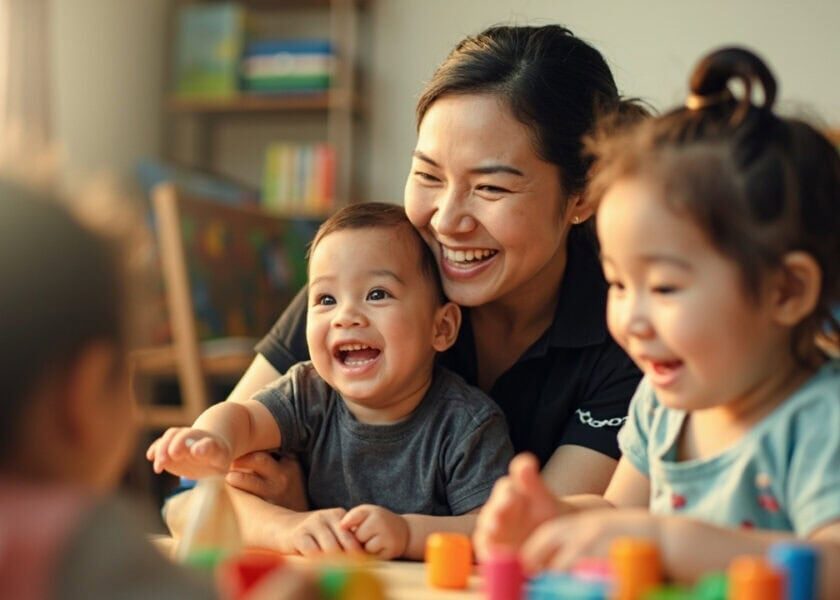
Quality care means your child is not lost in a crowd. Small caregiver-to-child ratios mean that each child is truly seen — their preferences noticed, their struggles understood, their progress tracked. When a caregiver knows three children deeply, they can support growth in ways that a caregiver managing ten cannot.
Consistent Routines, Safe Exploration
Young children build trust through predictability. When they know what comes next, they feel safe enough to explore, to try, to fail, to try again. A quality environment provides this consistency — the same arrival routine, the same nap schedule, the same caregivers who remember what happened yesterday and connect it to today.
Communication as Practice, Not Afterthought
You should know what your child is experiencing during the day. Not just whether they ate and slept — though that matters — but who they played with, what they discovered, how they handled a conflict, what made them laugh. This flow of information between caregivers and parents is not a bonus. It is how the observation that happens in care can inform the care you provide at home.
Transparent Environments
Where childcare settings use CCTV, it should serve transparency — not surveillance, but trust. You should feel comfortable knowing what happens when you are not there. And where possible, open-door policies and regular communication build the confidence that allows both you and your child to thrive.
EduNanny: A Partner in Your Family’s Growth
EduNanny was built within the ECDA Childminding Pilot, part of Singapore’s deliberate investment in giving families real choices for how their children are cared for. The pilot offers both home-based and centre-based pathways, recognizing that different families have different lives, and that the best childcare is the one that fits your life — not the one that demands your life conform to it.
What distinguishes EduNanny is the intentionality behind every element of its design. The infant ratio — up to one to three — ensures that caregivers can truly see each child, not just supervise them. Monday to Friday care blocks provide the consistency that young children need to build trust and confidence. Communication with families is not an afterthought but a practice, ensuring that the observation happening at school flows home and the observation happening at home informs the care.
For families navigating the cost of quality care, EduNanny’s pilot fee structures are designed to be accessible. CDA and Baby Bonus usability means the financial planning you have already done for your child can actually be used for the care you are choosing for them. Quality childcare should not be a privilege available only to those with significant means. It should be a genuine option for every family that wants it.
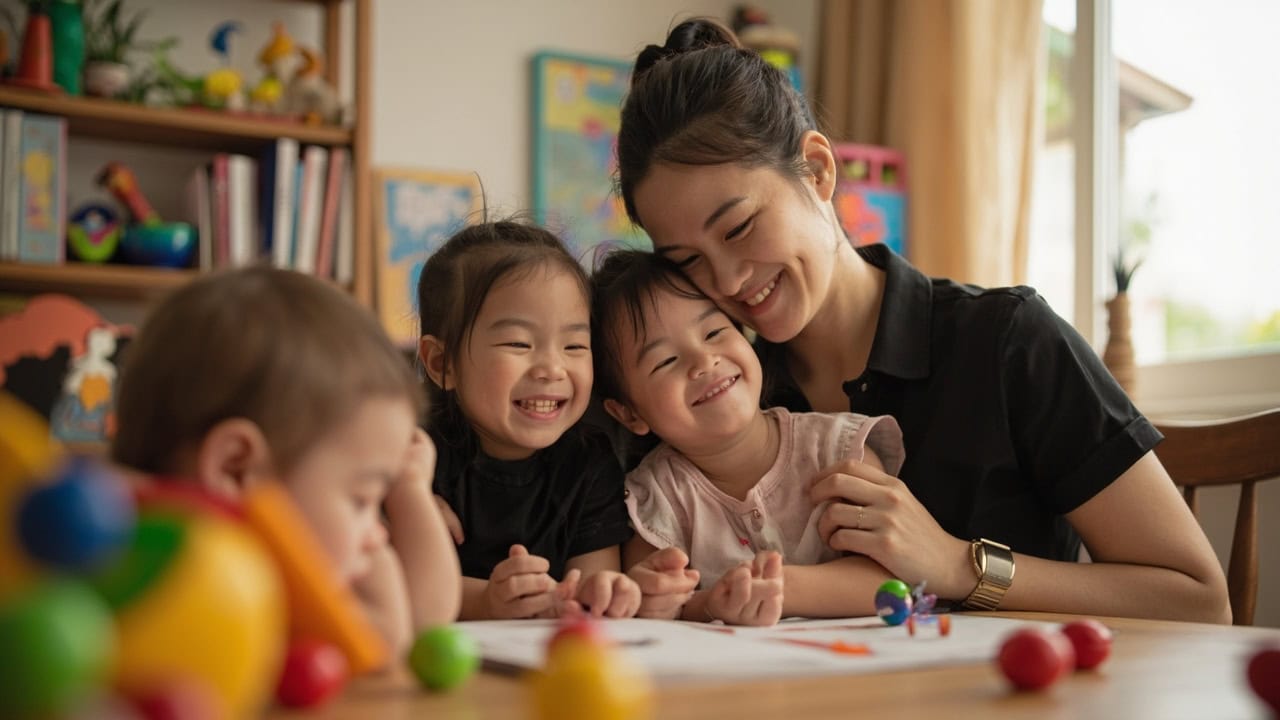
When you walk through EduNanny’s doors, you are not just finding a place for your child. You are finding a partner in this shared developmental journey. You are finding a team that understands your child is not a project to be managed but a person to be known. And you are finding, perhaps for the first time, an environment that respects the fact that you — the parent — are also growing. That you are not expected to have all the answers. That you are allowed to need help.
What Parents Really Want to Know
“Am I failing my child by not being the only caregiver?”
You are not failing your child. You are expanding their world. Research on child development consistently shows that children benefit from multiple warm, responsive relationships — not just one. What they need is not a single caregiver who does everything, but caregivers and environments that support their growth. Quality childcare adds to your child’s life. It does not subtract from your role as a parent.
“Will my child feel abandoned?”
Separation anxiety is real and it is healthy — it means your child has formed a secure attachment to you. But attachment to parents and attachment to caregivers can coexist. When care is consistent, warm, and responsive, children learn that you always come back. They learn to trust other adults because they first learned to trust you. The tears of the first weeks give way, in quality settings, to confident goodbyes and eager hellos.
“Am I growing alongside my child, or just coping?”
This is the right question. And the answer is: you can grow alongside your child, but only if the environment you choose supports your growth too. Quality childcare does not just hand your child back at the end of the day. It includes you in the observation. It shares what they noticed. It invites your perspective. When care is designed this way, you find yourself developing too — in patience, in curiosity, in your capacity to see your child clearly.
“Is this too expensive for what we are getting?”
Affordability is a legitimate concern, and it should not be dismissed. When evaluating cost, consider what you are actually purchasing: not just hours of supervision, but hours of intentional development. The ability to use CDA and Baby Bonus funds matters because it makes quality care accessible in a real, practical way. The investment is not just in your child’s day — it is in the conditions that allow both your child and your family to grow.
Practical Guidance for Choosing Infant Care in Singapore
If you are at the stage of researching options, here is what to prioritise:
- Observe the environment during a visit. Watch how caregivers interact with children — not just when they know they are being observed, but in the ordinary moments.
- Ask about ratios. How many children per caregiver? Smaller numbers mean more individual attention.
- Ask about communication. How will you know what your child is doing during the day? What is the pickup conversation like?
- Notice consistency. Will your child have the same caregiver each day, or rotating staff? Consistency builds trust.
- Check for pilot or regulatory alignment. In Singapore, look for providers operating within ECDA frameworks — these meet established standards for quality care.
- Trust your instincts. If something feels off during a visit, listen to that. You know your child best.
- Ask about adaptation support. Quality providers will have a plan for the transition period and will communicate with you honestly about how your child is adjusting.
A Different Way to See This Chapter
We have been taught to think of childcare as something parents do for their children. But what if we thought of it as something families do together?
What if we understood that when a child grows, their parents grow too — in empathy, in patience, in the capacity to see their child clearly, in the courage to let them become who they are meant to be?
This is not a soft ideal. It is a documented reality. When children are in environments that support their development, parents report feeling more confident, more connected, and more curious about their children. They report developing a relationship with their child that is based not on anxiety but on genuine interest. They report learning things about themselves they could not have learned without this experience.
You may have entered this search expecting to hear about curriculum, ratios, caregiver qualifications. These things matter, and quality providers take them seriously. But the story worth understanding is bigger than that.
It is the story of a family that walked through uncertainty and emerged on the other side with a deeper relationship than they thought possible. It is the story of a parent who learned to trust — in their child, in their caregiver, in themselves. It is the story of a child who surprised everyone, including themselves, with how much they could grow. And it is the story of how these two journeys — the child’s and the parent’s — were never separate at all. They were always happening in parallel. And when the conditions are right, they happen beautifully together.
EduNanny is not asking you to trust blindly. It is offering you a structure within which trust can grow — a space where your child can develop safely, where your family can be supported genuinely, and where your own growth as a parent is treated with the same seriousness as your child’s growth as a person.
If you are standing at a crossroads, wondering if you are making the right choice for your family, consider this: you are not just choosing a service for your child. You are choosing an environment in which your whole family can grow. You are choosing a partner who will observe your child with you, learn about them with you, and support their development — and yours — with intention and care.
The child you bring through those doors will change. They will grow in ways you can see and ways you cannot. They will learn to trust, to speak, to navigate the complex social world of childhood.
And as they do, so will you.
This is not a burden. It is an invitation. It is the understanding that parenting was never meant to be a solo journey, and that asking for help is not a sign of weakness but a recognition that children — and parents — flourish best when they are held by more than one pair of hands.
EduNanny stands ready to hold alongside you.
Not because you cannot do this alone. But because you do not have to. And because when you choose to do this with the right support, you will discover that you and your child are capable of more growth, more connection, more joy than you ever imagined.
Where your child grows. Where your family grows. Where growth happens together.
EduNanny by BUTLER.
Thoughtful, development-oriented childcare for families in Singapore. Learn more about EduNanny or connect with our team to explore how we can support your family.