The First Week of Childcare Changes Everything
The First Drop-Off: What Happens at the Door
Let us begin where every parent in Singapore begins, whether they choose a centre-based programme or a home-based arrangement through the ECDA Childminding Pilot: at the door.
The morning of the first drop-off arrives with its own strange momentum. You have prepared everything — the bags, the milk, the comfort object you have read somewhere might help. You have rehearsed the goodbye in your mind, because you have heard that an uncertain parting makes everything harder. You have told yourself, probably multiple times, that this is good for your child, that you have done the research, that the arrangement is sound.
And then the moment comes, and your child cries, or clings, or looks at you with an expression that has no name but somehow breaks something open in your chest. And you pry those small fingers off your neck, and you smile, and you say the words you practiced, and you walk away.
What happens next is what nobody prepares you for.
You get into your car or onto the train or simply keep walking, and the world looks exactly the same as it did yesterday. The hawker centre is still there. The traffic light still changes. The same advertisement plays on the same screen. But everything has shifted. You are moving through a world in which your child is somewhere else, in the care of someone else, and you have chosen this.
The urge to turn back is almost physical. And so is the urge to call. To check. To ask, how is she? Is she crying? Did she eat? Can I come back in for just a minute?
This is not weakness. This is not doubt. This is your attachment system responding to a real and significant change. You are not a nervous parent failing to trust your decision. You are a parent in the middle of an adjustment — and the adjustment belongs to you as much as it belongs to your child.
The Question That Changes Everything
Here is what most parents in Singapore do not know, or do not allow themselves to believe: the first week is not a test of whether you made the right choice. It is information. It is data about how your child responds to new people, new routines, new sounds and spaces. It is data about how you respond too.
If your child cries at drop-off, that is not evidence that the arrangement is wrong. It is evidence that your child knows the difference between you and everyone else — and that is, actually, a very good sign.
The question is not whether your child cries. The question is what happens after.
The Hours Between: Reclaiming Time and What It Stirs
Between drop-off and pick-up, there are hours. And those hours carry their own texture that varies from parent to parent.
For some, there is work — and the strange, disorienting experience of sitting at your desk with a mind that cannot quite engage. You are present in body, but some essential part of you is still standing at the childcare door, still hearing the echo of that cry. You try to focus. You send an email. You forget what you wrote. You check your phone. Nothing yet.
For others, there is a different experience entirely: the sudden, vertiginous awareness of time that belongs to you. Your hands are empty. Your schedule is your own. And instead of freedom, you feel the uncanny sensation of a room that is too quiet, a coffee that goes cold because you keep looking at the door, waiting for a child who is not there.
Both experiences are true. Both belong to the first week.
Quality childcare does not diminish your role as a parent. It restores you as a person. And that restoration is not a betrayal of your child. It is a gift to your child, because a parent who has been allowed to breathe, to work, to think, to be — that parent returns at the end of the day with something more to give.
Pick-Up: Watching Your Child Expand
Then comes pick-up.
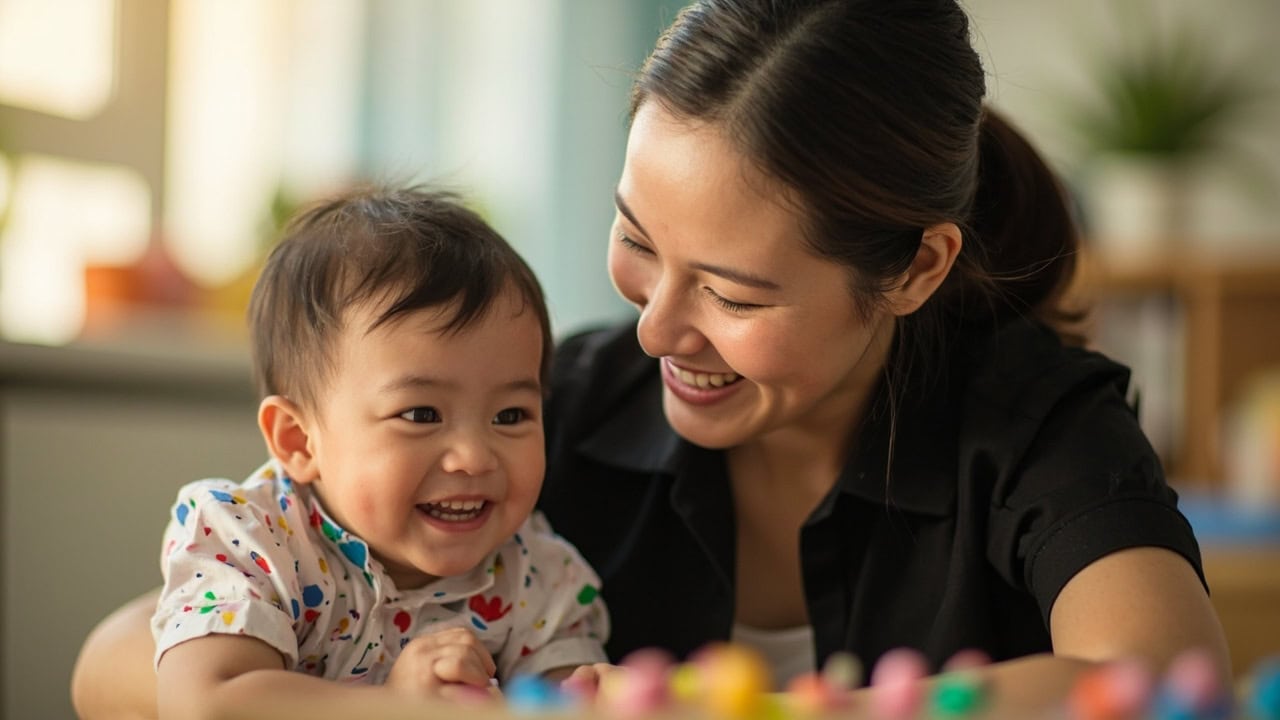
There is no moment in this entire transition quite like the first time you see your child at the end of a care day and something has shifted. It is not always dramatic. Sometimes it is simply this: she did not cry when you walked in. Or she ran to you with more energy than she had on Monday. Or he looked at his teacher and waved goodbye — actually waved goodbye — and something in your chest unlocked.
This is the moment that begins to change the story.
You are watching your child in a new way now. You are watching her in a space that is not yours, among people who are not you, learning things you did not teach her. And what you see is not damage. What you see is expansion.
She is reaching for toys with both hands. She is watching the other children. She is responding to a name that someone else gave her. She is becoming someone who exists in the world, not only in your home.
The conversations at the dinner table change. The morning routine changes. The way you describe your child’s day — his teacher, her friends, the song they learned, the painting he brought home — becomes richer, because it is now part of a larger story.
You are still the author of your family’s life. But the story has more characters, more settings, more texture. And that is growth, even when it does not feel like it.
The Guilt That Changes Shape
Let me be honest about something that many parents feel but few are given permission to name: the guilt does not disappear. It changes shape.
In the first days, it arrives loudly — the raw, anxious guilt of the morning drop-off, the grief of parting, the worry that you are somehow abandoning your child in a moment of need. That guilt, if it is met with reassurance, with evidence, with time, gradually softens. But it is replaced by something else, something quieter and more complex.
There is the guilt of the working parent who wonders if she is present enough. The guilt of the parent who sometimes, in an unguarded moment, is grateful for the break. The guilt of wanting more than one kind of life and trying, imperfectly, to live all of them at once.
This guilt is not irrational. It is the cost of loving deeply in a world that asks us to be many things. But it is also, often, unfounded — because the evidence from decades of research is clear: children do not suffer from quality childcare. They benefit from it. They benefit from parents who are less depleted, less resentful, less stretched beyond their limits. They benefit from the social world that quality care provides. And they benefit, profoundly, from the bond with a parent who has been given the space to come back whole.
Your guilt is not a sign that something is wrong. It is a sign that you care. And caring is not the problem. The question is what you do with that caring — whether you let it drain you, or whether you find a structure, a support, a care arrangement that allows your care to flow both ways.
What Quality Childminding Actually Looks Like
If you are researching infant care in Singapore, you will encounter many options. Understanding what distinguishes quality care from adequate care matters — not because perfection is required, but because the right support makes the difference between an anxious adjustment and a confident one.
Small Ratios Mean Real Attention
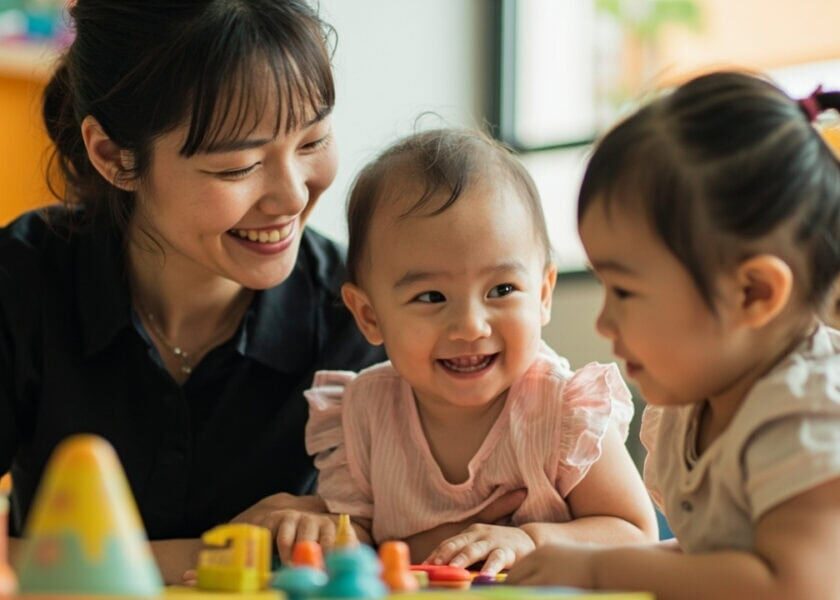
One of the clearest indicators of quality in infant care is the ratio of caregivers to children. In home-based childminding arrangements through the ECDA Childminding Pilot, ratios of up to one caregiver to three infants mean that every cry can be heard, every need can be met, every moment of distress can be met with genuine attention rather than logistical triage.
When your child is in a small group, she is not one of many. She is seen.
Communication as Evidence
Quality care communicates. Not occasionally, not only when something goes wrong — but consistently, transparently, every day.
When you receive a message mid-morning that says your child has settled in, or that she smiled when she saw the fish at the sensory corner, or that he ate better than yesterday — those messages are doing something profound. They are giving you evidence. Not proof that nothing will ever be hard, but evidence that the people caring for your child are paying attention.
Trained Caregivers Who Understand Development
Quality childminders are not just warm and well-meaning. They understand infant development. They know the difference between a cry of frustration and a cry of pain. They respond not with frustration but with curiosity — what is this child telling me? What does she need?
This is not a luxury. This is the foundation of care that allows both your child and you to thrive.
Trust-Building, Not Surveillance
Where deployed, transparency measures such as regular updates, open communication channels, and even visual access where appropriate are not surveillance features. They are trust-building tools. They are the evidence your anxious mind needs to begin believing what your rational mind already knows: that your child is safe, that she is loved, that the people caring for her are worthy of that trust.
Advice for Parents: Trusting the Process
If you are in the process of researching childcare options in Singapore, here is what I want you to carry with you:
Trust the Question, Not the Answer
Do not look for certainty. Look for a caregiver or centre that helps you feel, over time, that you can trust your own judgment. The right arrangement will not eliminate all anxiety — it will help you feel confident enough to tolerate the anxiety that remains.
Look for Evidence, Not Reassurance
The best childcare arrangements do not tell you to stop worrying. They give you reasons to worry less — daily updates, visible engagement, a caregiver who remembers details about your child and shares them with you naturally.
Give the First Week Time
The first week of childcare is not a verdict. It is a beginning. If your child cries at drop-off on Monday, do not conclude that the arrangement is wrong. Watch for what happens by Wednesday. Notice how your child responds at pick-up. Look for the small signs of settling — and trust that settling takes time.
Be Patient With Yourself
Your adjustment matters as much as your child’s. If you feel relief, that is not betrayal. If you feel grief, that is not weakness. If you feel both in the same hour, that is not confusion — that is the full reality of loving someone and letting them grow.
Choose for the Long Term, Not Just the First Week
The first days will be hard. Choose an arrangement you can imagine trusting for months and years, not just survive the first drop-off. Ask yourself: do I believe in the people caring for my child? Do I feel respected as a parent? Do I trust that my child’s needs will be met with attention and care?
What You and Your Child Are Learning
Here is what I want you to carry with you.
The first week of childcare is not about whether you are a good parent. It is about the kind of parent you are becoming — one who is willing to let go of control in order to give your child something you alone cannot provide. Not because you are failing. Because you are expanding.
Every time you walk through that door in the morning, you are making a declaration: I believe my child can do more than I sometimes give her credit for. I believe the world has something to offer her that I, however much I love her, cannot offer alone. I believe that the bond between us is strong enough to survive distance, and wise enough to grow from it.
That declaration is not easy. It requires you to sit with uncertainty. It requires you to tolerate your own discomfort alongside your child’s. It requires you to trust a process that you cannot fully see or control.
Your child is not just adapting to a new routine. She is developing the capacity to trust new people. He is building the resilience to navigate a world that will always contain separations, new faces, unfamiliar rooms. She is learning, in the smallest and most fundamental way, that the world is not only Mummy, not only Daddy — and that this is survivable, even good.
And you are learning something too. That your child belongs to more than just you. That your love does not shrink when it is shared but expands to fill the space it creates. That the hours apart give you back something you did not know you were losing — yourself, your work, your capacity to be present when you are together.
Quality childcare does not take your place in your child’s life. It restores you so that the place you hold can be deeper, wider, more fully yours.
EduNanny Singapore: Built for This Transition
EduNanny Singapore was built for this moment. Not the moment of crisis, but the moment of choice — the moment when a parent decides that she is ready to trust someone else with the most important thing in her life.
Through the ECDA Childminding Pilot, EduNanny offers pathways that are as varied as Singapore’s families:
- Home-based care that brings qualified childminders into the family’s own space, where the child can remain in familiar surroundings while the parent returns to work with confidence.
- Community and centre-based care where infants and toddlers are held in small, intimate groups with ratios that ensure every need is seen and met.
- Monday to Friday care blocks designed around the rhythms of working families.
- Affordable fee structures within the pilot that make quality care accessible rather than aspirational.
- Usability of CDA and Baby Bonus funds that Singapore has thoughtfully made available, because the government, too, understands that the early years are not a place to economise.
EduNanny’s childminders are not just caregivers but partners in your child’s development — people who have been trained, who are supported, who understand infant development, who communicate with you not because it is policy but because they understand that your trust is earned, one day at a time.
You are not alone in the silence that follows drop-off. That silence is shared by every parent who has walked this path before you. And on the other side of it, there is a moment — it will come sooner than you think — when you will see your child at pick-up and recognise, with a clarity that surprises you, that she is not just okay. She is thriving.
That recognition is not a gift from EduNanny. It is a gift from your child — and from the choice you had the courage to make.
Walk toward it.
#firstweekchildcare #singaporeinfantcare #childmindingSG #ECDAchildmindingpilot #EduNannySingapore