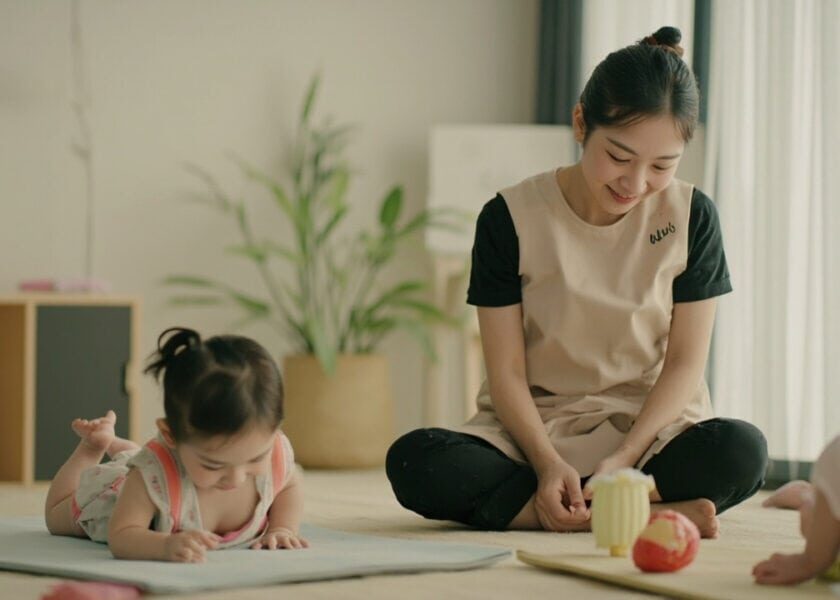
What to Look For in a Childcare Centre When Everything Seems Fine
The Moment Every Singapore Parent Recognises
You have booked the tour. You have walked through the lobby of a childcare centre—or perhaps several—and something has happened that is difficult to name. The director was warm. The facilities gleamed. The walls were painted in cheerful colours, and somewhere a child was laughing. By most reasonable measures, the visit went well.
And yet, as you drove home or lay awake that night, you felt a quiet uncertainty you could not put into words. Something did not quite settle. You did not know what you were looking at.
That discomfort is not inexperience. That unnamed feeling is not a weakness in you. It is the beginning of something far more useful than a checklist could ever be. It is the first whisper of discernment.
What you are doing—searching, questioning, hesitating to commit—is not a sign that you are uncertain. It is proof that you are paying attention. This guide will help you understand exactly what you are paying attention to, and how to trust what you already know how to see.
Why This Decision Resists Easy Measurement
Most content written for parents at this stage offers reassurance after the decision has already been made. It tells you how to read your child’s behaviour at pickup, how to build a partnership with your caregiver, how to manage the guilt of returning to work. All of that has its place.
But the parent I am speaking to today is not there yet. You are still standing in the lobby. You are still holding the enrollment form without signing it. You are still wondering whether you are being too picky, or not picky enough, or simply unable to see what is actually in front of you.
The reason this moment is so difficult is that you are trying to evaluate something that resists easy measurement. You can count the toys. You can note the cleanliness of the changing stations. You can ask about the curriculum and write down the answer.
But the thing that separates a genuinely excellent childcare environment from one that merely performs well—that is harder to see, harder to name, and far more important.
The Question That Reveals Everything
Here is the question I want you to carry into every centre you visit: Are the children genuinely engaged, or merely occupied?
Genuine engagement means children are invested in what they are doing—building, exploring, talking, problem-solving. They are not waiting for the next transition. They are not simply filling time.
Passive occupation means they are waiting for instructions, waiting for the next scheduled event, waiting to be managed. A centre that understands child development designs experiences that draw children in. A centre that is managing schedules fills time between transitions.
Your child knows this difference instinctively. That is why a child who is truly comfortable will explore and engage. A child who is merely managed will comply. The distinction is visible, if you know where to look.
The Framework: What to Actually Watch
I want to give you a tool that will change the way you see every centre you visit. It is not complicated, but it requires you to trust something you already possess: your ability to observe.
Not as a childcare professional, but as a human being who has spent your entire life reading environments and people. You walk into a restaurant and sense whether the kitchen is in control. You meet someone new and feel within minutes whether they are trustworthy. You know how to tell the difference between genuine warmth and performed friendliness.
That same capacity, applied deliberately, will tell you more than any brochure or star rating.
Watch the Caregivers
Not when they are presenting to you or guiding a structured activity for your benefit. Watch them in the ordinary moments. Ask yourself:
- How do they speak to a child who is frustrated?
- How do they respond when a toddler makes a mess or a baby cries?
- Do they move through the room with purpose and warmth?
- Or do they seem hurried, detached, counting the minutes until the next scheduled event?
The moments when no parent is watching are when the true culture of a centre reveals itself.
Watch the Environment
Does it feel alive—not merely clean and organised, but thoughtfully arranged to invite discovery? Or does it feel like a holding space, designed more for adult supervision than for children’s genuine engagement?
- Are materials accessible at a child’s eye level?
- Are there spaces for both active play and quiet retreat?
- Does the arrangement encourage children to make meaningful choices?
Look for evidence that the space was designed with children’s developmental needs in mind, not just parents’ aesthetic expectations.
Questions That Reveal Character
When a centre knows it is being evaluated, it will present its best self. Every organisation does this. But here is the crucial distinction: a centre that is genuinely excellent does not have a different version of itself for tours and another for ordinary days. Its culture is consistent. Its standard of care does not depend on observation.
When you ask a real question—not a softballs—notice whether the response is confident and specific, or smooth and vague.
Ask about how they handle illness. Ask about how they support a child who is struggling to settle. Ask what happens during diaper changes or naptime. Ask how they communicate with parents and how often.
The quality of the answers will tell you something profound. A centre that has thought carefully about its practices will answer in concrete terms. A centre that is managing impressions will offer warmth, reassurance, and carefully chosen language that does not quite answer what you asked.
| Ask About | Watch For |
|---|---|
| How exactly do you handle a fever? | “We follow all health regulations, don’t worry.” |
| What does settling look like? | “We have a gentle transition process.” |
| What if my baby cries at naptime? | “We are very responsive to all children’s needs.” |
| Tell me about caregiver training. | “Our staff are all qualified and experienced.” |
| How do you communicate daily? | “We have an app and regular updates.” |
Singapore Parents Are Right to Feel This Way
You are right to feel uncertain. Singapore parents are navigating something genuinely complex—the first extended separation, the first time someone else will be primarily responsible for your child’s safety, development, and emotional wellbeing during the hours that matter most.
That is not a small thing. The weight you feel is not irrational. It is appropriate. And the fact that you are taking it seriously enough to search, to question, to hesitate tells me that you are exactly the kind of parent who will make an excellent decision—if you give yourself permission to trust what you already know how to see.
What Good Actually Means
A good centre meets the standards. It has the right ratios, the clean facilities, the appropriate curriculum. It will keep your child safe, fed, and relatively content. You would not be wrong to choose it.
But an excellent centre does something more. It creates an environment where children do not merely survive the day, but flourish. Where caregivers are not just performing tasks but building relationships. Where routines are thoughtfully designed around children’s actual developmental needs. Where parents are not just informed but genuinely included as partners.
That difference is visible, once you know how to look for it. And it matters more than you might think, especially in the earliest years.
What We Have Built—and Why
At EduNanny Singapore, we are part of the ECDA Childminding Pilot because we believe in what it represents: a serious, structured approach to infant and childminding that raises the standard for what Singapore families can expect.
We offer both home-based and centre-based pathways because families are not all the same, and the best fit for your child may not look like the best fit for another.
Our infant ratios—up to one to three in our infant rooms—are not a regulatory floor. They are a commitment we make because we believe that the youngest children need and deserve individual attention, not group management.
Our care runs through structured Monday to Friday blocks because we know that predictability is not just convenient for parents—it is foundational for children’s security and development.
And because quality childcare should not be a privilege, our pilot fee structure is designed to be accessible, with CDA and Baby Bonus funds usable. We believe the financial logistics of parenting should never be a barrier to excellent care.
What We Really Want You to Know
We are not afraid of your questions. We are not unsettled by your hesitation. In fact, we welcome it. We believe that the best decisions are made by parents who have been genuinely discerning—who have compared, evaluated, and chosen from a place of real understanding rather than pressure or confusion.
We want you to leave every conversation with us more informed than you entered it. We want you to ask us about our caregiver training, about how we handle the moments that do not go smoothly, about what you can expect on a typical day and what happens when something unexpected occurs.
And if you find, after all of that, that we are the right fit for your family, we want you to choose us with full confidence—not the tentative, anxious confidence of someone who was not given enough information.
Your Invitation: Practical Steps for Your Next Visit
Here is what separates families who find the right childcare from those who spend months second-guessing themselves: they give themselves permission to be demanding. They refuse to accept a centre that merely looks acceptable. They wait for the moment when something feels not just okay but right—when they sense their child would not merely be cared for but genuinely nurtured.
That moment is available to you. It is not a fantasy. And it does not require you to lower your standards. It requires you to raise them, and then to trust that the right centre exists and that you have the ability to find it.
Before You Visit Your Next Centre
- Observe before you ask. Spend the first few minutes just watching. Where are the caregivers’ attention and energy directed?
- Notice the children. Are they engaged or merely occupied? Moving with purpose or waiting for direction?
- Ask one difficult question. Something specific about daily practice, not policy. Watch how it is answered.
- Request to see ordinary moments. A transition, a meal, or free play—not just a structured activity.
- Trust your read of the room. If something feels off and you cannot identify it, note that. Your instincts are data.
The trained eye is not a gift some parents are born with and others lack. It is a capacity that develops when you decide to pay close attention, and when you refuse to accept anything less than what your child deserves.
You already have it. You have been using it all along. Now it is time to trust it.
If you are ready to experience what discernment reveals, we invite you to schedule a conversation with our team. Bring your questions, your scrutiny, and your attention. We believe the right choice is made by parents who see clearly—and we are here to be seen.
Learn more about EduNanny’s ECDA Childminding Pilot or explore who we are.