What Singapore Parents Get Wrong About School Readiness
The Question Every Singapore Parent Carries
Singapore parents carry something specific when it comes to early childhood care. It is not just the ordinary concern every parent has about safety and happiness. It is something sharper. Something with a name, even if we do not always say it aloud: the fear that you might be making the wrong bet.
The fear that choosing care for your child in these early years might set them on the wrong path. That the cost of being wrong will show up three years from now — in a P1 classroom, in a seat they struggle to keep up in, in a confidence that quietly fades.
That fear is real. And it deserves a real answer.
This article covers what school readiness actually means, what the research tells us, and how to choose childcare based on what truly matters — not just what looks good on paper.
What Primary 1 Teachers Actually Look For
Ask yourself: what does a Primary One teacher actually look for when twenty-five new students walk into a classroom for the first time?
They are not scanning the room for children who can already read. They are looking for something else entirely.
They are looking for children who can sit and listen for a meaningful stretch of time. Children who can manage frustration when a lesson is hard or a concept does not click. Children who can communicate what they need — who can say, I do not understand, or I need help, or I feel upset — rather than shutting down or acting out.
Children who are curious. Who ask questions. Who want to know things.
And critically: children who can exist in a room with twenty other children and function as part of that group. Who can share, take turns, navigate small social conflicts, and recover when something does not go their way. Children who can do all of this with enough emotional resilience that the teacher has room to actually teach.
These are not soft skills. They are not nice-to-haves that sit alongside the real work of academics. They are the actual, concrete prerequisites for a child to thrive in Primary One — not just to survive it.
And they have almost nothing to do with whether your child arrived knowing how to write their name.
The Research Behind Real School Readiness
Research in early childhood development is remarkably consistent on this point. Children who enter school with strong social-emotional foundations — the ability to self-regulate, to engage, to persist, to connect — do better academically across their entire school career.
This is not because academics do not matter. It is because the skills that allow a child to engage with learning are built first. Everything else follows from there.
The Role of Play
Play is not what happens before real learning begins. Play is the medium through which young children learn most powerfully.
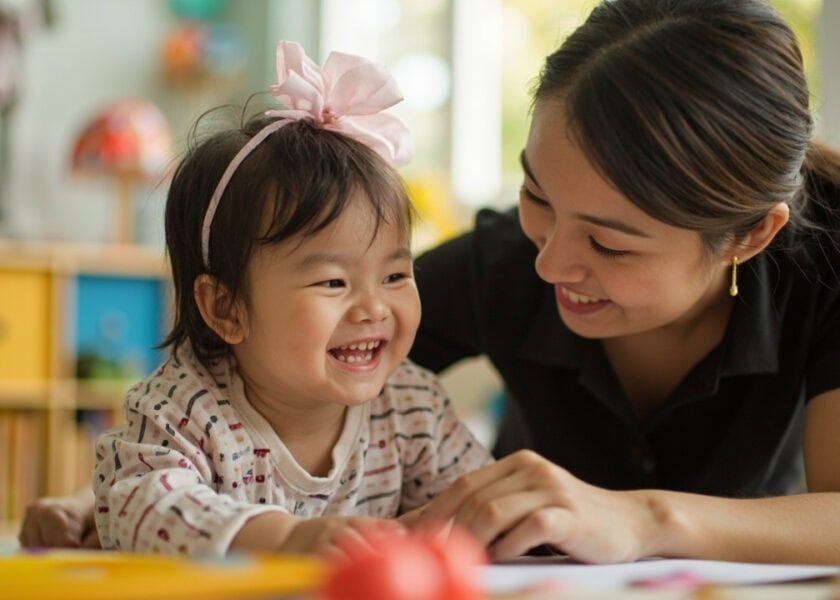
Consider what is actually happening when a child builds a tower with blocks. They are developing spatial reasoning, cause and effect, fine motor control, persistence, and the capacity to problem-solve when something falls down.
When a child is engaged in a group game on the nursery mat, they are building social coordination, language negotiation, and the emotional experience of winning and losing — skills that will make them a capable member of a classroom.
- Sensory play develops the neural architecture that later supports reading and mathematical thinking.
- Pretend play develops narrative thinking, empathy, and the ability to hold multiple perspectives — skills that underpin every subject your child will ever study.
- Language-rich conversation — back and forth, with a responsive adult who listens and expands — builds the vocabulary and comprehension that is the single greatest predictor of academic success across all subjects.
None of this looks like school. It looks like childhood. But it is precisely what builds the child who walks into a P1 classroom genuinely ready to learn.
What Academic Acceleration Gets Wrong
There is a version of parent anxiety that the market is very happy to exploit. Every preschool that promises accelerated literacy. Every programme that puts a three-year-old in front of a worksheet and calls it preparation.
The message is seductive: do this, and your child will be ready. Tick the boxes. Learn the letters. Pass the assessment.
But here is what that message gets wrong.
The children who benefit most from those programmes are not the children who needed them most. And in many cases, children who are drilled academically before the age of six actually perform worse as they move through the school system — not because they know less, but because the joy has been taken out of it. They have already seen this. The novelty is gone.
The intrinsic motivation to learn — which is the single most important thing you can cultivate in a young child — has been quietly replaced by compliance, boredom, or anxiety about performance.
The question is not how do I make my child look ready. It is how do I actually build the foundations that make readiness possible.
What Quality Childcare Looks Like in Practice
For parents researching infant care and childminding in Singapore, it helps to know what to look for — not in brochures, but in practice.
The Relationship Is the Curriculum
The single most important variable in early childhood care is not the curriculum, and it is not the facilities. It is the quality of the relationship between your child and the person caring for them.
Everything else — every programme, every framework, every beautifully designed learning space — is only as good as the human beings in it.
Ask yourself:
- Does my child feel known by their caregiver?
- Does the person caring for them respond with warmth and intention?
- Does my child come home a little more confident than they left?
The Conditions That Enable Real Development
Quality care is not accidental. It is structured around what children actually need to develop well.
Small caregiver-to-child ratios matter — not as a selling point, but as the condition under which real developmental care becomes possible. When a caregiver can truly respond to your child, not as one face in a crowd, but as someone who knows them, notices them, and meets them where they are — that is when development accelerates.
Consistent routines help children feel secure. Language exposure that is rich and responsive builds comprehension. Activities designed with developmental purpose, not just to fill time. Opportunities for children to move, explore, get messy, solve problems, feel frustrated, and recover.
All of these are not extras. They are the curriculum.
How EduNanny Approaches This
EduNanny, brought to you by BUTLER, operates within the ECDA Childminding Pilot. What that means in practice is important to understand.
It means the programme is grounded in a framework that takes early childhood development seriously. One that understands that the ratio of caregivers to children, the quality of responsive interaction, the richness of the environment, and the training of the people who care for your child are not incidental details. They are the work.
Whether through home-based or centre-based pathways, EduNanny is built around a conviction: that the early years are not a waiting period before real learning begins. They are the real learning. And the kind of care that shapes a child’s future should not be available only to those who can afford premium private programmes.
Fee structures within the pilot are designed to make quality care accessible. Payment mechanisms like CDA and Baby Bonus are available to eligible families. Communication with parents is ongoing and transparent — because you are your child’s first and most important advocate, and you deserve to know what is happening in their day.
Choosing Well: What to Look For and Trust
Choosing childcare is one of those decisions that can feel paralyzing precisely because there is so much noise. Programmes with impressive-sounding acronyms. Centres with long waiting lists. Advice from well-meaning relatives and strangers online.
Here is what matters most when you are researching your options:
- Observe the relationship. Watch how caregivers interact with the children. Does it feel warm? Attentive? Do children seem at ease?
- Ask about the day. Not just the schedule, but the philosophy. How do they handle frustration? What does free play look like? How is language woven into everyday moments?
- Notice your child. After a visit or a trial session, does your child seem more confident? More curious? Or drained and anxious?
- Trust your instincts. You know your child better than anyone. If something feels off, it is worth paying attention to.
The concern that choosing a warm, developmentally grounded childcare programme means your child will fall behind is not unreasonable — but it is based on a false choice. It assumes that enrichment and academic preparation are in tension.
That tension largely dissolves when you understand what actually produces good academic outcomes over time.
Children who are emotionally secure, genuinely curious, and confident in their capacity to learn will, over the course of their school careers, consistently outperform children who have been pushed into academic acceleration but arrive anxious, disengaged, or burned out.
The academic outcomes you want for your child are not produced by academic drilling in early childhood. They are produced by the developmental foundation that quality care builds. Trust that.
The Question Worth Asking
You are, I suspect, a parent who cares enormously about getting this right. You may have spent more time thinking about your child’s early years than you ever expected to. You may have felt, at times, that the weight of the decision was disproportionate to the information you had.
Here is what I want you to hear: the fact that you are thinking carefully about this is itself a sign that you are already doing something right. The parents who make the best decisions for their children are not the ones who have all the answers. They are the ones who are asking the right questions.
So let me leave you with one.
It is not: Will my child know enough before P1?
The question is: Will my child be the kind of learner who thrives — curious, capable, confident, emotionally grounded? Will they love school because school is a place where they feel capable and seen? Will they have the internal resources to weather the hard moments, the setbacks, the subjects that do not come easily? Will they leave school not just with grades, but with a genuine sense that they can figure things out?
If that is the child you want — and I believe it is — then what you are choosing when you choose quality childcare is not just care for the early years. You are choosing a foundation.
Foundations are not flashy. They are not always visible. But they are everything. They are what everything else stands on.
When you choose a childcare arrangement for your child, you are making a statement about what you believe your child deserves. You are saying: I believe these years matter. I believe that how my child spends their days in these first years shapes who they become. I am not going to treat this as a background decision. I am going to treat it as the investment that it is.
That is exactly the kind of parent EduNanny wants to partner with. And that is exactly the kind of care that has been built — not a shortcut, not a credential, but a foundation.
If you trust us with the privilege of being part of your child’s earliest years, know that we do not take that lightly. Every day, in every interaction, in every carefully planned activity and every spontaneous moment of connection, we are working toward the same thing you are.
We want your child to be ready. Not just for school. For life.
And we believe that those two things are not as different as they sometimes seem.
EduNanny is a development-oriented childminding and childcare service for families in Singapore. Learn more about our approach or get in touch to discuss what quality care could look like for your family.