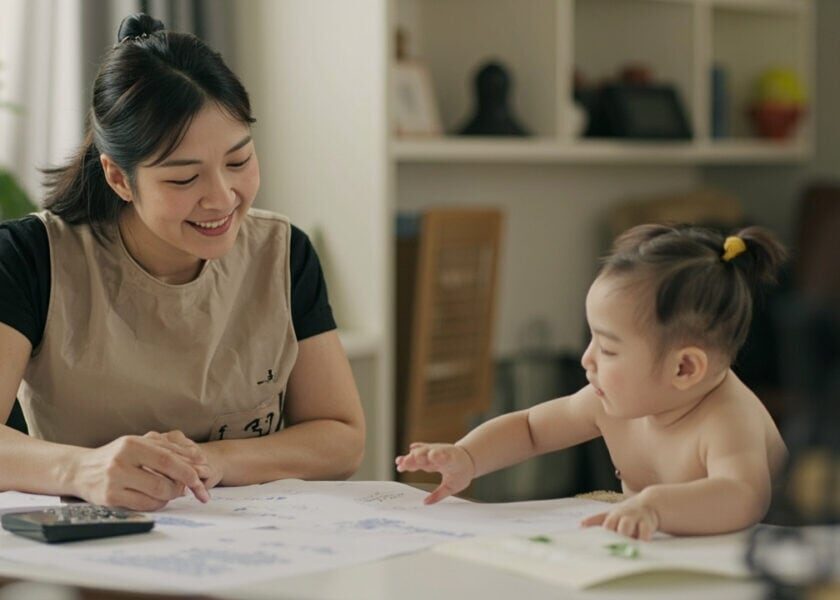
The Partnership Behind Your Child’s Best Development
What Developmental Partnership Actually Means
The childcare environment, understood properly, is not a place you drop your child and hope for the best. It is a developmental partnership — and that partnership is the true unit of childcare quality.
Let us begin with what that partnership is not. It is not a handing over of responsibility. It is not a transfer of knowledge from the expert to the novice. The parent remains the expert on their own child. No caregiver, no matter how experienced or well-trained, knows your child’s history the way you do. They do not carry the memory of your child’s birth, the texture of those first months, the specific rhythm of how your family lives. That knowledge is yours, and it matters enormously.
What the caregiver offers is something different but equally important. They offer a complementary perspective. They see your child in a different context — in the company of other children, in the particular environment of the childcare setting, in moments when you are not there to interpret what is happening. They notice things that you, being so close, might miss.
When this complementary knowledge is shared openly, honestly, and consistently, it creates something powerful: a fuller picture of your child than either of you could hold alone.
The Knowledge Gap Is an Opportunity, Not a Problem
When you step back, you gain perspective. When your caregiver steps in, they gain context. Neither of you is meant to see everything. What you are meant to do is share what you each see so that, together, you build the most complete understanding possible.
Consider an example. You notice that your child has been clingy in the mornings before drop-off. You mention this to the caregiver. She observes that your child actually settles quickly once inside — and that the clinginess seems to peak when you are running late and the handover feels rushed. Together, you begin to understand something neither of you could have seen alone: your child needs a slower, more intentional transition. The clinginess is not a sign that something is wrong at childcare. It is a signal that the morning ritual needs adjustment.
This is how the partnership works. It is not about one person being right and the other being wrong. It is about two attentive adults bringing their different angles to the same child, and building a shared understanding over time.
The Handover as Daily Ritual
You have experienced it before, even if you have not named it this way. It happens every morning, and it happens again at pickup. It is the handover.
The morning drop-off. The brief exchange at the door. The caregiver asking how the night was. You noting that your child seems tired today, or that they have been asking about their friend from yesterday, or that a tooth is coming in and they may be uncomfortable. The caregiver listening — really listening — and then the small nod that says: I understand. I will watch for this.
Then later, at pickup, the information that comes back. Not a transactional report, but a story. Your child was so proud when they stacked the blocks that high. They asked for the book about the sea turtle again, and we read it twice. They were a little clingy after lunch — I wonder if they are coming down with something, or if it was just a big morning. Would you like me to describe what I saw?
This is the handover as ritual. And it is far more significant than it appears.
What Children Learn From Watching You Connect
Every handover is an act of continuity. It tells your child that you and the caregiver are connected, that you communicate, that there is an invisible thread between the world of home and the world of childcare.
Children are exquisitely sensitive to this. When they see their parent and caregiver exchange something more than a nod — a real conversation, a shared smile, a moment of genuine recognition — they internalize something profound:
- They learn that the adults in their life talk to each other about them
- They learn that they are known in multiple places
- They learn that the boundaries between these places are permeable
- They learn that care flows between them
- They learn that they are held by a network of adults who are paying attention
For Singapore parents, this is particularly important. In a city where distances are short but schedules are tight, where grandparents may be across the island and extended family is often far away, your child’s sense of being held by attentive adults may rest largely on the quality of the childcare partnership you build.
Reading What Your Child Brings Home
After pickup, when you are home with your child, you may notice things that make you pause. Your child says a word you have not taught them. They demonstrate a skill that seems new. They have a question about something that happened during the day — a friend, an activity, a feeling they do not yet have language for.
These moments are not mysteries to solve. They are signals to read.
The behaviors and questions your child brings home from childcare are meaningful data about their inner life. The child who comes home chatty and energetic is telling you something different from the child who is quiet and clingy. The child who spontaneously plays out a scene from the childcare day — feeding a doll, building a tower, lining up toys — is processing what they experienced, integrating it into their understanding of the world, and making it their own.
| Behavior at Home | Possible Signal |
|---|---|
| Chatty, energetic, eager to share | A stimulating, positive day; a sense of security |
| Quiet, clingy, seeking closeness | Need for reconnection; possible overstimulation or tiredness |
| Re-enacting scenes from childcare | Processing experiences; making sense of social dynamics |
| New words or phrases | Learning through imitation; social observation |
| Regressing in certain skills | Normal developmental fluctuation; need for extra comfort |
| Asking repeatedly about the caregiver | Secure attachment; trust in the relationship |
When you take these signals seriously, when you respond with curiosity rather than concern, you do something important. You validate your child’s experience. You teach them that their inner life is worth paying attention to, that feelings and observations and questions all matter, and that you — their parent — are someone they can bring these things to.
How Quality Care Shapes Your Child’s Development
Children learn what they live, and what they live in the childcare environment shapes them in ways that will outlast these years.
When a child experiences consistent, responsive care — when they learn that their needs will be met, that their feelings will be acknowledged, that the adults around them are trustworthy and attentive — they internalize something that becomes the foundation for everything else. They internalize security. They internalize curiosity. They internalize the belief that they are capable and worthy of attention.
This is not a soft outcome. It is a developmental achievement with measurable consequences:
- Children who feel secure are more willing to explore — they take risks, try new things, and develop confidence in their own capabilities
- Children who feel seen are more willing to communicate — they use words for feelings, ask questions, and engage with adults and peers
- Children who trust their caregivers are more willing to form relationships — they carry that capacity for trust into friendships, school, and later life
Why Ratios Matter
In a childcare setting where one caregiver is responsible for five, six, or more children, the kind of observation and responsiveness we are describing becomes nearly impossible. There is simply not enough time, attention, or relational continuity to know each child deeply.
In home-based care with ratios of up to one to three infants, something different becomes possible. Caregivers can truly know each child — their rhythms, their curiosities, the particular ways they express themselves when they are joyful and when they are overwhelmed. This is not a logistical arrangement. It is a relational one, and it shapes everything.
What EduNanny Builds With Your Family
In the ECDA Childminding Pilot, we have seen what becomes possible when partnership is treated as the central purpose of childcare rather than a pleasant side effect.
Our caregivers are not just providers of supervision. They are developmental partners, invested in the child’s growth in the same way the parent is. They take joy in the child’s discoveries. They celebrate the child’s small victories. They sit with the child when things are hard, and they help the child find words for what they are feeling.
Over months and years, something remarkable can happen between a family and their caregiver. What begins as a professional relationship becomes something closer to a partnership of trust:
- The parent begins to feel genuinely supported rather than merely served
- The caregiver begins to feel genuinely recognized rather than merely employed
- The child flourishes — not because any single interaction was transformative, but because the consistency of care, the predictability of the relationship, and the ongoing communication between home and childcare created the conditions for deep developmental progress
Communication rhythms are established with each family from the beginning, so that you always know what to expect. The handover is treated as a genuine exchange — a ritual of continuity — not a hurried transaction.
Where challenges arise, we are here to help navigate them. Monday to Friday care blocks provide the consistency that developmental partnership requires. Your child does not have to recalibrate to new environments every few days. The caregiver does not have to start fresh with each arrival. The relationship deepens over time because the conditions for depth are present.
Questions That Reveal a True Partnership
How do you know if your childcare provider is genuinely co-developing your child, not just caring for them? These questions cut to what matters most.
Look for Evidence of Curiosity
- Does your caregiver ask questions about your child?
- Do they share observations unprompted?
- Do they seem interested in your child’s inner life, not just their physical needs?
- Do they welcome your input and treat it as valuable?
Look for Evidence of Continuity
- Does the caregiver reference what you have shared?
- Do they remember the details you mentioned weeks ago?
- Do they seem to be tracking your child’s development over time, not just managing each day as it comes?
Look for Evidence of Communication
- Are you informed about your child’s day in a way that goes beyond logistics?
- Do you receive insights, reflections, questions — not just a list of meals and naps?
- Do you feel that the communication is bidirectional — that your observations at home are incorporated into what happens at childcare?
Look for Evidence of Trust
- Do you feel trusted as the expert on your child?
- Does the caregiver respect your instincts, your values, your knowledge?
- Do they position themselves as your partner rather than your replacement?
The Thread That Holds Everything Together
Your role as a parent is not diminished by needing childcare. It is not compromised. It is not something you do reluctantly until you can do it perfectly on your own. Your role is central, ongoing, and irreplaceable. You are the expert on your child. You are the anchor of their emotional world.
When you find a childcare partner who respects that expertise, who communicates with genuine curiosity about your child, who sees themselves as an extension of your parenting rather than a substitute for it — you are not losing something. You are building something.
The hours your child spends in quality childcare are not lost hours. They are hours in which your child’s sense of security, curiosity, and self-worth are being shaped by people who are paying close attention. And when those people talk to you — really talk to you, in the handover, through the day, in the quiet moments of reflection you share — you become part of that shaping.
It feels like leaving your child in the morning and not feeling guilty — not because you have convinced yourself that guilt is wrong, but because you genuinely trust the person you are leaving your child with, and you know that they are seeing your child the way you would see them if you could be there.
It feels like coming home and having something real to talk about. Not just “how was your day” — but something specific, something that shows you were both paying attention to the same child, something that deepens your understanding of who they are becoming.
It feels like watching your child develop a vocabulary for their inner life. Not just “I am happy” or “I am sad,” but “I missed you,” “I was proud of myself,” “I felt shy but then I wasn’t.” These words are not taught in a lesson. They are learned through relationship, through the consistent reflection of attentive caregivers and the ongoing communication between home and childcare.
Making Quality Care Accessible
We know that childcare costs are a real consideration for Singapore families. EduNanny operates within the ECDA Childminding Pilot, which means our model is designed to meet the standards and intentions of Singapore’s regulatory framework for quality home-based care. This structure allows us to maintain the ratios, training, and oversight that make developmental partnership possible.
For families navigating these costs, EduNanny offers pathways that recognize how Singapore families actually manage them. CDA and Baby Bonus funds are usable where applicable, and our team can walk you through the practical details so that the administrative side does not become a barrier to what matters most.
Ready to Begin
If you are researching infant care or childminding in Singapore, here is how to start building the right partnership for your family:
- Name what you are actually looking for. Before you evaluate providers, get clear on what matters most to you. Is it the caregiver’s ability to observe and reflect? The consistency of the relationship? The communication rhythms?
- Ask about their approach to handover. How do they handle the morning drop-off and evening pickup? Do they see it as a genuine exchange of information, or as a logistics checkpoint?
- Observe how they talk about your child. During initial conversations, notice whether the caregiver asks about your child’s inner life — their moods, their interests, their ways of expressing themselves — or only about practical matters.
- Ask what happens when something goes wrong. How do they handle concerns? What is their communication process when there is a challenge? The answer reveals how they understand partnership.
- Trust your instincts. You know your child better than anyone. If something feels off during the consultation, pay attention. If something feels right, that matters too.
We are here to be the trusted extension of your parenting. To see your child as you see them. To grow alongside your family. And to remind you, whenever you need to hear it, that what you are building matters enormously.
Ready to explore how EduNanny can support your family? We invite you to schedule a conversation with our team — no obligations, no pressure, just an honest discussion about what you are looking for and how we might help.
At EduNanny Singapore, we believe that quality childcare is built on partnership. Learn more about our approach to developmental childminding and infant care.