What Quality Childcare Looks Like When Your Child Is Known
What Quality Childcare Hours Actually Look Like
Before we go deeper, here is what you need to know:
- Your child’s body reads every room. Quality environments are designed so children feel safe before they have words to describe what safe means.
- Attention changes everything. When one caregiver cares for three infants instead of eight or ten, your child is noticed — not just supervised.
- Separation is a skill. Children learn to trust that goodbyes end. This is one of the most important things they will ever learn.
- Peers matter from the start. Even infants notice each other. Quality care witnesses and supports these early social moments.
- Your child is becoming more themselves. Quality childcare does not diminish a child’s sense of self. It expands it.
The Environment That Tells a Child’s Body They Are Safe
Let me begin with the body, because that is where experience begins for a young child. Long before a child has language to describe what they feel, their nervous system knows.
When a child walks into a room that is warm, where the light is soft, where the air carries the faint smell of food being prepared or soap being used on small hands — their body reads it all. Their shoulders drop, or they stay tense. Their breath slows, or it stays shallow. Their eyes move — do they find a face that looks back?
In quality infant care, this reading of the environment is not left to chance. The textures they touch, the sounds they absorb, the temperature of the room, the pace at which adults move — all of these things shape whether a child feels calm or alert, whether their curiosity can open or their defenses must hold.
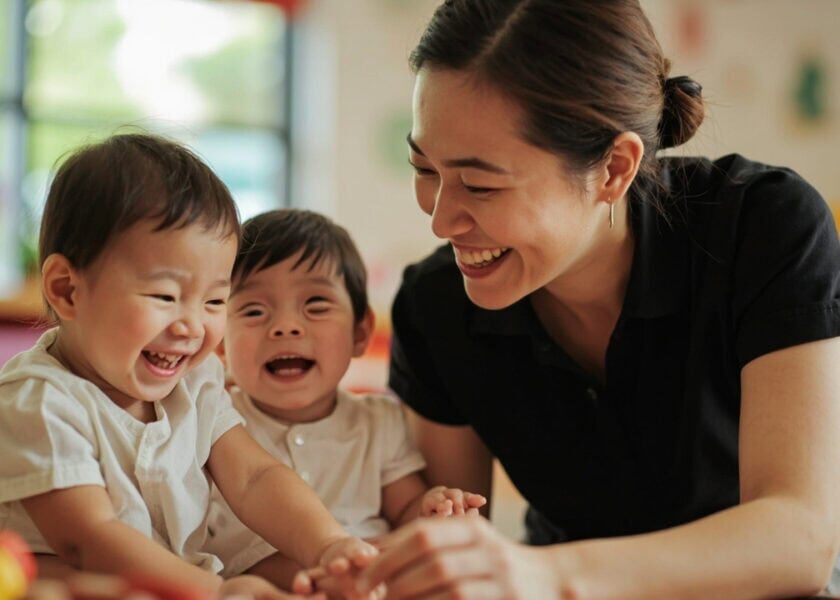
There is also a number that matters more than most parents realise: up to three infants for every caregiver. When a caregiver can give genuine attention to three children instead of eight or ten, they notice the moment a child’s brow furrows, the moment a small hand reaches out and then pulls back.
They notice, and they respond. And in that noticing, a child learns something profound: I am known here. I am not just being watched.
How Children Learn and Grow in These Hours
Children process. They process the morning drop-off, the separation from you, the fact that the world contains people and places beyond the ones they know best — and that this is survivable, and even good.
The first few days, sometimes the first few weeks, a child may cry at drop-off. This is not a sign that childcare has failed. This is a sign that a child has a healthy attachment, that your child knows the difference between loved and not loved.
What happens next — what happens in the hours after you leave — is where the real learning takes place. A skilled caregiver does not rush a child out of their distress. They sit with it, holding it with quiet steadiness, until a child begins to trust the pattern: my parent leaves, something happens that is not terrible, my parent returns.
Children learn that the world has a shape. They are held even when they cannot see the people they love most.
Between the work of emotional processing and the moments of caregiver attention, there is another world — the world of peers. Even infants notice each other. They reach across blankets. They watch another baby’s face. They respond to a cry that is not their own with a tilt of the head, a softening of their own features.
In quality care, these early peer encounters are witnessed and gently supported. A caregiver might narrate what they see — “Ah, you noticed Hana” — giving language to an experience a child is having. They might step back when a moment of peer engagement is happening and trust that children can manage small social encounters with just the right amount of scaffolding.
These are the earliest lessons in what it means to be with others. They accumulate, over months and years, into the social fluency that will serve a child throughout their life.
And there is something else worth saying: your child is becoming more themselves. Not less.
You may have worried that time in childcare would diminish your child’s sense of self. The opposite is true. In an environment where a child’s inner world is noticed and responded to, where their individual rhythms and preferences and curiosities are seen as useful data — a child flourishes.
The child who loves to sort things finds objects to sort. The child who asks a thousand questions finds adults who answer. The child who is shy finds a quiet corner that is valued as part of the group ecology. Quality care does not impose a template. It holds space for the child who is already there, already becoming.
Supervision vs Being Known
Here is the difference that matters most: a child can be supervised, or a child can be known.
Supervision means the basics are covered — the child is fed, changed, does not come to harm.
Being known means a caregiver notices that your child’s left hand keeps returning to a small stuffed animal, signalling tiredness, and gently adjusts the afternoon routine. Being known means a caregiver can tell you at pickup that your child spent twenty minutes building a tower and knocking it down, and that each time it fell, they laughed instead of getting frustrated.
Being known means your child has a day that is visible, even to you, even across the distance of the hours you were apart.
For parents, this distinction matters in a different way too. Trust is not a given when you are leaving your child with someone you have only just met. Quality childcare providers understand this, which is why communication tools and transparency practices matter — not as surveillance, but as trust-building measures. They say: we know you need to believe what we say about what happens here, and so we give you windows. We give you evidence.
When a caregiver returns day after day, when they learn a child’s favourite song, when they carry all of this forward from week to week — that is when trust becomes possible. That is when you can walk away at drop-off and feel something other than anxiety.
What This Looks Like for Families in Singapore
The philosophy is one thing, but the logistics are another. For this to be real for your family, it has to be workable.
EduNanny, operating through the ECDA Childminding Pilot, offers pathways designed to meet families where they are — whether home-based or community and centre-based. The pilot fee structures are designed to be accessible, and the Child Development Account and Baby Bonus provisions offer meaningful support for families navigating the costs of quality care.
Monday to Friday care blocks create the rhythm that children need to thrive. Predictability is not a bureaucratic preference — it is a developmental need.
EduNanny’s approach is built on the distinction between supervision and genuine knowing. Within the ECDA Childminding Pilot, caregivers are trained, consistent, and present in numbers that make genuine attention possible. The communication is ongoing — not a daily report that feels like a checkbox, but real transparency about what a child’s day contained, what they seemed to enjoy, who they were in those hours you could not see.
Will my child cry every day?
Some crying at the beginning is normal and healthy — it signals your child knows the difference between loved and not loved. In quality care, skilled caregivers sit with that distress and give children the time they need to learn that goodbyes end. Over days and weeks, most children settle.
Is my child just being babysat?
The difference between supervision and genuine knowing is real. Ask questions. Observe. Can a caregiver tell you something specific about your child’s day? Do they treat your child as a person with an inner world rather than a schedule to manage?
Will my child lose their attachment to me?
Quality childcare strengthens rather than replaces your attachment. Children with secure attachments are better able to form positive relationships with other caregivers — this is a sign of healthy development, not a threat to your bond.
How do I know what is actually happening during the day?
Ask about communication practices before you enrol. Look for transparency and specificity. Ask whether caregivers can tell you something about your child’s mood, their interactions, their small victories.
What to Look For and Ask
- Observe the sensory environment. Does the space feel warm? Do caregivers move at a pace that feels calm? Trust your body’s reading of the room.
- Ask about ratios. How many infants per caregiver? Lower ratios mean more genuine attention.
- Ask about consistency. Will your child have the same caregiver over time? Will the room and routine stay the same?
- Ask how they handle separation. Look for patience, steadiness, and the willingness to sit with difficult emotions.
- Ask about communication. What will you know about your child’s day? Look for specificity, not just checklists.
- Notice how your instincts respond. After a visit, pay attention to how you feel. Your instincts are data too.
Returning to You
Now, let me return to you — the parent standing at the threshold, the parent walking away, the parent who is trying to live a full life and love a small person at the same time.
What you are doing when you choose quality childcare is not an abandonment of your role. It is an expansion of it.
You are saying: there is more to my child’s world than me, and that is good. There are other hands that can hold my child well. There are other eyes that can see my child clearly. There are other places where my child’s inner world can be tended while I tend to the other parts of my life.
This is not a compromise. This is wisdom.
EduNanny exists because children deserve to be known. Because parents deserve to know what happens in the hours they cannot see. Because quality childminding is not a stopgap — it is a genuine developmental environment where children grow, and learn, and become more fully themselves.
And when you walk away at drop-off, and the ache comes, and the question surfaces — what is actually happening in the hours I am not there — you can let that question soften.
Not because the ache disappears, but because you have made a choice that you can trust. You have chosen a place where your child is not just supervised but genuinely seen. Where every day, your child is becoming more themselves, not less.
The hours your child lives while you are not there are not empty. They are full — full of small discoveries, quiet processing, peer connections, caregiver attention, sensory experiences that shape calm and curiosity. They are full of your child, growing. And when they come home at the end of the day, they bring all of that with them — a little more themselves, a little more ready for the world.
If you are ready to explore what quality childminding can look like for your family, EduNanny welcomes the conversation.
EduNanny is a Singapore-based childminding and childcare service operating through the ECDA Childminding Pilot. Learn more about our approach and programme or read about who we are.