The First Three Years: What Brain Science Tells Singapore Parents About Quality Childcare
What Neuroscience Reveals About Your Child’s Early Years
In the first three years of life, a child’s brain forms approximately one million new neural connections every second. Every second. This is not metaphor. This is the measurable, observable rate at which your child is building the architecture that will later support reasoning, language, emotional regulation, and the capacity to form relationships.
By age three, this architecture is largely complete—not finished, never finished, but fundamentally structured. What happens inside those three years matters in ways that cannot be fully repaired later. The brain is extraordinarily plastic, and that plasticity is concentrated in the early years with an intensity that never recurs.
When a young child enters a childcare environment, her brain is not simply waiting to be entertained. It is actively seeking patterns, building predictions, forming associations, learning what to expect from the world and from other people. Every interaction becomes a data point her brain incorporates into its emerging structure:
- Every time a caregiver notices her distress and responds with calm attunement
- Every time a peer takes a toy and she must navigate the felt sense of frustration
- Every time a story is read with attention to her wonder rather than to the clock
The quality of those interactions is not incidental. It is constitutive. It is building the child.
When a child enters Primary One able to sit with curiosity in a room full of other children, able to wait when she must, able to ask questions when she does not understand, able to feel safe enough to try and fail and try again—that child is not displaying innate talent. She is displaying the accumulated result of three years of developmental environment. She is showing you what her childcare experience taught her about herself and about learning.
Supervision vs. Intentional Developmental Environment
There is a distinction that matters enormously, and it is one that most parents are never taught to look for: the difference between supervision and intentional developmental environment.
Supervision means a child is kept safe, kept fed, kept clean, kept from harm. This is the floor. It is necessary. It is not sufficient.
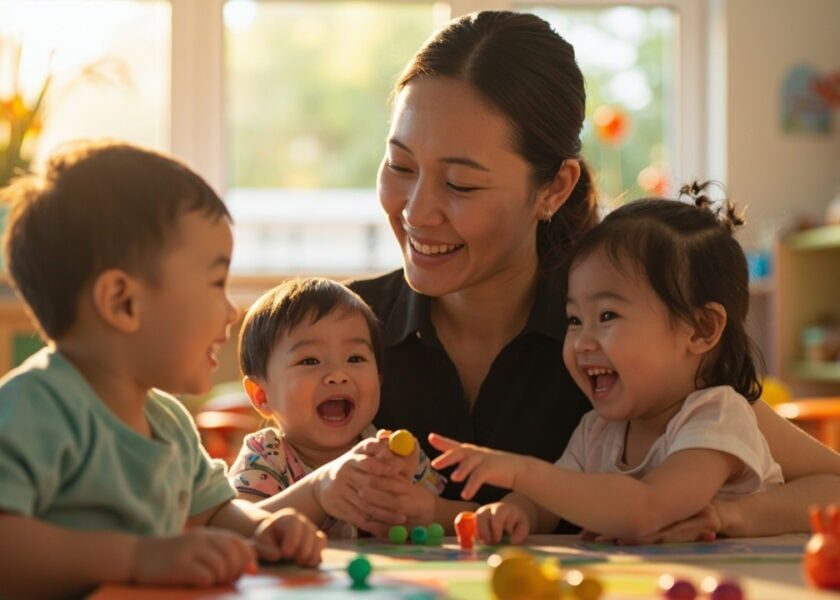
An intentional developmental environment means that the adults in the space understand what young children need for their brains to grow well, and they design the rhythms, interactions, materials, and responses of the day around that understanding.
It means the afternoon block is not just time to fill before pickup, but a carefully considered window for the kind of play that builds executive function—the capacity to plan, to inhibit impulses, to shift flexibly between tasks.
It means a tantrum is not an inconvenience to be managed but a data point to be understood, an opportunity to teach emotional vocabulary and co-regulation before the window for that teaching closes.
It means getting down on the floor and entering the child’s world rather than directing it from above. It means rich, responsive communication that expands the child’s thinking—not baby talk that underestimates her capacity.
You will feel this intentionality in the pace of the day, which respects the toddler’s need for both stimulation and restoration, for both exploration and the comfort of predictable routines that allow her to build internal security.
This is what separates a childcare that watches from a childcare that nurtures growth. The difference is not always visible on a tour. It is not captured in a brochure. But it becomes visible over months—in the child who emerges from it.
What Quality Care Looks Like: Observable Signs at Home
Quality childcare reveals itself in your child, over time, in ways that are recognizable if you know what to look for.
How Your Child Plays
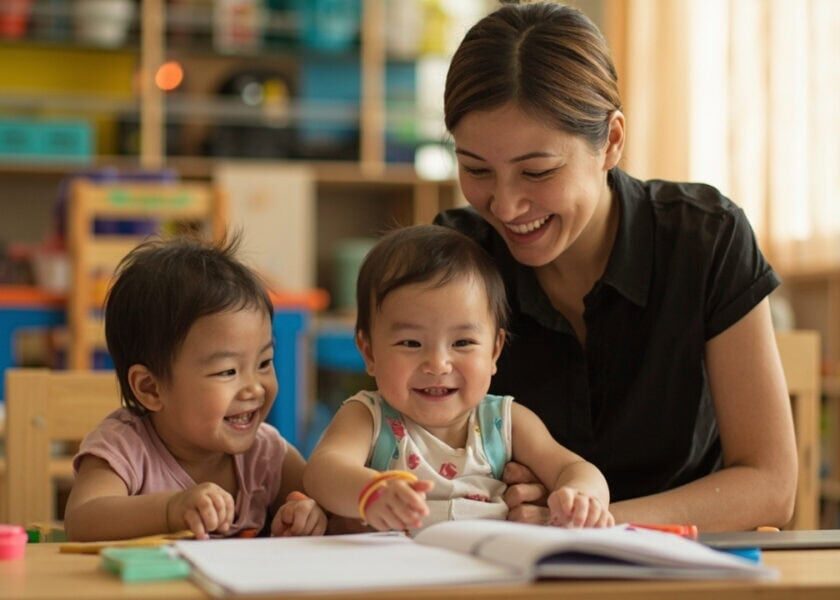
At eighteen months, play is the primary work of the brain. Through play, children experiment with cause and effect, practice social scripts, build symbolic thinking, and process the overwhelming experiences of being a small person in a large world.
When play is rich—when it is supported by a caregiver who understands its importance, who provides open-ended materials and protects the child’s focus—you will notice the play becoming more complex. It begins to hold narrative, to involve others, to extend across time.
Your two-year-old starts to create worlds within her play that you can see are teaching her something about how things work, how people relate, how stories have structure. This is not coincidence. This is brain building.
How Your Child Speaks About Her Day
A child in a quality environment will often come home with language that surprises you—not just new words, but new ways of expressing experience, new emotional vocabulary, new descriptions of what she felt and thought and wondered about.
She may tell you about a friend. She may narrate an activity with a coherence that reflects her growing capacity to sequence and make meaning. She may ask questions that reveal she has been paying attention to things you would not have thought a toddler could notice.
This language explosion is fed by the quality of conversational exchange she experiences in her childcare hours—adults who listen carefully, who expand her utterances, who introduce new words in context.
How Your Child Handles Frustration
This is one of the most telling markers. Young children face frustration many times a day—it is simply the nature of being small in a world designed for adults.
In a supervision-only environment, frustration is often managed by distraction or by the child’s gradual habituation to unmet needs.
In an intentional developmental environment, frustration is a teaching moment. A well-trained caregiver will stay close, will name the feeling, will help the child feel it without being overwhelmed by it, and will scaffold the child toward her own coping strategies.
Over months, you will notice your child’s frustration tolerance increasing. She will still cry—she is young—but she will recover more quickly. She will begin to show you that she is learning what to do with big feelings.
This is emotional regulation in its earliest, most foundational form. It is building the capacity that will later allow her to sit through a difficult maths problem without quitting, to navigate a friendship conflict without withdrawing entirely, to manage the inevitable disappointments of growing up.
Whether Curiosity Remains Intact
A child whose developmental environment has been good will show you a spark—not performative enthusiasm that adults find adorable, but a genuine, persistent, exploratory orientation toward the world.
She will point at things and ask what they are. She will experiment with objects, testing their properties. She will return again and again to activities that intrigue her, building concentration through repeated engagement.
When you see this curiosity intact in your three-year-old, you are seeing evidence that her childcare environment protected and nurtured the thing that makes humans capable of learning anything at all.
The Invisible Foundation: Why Attachment Security Changes Everything
These observable markers point to something deeper: researchers call it attachment security, and parents recognize it in a simpler way as the felt sense of whether their child believes the world to be a trustworthy place.
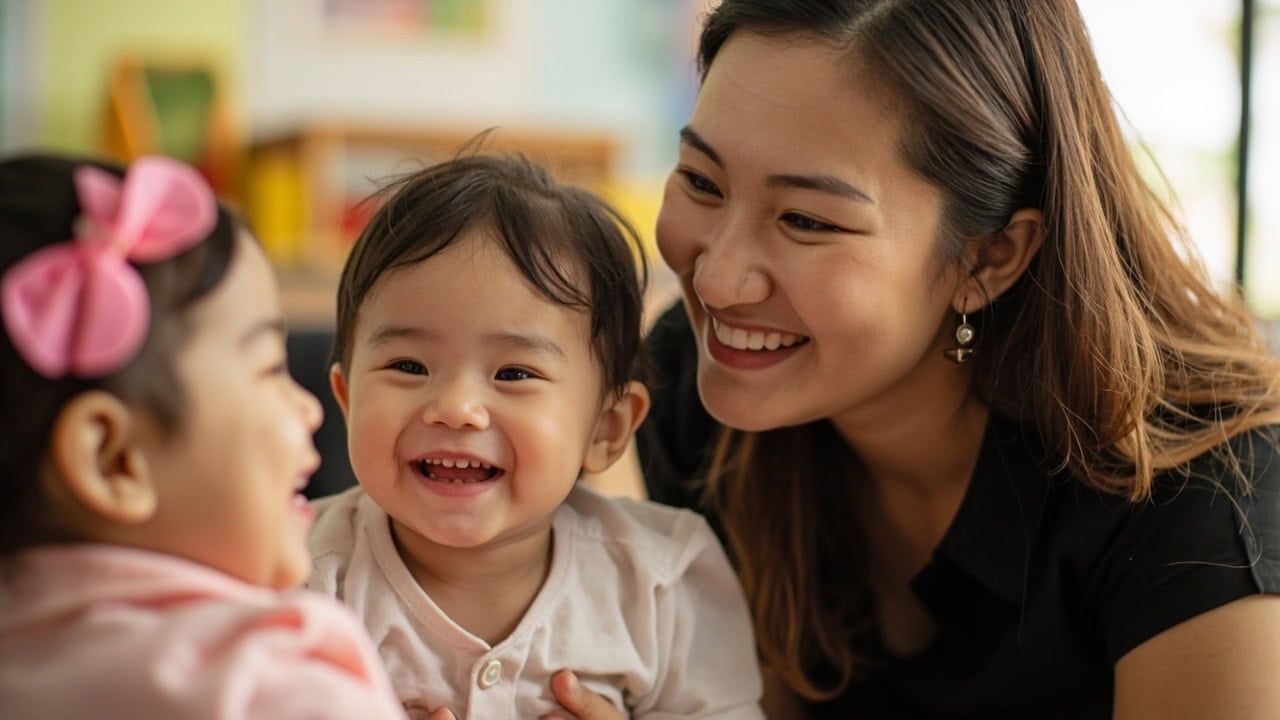
When a young child forms a secure attachment with a consistent, responsive caregiver—one who is present enough, attuned enough, and warm enough to become a genuine relational anchor—she builds something inside herself that goes far beyond comfort in the immediate moment.
She builds a model of what relationships are like, what she can expect from others, what she deserves. She builds the internal security that allows her to venture away and explore, knowing that the connection remains. This is the emotional foundation for later independence.
This is why caregiver-to-infant ratios matter so profoundly. In an environment where one caregiver is responsible for six or eight infants, the basic attentiveness required for secure attachment formation is simply not possible.
The child may be safe. She may be fed. She may develop in roughly typical ways. But the quality of attunement—the moment-to-moment reading of the child’s signals and the responsive meeting of her needs—requires time, attention, and consistency.
When ratios of one caregiver to three infants are maintained, this becomes possible. It makes possible the kind of presence that allows a caregiver to notice:
- Not just when a child is crying, but when she is about to cry
- When her play is becoming frustrated
- When she is seeking connection but does not yet know how to ask
It makes possible the slow building of a relationship that your child will carry inside her as she grows.
The Real Pressures Singapore Parents Face
Let us be honest about something that parents in Singapore understand in their bones: you are doing this under pressure.
- The pressure of work demands that do not bend easily for the realities of parenting
- The pressure of Singapore’s high-cost environment, which makes full-time parental presence a luxury that feels out of reach for many families
- The pressure of cultural expectations that can make you feel both needed at work and guilty for being away from your child
- The pressure of wanting to give your child everything but being one person, working within real constraints
These pressures are real, and they are not your fault. They are the conditions under which modern parenting happens in Singapore, and they deserve honest acknowledgment rather than platitudes.
What your child needs, in the face of these realities, is not a perfect parent who is always present. What your child needs is an environment that understands what she is going through—being young, being in a group, being away from her primary attachment figure for significant hours—and that responds to her needs with wisdom, warmth, and developmental intentionality.
This is where the choice you make matters most. Not in the abstract sense of optimizing for some theoretical best outcome, but in the immediate, practical sense of whether your child’s daily experience during these critical years is building her up or merely keeping her occupied.
EduNanny Singapore: Built Around What Children Actually Need
EduNanny Singapore was built around this understanding. It began as a recognition that the existing options for parents in Singapore—between centre-based childcare with high ratios and informal arrangements with variable quality—left a gap that serious, loving parents should not be expected to bridge on their own.
Operating under the ECDA Childminding Pilot, EduNanny was designed to offer something specific: infant and toddler care that takes developmental science seriously, that maintains the ratios necessary for genuine attunement, and that treats every hour of every day as an opportunity to build the child rather than simply to mind her.
This is not a marketing claim. It is a structural commitment.
What That Commitment Looks Like in Practice
One-to-three ratios in infant care are not a luxury but a developmental necessity, based on research on attachment formation and early brain development. These ratios make possible the kind of presence that builds genuine security.
Caregiver training goes beyond safety protocols. Caregivers understand child development principles—what is happening in a one-year-old’s brain when she throws food off the highchair tray repeatedly, what is happening in a two-year-old’s brain when she refuses to share, what is happening in a three-year-old’s brain when she is building a tower and it falls and she looks to see how adults will respond.
These are not accidents or inconveniences. They are the raw material of development, and the quality of the adult response determines what your child learns from them.
Accessible fees within the pilot structure matter. Quality early care should not be available only to families with significant financial resources. Families can use the Child Development Account and Baby Bonus schemes to reduce the financial weight of quality care.
Transparent communication is built into the approach. Where CCTV measures are deployed, they are available to parents not as surveillance of caregivers but as a window—a way of seeing, when you cannot be there yourself, what your child’s day looks like. Updates and descriptions of your child’s day are genuine glimpses of the specific, individual experiences she is having, not standardized templates.
Your Child Is Becoming Someone
The years before your child turns three are not a rehearsal. They are the original.
Every day that passes is a day that cannot be recovered. Your child’s brain continues to build during the hours you are apart. The emotional patterns continue to form. Every hour is an hour that matters.
Ask any parent whose child has spent a year in a quality environment what they notice, and they will tell you something that sounds almost like magic but is not magic at all. Their child is different—not superficially different, not just better behaved, but fundamentally different in the way she moves through the world: in her curiosity, in her confidence, in her capacity to be with others, in her willingness to try new things.
The change was so gradual they almost did not see it. And then one day they looked at their child and realized that she had become someone remarkable, and that the hours they had entrusted to her caregivers had been part of making her that way.
EduNanny Singapore exists to do this work alongside you—not as a replacement for your love and your role as parent, but as a partner who understands that your child’s development does not pause when she is away from you.
We believe that childminding is not a lesser alternative to parental care. It is a legitimate, necessary, and valuable form of early childhood environment—one that can be done with the same quality of intention and attentiveness that any loving parent would want for their child.
We believe that the caregivers who do this work deserve recognition and support, because they are not babysitters filling time. They are early childhood educators in the most literal and important sense. They are shaping the children who will grow up to be Singapore’s next generation of thinkers, creators, parents, and citizens.
If you are a parent in Singapore navigating this choice—if you are carrying the weight of wanting to do right by your child while working within real constraints—know that you are not alone in this.
Know that the research on child development is not an abstraction but a guide, and that there are people who have organized their lives around applying it with care and consistency.
Know that the question you are really asking is the right question: what does my child need to grow, and where can she find it?
The answer is not always simple. But it is findable. And it begins with understanding that your child’s potential is not being wasted while you are apart from her. It is being shaped—by you, by her caregivers, by the quality of the environment you choose together.
EduNanny Singapore offers infant and toddler care through the ECDA Childminding Pilot, with the ratios, training, and developmental intentionality that your child deserves. Speak with our team to learn more about what quality care looks like for your family.