What Quality Childcare Looks Like When You Trust Your Senses
The Physical Environment: What the Space Teaches First
When you enter a well-designed infant environment, the physical space is not neutral. Every element has been considered.
The materials are safe and natural—wood, fabric, natural fibres—chosen not for aesthetics alone but because young children learn through taste, touch, and texture. These are intentional choices that communicate: this environment was designed for your child’s learning.
The lighting is warm and diffused, not the flat fluorescence of a utility space. This is not an aesthetic preference. Infants are still developing their visual systems, and the quality of light affects their regulation, their comfort, their ability to settle. A room that feels calm under artificial light is a room that has been considered.
The layout allows for movement. For crawling. For the purposeful, exhausting, developmental work that happens when a one-year-old walks deliberately toward a window to watch a bird. There are quiet corners and open floors. There are soft places to land and interesting surfaces to reach.
The room is not simply clean. It is structured for safety, yes. But it is also structured for exploration. This is the first lesson quality childcare teaches—silently, continuously, before any lesson plan is opened.
The Relational Environment: Listening to What You Hear
The physical environment is only one dimension. The second, and perhaps more important, is the relational environment.
Walk into any childcare room and listen. Not to the director’s introduction. Listen to the voices in the room.
How do the caregivers speak to the children? Not in general, not on best-behavior tour day, but in the ordinary moments. When a toddler drops a spoon. When a baby reaches for a toy just out of grasp. When two children reach for the same block.
The tone of a caregiver’s voice in these moments is one of the most honest quality signals you will ever encounter. Is it warm? Is it patient? Does it communicate genuine interest in the child’s experience, or does it carry the subtle edge of impatience, of management, of moving through a task list?
This is not about perfection. No caregiver is warm in every moment. But the baseline tone, the default register, the quality of attention that a caregiver brings to ordinary interactions—that tells you something essential about the relational environment your child will inhabit for eight, ten, sometimes twelve hours of their day.
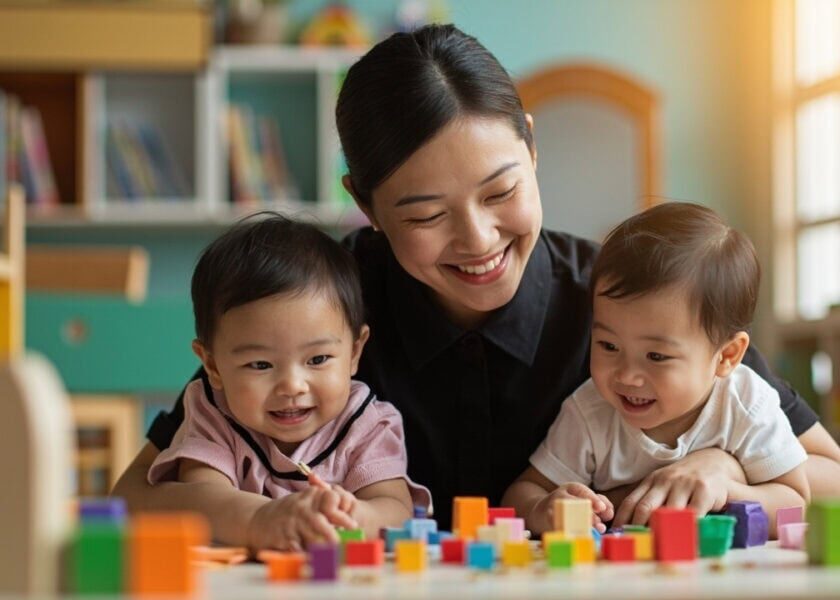
Watch how children respond to their caregivers. Not to you, the visitor. To their caregivers. Do they approach with ease? Do they make eye contact comfortably? Do they seek a caregiver’s lap as a place of comfort? These are not trained behaviors. They are the organic expressions of felt safety.
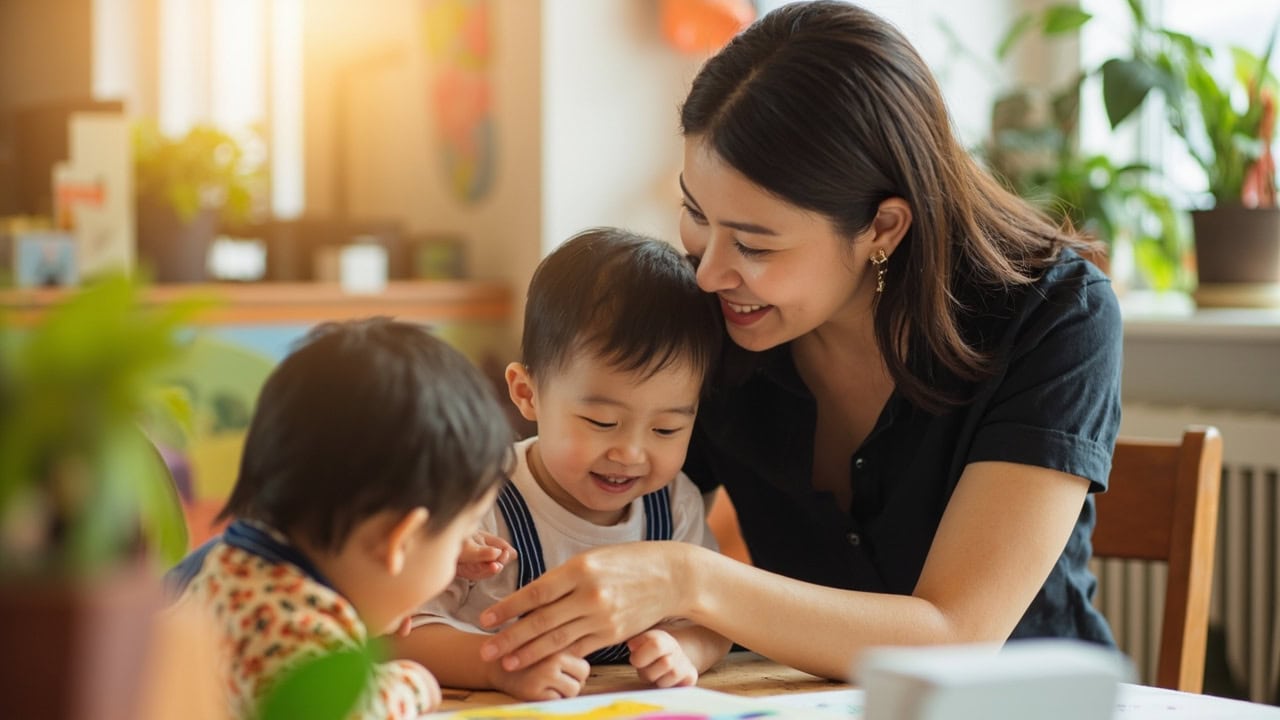
When you visit, notice whether you see caregivers talking to children about what they are doing—not just directing, not just managing, but narrating, describing, engaging with genuine interest.
“You found the blue one. You like how it feels, don’t you? It’s smooth.”
This is not small talk. This is the highest form of early childhood care: the caregiver who treats the child’s internal world as worthy of real attention.
The Daily Rhythm: Why Structure Supports Development
Every quality childcare environment has a daily rhythm, and this rhythm is not arbitrary. It is an intentional structure that communicates safety, predictability, and developmental respect.
Children, especially infants and toddlers, are not simply entertained by routine. They are developed by it. When a child knows that the morning greeting comes first, then free play, then snack, then outdoor time, then rest, the world becomes legible. Predictable. Safe.
The rhythm of the day is a scaffold for trust. It says: in this environment, things happen in a way that you can understand. You will not be surprised by chaos. You will not be left without direction. The day has a shape, and you will learn to move through it with growing confidence.
This is why quality childcare environments are never rigid, but they are never formless either. There is a gentle architecture to the hours. A sense that the day was designed with the child’s developmental needs in mind, not merely the adult’s convenience.
When you visit a centre, notice this. Is there a discernible rhythm, or does the day feel like a series of disconnected activities? Are transitions handled with care, or are they abrupt, rushed, marked by the sound of bells or timers rather than human guidance? The quality of transitions is, in many ways, the quality of the environment in miniature.
What Children Tell You: The Most Honest Evidence
Here is a truth that no brochure can convey and no director can perform away: children are the most honest evidence of a childcare environment’s quality.
Walk into a room and watch. Not the activities. Not the materials. Watch the children.
Are they relaxed? Not listless, not apathetic, but genuinely relaxed. Their bodies are soft. Their movements are purposeful. They are not performing for adults. They are simply present.
Are they engaged? Not busy, not contained, but genuinely engaged. When a child is absorbed in an activity—the cardboard box, the wooden spoon, the play dough, the sand tray—their engagement is visible. Their attention is whole. They are in a state of flow, the precursor to all deep learning.
Are they safe? This is the question beneath all others. Does a child in this environment look safe? Not just physically supervised, but emotionally secure? Do they explore with confidence? Do they seek connection without anxiety? Do they rest without distress?
You can learn more about a centre in ten minutes of watching children than in an hour of talking to its director. Because children do not perform. Children do not mask. Children reflect the environment that holds them with absolute, unvarnished honesty.
| Signal | What It May Indicate |
|---|---|
| Children approach caregivers with ease | Secure attachment; consistent, warm caregiving |
| Bodies are soft, movements purposeful | Emotional regulation; felt safety |
| Sustained attention in self-directed play | Environment supports engagement and curiosity |
| Children seek comfort when distressed | Trust in caregivers; relational safety |
| Exploration without anxiety | Environment is not overwhelming; confidence is supported |
Reading the Room: A Framework for Your Visit
Here are key distinctions that may help you interpret what you observe during a visit.
Safety goes beyond supervision. It is an environment where children feel comfortable expressing distress, where a caregiver responds to a fall not just with first aid but with comfort, where a child who is scared can find a safe harbour without being told to “tough it out.”
Warmth goes beyond friendliness. A friendly environment is pleasant. A warm environment is sustaining. Warmth is the quality of connection that persists through a long day, that does not fluctuate with the caregiver’s mood or the traffic outside.
Engagement goes beyond entertainment. An entertaining environment keeps children busy. An engaging environment absorbs children in meaningful activity. Notice whether children’s attention is self-directed, whether they are following their own curiosity, or being led from one adult-directed activity to the next.
Intentionality goes beyond decoration. Every element has been considered: the materials, the scale, the arrangement, the openness or enclosure of different zones. When you see a childcare room that looks intentional, you are looking at evidence of professional knowledge. You are looking at a space that was designed with the child in mind, not simply arranged for the adult’s convenience.
When you visit a childcare centre, you do not need a checklist. You need your senses, and you need permission to trust what they tell you.
Begin before you enter. Walk through the entrance and notice how the space feels. Is it welcoming? Lived-in? Child-scaled? Or does it feel institutional, sterile, designed for inspection rather than habitation?
Pause when you enter. Before the tour guide begins, before the introduction, take thirty seconds to simply observe. What do you hear? What do you see? How do the children in the room occupy their bodies? How do the caregivers move among them?
Ask yourself: If I had to leave my child here today, without speaking to anyone, would I feel at ease leaving them at this centre?
Engage thoughtfully. Speak to the caregivers, not about the curriculum, but about the children. Ask questions that invite them to talk about what they observe, what they notice, what they find meaningful in their work. The answers will tell you whether they see children as individuals or as a category.
Ask to observe a transition. Not the best-behavior transition, but an ordinary one. The move from indoor to outdoor, or from activity to snack. Transitions reveal the quality of the environment like almost nothing else, because they are the moments when structure is tested, when children’s emotions are most present, and when caregiver skill is most visible.
Sit with your memory. When you leave, before you read another review or visit another centre, sit with your memory of the room. Not your impression of the director’s presentation, but your memory of the room itself. The sounds. The light. The children’s faces. The caregivers’ hands. This is what you sensed. This is real. And now, you have the language to trust it.
Why the Environment Matters More Than You Might Think
Many Singapore parents carry a quiet guilt about placing their children in childcare. As if the act of working, of needing support, of asking for help, is somehow a deficit to be defended rather than a normal, human choice to be honored.
This guilt is understandable, and it is also, I believe, unfounded.
Research tells us that warm, responsive caregiving in the first years promotes healthy attachment, supports language development, builds executive function, and creates the neural pathways for emotional regulation that will serve a child throughout their life. The quality of the early environment shapes outcomes not just in the short term, but in the long term. For school readiness. For social competence. For the ability to regulate one’s own emotions and persist through difficulty.
The early years are not a warm-up for life. They are life, in their most formative and significant form. The sensory and relational environment that a child inhabits during these years leaves lasting imprints on the architecture of the brain.
This is why the choice matters. Not because parents are failing if they choose poorly, but because children deserve environments that honor their developmental needs, and parents deserve to find those environments with confidence.
A warm, intentional, well-designed childcare environment is not a compromise. For many children, it is the gift of consistent, knowledgeable, attentive caregiving at a stage when the brain is developing faster than it ever will again.
EduNanny: An Environment That Speaks for Itself
EduNanny participates in the ECDA Childminding Pilot, part of Singapore’s commitment to developing quality, accessible childminding options for families across the island. We believe that quality childminding is not merely a service for parents who need it. It is a recognition of the developmental significance of the early years, and a commitment to honoring that significance with professionalism, care, and intentionality.
Our approach begins with the environment. Not as an afterthought, not as a feature to be marketed, but as the foundation of everything we do. We have designed our spaces—home-based and centre-based—to be safe, warm, and developmentally purposeful.
We have trained our caregivers not only in safety protocols, but in the art of responsive caregiving: the ability to read a child’s signals, to respond with warmth, to engage with genuine interest in what each child is discovering about the world.
We keep our ratios small—up to one caregiver for every three infants in our infant programme. This is not simply a safety measure. It is a commitment to capacity: the capacity for genuine relationship, for individualized attention, for knowing each child deeply enough to respond to their unique rhythms and needs.
Our care blocks run Monday through Friday, designed to meet the realities of working families in Singapore. Our fees within the pilot structure are structured to be accessible, and families can utilize Baby Bonus and CDA funds to manage the practical side of this important decision.
We communicate with transparency. Where CCTV is deployed, parents have visibility into their child’s day. Where direct communication is practiced, caregivers share observations, milestones, and the small, ordinary moments that matter.
This is what we have built. Not a childcare service that happens to care, but a care environment that was designed with intention, with knowledge, and with genuine respect for the children it holds.
Ready to Visit?
If you are searching for a childcare environment that speaks clearly through its space, its people, and its rhythm, we invite you to experience EduNanny firsthand.
Come with your senses open. Trust what you feel. Walk through the door and notice: the quality of the light, the sounds, the children’s faces, the caregivers’ hands. Ask yourself the question that matters most.
If I had to leave my child here today, without speaking to anyone, would I feel at ease?
We believe the room will say what words cannot.
EduNanny Singapore
ECDA Childminding Pilot Participant
#childcaresingapore #infantcare #childminding #singaporeparents #earlychildhoodeducation #EduNannySG #ECDAchildmindingpilot #qualitychildcare