What Trained Caregivers Do in the Hours You Do Not See
Quick Summary: What This Article Covers
- Why the ordinary hours matter more than most parents realize
- What separates a trained caregiver from a merely capable one
- How expert caregivers transform routine moments into developmental opportunities
- Why ratios and training are foundations, not buzzwords
- What quality childminding actually looks like in practice
- How to recognize genuine developmental engagement
- What to expect from care that honors your child’s potential
The Invisible Curriculum: Why Ordinary Hours Matter Most
There is a question that most parents never voice aloud, but that lives quietly in the background of every morning goodbye. It surfaces in the brief pause at the gate, in the moment after you hand your child over and turn to leave.
It is not about safety. You have already done that work. You have asked the questions, visited the spaces, checked the ratios, and made the decision you believe is right.
The question is something else. It is simpler and, in its own way, far more profound:
What is actually happening in the hours when I am not there?
What is happening when your child is not performing something observable, when there is no milestone to mark, when the day is simply made up of the ordinary moments—the waking, the feeding, the diaper change, the long stretch of play that looks, from the outside, like nothing much at all?
This is the question that stays with parents who have already chosen well. And it is the question that reveals something important about what we are really looking for when we search for quality childcare—not just a safe place, not just a capable pair of hands, but something deeper.
We live in a city that understands the value of preparation. Singapore parents plan, research, and choose carefully. You want evidence. You want to know what you are buying into.
But here is the challenge with infant care: the most important work often cannot be seen in the moment. It does not always announce itself with visible milestones or dramatic breakthroughs.
It happens in the way a caregiver adjusts a high chair when a baby begins to lean forward, noticing the shift in balance before the child topples. It happens in the pause a trained caregiver takes before responding to a toddler’s frustrated shriek—not out of uncertainty, but out of deliberate choice about what that moment needs. It happens in the way language is woven into a diaper change, turning a routine task into a back-and-forth of sounds and smiles that the child will not remember consciously but will carry forward into the architecture of their growing mind.
This is the invisible curriculum. And it is the difference that matters.
Capable Supervision vs. Trained Caregiving
A capable supervisor can keep a child safe. They can follow schedules, prepare meals, clean surfaces, and ensure that no harm comes to the little ones in their care. This is not nothing. Reliable supervision is the foundation, and no one should undervalue it.
But capable supervision is reactive. It responds to what is happening. It manages the present moment without a deeper framework for shaping what that moment becomes.
A trained caregiver thinks differently. They carry an intentional framework into every interaction, even the ones that seem too small to matter.
The Scaffolding That Shapes Development
There is a concept in child development known as scaffolding—the idea that a skilled adult provides just enough support to help a child reach slightly beyond what they could manage alone, then gently withdraws as the child gains competence.
A trained caregiver scaffolds constantly, intuitively, throughout the day:
- They offer the word when a child reaches for something beyond their vocabulary
- They extend a narrative when a child points at a picture
- They create a small challenge—stacking one more block than last week, using a word that is almost within reach—that stretches development forward without causing the frustration that shuts learning down
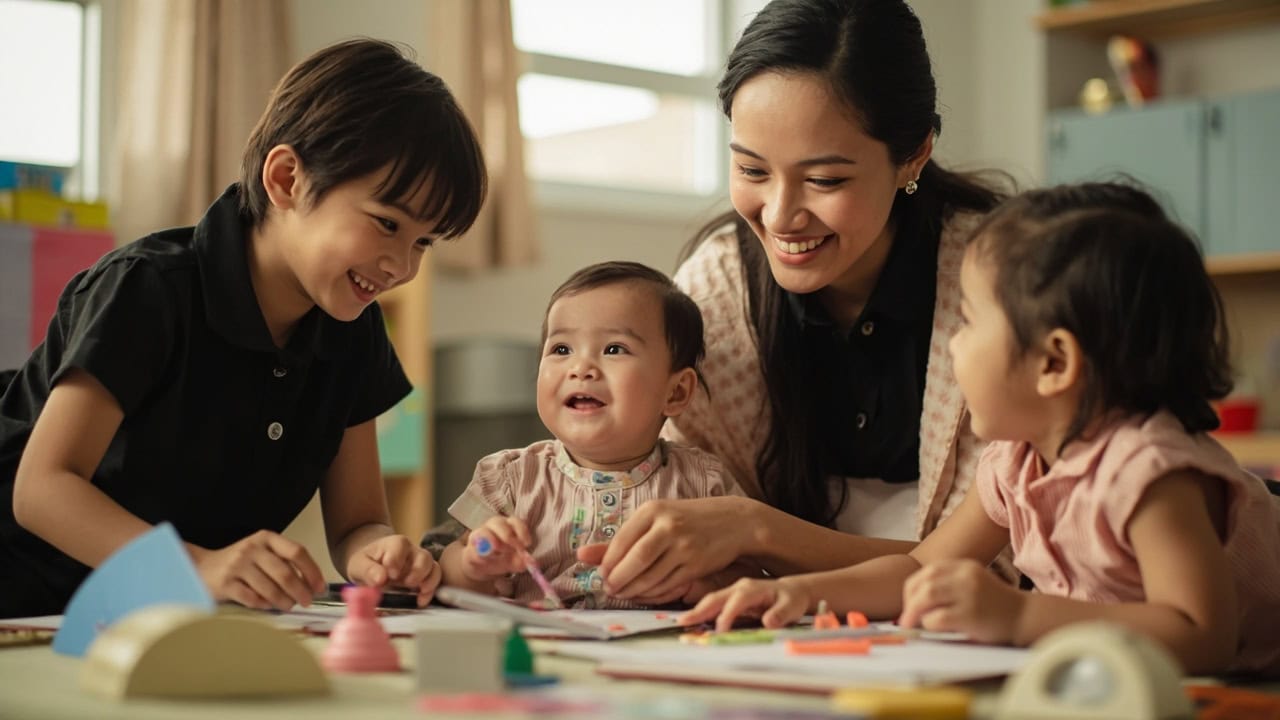
Consider a diaper change. When a trained caregiver changes a diaper, they are not merely cleaning a child and moving on. They are reading the baby’s facial expressions, narrating the process in a way that builds language comprehension, using the intimate physical closeness to strengthen the bond of trust, and creating a sense of security that allows the child to feel safe enough to explore.
Or consider mealtime. When a trained caregiver sits with a toddler during a meal, they are noticing which hand the child favors and tracking fine motor development. They are reading signs of frustration before they escalate. They are making a deliberate choice about whether to step in with help or allow one more moment of determined struggle that builds confidence.
This is the work that happens in the hours that look like nothing. And it happens not because trained caregivers are somehow better people, but because they have been equipped with a way of seeing.
Why Ratios and Training Are Foundations, Not Buzzwords
This is why the ratio matters so profoundly. When a caregiver is responsible for three infants instead of six, or eight, or more, the scaffolding can actually happen.
There is time to notice. There is attention available for the small but significant moments.
A caregiver with fewer children can catch the first signs of a developmental leap before it passes unobserved. They can linger with a child who needs more time to master a skill. They can respond to a cry not with efficiency but with attunement. They can notice the subtle shift in mood that precedes a meltdown. They can celebrate the small victory that would otherwise go unacknowledged.
In the earliest months and years, every interaction is a building block. The conditions that allow caregivers to be truly present are not luxuries—they are necessities for quality to emerge.
Generic supervision cannot do this. It lacks the framework, the training, the observation skills, and the intentionality that scaffolding requires. It may not be harmful—it may simply be neutral.
But neutrality, over a thousand ordinary hours, is not nothing. It is a missed opportunity that compounds quietly, invisibly, until the gaps become visible in a child’s confidence, language, or ability to manage their own emotions.
What Quality Childminding Actually Looks Like
Parents often ask what they should actually look for when trying to understand whether their child is receiving this kind of care. How do you see quality when you are not there to see it?
The answer begins with interaction.
Watch not the environment—the toys, the furniture, the artwork on the walls—though these matter. Watch the interactions.
Signs of Quality in Caregiver Interaction
- Language richness: Notice whether your child is met with words when they reach for something, or whether their reach is simply acknowledged with a hand. Notice whether the caregiver narrates what is happening or whether silence fills the room during routine tasks.
- Transition handling: Notice whether changes are handled with language—a warning before a change, a name for what is coming—or whether they happen abruptly, without the verbal scaffolding that helps children understand and navigate their world.
- Responsiveness: Watch how caregivers respond to children’s cues. Do they notice the early signs of distress and intervene before crying escalates? Do they acknowledge a child’s efforts with specific, genuine praise rather than generic approval?
- Engagement quality: Notice whether your child seems genuinely engaged or merely supervised. Quality care is not about constant entertainment—it is about responsive, attuned interaction that meets the child where they are.
The Return Test: Reading Your Child
Notice, too, the quality of your child’s engagement when you return. Ask yourself:
- Does my child seem calm, regulated, curious?
- Or do they seem overstimulated, disconnected, or somehow depleted?
- Is this the tiredness that signifies growth—or the fatigue of mere entertainment?
Children cannot tell us in words what their days have been like, but their bodies and behaviors speak. A child who returns from quality care is often tired in the way that signifies growth—not the tiredness of mere entertainment or passive watching, but the satisfying fatigue of a mind that has been engaged, challenged, and supported.
The First Thousand Days: Why Every Hour Counts
The first thousand days, as researchers have come to call them, are not merely a concept from a parenting book. They are a reality.
The brain connections formed in the earliest years, the emotional patterns established, the language foundations laid—these are not metaphors. They are the architecture of the person your child will become.
And this architecture is built not in dramatic lessons or special activities, but in the ordinary hours.
A child who has been spoken to extensively during their first year enters the world of language with an advantage that researchers can detect even before preschool. A child who has experienced responsive caregiving—someone noticing their distress and responding in predictable, calming ways—develops a sense of security that becomes the foundation for exploration and risk-taking. A child who has been allowed appropriate struggle, with just enough support to eventually succeed, builds resilience not as an abstract concept but as a lived experience of their own capability.
None of this happens in a single dramatic moment. It happens in the ordinary hours. It happens when no one is watching except the person who has been trained to watch.
- In the way a caregiver responds to a baby’s first uncertain steps across the room
- In the way a toddler’s emerging frustration at a puzzle is acknowledged and gently supported
- In the way a child’s name is spoken with genuine warmth so many times a day that the child begins to understand, at a cellular level, that they are seen, that they matter, that they belong
This is the work. This is what quality childminding makes possible.
The EduNanny Approach: Built Around Quality
At EduNanny, this understanding shapes everything we do. As part of the ECDA Childminding Pilot, we have structured our service around the belief that quality emerges from the conditions that allow it to exist.
Our home-based pathways and centre-based options are designed with ratios that give caregivers the space to think, observe, and engage—up to three infants per caregiver in our infant care settings, because we know that in the earliest months and years, every interaction is a building block.
This is not an accident of policy. It is a deliberate choice to honor the reality that expert caregivers need time to be expert. They need the conditions that allow them to bring their training fully to bear on the ordinary hours that make up a child’s day.
What This Means for Your Family
When you choose EduNanny, you are choosing:
- Caregivers trained to engage—not merely to supervise, but to bring intentional frameworks to every interaction
- Ratios structured to enable excellence—not just to meet standards, but to create the conditions where quality can emerge
- Communication designed for understanding—bridging the gap between what happens at home and what happens in our care
We know that parents carry questions. We know that the hours apart can feel uncertain even when trust exists.
This is why we have built systems that allow visibility—communication practices, documentation, and transparency measures that give parents windows into their child’s day without the intrusion of constant surveillance.
Because what we want is not to monitor our caregivers, but to share with parents the beauty of what trained engagement looks like, so that the question “what is happening when I am not there?” can be answered with richness and specificity rather than vague reassurance.
Common Questions Parents Ask
How do I know if my child is really developing?
You may not see dramatic milestones every day—and that is okay. Quality development often happens in small, quiet moments rather than visible breakthroughs. What you can watch for is the overall trajectory: Is your child growing in confidence? Is their language developing? Are they learning to manage frustration and regulate emotions? These are the marks of quality care working over time.
Isn’t all licensed childcare basically the same?
Licensing sets a floor, not a ceiling. It ensures safety and basic standards. But within those standards, there is enormous variation in how caregivers engage with children, how ratios affect attention, and how intentional frameworks translate into daily practice. Understanding what to look for helps you distinguish between adequate supervision and genuine developmental care.
How can I afford quality care?
Quality care should not be available only to those with unlimited resources. The ECDA Childminding Pilot offers fee structures designed to make this kind of care achievable for families across Singapore. CDA and Baby Bonus usability means that the financial pathways to quality are real and navigable.
What if I still feel uncertain?
That uncertainty is not a weakness—it is exactly what good parents feel. The question you carry is a sign that you understand how much is at stake in these early years. The difference is that now you have a framework for understanding what to look for. Trust that question, and use it as a guide when evaluating care options.
Recognizing Quality: Your Role as a Parent
There is something else worth naming here: the dignity of the work itself.
The caregivers who show up every day with intention, who bring frameworks and training and genuine care to diaper changes and mealtimes and the quiet moments between activities, are performing a kind of invisible labor that our society has not always recognized adequately.
They are not babysitters in the casual sense of the word. They are professionals who carry knowledge, who make hundreds of micro-decisions every hour, who hold the developmental trajectory of the children in their care as a real responsibility.
If you are a parent who has chosen quality care, we want to honor that choice by helping you understand what you have chosen. Not just the decision itself, but the daily reality of what is happening in those hours when you are not there to see it.
You deserve language to recognize quality when you encounter it. You deserve to trust that when your child is in the care of a trained, intentional caregiver, the ordinary moments of their day are doing the quiet, profound work of building a future.
Here is what to remember:
- The environment matters less than the interaction. A beautiful room full of toys means less than a caregiver who engages your child with language, attention, and attunement.
- Ordinary moments are developmental moments. Diaper changes, mealtimes, transitions—these are not interruptions to “real” learning. They are learning.
- Small differences compound. A caregiver who offers one more word, one more moment of patience, one more instance of attuned responsiveness is building something that will show up in your child’s confidence, language, and emotional regulation years from now.
- Your child’s behavior tells a story. Pay attention to how they seem when they return to you. Calm and curious suggests quality. Overstimulated and disconnected may suggest something different.
- You are right to ask questions. The fact that you want to understand what is happening in those ordinary hours is a sign of exactly the kind of thoughtful parenting that quality caregivers want to partner with.
What Is Actually Happening When You Are Not There
If you are considering what kind of care you want for your child, we want you to know that this is what is possible. This is what trained caregivers do. This is why the framework matters, why the ratios matter, why the training matters.
Not because your child will remember specific moments, but because the accumulated weight of those moments—the scaffolding, the attunement, the intentional engagement with the mundane—will become part of who they are.
You have already shown that you care enough to ask the question. Now you have a framework for understanding what the answer looks like.
If you are already part of the EduNanny community, we want to thank you for trusting us with the hours that matter most. We do not take that trust lightly.
Every morning that a child is handed to us is a responsibility we carry with full awareness of its weight. We know that behind every child in our care is a parent who asked the question we began with—who wondered, quietly, what is happening in the hours when I am not there.
This is what is happening:
Growth. Development. Attention. Intention.
The quiet, invisible curriculum of a trained caregiver who understands that every moment—even the smallest, even the most ordinary—is an opportunity to build.
If this approach resonates with you, we invite you to explore how EduNanny Singapore brings these principles to life. Speak with our team, and see for yourself what quality childminding looks like when ordinary hours are treated as what they truly are: opportunities.
The hours that look like nothing are everything. And we are honored to be part of them.