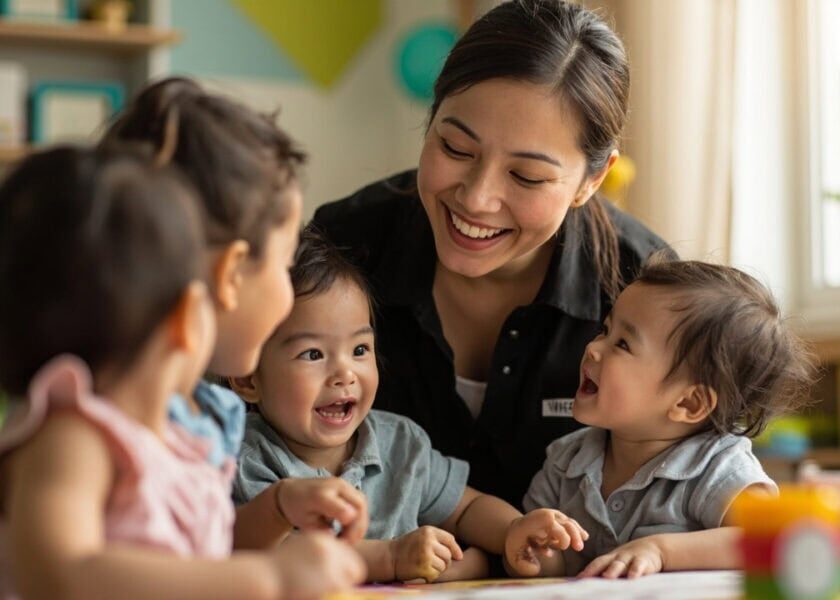
What Your Childcare Provider Should Be Telling You About Development
The Difference Between Safety and Growth
Most parents in Singapore can tell you whether their child slept well, ate well, and seemed generally content at pickup. These are real and valid indicators. But they describe a child’s state, not their trajectory. A safe and happy child is the floor, not the ceiling.
What quality childcare adds — what separates genuine developmental care from well-intentioned babysitting — is the trained ability to read the signs of growth that most parents have not been taught to notice.
Think about it. When a trained caregiver watches a toddler build a tower of blocks, she is not just supervising play. She is observing how many blocks the child attempted before frustration set in, whether the child tried a new strategy after a collapse, whether the frustration was directed inward or outward, and what the child’s face did in the half-second before the tower fell.
That micro-moment — the breath before persistence or the instant of flexibility — is a developmental signal. It tells you something real about your child’s emerging temperament, their frustration tolerance, their problem-solving orientation.
A caregiver trained in developmental observation notices this. A supervisor does not.
You do not need your child’s caregiver to tell you your child is happy. You need them to tell you that your child persisted. That your child asked a question. That your child noticed another child was upset and responded in a way that was new for them. These are the observable traces of real growth, and they are what trained caregivers learn to recognize, document, and share.
Why This Matters Especially in Singapore
We are a city of dual-income households, of parents who returned to work when their children were still infants, of commutes that begin before breakfast and end after dark.
The hours children spend in care are not incidental. They are substantial. In those hours, something is happening — something that is either nourishing your child’s development or simply occupying their time.
The difference between the two is almost entirely determined by whether the person holding your child has been trained to observe what development looks like when it is happening.
Singapore parents carry a particular weight. You are making consequential decisions while managing the guilt, logistics, and financial pressure that come with raising children in one of the world’s most expensive cities. The last thing you need is uncertainty about whether your child is thriving. And yet, that uncertainty persists — not because you are doing anything wrong, but because the systems meant to support you have not given you the language to understand what quality care actually looks like.
Developmental Signs to Look For
Here is what this actually means in practice. These are the observable signs of genuine development across the domains that matter most in early childhood.
Cognitive Development: The Architecture of Thought
A child who is genuinely developing in quality care will begin to show signs of symbolic thinking — not just mimicking actions but imbuing them with meaning. A caregiver trained to observe will notice your eighteen-month-old picking up a wooden spoon, walking it to a toy stove, and pausing before touching it to the surface as if performing an act of memory or imagination.
This is not cute behavior. It is the early architecture of abstract thought.
What to look for:
- Pretend play that mimics real-life actions with increasing accuracy
- Use of objects as symbols (a block becoming a phone, a blanket becoming a cape)
- Sequence-building in play (first this, then that)
- Curiosity expressed through questions, not just reactions
Language Development: Words as Tools
The observable signs of language growth are often hiding in plain sight. A child who is absorbing language in a rich environment will begin to demonstrate what educators call pragmatic language awareness — the sense that words are used to accomplish things, not just label them.
You might hear your toddler point at a bird and say “bird,” and think it is simply naming. But a trained observer will note whether the child was pointing to share something, to request something, or to comment on something — whether the language was self-directed or socially directed.
This distinction is one of the earliest markers of communicative intent. It is the difference between a child who is hearing language and a child who is learning to use it.
What to look for:
- Pointing to share attention (“Look at that!”)
- Using words to request, not just label
- Responding to questions with relevant answers
- Attempts to negotiate or argue using language
Emotional Development: The Capacity to Regulate
This is where Singapore parents often feel most uncertain. You might worry if your two-year-old seems clingy at pickup. But a trained caregiver will help you read that differently.
Is the clinginess the same intensity as last month, or has it shortened? Does your child settle more quickly now than they did three months ago?
The capacity to regulate an emotional response over time — to move through distress with increasing speed and decreasing intensity — is one of the most important developmental achievements of the toddler years.
A caregiver who can tell you that your child’s settling time has halved since September is giving you something no amount of reassurance about your child being “fine” can provide. They are giving you evidence.
What to look for:
- Shorter recovery time after upset
- Increasing ability to self-soothe with familiar objects or routines
- Greater flexibility in accepting transitions
- Emotional vocabulary expanding beyond basic “sad” and “happy”
Social Development: Navigating Relationships
In the social domain, the signs are often invisible to untrained eyes. You may not know to look for whether your three-year-old is beginning to negotiate rather than simply claim. Whether they are using words like “mine” and “yours” as social tools rather than territorial declarations.
Whether they have developed a preference for certain playmates — and more importantly, whether they can navigate the loss of a preferred playmate’s attention without collapsing.
These are not personality traits. They are social milestones, and they unfold in predictable sequences that trained caregivers learn to recognize.
What to look for:
- Active attempts to join other children’s play
- Use of sharing and turn-taking language
- Showing awareness of others’ emotions
- Ability to play alongside other children, not just parallel play
Motor Development: Beyond Walking and Running
The motor domain is sometimes treated as the simplest to assess but is in fact the most nuanced. Quality observation goes well beyond whether a child can walk or run. It asks how a child moves, whether their movement is becoming more purposeful, whether they are beginning to anticipate the physical demands of a task before attempting it.
What to look for:
- Increasing precision in fine motor tasks
- Better anticipation of physical challenges
- Willingness to attempt new physical activities
- Improved balance and spatial awareness
The Communication Gap in Singapore Childcare
Most childcare arrangements create a communication gap that leaves parents with the wrong information.
You drop off in the morning and pick up in the evening with a brief window of exchange — “she ate well, she napped well” — that tells you about your child’s biological needs being met but almost nothing about your child’s mind being engaged.
The gap between what parents know about their child’s development at home and what they know about their child’s development in care is enormous. And it is one of the primary sources of the anxiety we described at the beginning of this article.
You are not anxious because you do not love your child enough. You are anxious because you are being asked to trust a process you cannot see, and nobody has given you the tools to understand what that process looks like when it is working.
How EduNanny Closes the Gap
When you entrust your child to EduNanny Singapore, you are not simply accessing a childcare service. You are entering a partnership built on the deliberate practice of seeing your child clearly.
This is not an accident of good hiring. It is the result of a specific training philosophy grounded in the ECDA Childminding Pilot, which recognizes that caregiver observation is a professional skill — one that must be taught, practiced, and refined — not a natural byproduct of warmth or good intentions.
EduNanny caregivers are trained to observe along the same developmental dimensions that early childhood researchers and pediatric specialists use. They learn to recognize not just what a child does, but the quality of how they do it — the process, not only the outcome.
They document what they see in ways that are precise enough to track progress over weeks and months, and accessible enough to communicate to a parent who is not an early childhood professional.
Most childcare settings prioritize logistics over observation. The incentive structure in many centres — high child-to-caregiver ratios, time pressures, generic reporting templates — makes genuine observation difficult to sustain. When a caregiver is responsible for ten or fifteen children, the kind of micro-observation we have described simply is not possible.
EduNanny’s small ratios — up to one caregiver to three infants — are deliberately designed to make this kind of observation feasible. A caregiver who knows three infants well can notice what a caregiver who knows fifteen cannot.
What EduNanny Communication Looks Like
Parents receive regular, structured updates that are not generic wellness reports but specific, observation-based narratives about what their child engaged in, how they engaged, and what it might mean for their development.
When EduNanny communicates with parents, the intention is to translate the language of child development into the language of daily life — to say, in plain terms, what was happening in your child’s cognitive, emotional, social, and motor world during the hours you were not there.
Imagine receiving this at pickup: “Your daughter has been working on a puzzle-solving strategy for three weeks, and today I saw her try a diagonal approach she has never tried before. That is a significant cognitive shift for a child her age.”
That is not the caregiver being impressive. That is you gaining access to knowledge about your own child that you would otherwise be denied. And that knowledge changes things. It changes the way you engage with your child in the evening. It changes the toys you might offer on the weekend. It changes the questions you ask.
It turns the hours apart into a coherent developmental story in which you remain the protagonist, even when you are not present.
For Families Considering EduNanny
Operating within the ECDA Childminding Pilot framework, EduNanny offers both home-based and community or centre-based pathways, giving families the arrangement that best fits their lives.
The infant ratios — up to one to three — are deliberately small because small ratios are not just safer. They are more observable.
Care is available across Monday to Friday blocks, and fee structures within the pilot are designed to be accessible. Payment mechanisms including CDA and Baby Bonus funds are usable where applicable.
Answering Your Real Concerns
“Shouldn’t I be able to do this myself?”
Developmental observation is a specialized professional skill. Just as you do not expect yourself to interpret an echocardiogram, you should not expect yourself to read your child’s developmental trajectory with the precision of a trained early childhood educator. What EduNanny offers is not a demand that parents become experts. It is the recognition that parents deserve access to expertise — that the information your child’s caregiver holds about your child’s growth is yours to receive, not a privilege reserved for professionals.
“What if I still feel anxious?”
That is entirely normal. For families who value it, transparency measures including CCTV deployment are in place where relevant — not as surveillance, but as an extension of the same philosophy: that parents deserve to see what is happening, even when they cannot be there in person.
But transparency is not the same as reassurance. The goal is not to make you feel better through constant access. The goal is to give you the information you need to trust the process — so that eventually, you do not need to look constantly, because you trust what is happening when you are not looking.
Questions to Ask at Your Next Childcare Visit
Whether or not you choose EduNanny, these questions will help you evaluate whether your childcare provider is genuinely observing your child’s development:
- Can you tell me about a time my child showed persistence or problem-solving in the past week?
- How has my child’s approach to social situations changed since they started?
- What does my child’s play look like when they are most engaged, and what do you notice about it?
- How do you document what you observe, and how often will I receive updates?
- What is one thing my child did recently that surprised you or that was new?
If a caregiver or centre cannot answer these questions, that is information. It does not mean they are not caring for your child — it means they may not have the training or the capacity to observe your child’s development the way you deserve.
From Uncertainty to Curiosity
There is a moment — and any parent who has experienced quality care will recognize it — when something shifts. It usually happens not as a single revelation but as a pattern of small recognitions.
- You pick up your child and notice they used a word you have never heard them use before.
- You receive a note from the caregiver describing how your toddler managed a conflict with another child — not just that it happened, but how it was resolved, what words were used, what the child’s face looked like.
- You glance at a photograph from the day’s activities and see your child engaged in something with a focus and pleasure that surprises you.
In that moment, the anxiety that has quietly accompanied you since you first left your child in someone else’s care does not vanish. But it changes texture. It becomes something closer to curiosity.
You are no longer wondering whether your child is simply being minded. You are wondering what they will show you next.
That shift — from uncertainty to curiosity, from doubt to engaged interest — is the most profound thing quality care can give a parent. And it is not magic. It is trained observation, shared honestly and regularly, over time. It is a caregiver who knows your child well enough to notice when something changes, and who cares enough to tell you.
We started today with a question: is my child actually growing while she is away from me? You already know the answer is yes, if you have chosen well. But knowing it and seeing it are different things. And for Singapore parents, the difference between vague reassurance and visible, nameable progress is not a luxury. It is the difference between trust that rests on hope and trust that rests on knowledge.
EduNanny exists because we believe that every child deserves to be seen clearly in the hours they are not with their parents. And every parent deserves to receive that clarity — not in the language of marketing, not in the language of reassurance, but in the language of real, observable, human growth.
Your child is not just being minded. Your child is becoming someone. Let us help you see who that someone is.
Ready to explore what quality developmental observation could look like for your family? Reach out to EduNanny Singapore to learn more about our caregiver approach, our small ratios, and how we communicate your child’s growth in language you can use.