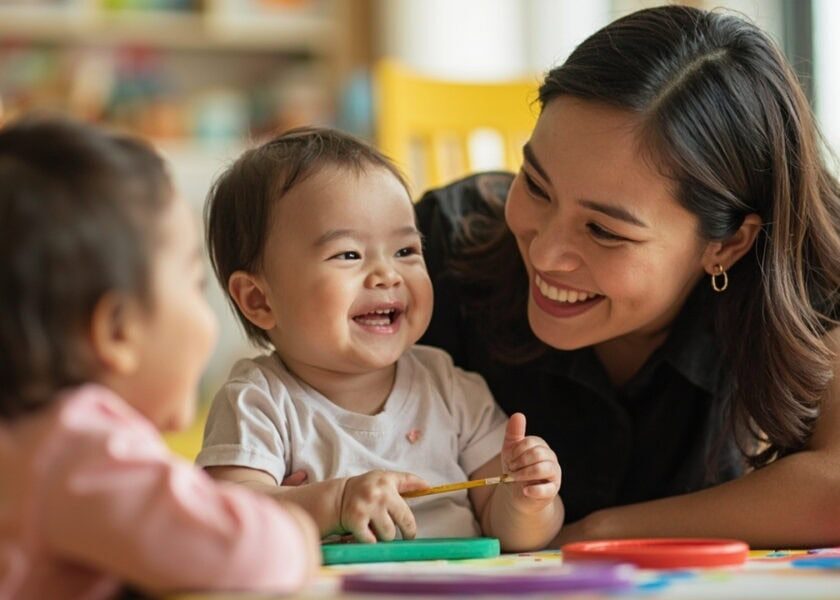
The Sound of a Village Forming

The Silence on Weekday Mornings
There is a particular silence on weekday mornings that no one warns you about.
It is the silence after you have breastfed your baby for the last time before your first day back at work. It is the silence of the car ride where you replay every worst-case scenario in your head. It is the silence of your front door clicking shut behind you, and the world rushing back in—the traffic, the emails, the meetings—but something inside you has gone very quiet and very far away.
If your chest aches as you walk away from your baby this morning, or last week, or sometime in the uncertain future, you are not failing. You are not choosing ambition over connection. You are doing something that humans have always done, but doing it in a world that has made it unbearably hard, and you are doing it with your whole heart.
You are doing it badly, you might think. But you are not. You are doing it like someone who loves too much to do it any other way.

The Guilt Is Not the Problem. The Story Is.
The guilt of the working parent in Singapore is not a sign that something is wrong with you. It is a sign that something is profoundly, primally right with you.
You are not broken. You are bonded.
Your body produced hormones during pregnancy and breastfeeding that wired you to your child in ways that make separation feel like amputation. Oxytocin, prolactin, the whole complex neuroendocrine cascade that turns a person into a parent—that is not weakness. That is biology doing exactly what it was designed to do.
The problem is not your guilt. The problem is the story we have been told about it—that if you feel this way, something must be incompatible. That you must choose. That ambition and attachment exist on opposite ends of a scale, and every step you take toward your career tips the balance away from your child.
That story is incomplete.
What if the ache you feel when you leave your baby is not telling you to stay? What if it is telling you to find a different way? What if the solution to your aching heart is not more guilt, but more trust—not in systems or checklists, but in the radical possibility that your baby can be safe, loved, and close to home while you are somewhere else in the world, rebuilding the parts of yourself that also need tending?

Singapore’s Hidden Contradiction
Singapore has built one of the most efficient childcare systems in the world. Subsidies and schemes. Enrollment portals and waiting lists. Centres with excellent curricula and dedicated teachers. For parents who need childcare, this infrastructure is genuinely valuable.
And yet, the transition back to work after maternity leave remains one of the most emotionally destabilizing experiences a parent can go through.
Why?
Because for four months—sometimes three, sometimes a precious few weeks—you have been fully immersed in a relationship with your child. You have learned her cries and her coos. You know what she needs when she scrunches her face a certain way. You have been her entire world, and she has been yours, and somewhere in those midnight feeds and quiet afternoons, an identity has formed around this closeness.
You are no longer just yourself. You are her mother.
And then the leave ends, and you must return to being also a professional, also a colleague, also someone with ambitions and responsibilities and a salary that perhaps helps pay the mortgage or fund the school fees or simply contributes to the household that your child comes home to every evening.
This is not a failure of Singapore’s childcare infrastructure. This is a failure of narrative. We have built systems to care for children. We have not always built spaces to hold the grief of parents who love those children.
We need to talk about this grief honestly. Not to dwell in it, but to honor it. Because the parent who returns to work after maternity leave in Singapore is not just managing a logistics problem. She is navigating a profound identity shift. She is grieving the loss of a version of herself that existed in those quiet months.
She is learning that love does not require constant physical presence to be real, even though every nerve in her body tells her otherwise.
This grief is legitimate. It is not melodrama. It is the sound of a heart expanding to hold more than it was built to hold.

What Your Baby Actually Needs
The parents who find their way through most peacefully are not the ones who feel less. They are the ones who find a different kind of closeness.
There is a concept in early childhood development called attachment security. It is the idea that children form internal working models of relationships based on the consistency, responsiveness, and emotional attunement they receive in their earliest years.
For a long time, the dominant narrative suggested that this security came primarily from the mother—that the mother was the irreplaceable attachment figure, and that any separation would damage this bond.
The research is more nuanced than that.
What children need is not one specific person. What they need is a relationship characterized by warmth, consistency, and responsiveness. They need to feel that the world is a safe place and that the people who care for them can be trusted.
This can come from a mother. It can also come from a grandparent, a relative, a consistent and loving caregiver. This is not a license to abandon your child to anyone. This is a recognition that the architecture of love in a child’s life can have more than one pillar.
What Quality Childminding Looks Like
When we talk about near-home care, it helps to be specific about what “quality” means in practice—not as a checklist, but as a set of qualities that matter when your baby’s day is happening somewhere you cannot see.
| Quality Indicator | What It Looks Like |
|---|---|
| Consistency | The same caregiver most days. Familiar routines your baby can anticipate. |
| Responsiveness | Crying is met with comfort. Needs are acknowledged promptly. Your baby’s cues are read and respected. |
| Warmth | Genuine affection in tone and touch. Eye contact. Smiles that reach the eyes. |
| Communication | Updates that feel like sharing, not reporting. Photos that show your baby in natural light, engaged and content. |
| Partnership | Your role as parent is respected and reinforced. The caregiver speaks of you positively to your child. You are kept in the loop without having to ask. |
Quality childminding is not about finding someone who will replace you. It is about finding someone who will extend the conditions of safety and love that you have already established—and do so in your absence without erasing your presence from your child’s emotional landscape.

The Morning Handoff: Where Everything Changes
There is a moment in the morning handoff that transforms everything. It is brief—maybe ten minutes, maybe less—but in those ten minutes, something shifts.
Your childminder arrives. She is warm, she has read your notes from the night before, she has greeted your baby by name and gotten down to eye level.
You show her the bruise on your baby’s knee from yesterday’s crawl. The way she prefers to be held with her head on the right shoulder. The book she has been fixated on for three days straight.
In those ten minutes, you are not just handing off logistics. You are building a bridge. You are teaching your childminder your child, and in doing so, you are trusting her with something more precious than money can pay for.
And then something remarkable happens: you watch your child respond to this person. You watch the recognition flicker in her eyes—not the recognition of mother, not the depth of what you share—but something real. A comfort. A willingness to explore this other human who has been welcomed into her small universe.
This is not a betrayal of your bond. This is an expansion of your child’s world. And the expansion happens not despite your presence, but because of it.
Because you chose this person. Because you prepared this ground. Because you are present at the handoff, and your calm confidence teaches your child that this is safe, that this is okay, that the world has more than one kind of love in it.
After you leave, there will be photos. Perhaps a short video. A note about how much she ate, how long she slept, what made her laugh. These are not bureaucratic updates. These are lifelines. They are your childminder saying: I see her too. I am paying attention too. You are not missing this.

Addressing What Keeps You Up at Night
“Will my baby feel abandoned?”
Your baby is learning, every day, whether the world is a safe place. What matters is not the number of hours you are apart, but the quality of the connection when you are together, and the consistency and warmth of the care your baby receives in your absence.
A baby who experiences secure attachment with a primary caregiver, and who has secondary caregivers who are warm, consistent, and responsive, does not experience that arrangement as abandonment. She experiences it as a world that has more than one trustworthy person in it—which is simply true.
“What if the caregiver doesn’t love my baby the way I do?”
No one will love your baby exactly the way you do, and that is okay.
Your baby has a mother. What she also needs is a caregiver who is reliable, warm, and attentive. That is a different kind of love—not lesser, just different. The caregiver’s love is not in competition with yours. It is a supplement, an extension, a bridge back to you.
“How do I trust someone with my baby when I barely know them?”
Trust is built in the handoff moments. Trust is built in the daily updates. Trust is built when you see your baby content, when the caregiver remembers the small details, when the communication flows both ways.
You do not have to trust someone with your baby all at once. You can trust them incrementally, and you can revoke that trust if it is broken. Trust is a daily practice, not a one-time decision.
“I feel like I am choosing my career over my child.”
You are not choosing your career over your child. You are choosing to be a whole person for your child—a parent who is fulfilled, who has used her mind, who has something to give that comes from a life with more dimensions than caregiving alone.
The parent who comes home energized from meaningful work has something different to offer than the parent who comes home depleted and resentful. Your ambition is not betraying your child. Your ambition is feeding your child in ways that go beyond the financial.

EduNanny’s Approach
EduNanny was built with this truth in mind. Not as an afterthought, not as a feature list, but as a foundational belief: that parents deserve to return to work without the constant low hum of dread. That children deserve to be cared for in environments that feel familiar and warm. That the relationship between parent and childminder should be one of trust, transparency, and genuine partnership.
In the ECDA Childminding Pilot, EduNanny by BUTLER offers pathways that bring care closer to home—literally. Home-based care. Community-based care. Options that keep your child in the fabric of their neighborhood, in spaces that feel known, with ratios that allow for real attention.
When care happens close to home, something changes. The updates feel different when you know the street outside the window. The photos mean more when you recognize the light. The communication feels less like reporting and more like sharing—two people who care about the same small person, exchanging observations about a life that is worth paying attention to.
EduNanny’s approach recognizes that the daily handoff is not a transaction. It is a relationship. That is why care is designed to be consistent, why communication is prioritized, why transparency measures exist not to surveil but to connect.
This is not about replacing parents. It is about extending the village.

The Morning Will Come Again
If you are afraid that going back to work will damage your bond with your baby, I want you to know: the bond you built in those early months is stronger than distance. It is stronger than a few hours apart. It is encoded in your child’s nervous system, in the way she turns to your voice, in the comfort she finds in your smell.
Nothing can erase it.
What can happen, if you choose care that is close and consistent and kind, is that the bond can grow in new directions. Your child can learn that love is not a finite resource, taken away by absence. Your child can learn that there are other trustworthy people in the world, and that this does not diminish the love that comes from you.
And you—you can learn something too.
You can learn that you do not have to be everything to your child to be enough. You can learn that the hours you are present are more valuable than the hours you fill with guilt. You can learn that choosing a path that honors both your ambition and your attachment is not a compromise.
It is a kind of courage.
The morning will come again. The silence after the feed, the click of the door, the walk to the car or the train or the office. But this time—if you let it—this silence can mean something different.
Not absence. Not failure.
But the sound of a village forming. The sound of love finding new ways to travel.
Your baby is close. Closer than you think.
And so are you.
EduNanny is here to walk this path with you. Not as a service provider alone, but as a partner in the village you are building for your child.
Start a conversation with EduNanny today.